
SLIDE 1
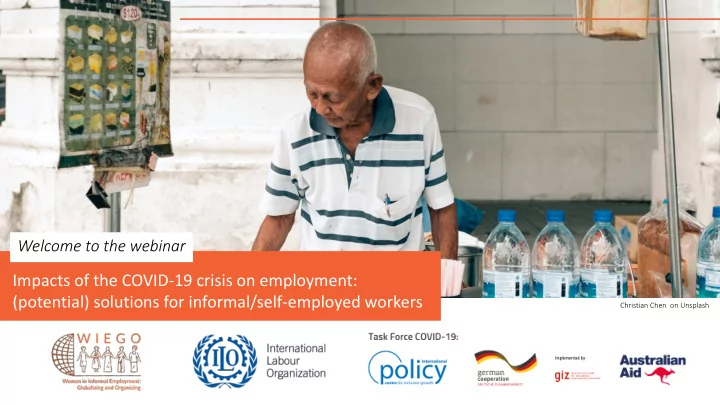
Impacts of the COVID-19 crisis on employment: (potential) solutions for informal/self-employed workers
Welcome to the webinar
Christian Chen on Unsplash
Impacts of the COVID-19 crisis on employment: (potential) solutions - - PowerPoint PPT Presentation
Welcome to the webinar Impacts of the COVID-19 crisis on employment: (potential) solutions for informal/self-employed workers Christian Chen on Unsplash Social protection responses to #COVID19 This joint effort is inspired by colleagues and
Impacts of the COVID-19 crisis on employment: (potential) solutions for informal/self-employed workers
Welcome to the webinar
Christian Chen on Unsplash
This joint effort is inspired by colleagues and
issemin inate and dis iscu cuss th the e mos
ecent con
esponses es to
19. The initiative has three major components:
1. A weekly special edition of a dedicated ne newsle letter, featuring a compilation of relevant information from all over the world on social protection initiatives dealing with COVID-19; 2. Weekly web ebin inars to foster discussions and exchanges; 3. An Onl Onlin ine Co Communit ity to systematise the information gathered
Social protection responses to #COVID19
Ronnie Pitman / Flickr / CC BY-NC 2.0
#SPcovid19 #COVID19 #SPresponses
Next xt webin inar
Photo: Macau Photo Agency on Unsplash
Tuesday, 28 April, at 9 am EDT/GMT-4
Impa mpacts cts of the e COVID VID-19 19 crisi sis s on n form rmal al sector
ers: s:
(potential al) social al protect ction
mployment re resp spon
ses
socialprotection.org presents:
Presenters Laura Alfers, Director, Social Protection Programme, WIEGO Carmen Roca, Lima Focal City Coordinator, WIEGO Discussant Portia Kekana, Market Access and Strategic Partnerships Director, Department of Small Business Development, South Africa Moderator Christina Behrendt, Head, Social Policy Unit, ILO
Impacts of the COVID-19 crisis on employment: (potential) solutions for informal/self-employed workers
Presenter
Laura Alfers
WIEGO
Impacts of the COVID-19 crisis on employment:
(potential) solutions for informal/self-employed workers
Laura Alfers is the Director of the Social Protection Programme of the global research-action advocacy network, Women in Informal Employment: Globalizing and Organizing (WIEGO). In her work for WIEGO, she has worked with organizations of informal workers in Latin America, Sub- Saharan Africa and Asia to better understand the risks faced by these workers and the possibilities for developing holistic solutions which cross the domains of social protection, public services and urban infrastructure. Laura completed her PhD at the University of KwaZulu-Natal in South Africa, and currently holds a position as Research Associate in the Department of Sociology at Rhodes University also in South Africa.
Presenter
Carmen Roca
WIEGO
Impacts of the COVID-19 crisis on employment:
(potential) solutions for informal/self-employed workers
Currently, most of Carmen's work is concentrated in WIEGO’s Focal City, Lima, Perú. Before joining WIEGO, Carmen worked for the International Development Research Centre (IDRC) of Canada for almost 10 years on issues of social and economic policy. She was Deputy Director of the Consorcio de Investigación Económica y Socia (CIES) in Perú until 2009. Social protection for the working poor in the informal economy, capacity building for MBOs, and policy improvements at national and local levels are her current main areas of work. Carmen holds an MBA in Management for Development from McGill University (Canada), Perú.
Discussant
Portia Kekana
Department of Small Business Development, Government of South Africa
Impacts of the COVID-19 crisis on employment:
(potential) solutions for informal/self-employed workers
Ms Mmapula Portia Kekana holds an MSc in Social Protection Financing (University of Mauritius). Her career history includes development planning, training & facilitation, project management, fund disbursement & management, policy development, research, development & evaluation as well as programme operations. Ms. Kekana is an accredited Master Trainer for TRANSFORM, a Social Protection Leadership course which is run in the Sub-Saharan region and aimed at policy makers, civil society, and practitioners. She was a senior manager within the Social Security Branch of the Department of Social Development (South Africa) for ten years, after which she joined the National Economic Development and Labour Council (NEDLAC) as the Head of Programme Operations. Currently she is a Director responsible for Strategic Partnerships and Market Access at the Department of Small Business Development, designing policy instruments to link small businesses and co-operatives to markets both nationally and internationally.
Moderator
Christina Behrendt
ILO
Impacts of the COVID-19 crisis on employment:
(potential) solutions for informal/self-employed workers
Christina Behrendt is Head of the Social Policy Unit in the International Labour Office (ILO)’s Social Protection Department in Geneva (Switzerland); her earlier work experience includes assignments as regional social security specialist at the ILO Regional Office for Arab States in Beirut (Lebanon), as consultant at the International Social Security Association (ISSA), and as lecturer and research fellow at the University of Konstanz. She has worked and published on various aspects of social security in both developed and developing country contexts. Having studied in Konstanz and Edinburgh, she earned her Master degree in Politics and Public Administration and her PhD in Social Policy from the University of Konstanz (Germany).
Share your questions to the speakers!
#SPorgWebinar #SPcovid19 #COVID19 #SPresponses
type them in the chat bar
Also, interact with us on Twitter (@SP_Gateway):
Impacts of the COVID-19 crisis on employment:
(potential) solutions for informal/self-employed workers
Impacts of the COVID-19 crisis
for informal/self-employed workers: Setting the scene
Webinar, 21 April 2020 Christina Behrendt, ILO Social Protection Department, Geneva
Advancing social justice, promoting decent work
11
81% of the global workforce lives in countries with mandatory or recommended closures
Source: ILO. 2020. ‘ILO Monitor 2nd Edition: COVID-19 and the World of Work Updated Estimates and Analysis’.
COVID-19 pandemic represents the most severe crisis since WW II: employment losses are rising rapidly around the world
Advancing social justice, promoting decent work
12 % decline in working hours Full-time equivalent (40 hour week, million) Full-time equivalent (48 hour week, million) World 6.70% 230 190 Low income 5.30% 15 12 Lower-middle income 6.70% 80 70 Upper-middle income 7.00% 100 80 High income 6.50% 36 30
Source: ILO. 2020. ‘ILO Monitor 2nd Edition: COVID-19 and the World of Work Updated Estimates and Analysis’.
Millions of informal workers under lockdown and other containment measures
Advancing social justice, promoting decent work
13
Note: x-axis: University of Oxford’s COVID-19 Government Response Stringency Index. y-axis: informal employment as a share of total employment in the respective country Size of bubbles: relative size of total informal employment in each country Source: ILO. 2020. ‘ILO Monitor 2nd Edition: COVID-19 and the World of Work Updated Estimates and Analysis’.
Advancing social justice, promoting decent work
14
Increase in vulnerability for informal and self-employed workers
Source: ILO. 2020. ‘ILO Monitor 2nd Edition: COVID-19 and the World of Work Updated Estimates and Analysis’.
Policy responses around 4 pillars
Stimulating the economy and employment
Supporting enterprises, jobs and incomes
enterprises
Protecting workers in the workplace
Relying on social dialogue for solutions
policy responses
work and employment
Advancing social justice, promoting decent work
15
Informal sector Formal sector
e.g. Poverty targeted programmes, Public works ,food for work, etc.
Social insurance Tax-financed benefits: universal benefits and social assistance LM policies
e.g. unemployment benefits, pensions, sickness benefits employment injury benefits
YET in many L-MICs, SP systems are usually fragmented and don’t give adequate protection to all risks and to all population
poorer better-off
Ideally, ‘universal’ coverage, across programmes
‘MISSING MIDDLE’
School feeding Social care services Some categorical cash transfers
e.g. Employment incentives, Wage subsidies, Labour intermediation Training
Slide borrowed from V. Barca’s presentation
Extending social security to self-employed workers and those in the informal economy: key lessons learnt
Mandatory coverage Large risk pool High-quality benefits and services, easy access Simplified administrative procedures, harnessing digital technology High transparency and accountability, high trust Unified/coordinated system Integrated policy framework Sufficient fiscal space using a good mix of contribution and tax financing Broad and well-informed social dialogue Voluntary coverage Small risk pools Low quality and poor access to benefits and services Complex and cumbersome administrative procedures Low transparency and accountability, low trust Fragmented schemes Isolated/disconnected policies Inadequate financing framework No social dialogue
Encouraged Discouraged
informaleconomy. social-protection.org
Universal social protection is not only about coverage:
Framework set out in the ILO Centenary Declaration for the Future of Work (2019)
universal compre- hensive adequate sustainable adapted to the world
Comprehensive protection (risks covered): Providing comprehensive protection
throughout the life course, including income security and access to health protection.
Universal coverage (persons protected):
Closing coverage gaps in an inclusive way: no one should be left behind; respect for people’s rights and dignity; non-discrimination, gender equality and responsiveness to special needs
Adequate protection:
Adequate protection goes beyond just reducing poverty – it should prevent poverty, and guarantee social security and an adequate standard of living in line with human rights and ILO social security standards.
Sustainable and equitable financing:
Financial, economic and social sustainability based on the principles of solidarity; transparent, acountable and sound financial governance; balance of interest between those who benefit and those who finance the system.
Adapted to developments in the world of work: Ensuring that systems are
constantly improved and adapted to respond to a changing economic and social context; supporting labour mobility and life and work transitions, as well as the structural transformation of the economy.
SOCIAL PROTECTION
Cash Transfer / Public Works, etc Social pension Universal Transfers Social insurance Tax & rev. databases Social reg. &
On demand registration
SP Beneficiaries SP Non- Beneficiaries
Menu of options for leveraging social protection in response to Covid- 19: building on what is already in place
Payment mechanisms in place (strong? Flexible?)
(depends); often socio-economic data.
‘enrolment' to enable payments
needs to be designed
INFORMAL SECTOR + OTHERS FORMAL SECTOR
Outreach, registration, enrolment already completed
…
centres, etc.
and criteria
Slide borrowed from V. Barca’s presentation
Priority actions towards guaranteeing a social protection floor as part of national social protection systems
Internationally agreed framework provided by ILO Recommendation, 2012 (No. 202)
Vertical dimension: progressively ensuring higher levels of protection, guided by Convention No.102 and more advanced standards Horizontal dimension: Guaranteeing access to essential health care and minimum income security for all, guided by Recommendation No. 202 Social insurance individual/household income
social protection floor: basic income security and access to health care for all
level of protection high
high
low low
voluntary insurance/savings under gov. regulation
social protection benefits
(usually social insurance)
Social protection floor guarantees
Everyone has access to essential health care,
including maternity care
All children enjoy basic income security,
providing access to nutrition, education, care, and any other necessary goods and services
All persons in active age who cannot earn
sufficient income, enjoy basic income security, particularly in cases of sickness, unemployment, maternity, disability
All older persons enjoy basic income security
Anchored in human rights framework and reflected in SDGs 1.3 and 3.8
Social protection system (nationally defined)
Food for thought
Advancing social justice, promoting decent work
21
Which categories of informal workers and
self-employed are being impacted by the crisis? What are their specific needs now and in the future? How can they best be reached?
Which social protection responses are
particularly promising, and what are possible drawbacks?
How to ensure the active involvement of
informal workers in the quest for effective solutions? Further questions:
How to can well-designed short-term
measures contribute to more equitable and sustainable solutions for the future?
How to ensure that social protection
responses are anchored in a rights- based framework and don’t leave anyone behind?
Lessons learned for the future with
regard to social protection systems, including floors?
COVID-19 crisis: ilo.org/global/topics/coronavirus www.social-protection.org/gimi/ ShowWiki.action?id=62&lang=EN
Useful resources
Other key resources: World Social Protection Report 2017-19: Universal social protection to achieve the Sustainable Development Goals (Geneva, ILO, 2017). Policy Resource Package: Extending social security to workers in the informal economy http://informaleconomy.social-protection.org ILO Social Protection Platform: www.social-protection.org/ Joint UN Social Protection and Human Rights web platform: www.socialprotection-humanrights.org/ Global Partnership for Universal Social Protection: www.USP2030.org
Laura Alfers, WIEGO Social Protection Programme, 20 April 2020
Economic Impact & Social Protection Solutions
WIEGO Rapid Assessment: https://www.wiego.org/resources/impact-public-health-measures-informal- workers-livelihoods-rapid-assessment
– Movement barred – Work in public space banned
– Drop in tourism decreases demand for craft products – Domestic workers laid off as fear of infection grows
– Rising cost of transport – PPE costs borne by workers themselves
– As schools close, women workers in particular are finding it difficult to balance care and paid work.
– impacts will differ according to gender, place of work, occupation, age; policy solutions may also therefore differ (e.g. rebuilding market relationships)
– poses a problem where IWs have been left out of SP systems.
– Need to think longer term about support interventions.
– DO NO HARM to existing informal livelihoods; support cannot end with cash. – protect and enhance market position of informal workers.
What policy responses are we seeing….
HOW GOVTS ARE REACHING INFORMAL WORKERS
OPTION ADVANTAGES DISADVANTAGES
Universal Income Grant (usually once-off) e.g. Hong Kong
Targeting Out (targets out workers covered by SS & SA beneficiaries; leverages national ID system; on-demand reg) e.g. Thailand; Namibia
than TI
narrow down vulnerable pop.
less likely to have ID
in formal sector? Targeting In (targets in informal workers) e.g. Peru, Colombia, Zimbabwe, Argentina
systems already in place. Employer responsibility (esp. informal workers in formal sector; in households)
working with employer associations to promote paid leave.
DATA SOURCE EXAMPLES Social registries Colombia (social registry data covers approx. 50% of the population). Other government databases (social security, health, taxes etc) Thailand, Chile, Turkey have used to complement registration data. Databases from informal worker
In Zimbabwe, the Zimbabwe Chamber of Informal Economy Associations was asked to submit membership lists to
targeted measures.
– Creative proposals for expanding fiscal space
– Leveraging existing inclusive policy spaces – Working with (and strengthening) structures that already exist to reach informal workers – Communication and outreach to the grassroots
Women in informal employment: globalizing and organizing (WIEGO) is a global network focused on securing livelihoods for the working poor, especially women, in the informal economy. we believe all workers should have equal economic opportunities and rights. WIEGO creates change by building capacity among informal worker organizations, expanding the knowledge base about the informal economy and influencing local, national and international policies. visit www.wiego.org
Lima: 10 million people
Why so many people in Lima?
26 regions
Natural regions: Coast, Sierra (Andes), and Amazon area
Social Security Health Insurance
Ministry of Health, with SIS Private
Municipal Hospitals Armed Forces Hospitals
No cost for the poor, who are listed in the System of Focalization of Households It is a financing mechanism, no additional supply of hospitals but increased demand Lots of problems: Long line ups Limited number of patients per day Lack of medicines
110 USD for the “poor” and “extreme poor” according to Household Focalization Directory Same later, for “not poor” in HFD to reach independent workers to cover 780,000 households
Voluntary registry in NRUS, for independent workers, low monthly tax of 6 USD per month, 0 tax for perishable food SVs around markets Registries of wokers associations: already in Public (Notarized) Registry + those at Ministry of Labor Local Gov’s: have list of licenses for street and market vendors, newspaper vendors, shoe shiners. Also enlisted waste-pickers + registered associations Proof of payment to Municipalities of licenses and daily fees paid by street vendors
WIEGO’s Proposal for final listing of independent workers´ cash grant – not taken because NOT OFFICIAL DATA
Independent workers: Not beneficiaries of other social programs of Government (monthly normal cash grant and non-contributory pensions) – Ministry of Social Development
Independent workers: Nobody in home is in public or private payroll – Ministry of Labor
Independent workers: Nobody in home earns more than 330 USD per month – Tax Office and Supervisory entity of Banks
Independent workers: Nobody in home has a contract with State – Ministry of Finance
Independent workers: Be in geographic ambits of greater sanitary vulnerability – Ministry of Health
Independent workers: home spends not more than 20 USD in electricity bill monthly - CANCELED
Money distributed to 1,864 local gov’s nationwide for them to deliver food baskets to the most vulnerable Delivered at curfew hours, but cash would have been more effective, local Govs not capable: raffles, corruption, and non delivery
19 19,000 people si signed up as s volu lunteers to call ll el elderly ly vu vulnerable people
Impacts of the COVID-19 crisis on employment: (potential) solutions for informal/self-employed workers
Next xt webin inar
Photo: Macau Photo Agency on Unsplash
Tuesday, 28 April, at 9 am EDT/GMT-4
Impa mpacts cts of the e COVID VID-19 19 crisi sis s on n form rmal al sector
ers: s:
(potential al) social al protect ction
mployment re resp spon
ses
+ Become a member of
Make sure to answer our webinar survey, available after the session!