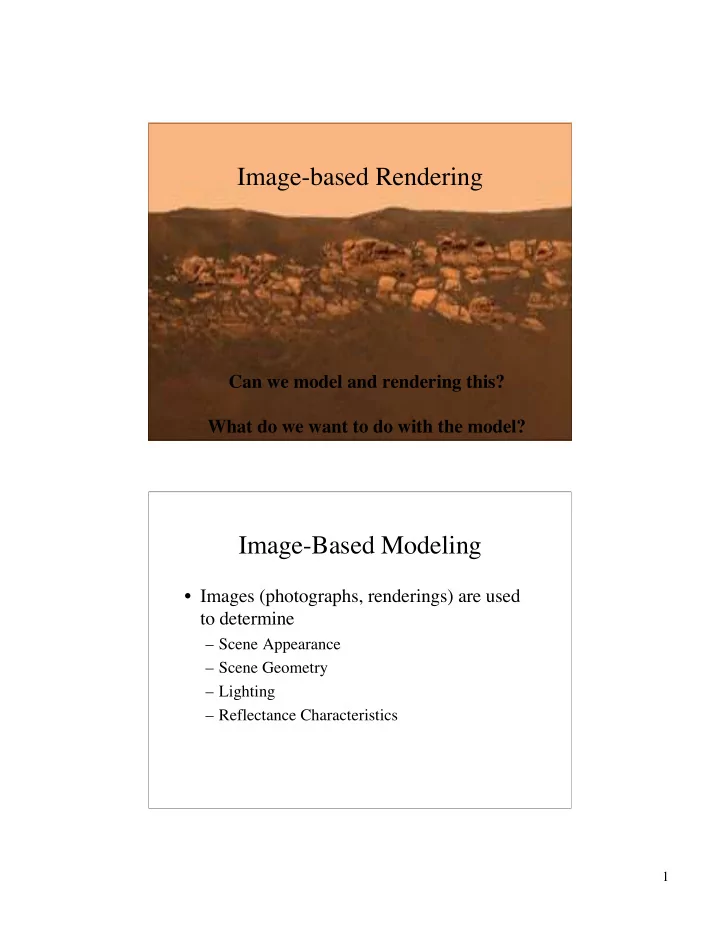
Image-based Rendering Can we model and rendering this? What do we - - PDF document

image based rendering
SMART_READER_LITE
LIVE PREVIEW

Image-based Rendering Can we model and rendering this? What do we - - PDF document

Image-based Rendering Can we model and rendering this? What do we want to do with the model? Image-Based Modeling Images (photographs, renderings) are used to determine Scene Appearance Scene Geometry Lighting

slide-1
SLIDE 1

1

Image-based Rendering

Can we model and rendering this? What do we want to do with the model?

Image-Based Modeling

  • Images (photographs, renderings) are used

to determine

– Scene Appearance – Scene Geometry – Lighting – Reflectance Characteristics

slide-2
SLIDE 2

2

Image-Based Rendering

  • Appearance in available views is used to

determine appearance in novel views

  • Don’t need to perform full illumination

computations

  • > Rendering is faster

Image Based Rendering

  • Traditions from

– Photogrammertry (camera calibration) – Computer Vision (robots, image understanding) – Computer Graphics

slide-3
SLIDE 3

3

Cohen, SIG 99 IBMR course Cohen, SIG 99 IBMR course

slide-4
SLIDE 4

4

Cohen, SIG 99 IBMR course Cohen, SIG 99 IBMR course

slide-5
SLIDE 5

5

Image-Based Rendering

Generation of Novel Views Generation of Novel Illumination Plenoptic Functions Single Images Multiple Images Pixel BRDFs Basis Images Bump Mapping LightFields Lumigraphs Environment Maps Interpolation Reconstruction Fixed Source Illumination Cone

Generation of Novel Views

  • Start with multiple images
  • Fixed illumination
  • Generate new viewpoint

– Plenoptic Function

slide-6
SLIDE 6

6

Direction manipulation of Example Images

  • QuickTimeVR
  • Morphing
  • http://www.research.microsoft.com/~cohen/SIG_97_IBR/index.htm
  • http://graphics.lcs.mit.edu/~mcmillan/IBRpanel/slide10.html

Direction manipulation

  • Given

– Two views – Camera’s internal & extern params

  • Correspondence btwn image pixels in any third

view can be reconstructed

  • For orthographic: only need pixel correspondences
  • For perspective, need pixel correspondences &

epipolar geometry for two views

– Estimated from small number of point correspondences

slide-7
SLIDE 7

7

Definition Epipolar Geometry

  • http://www-sop.inria.fr/robotvis/personnel/sbougnou/Meta3DViewer/EpipolarGeo.html
slide-8
SLIDE 8

8

Example Cylindrical Panorama 3D Scene Capture

Fuchs et.al., UNC

UNC and UVA

slide-9
SLIDE 9

9

Plenoptic function

  • 5D Parameterized function
  • Describe everything that is visible a single

point in 3D space

  • Latin:

– plenus = complete or full – optic = pertaining to vision

slide-10
SLIDE 10

10

Plenoptic Function

McMillian, SIG 99 IBMR course

Azimuth, Elevation, Position, Wavelength, Time

Plenoptic Function

  • A single viewpoint --> function is reduced

from 5D to 2D,

– Azimuth and elevation angle

McMillian, SIG 99 IBMR course

slide-11
SLIDE 11

11

Plenoptic Function

  • If the view is from inside convex hull, it is

reduced from 5D to 4D

– Large amoounts of storage

Cylindric Panoramas

  • 36 images, uncalibrated video camera 360o
  • 31 images, 60 inches from first
slide-12
SLIDE 12

12

Arbitrary Reprojections

slide-13
SLIDE 13

13

Summary

  • Digitized at 5fps
slide-14
SLIDE 14

14

This paper is cool because

  • Doesn’t require scene depth

Credits

  • http://www.dai.ed.ac.uk/CVonline/LOCAL_COPIES/ASHBROOK1/node1.html#SECTION000

10000000000000000

  • http://www.research.microsoft.com/~cohen/SIG_97_IBR/index.htm
  • http://graphics.lcs.mit.edu/~mcmillan/IBRpanel/slide06.html
  • http://peter-oel.de/ibmr-focus/
  • http://www.cs.berkeley.edu/~debevec/IBMR99/
  • http://www-2.cs.cmu.edu/~ph/869/www/869.html