Idempotent generation in partition monoids James East University of - - PowerPoint PPT Presentation

idempotent generation in partition monoids
SMART_READER_LITE
LIVE PREVIEW

Idempotent generation in partition monoids James East University of - - PowerPoint PPT Presentation

Idempotent generation in partition monoids James East University of Western Sydney Workshop on Diagram Algebras 812 Sept 2014 Universit at Stuttgart James East Idempotent generation in partition monoids Joint work with Bob Gray (and


slide-1
SLIDE 1

Idempotent generation in partition monoids

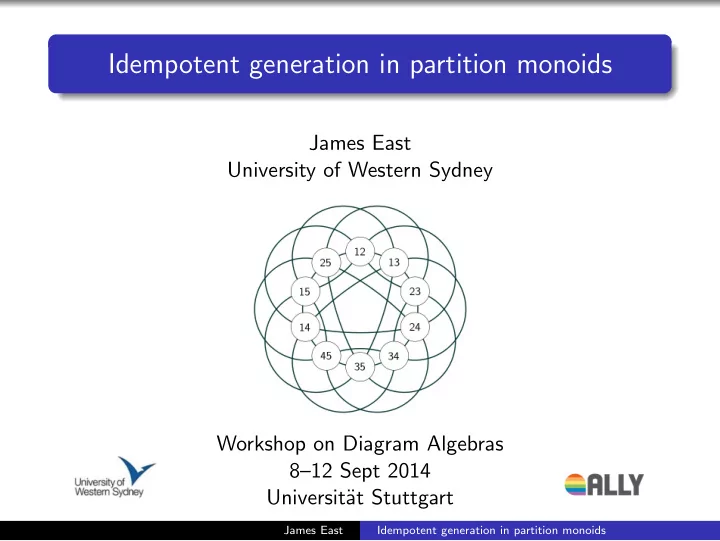
James East University of Western Sydney Workshop on Diagram Algebras 8–12 Sept 2014 Universit¨ at Stuttgart

James East Idempotent generation in partition monoids
slide-2
SLIDE 2

Joint work with Bob Gray (and others)

James East Idempotent generation in partition monoids

slide-3
SLIDE 3

Shona says Hi . . .

James East Idempotent generation in partition monoids

slide-4
SLIDE 4

Partition Monoids

James East Idempotent generation in partition monoids

slide-5
SLIDE 5

Partition Monoids

Let n = {1, . . . , n} and n′ = {1′, . . . , n′}.

James East Idempotent generation in partition monoids

slide-6
SLIDE 6

Partition Monoids

Let n = {1, . . . , n} and n′ = {1′, . . . , n′}.

1 2 3 4 5 6 1′ 2′ 3′ 4′ 5′ 6′

  • n
  • n′

James East Idempotent generation in partition monoids

slide-7
SLIDE 7

Partition Monoids

Let n = {1, . . . , n} and n′ = {1′, . . . , n′}. The partition monoid on n is Pn =

  • set partitions of n ∪ n′

1 2 3 4 5 6 1′ 2′ 3′ 4′ 5′ 6′

  • n
  • n′

James East Idempotent generation in partition monoids

slide-8
SLIDE 8

Partition Monoids

Let n = {1, . . . , n} and n′ = {1′, . . . , n′}. The partition monoid on n is Pn =

  • set partitions of n ∪ n′

Eg: α =

  • {1, 3, 4′}, {2, 4}, {5, 6, 1′, 6′}, {2′, 3′}, {5′}
  • ∈ P6

1 2 3 4 5 6 1′ 2′ 3′ 4′ 5′ 6′

  • n
  • n′

James East Idempotent generation in partition monoids

slide-9
SLIDE 9

Partition Monoids

Let n = {1, . . . , n} and n′ = {1′, . . . , n′}. The partition monoid on n is Pn =

  • set partitions of n ∪ n′

  • graphs on vertex set n ∪ n′

. Eg: α =

  • {1, 3, 4′}, {2, 4}, {5, 6, 1′, 6′}, {2′, 3′}, {5′}
  • ∈ P6

1 2 3 4 5 6 1′ 2′ 3′ 4′ 5′ 6′

  • n
  • n′

James East Idempotent generation in partition monoids

slide-10
SLIDE 10

Partition Monoids

Let n = {1, . . . , n} and n′ = {1′, . . . , n′}. The partition monoid on n is Pn =

  • set partitions of n ∪ n′

  • graphs on vertex set n ∪ n′

. Eg: α =

  • {1, 3, 4′}, {2, 4}, {5, 6, 1′, 6′}, {2′, 3′}, {5′}
  • ∈ P6

1 2 3 4 5 6 1′ 2′ 3′ 4′ 5′ 6′

  • n
  • n′

James East Idempotent generation in partition monoids

slide-11
SLIDE 11

Partition Monoids

Let n = {1, . . . , n} and n′ = {1′, . . . , n′}. The partition monoid on n is Pn =

  • set partitions of n ∪ n′

  • graphs on vertex set n ∪ n′

. Eg: α =

  • {1, 3, 4′}, {2, 4}, {5, 6, 1′, 6′}, {2′, 3′}, {5′}
  • ∈ P6

1 2 3 4 5 6 1′ 2′ 3′ 4′ 5′ 6′

  • n
  • n′

James East Idempotent generation in partition monoids

slide-12
SLIDE 12

Partition Monoids

Let n = {1, . . . , n} and n′ = {1′, . . . , n′}. The partition monoid on n is Pn =

  • set partitions of n ∪ n′

  • graphs on vertex set n ∪ n′

. Eg: α =

  • {1, 3, 4′}, {2, 4}, {5, 6, 1′, 6′}, {2′, 3′}, {5′}
  • ∈ P6

1 2 3 4 5 6 1′ 2′ 3′ 4′ 5′ 6′

  • n
  • n′

James East Idempotent generation in partition monoids

slide-13
SLIDE 13

Partition Monoids

Let n = {1, . . . , n} and n′ = {1′, . . . , n′}. The partition monoid on n is Pn =

  • set partitions of n ∪ n′

  • graphs on vertex set n ∪ n′

. Eg: α =

  • {1, 3, 4′}, {2, 4}, {5, 6, 1′, 6′}, {2′, 3′}, {5′}
  • ∈ P6

1 2 3 4 5 6 1′ 2′ 3′ 4′ 5′ 6′

  • n
  • n′

James East Idempotent generation in partition monoids

slide-14
SLIDE 14

Partition Monoids

Let n = {1, . . . , n} and n′ = {1′, . . . , n′}. The partition monoid on n is Pn =

  • set partitions of n ∪ n′

  • graphs on vertex set n ∪ n′

. Eg: α =

  • {1, 3, 4′}, {2, 4}, {5, 6, 1′, 6′}, {2′, 3′}, {5′}
  • ∈ P6

1 2 3 4 5 6 1′ 2′ 3′ 4′ 5′ 6′

  • n
  • n′

James East Idempotent generation in partition monoids

slide-15
SLIDE 15

Partition Monoids

Let n = {1, . . . , n} and n′ = {1′, . . . , n′}. The partition monoid on n is Pn =

  • set partitions of n ∪ n′

  • (equiv. classes of) graphs on vertex set n ∪ n′

. Eg: α =

  • {1, 3, 4′}, {2, 4}, {5, 6, 1′, 6′}, {2′, 3′}, {5′}
  • ∈ P6

1 2 3 4 5 6 1′ 2′ 3′ 4′ 5′ 6′

  • n
  • n′

James East Idempotent generation in partition monoids

slide-16
SLIDE 16

Partition Monoids

Let n = {1, . . . , n} and n′ = {1′, . . . , n′}. The partition monoid on n is Pn =

  • set partitions of n ∪ n′

  • (equiv. classes of) graphs on vertex set n ∪ n′

. Eg: α =

  • {1, 3, 4′}, {2, 4}, {5, 6, 1′, 6′}, {2′, 3′}, {5′}
  • ∈ P6

1 2 3 4 5 6 1′ 2′ 3′ 4′ 5′ 6′

  • n
  • n′

James East Idempotent generation in partition monoids

slide-17
SLIDE 17

Partition Monoids

Let n = {1, . . . , n} and n′ = {1′, . . . , n′}. The partition monoid on n is Pn =

  • set partitions of n ∪ n′

  • (equiv. classes of) graphs on vertex set n ∪ n′

. Eg: α =

  • {1, 3, 4′}, {2, 4}, {5, 6, 1′, 6′}, {2′, 3′}, {5′}
  • ∈ P6

1 2 3 4 5 6 1′ 2′ 3′ 4′ 5′ 6′

  • n
  • n′

James East Idempotent generation in partition monoids

slide-18
SLIDE 18

Partition Monoids

Let n = {1, . . . , n} and n′ = {1′, . . . , n′}. The partition monoid on n is Pn =

  • set partitions of n ∪ n′

  • (equiv. classes of) graphs on vertex set n ∪ n′

. Eg: α =

  • {1, 3, 4′}, {2, 4}, {5, 6, 1′, 6′}, {2′, 3′}, {5′}
  • ∈ P6

1 2 3 4 5 6 1′ 2′ 3′ 4′ 5′ 6′

  • n
  • n′

Note: Pn is the basis of the partition algebra Pδ

n.

James East Idempotent generation in partition monoids

slide-19
SLIDE 19

Product in Pn

James East Idempotent generation in partition monoids

slide-20
SLIDE 20

Product in Pn

Let α, β ∈ Pn. α

  • β
  • James East

Idempotent generation in partition monoids

slide-21
SLIDE 21

Product in Pn

Let α, β ∈ Pn. To calculate αβ: (1) connect bottom of α to top of β, α

  • β
  • 1

James East Idempotent generation in partition monoids

slide-22
SLIDE 22

Product in Pn

Let α, β ∈ Pn. To calculate αβ: (1) connect bottom of α to top of β, (2) remove middle vertices and floating components, α

  • β
  • 1

2 James East Idempotent generation in partition monoids

slide-23
SLIDE 23

Product in Pn

Let α, β ∈ Pn. To calculate αβ: (1) connect bottom of α to top of β, (2) remove middle vertices and floating components, (3) smooth out resulting graph to obtain αβ. α

  • β
  • 1

2

  • αβ

3 James East Idempotent generation in partition monoids

slide-24
SLIDE 24

Product in Pn

Let α, β ∈ Pn. To calculate αβ: (1) connect bottom of α to top of β, (2) remove middle vertices and floating components, (3) smooth out resulting graph to obtain αβ. α

  • β
  • 1

2

  • αβ

3

The operation is associative, so Pn is a semigroup (monoid, etc).

James East Idempotent generation in partition monoids

slide-25
SLIDE 25

Product in Pn

Let α, β ∈ Pn. To calculate αβ: (1) connect bottom of α to top of β, (2) remove middle vertices and floating components, (3) smooth out resulting graph to obtain αβ. α

  • β
  • 1

2

  • αβ

3

The operation is associative, so Pn is a semigroup (monoid, etc). Note: usual multiplication in partition algebra Pδ

n with δ = 1.

James East Idempotent generation in partition monoids

slide-26
SLIDE 26

Submonoids of Pn

James East Idempotent generation in partition monoids

slide-27
SLIDE 27

Submonoids of Pn

Bn =

  • α ∈ Pn : |A| = 2 (∀A ∈ α)
  • — Brauer monoid

∈ B5

James East Idempotent generation in partition monoids

slide-28
SLIDE 28

Submonoids of Pn

Bn =

  • α ∈ Pn : |A| = 2 (∀A ∈ α)
  • — Brauer monoid

∈ B5 TLn =

  • α ∈ Bn : α is planar
  • — Temperley-Lieb monoid

(aka Jones or Kauffman monoid) ∈ TL5

James East Idempotent generation in partition monoids

slide-29
SLIDE 29

Submonoids of Pn

Bn =

  • α ∈ Pn : |A| = 2 (∀A ∈ α)
  • — Brauer monoid

∈ B5 TLn =

  • α ∈ Bn : α is planar
  • — Temperley-Lieb monoid

(aka Jones or Kauffman monoid) ∈ TL5 Sn =

  • α ∈ Bn : |A ∩ n| = |A ∩ n′| = 1 (∀A ∈ α)
  • — symmetric group

∈ S5

James East Idempotent generation in partition monoids

slide-30
SLIDE 30

Submonoids of Pn

Tn =

  • α ∈ Pn : |A ∩ n′| = 1 (∀A ∈ α)
  • — full transformation semigroup

∈ T5

James East Idempotent generation in partition monoids

slide-31
SLIDE 31

Submonoids of Pn

Tn =

  • α ∈ Pn : |A ∩ n′| = 1 (∀A ∈ α)
  • — full transformation semigroup

∈ T5 T ∗

n =

  • α ∈ Pn : |A ∩ n| = 1 (∀A ∈ α)
  • — T ∗

n ∼

=op Tn

James East Idempotent generation in partition monoids

slide-32
SLIDE 32

Submonoids of Pn

Tn =

  • α ∈ Pn : |A ∩ n′| = 1 (∀A ∈ α)
  • — full transformation semigroup

∈ T5 T ∗

n =

  • α ∈ Pn : |A ∩ n| = 1 (∀A ∈ α)
  • — T ∗

n ∼

=op Tn In =

  • α ∈ Pn : |A ∩ n′| ≤ 1 and |A ∩ n| ≤ 1 (∀A ∈ α)
  • — symmetric inverse monoid (aka rook monoid)

∈ I5

James East Idempotent generation in partition monoids

slide-33
SLIDE 33

Submonoids of Pn

Tn =

  • α ∈ Pn : |A ∩ n′| = 1 (∀A ∈ α)
  • — full transformation semigroup

∈ T5 T ∗

n =

  • α ∈ Pn : |A ∩ n| = 1 (∀A ∈ α)
  • — T ∗

n ∼

=op Tn In =

  • α ∈ Pn : |A ∩ n′| ≤ 1 and |A ∩ n| ≤ 1 (∀A ∈ α)
  • — symmetric inverse monoid (aka rook monoid)

∈ I5 In many ways, Pn is just like a transformation semigroup.

James East Idempotent generation in partition monoids

slide-34
SLIDE 34

Generators

Proposition There is a factorization Pn = Tn In T ∗

n . Consequently,

Pn = s1, . . . , sn−1, e1, . . . , en, t1, . . . , tn−1.

i 1 n

si =

i 1 n

ei =

i 1 n

ti =

James East Idempotent generation in partition monoids

slide-35
SLIDE 35

Presentations

Theorem (Halverson and Ram, 2005; E, 2011) The partition monoid Pn has presentation Pn ∼ = s1, . . . , sn−1, e1, . . . , en, t1, . . . , tn−1 : (R1—R16), where (R1) s2

i = 1

(R2) sisj = sjsi (R3) sisjsi = sjsisj (R4) e2

i = ei

(R5) eiej = ejei (R6) siej = ejsi (R7) siei = ei+1si (R8) eiei+1si = eiei+1 (R9) t2

i = ti

(R10) titj = tjti (R11) sitj = tjsi (R12) sisjti = tjsisj (R13) tisi = siti = ti (R14) tiej = ejti (R15) tiejti = ti (R16) ejtiej = ej.

James East Idempotent generation in partition monoids

slide-36
SLIDE 36

Presentations

Theorem (Halverson and Ram, 2005; E, 2011) The partition algebra Pδ

n has presentation

n ∼

= s1, . . . , sn−1, e1, . . . , en, t1, . . . , tn−1 : (R1—R16), where (R1) s2

i = 1

(R2) sisj = sjsi (R3) sisjsi = sjsisj (R4) e2

i = δei

(R5) eiej = ejei (R6) siej = ejsi (R7) siei = ei+1si (R8) eiei+1si = eiei+1 (R9) t2

i = ti

(R10) titj = tjti (R11) sitj = tjsi (R12) sisjti = tjsisj (R13) tisi = siti = ti (R14) tiej = ejti (R15) tiejti = ti (R16) ejtiej = ej.

James East Idempotent generation in partition monoids

slide-37
SLIDE 37

Presentations

Theorem (E, 2011) The singular partition monoid Pn \ Sn has presentation Pn \ Sn ∼ = e1, . . . , en, tij (1 ≤ i < j ≤ n) : (R1—R10), where (R1) e2

i = ei

(R2) eiej = ejei (R3) t2

ij = tij

(R4) tijtkl = tkltij (R5) tijektij = tij (R6) ektijek = ek (R7) tijek = ektij (R8) tijtjk = tjktki = tkitij (R9) ektkieitijejtjkek = ektkjejtjieitikek (R10) ektkieitijejtjleltlkek = ektkleltlieitijejtjkek.

i 1 n

ei =

i j 1 n

tij =

James East Idempotent generation in partition monoids

slide-38
SLIDE 38

Presentations

Theorem (Kudryavtseva and Mazorchuk, 2006; see also Birman-Wenzl and Barcelo-Ram) The Brauer monoid Bn has presentation Bn ∼ = s1, . . . , sn−1, u1, . . . , un−1 : (R1—R10), where (R1) s2

i = 1

(R2) sisj = sjsi (R3) sisjsi = sjsisj (R4) u2

i = ui

(R5) uiuj = ujui (R6) siuj = ujsi (R7) siui = uisi = ui (R8) uiujui = ui (R9) siujui = sjui (R10) uiujsi = uisj.

i 1 n

si =

i 1 n

ui =

James East Idempotent generation in partition monoids

slide-39
SLIDE 39

Presentations

Theorem (Maltcev and Mazorchuk, 2007) The singular Brauer monoid Bn \ Sn has presentation Bn \ Sn ∼ = uij (1 ≤ i < j ≤ n) : (R1—R6), where (R1) u2

ij = uij

(R2) uijukl = ukluij (R3) uijujkuij = uij (R4) uijuikujk = uijujk (R5) uijujkukl = uijuilukl (R6) uijukluik = uijujluik.

i j 1 n

uij =

James East Idempotent generation in partition monoids

slide-40
SLIDE 40

Presentations

Theorem (Borisavljevi´ c, Doˇ sen, Petri´ c, 2002; see also Jones, Kauffman, etc) The (singular) Temperley-Lieb monoid TLn has presentation TLn ∼ = u1, . . . , un−1 : (R1—R3), where (R1) u2

i = ui

(R2) uiuj = ujui (R3) uiujui = ui.

i 1 n

ui =

James East Idempotent generation in partition monoids

slide-41
SLIDE 41

Idempotent generation — questions

So the singular parts of Pn, Bn, TLn are idempotent generated . . .

James East Idempotent generation in partition monoids

slide-42
SLIDE 42

Idempotent generation — questions

So the singular parts of Pn, Bn, TLn are idempotent generated . . . What is the smallest number of (idempotent) partitions required to generate Pn \ Sn?

James East Idempotent generation in partition monoids

slide-43
SLIDE 43

Idempotent generation — questions

So the singular parts of Pn, Bn, TLn are idempotent generated . . . What is the smallest number of (idempotent) partitions required to generate Pn \ Sn? i.e., What is the rank and idempotent rank, rank(Pn \ Sn) and idrank(Pn \ Sn)?

James East Idempotent generation in partition monoids

slide-44
SLIDE 44

Idempotent generation — questions

So the singular parts of Pn, Bn, TLn are idempotent generated . . . What is the smallest number of (idempotent) partitions required to generate Pn \ Sn? i.e., What is the rank and idempotent rank, rank(Pn \ Sn) and idrank(Pn \ Sn)? How many (idempotent) generating sets of minimal size are there?

James East Idempotent generation in partition monoids

slide-45
SLIDE 45

Idempotent generation — questions

So the singular parts of Pn, Bn, TLn are idempotent generated . . . What is the smallest number of (idempotent) partitions required to generate Pn \ Sn? i.e., What is the rank and idempotent rank, rank(Pn \ Sn) and idrank(Pn \ Sn)? How many (idempotent) generating sets of minimal size are there? What about other ideals of Pn?

James East Idempotent generation in partition monoids

slide-46
SLIDE 46

Idempotent generation — questions

So the singular parts of Pn, Bn, TLn are idempotent generated . . . What is the smallest number of (idempotent) partitions required to generate Pn \ Sn? i.e., What is the rank and idempotent rank, rank(Pn \ Sn) and idrank(Pn \ Sn)? How many (idempotent) generating sets of minimal size are there? What about other ideals of Pn? How many idempotents does Pn contain?

James East Idempotent generation in partition monoids

slide-47
SLIDE 47

Idempotent generation — questions

So the singular parts of Pn, Bn, TLn are idempotent generated . . . What is the smallest number of (idempotent) partitions required to generate Pn \ Sn? i.e., What is the rank and idempotent rank, rank(Pn \ Sn) and idrank(Pn \ Sn)? How many (idempotent) generating sets of minimal size are there? What about other ideals of Pn? How many idempotents does Pn contain? What about infinite partition monoids PX?

James East Idempotent generation in partition monoids

slide-48
SLIDE 48

Idempotent generation — questions

So the singular parts of Pn, Bn, TLn are idempotent generated . . . What is the smallest number of (idempotent) partitions required to generate Pn \ Sn? i.e., What is the rank and idempotent rank, rank(Pn \ Sn) and idrank(Pn \ Sn)? How many (idempotent) generating sets of minimal size are there? What about other ideals of Pn? How many idempotents does Pn contain? What about infinite partition monoids PX? Same questions for Bn and TLn . . .

James East Idempotent generation in partition monoids

slide-49
SLIDE 49

Number of idempotents — Bn

Theorem (Dolinka, E, Evangelou, FitzGerald, Ham, Hyde, Loughlin, 2014) The number of idempotents in the Brauer monoid Bn is equal to en =

  • µ⊢n

n! µ1! · · · µn! · 2µ2 · · · (2k)µ2k where k = ⌊n/2⌋ — i.e., n = 2k or 2k + 1.

James East Idempotent generation in partition monoids

slide-50
SLIDE 50

Number of idempotents — Bn

Theorem (Dolinka, E, Evangelou, FitzGerald, Ham, Hyde, Loughlin, 2014) The number of idempotents in the Brauer monoid Bn is equal to en =

  • µ⊢n

n! µ1! · · · µn! · 2µ2 · · · (2k)µ2k where k = ⌊n/2⌋ — i.e., n = 2k or 2k + 1. The numbers en satisfy the recurrence e0 = 1, en = a1en−1 + a2en−2 + · · · + ane0

where a2i = n−1

2i−1

  • (2i − 1)! and a2i+1 =

n−1

2i

  • (2i + 1)!.

James East Idempotent generation in partition monoids

slide-51
SLIDE 51

Number of idempotents — Bδ

n

Theorem (DEEFHHL, 2014) The number of idempotent basis elements in the Brauer algebra Bδ

n

is equal to

  • µ

n! µ1!µ3! · · · µ2k+1!, where k = ⌊ n−1

2 ⌋,

the sum is over all integer partitions µ ⊢ n with only odd parts, δ is not a root of unity.

James East Idempotent generation in partition monoids

slide-52
SLIDE 52

Number of idempotents — Pn

Theorem (DEEFHHL, 2014) The number of idempotents in the partition monoid Pn is equal to n! ·

  • µ⊢n

c(1)µ1 · · · c(n)µn µ1! · · · µn! · (1!)µ1 · · · (n!)µn , where c(k) =

k

  • r,s=1

(1 + rs)c(k, r, s), and

c(k, r, 1) = S(k, r) c(k, 1, s) = S(k, s) c(k, r, s) = s · c(k − 1, r − 1, s) + r · c(k − 1, r, s − 1) + rs · c(k − 1, r, s) +

k−2

  • m=1

k − 2 m r−1

  • a=1

s−1

  • b=1
  • a(s − b) + b(r − a)
  • c(m, a, b)c(k − m − 1, r − a, s − b)

if r, s ≥ 2. James East Idempotent generation in partition monoids

slide-53
SLIDE 53

Number of idempotents — Pδ

n

Theorem (DEEFHHL, 2014) The number of idempotent basis elements in the partition algebra Pδ

n is equal to

n! ·

  • µ⊢n

c′(1)µ1 · · · c′(n)µn µ1! · · · µn! · (1!)µ1 · · · (n!)µn , where c′(k) =

k

  • r,s=1

rs · c(k, r, s), and δ is not a root of unity.

James East Idempotent generation in partition monoids

slide-54
SLIDE 54

Less algebra, more diagrams. . .

James East Idempotent generation in partition monoids

slide-55
SLIDE 55

Number of idempotents — TL1–TL7 (GAP)

The number of idempotents in TLn is currently unknown.

James East Idempotent generation in partition monoids

slide-56
SLIDE 56

Number of idempotents — TL8–TL11 (GAP)

The number of idempotents in TLn is currently unknown.

James East Idempotent generation in partition monoids

slide-57
SLIDE 57

Number of idempotents — inside TL15–TL17 (GAP)

The number of idempotents in TLn is currently unknown. Thanks to Attila Egri-Nagy for these . . .

James East Idempotent generation in partition monoids

slide-58
SLIDE 58

Rank and idempotent rank — Pn \ Sn

James East Idempotent generation in partition monoids

slide-59
SLIDE 59

Rank and idempotent rank — Pn \ Sn

Theorem (E, 2011) Pn \ Sn is idempotent generated. Pn \ Sn = e1, . . . , en, tij (1 ≤ i < j ≤ n).

r 1 n

er =

i j 1 n

tij =

James East Idempotent generation in partition monoids

slide-60
SLIDE 60

Rank and idempotent rank — Pn \ Sn

Theorem (E, 2011) Pn \ Sn is idempotent generated. Pn \ Sn = e1, . . . , en, tij (1 ≤ i < j ≤ n).

r 1 n

er =

i j 1 n

tij = rank(Pn \ Sn) = idrank(Pn \ Sn) = n + n

2

  • =

n+1

2

  • = n(n+1)

2

.

James East Idempotent generation in partition monoids

slide-61
SLIDE 61

Minimal idempotent generating sets — Pn \ Sn

Any minimal idempotent generating set for Pn \ Sn is a subset of {er : 1 ≤ r ≤ n} ∪ {tij, fij, fji, gij, gji : 1 ≤ i < j ≤ n} .

r 1 n

er =

i j 1 n

tij =

i j 1 n

fij =

i j 1 n

fji =

i j 1 n

gij =

i j 1 n

gji =

James East Idempotent generation in partition monoids

slide-62
SLIDE 62

Minimal idempotent generating sets — Pn \ Sn

Any minimal idempotent generating set for Pn \ Sn is a subset of {er : 1 ≤ r ≤ n} ∪ {tij, fij, fji, gij, gji : 1 ≤ i < j ≤ n} .

r 1 n

er =

i j 1 n

tij =

i j 1 n

fij =

i j 1 n

fji =

i j 1 n

gij =

i j 1 n

gji = To see which subsets generate Pn \ Sn, we create a graph. . .

James East Idempotent generation in partition monoids

slide-63
SLIDE 63

Minimal idempotent generating sets — Pn \ Sn

Let Γn be the di-graph with vertex set V (Γn) = {A ⊆ n : |A| = 1 or |A| = 2} and edge set E(Γn) = {(A, B) : A ⊆ B or B ⊆ A} .

1 2 3 4 5

12 13 14 15 23 24 25 34 35 45

Γ5 (with loops omitted)

James East Idempotent generation in partition monoids

slide-64
SLIDE 64

Minimal idempotent generating sets — Pn \ Sn

For only $59.95. . .

James East Idempotent generation in partition monoids

slide-65
SLIDE 65

Minimal idempotent generating sets — Pn \ Sn

Let Γn be the di-graph with vertex set V (Γn) = {A ⊆ n : |A| = 1 or |A| = 2} and edge set E(Γn) = {(A, B) : A ⊆ B or B ⊆ A} .

1 2 3 4 5

12 13 14 15 23 24 25 34 35 45

Γ5 (with loops omitted)

James East Idempotent generation in partition monoids

slide-66
SLIDE 66

Minimal idempotent generating sets — Pn \ Sn

Let Γn be the di-graph with vertex set V (Γn) = {A ⊆ n : |A| = 1 or |A| = 2} and edge set E(Γn) = {(A, B) : A ⊆ B or B ⊆ A} .

1 2 3 4 5

12 13 14 15 23 24 25 34 35 45

e1 =

Γ5 (with loops omitted)

James East Idempotent generation in partition monoids

slide-67
SLIDE 67

Minimal idempotent generating sets — Pn \ Sn

Let Γn be the di-graph with vertex set V (Γn) = {A ⊆ n : |A| = 1 or |A| = 2} and edge set E(Γn) = {(A, B) : A ⊆ B or B ⊆ A} .

1 2 3 4 5

12 13 14 15 23 24 25 34 35 45

e1 = = t45

Γ5 (with loops omitted)

James East Idempotent generation in partition monoids

slide-68
SLIDE 68

Minimal idempotent generating sets — Pn \ Sn

Let Γn be the di-graph with vertex set V (Γn) = {A ⊆ n : |A| = 1 or |A| = 2} and edge set E(Γn) = {(A, B) : A ⊆ B or B ⊆ A} .

1 2 3 4 5

12 13 14 15 23 24 25 34 35 45

e1 = = t45 f23 =

Γ5 (with loops omitted)

James East Idempotent generation in partition monoids

slide-69
SLIDE 69

Minimal idempotent generating sets — Pn \ Sn

Let Γn be the di-graph with vertex set V (Γn) = {A ⊆ n : |A| = 1 or |A| = 2} and edge set E(Γn) = {(A, B) : A ⊆ B or B ⊆ A} .

1 2 3 4 5

12 13 14 15 23 24 25 34 35 45

e1 = = t45 f23 = = g51

Γ5 (with loops omitted)

James East Idempotent generation in partition monoids

slide-70
SLIDE 70

Minimal idempotent generating sets — Pn \ Sn

A subgraph H of a di-graph G is a permutation subgraph if V (H) = V (G) and the edges of H induce a permutation of V (G).

James East Idempotent generation in partition monoids

slide-71
SLIDE 71

Minimal idempotent generating sets — Pn \ Sn

A subgraph H of a di-graph G is a permutation subgraph if V (H) = V (G) and the edges of H induce a permutation of V (G).

1 2 3 4 5

12 13 14 15 23 24 25 34 35 45

James East Idempotent generation in partition monoids

slide-72
SLIDE 72

Minimal idempotent generating sets — Pn \ Sn

A subgraph H of a di-graph G is a permutation subgraph if V (H) = V (G) and the edges of H induce a permutation of V (G).

1 2 3 4 5

12 13 14 15 23 24 25 34 35 45

James East Idempotent generation in partition monoids

slide-73
SLIDE 73

Minimal idempotent generating sets — Pn \ Sn

A subgraph H of a di-graph G is a permutation subgraph if V (H) = V (G) and the edges of H induce a permutation of V (G).

1 2 3 4 5

12 13 14 15 23 24 25 34 35 45

James East Idempotent generation in partition monoids

slide-74
SLIDE 74

Minimal idempotent generating sets — Pn \ Sn

A subgraph H of a di-graph G is a permutation subgraph if V (H) = V (G) and the edges of H induce a permutation of V (G).

1 2 3 4 5

12 13 14 15 23 24 25 34 35 45

James East Idempotent generation in partition monoids

slide-75
SLIDE 75

Minimal idempotent generating sets — Pn \ Sn

A subgraph H of a di-graph G is a permutation subgraph if V (H) = V (G) and the edges of H induce a permutation of V (G).

1 2 3 4 5

12 13 14 15 23 24 25 34 35 45

James East Idempotent generation in partition monoids

slide-76
SLIDE 76

Minimal idempotent generating sets — Pn \ Sn

A subgraph H of a di-graph G is a permutation subgraph if V (H) = V (G) and the edges of H induce a permutation of V (G).

1 2 3 4 5

12 13 14 15 23 24 25 34 35 45

James East Idempotent generation in partition monoids

slide-77
SLIDE 77

Minimal idempotent generating sets — Pn \ Sn

A subgraph H of a di-graph G is a permutation subgraph if V (H) = V (G) and the edges of H induce a permutation of V (G).

1 2 3 4 5

12 13 14 15 23 24 25 34 35 45

James East Idempotent generation in partition monoids

slide-78
SLIDE 78

Minimal idempotent generating sets — Pn \ Sn

A subgraph H of a di-graph G is a permutation subgraph if V (H) = V (G) and the edges of H induce a permutation of V (G).

1 2 3 4 5

12 13 14 15 23 24 25 34 35 45

James East Idempotent generation in partition monoids

slide-79
SLIDE 79

Minimal idempotent generating sets — Pn \ Sn

A subgraph H of a di-graph G is a permutation subgraph if V (H) = V (G) and the edges of H induce a permutation of V (G).

1 2 3 4 5

12 13 14 15 23 24 25 34 35 45

James East Idempotent generation in partition monoids

slide-80
SLIDE 80

Minimal idempotent generating sets — Pn \ Sn

A subgraph H of a di-graph G is a permutation subgraph if V (H) = V (G) and the edges of H induce a permutation of V (G).

1 2 3 4 5

12 13 14 15 23 24 25 34 35 45

James East Idempotent generation in partition monoids

slide-81
SLIDE 81

Minimal idempotent generating sets — Pn \ Sn

A subgraph H of a di-graph G is a permutation subgraph if V (H) = V (G) and the edges of H induce a permutation of V (G).

1 2 3 4 5

12 13 14 15 23 24 25 34 35 45

James East Idempotent generation in partition monoids

slide-82
SLIDE 82

Minimal idempotent generating sets — Pn \ Sn

A subgraph H of a di-graph G is a permutation subgraph if V (H) = V (G) and the edges of H induce a permutation of V (G).

1 2 3 4 5

12 13 14 15 23 24 25 34 35 45

James East Idempotent generation in partition monoids

slide-83
SLIDE 83

Minimal idempotent generating sets — Pn \ Sn

A subgraph H of a di-graph G is a permutation subgraph if V (H) = V (G) and the edges of H induce a permutation of V (G).

1 2 3 4 5

12 13 14 15 23 24 25 34 35 45

James East Idempotent generation in partition monoids

slide-84
SLIDE 84

Minimal idempotent generating sets — Pn \ Sn

A subgraph H of a di-graph G is a permutation subgraph if V (H) = V (G) and the edges of H induce a permutation of V (G).

1 2 3 4 5

12 13 14 15 23 24 25 34 35 45

James East Idempotent generation in partition monoids

slide-85
SLIDE 85

Minimal idempotent generating sets — Pn \ Sn

A subgraph H of a di-graph G is a permutation subgraph if V (H) = V (G) and the edges of H induce a permutation of V (G).

1 2 3 4 5

12 13 14 15 23 24 25 34 35 45

James East Idempotent generation in partition monoids

slide-86
SLIDE 86

Minimal idempotent generating sets — Pn \ Sn

A subgraph H of a di-graph G is a permutation subgraph if V (H) = V (G) and the edges of H induce a permutation of V (G).

1 2 3 4 5

12 13 14 15 23 24 25 34 35 45

James East Idempotent generation in partition monoids

slide-87
SLIDE 87

Minimal idempotent generating sets — Pn \ Sn

A subgraph H of a di-graph G is a permutation subgraph if V (H) = V (G) and the edges of H induce a permutation of V (G).

1 2 3 4 5

12 13 14 15 23 24 25 34 35 45

James East Idempotent generation in partition monoids

slide-88
SLIDE 88

Minimal idempotent generating sets — Pn \ Sn

A subgraph H of a di-graph G is a permutation subgraph if V (H) = V (G) and the edges of H induce a permutation of V (G).

1 2 3 4 5

12 13 14 15 23 24 25 34 35 45

A permutation subgraph of Γn is determined by: a permutation of a subset A of n with no fixed points or 2-cycles (A = {2, 3, 5}, 2 → 3 → 5 → 2), and a function n \ A → n with no 2-cycles (1 → 4, 4 → 4).

James East Idempotent generation in partition monoids

slide-89
SLIDE 89

Minimal idempotent generating sets — Pn \ Sn

Theorem (E+Gray, 2014) The minimal idempotent generating sets of Pn \ Sn are in one-one correspondence with the permutation subgraphs of Γn. The number of minimal idempotent generating sets of Pn \ Sn is equal to

n

  • k=0

n k

  • akbn,n−k,

where a0 = 1, a1 = a2 = 0, ak+1 = kak + k(k − 1)ak−2, and bn,k =

⌊ k

2 ⌋

  • i=0

(−1)i k 2i

  • (2i − 1)!!nk−2i.

n 1 2 3 4 5 6 7 · · · 1 1 3 20 201 2604 40915 754368 · · ·

James East Idempotent generation in partition monoids

slide-90
SLIDE 90

Ideals — Pn \ Sn

James East Idempotent generation in partition monoids

slide-91
SLIDE 91

Ideals — Pn \ Sn

The ideals of Pn are Ir = {α ∈ Pn : α has ≤ r transverse blocks} for 0 ≤ r ≤ n.

James East Idempotent generation in partition monoids

slide-92
SLIDE 92

Ideals — Pn \ Sn

The ideals of Pn are Ir = {α ∈ Pn : α has ≤ r transverse blocks} for 0 ≤ r ≤ n. Theorem (E+Gray, 2014) If 0 ≤ r ≤ n − 1, then Ir is idempotent generated, and rank(Ir) = idrank(Ir) =

n

  • j=r

S(n, j) j r

  • .

James East Idempotent generation in partition monoids

slide-93
SLIDE 93

Ideals — Pn \ Sn

The ideals of Pn are Ir = {α ∈ Pn : α has ≤ r transverse blocks} for 0 ≤ r ≤ n. Theorem (E+Gray, 2014) If 0 ≤ r ≤ n − 1, then Ir is idempotent generated, and rank(Ir) = idrank(Ir) =

n

  • j=r

S(n, j) j r

  • .

The idempotent generating sets of this size have not been classified/enumerated (for 1 ≤ r ≤ n − 2).

James East Idempotent generation in partition monoids

slide-94
SLIDE 94

Rank and idempotent rank — Bn \ Sn

James East Idempotent generation in partition monoids

slide-95
SLIDE 95

Rank and idempotent rank — Bn \ Sn

Theorem (Maltcev and Mazorchuk, 2007) Bn \ Sn is idempotent generated. Bn \ Sn = uij (1 ≤ i < j ≤ n).

i j 1 n

uij =

James East Idempotent generation in partition monoids

slide-96
SLIDE 96

Rank and idempotent rank — Bn \ Sn

Theorem (Maltcev and Mazorchuk, 2007) Bn \ Sn is idempotent generated. Bn \ Sn = uij (1 ≤ i < j ≤ n).

i j 1 n

uij = rank(Bn \ Sn) = idrank(Bn \ Sn) = n

2

  • = n(n−1)

2

.

James East Idempotent generation in partition monoids

slide-97
SLIDE 97

Minimal idempotent generating sets — Bn \ Sn

Let Λn be the di-graph with vertex set V (Λn) = {A ⊆ n : |A| = 2} and edge set E(Λn) = {(A, B) : A ∩ B = ∅} .

23 13 12

Λ3

12 13 14 23 24 34

Λ4

James East Idempotent generation in partition monoids

slide-98
SLIDE 98

Minimal idempotent generating sets — Bn \ Sn

Theorem (E+Gray, 2014) The minimal idempotent generating sets of Bn \ Sn are in one-one correspondence with the permutation subgraphs of Λn. No formula is known for the number of minimal idempotent generating sets of Bn \ Sn (yet). Very hard! n 1 2 3 4 5 6 7 1 1 1 6 265 126,140 855,966,441 ???? 1 1 1 2 12 288 34,560 24,883,200 There are (way) more than (n − 1)! · (n − 2)! · · · 3! · 2! · 1!. Thanks to James Mitchell for n = 5, 6 (GAP).

James East Idempotent generation in partition monoids

slide-99
SLIDE 99

Ideals — Bn \ Sn

The ideals of Bn are Ir = {α ∈ Bn : α has ≤ r transverse blocks} for 0 ≤ r = n − 2k ≤ n. Theorem (E+Gray, 2014) If 0 ≤ r = n − 2k ≤ n − 2, then Ir is idempotent generated and rank(Ir) = idrank(Ir) = n 2k

  • (2k − 1)!! =

n! 2kk!r!.

James East Idempotent generation in partition monoids

slide-100
SLIDE 100

Rank and idempotent rank — TLn

Theorem (Borisavljevi´ c, Doˇ sen, Petri´ c, 2002, etc) TLn is idempotent generated. TLn = u1, . . . , un−1.

i 1 n

ui = rank(TLn) = idrank(TLn) = n − 1.

James East Idempotent generation in partition monoids

slide-101
SLIDE 101

Minimal idempotent generating sets — TLn

Let Ξn be the di-graph with vertex set V (Ξn) =

  • {1, 2}, {2, 3}, . . . , {n − 1, n}
  • and edge set

E(Ξn) = {(A, B) : A ∩ B = ∅} .

12 23 34 45

Ξ5

James East Idempotent generation in partition monoids

slide-102
SLIDE 102

Minimal idempotent generating sets — TLn

Theorem (E+Gray, 2014) The minimal idempotent generating sets of TLn are in one-one correspondence with the permutation subgraphs of Ξn. The number of minimal idempotent generating sets of TLn is Fn, the nth Fibonacci number. n 1 2 3 4 5 6 7 · · · 1 1 1 2 3 5 8 13 · · ·

James East Idempotent generation in partition monoids

slide-103
SLIDE 103

Ideals — TLn

The ideals of TLn are Ir = {α ∈ TLn : α has ≤ r transverse blocks} for 0 ≤ r = n − 2k ≤ n. Theorem (E+Gray, 2014) If 0 ≤ r = n − 2k ≤ n − 2, then Ir is idempotent generated and rank(Ir) = idrank(Ir) = r + 1 n + 1 n + 1 k

  • .

James East Idempotent generation in partition monoids

slide-104
SLIDE 104

Ideals — TLn

Values of rank(Ir) = idrank(Ir): n \ r 1 2 3 4 5 6 7 8 9 10 1 1 1 2 1 1 3 2 1 4 2 3 1 5 5 4 1 6 5 9 5 1 7 14 14 6 1 8 14 28 20 7 1 9 42 48 27 8 1 10 42 90 75 35 9 1

James East Idempotent generation in partition monoids

slide-105
SLIDE 105

I have more problems but I should stop now. . .

James East Idempotent generation in partition monoids

slide-106
SLIDE 106

I have more problems but I should stop now. . .

. . . unless I have a few minutes to spare. . .

James East Idempotent generation in partition monoids

slide-107
SLIDE 107

Infinite partition monoids — PX

James East Idempotent generation in partition monoids

slide-108
SLIDE 108

Infinite partition monoids — PX

Theorem PX = SX, α, β where α =

|X| |X| |X| |X| |X|

  • β =

|X| |X| |X| |X|

  • |X|

James East Idempotent generation in partition monoids

slide-109
SLIDE 109

Infinite partition monoids — PX

Proof: Let γ ∈ PX.

James East Idempotent generation in partition monoids

slide-110
SLIDE 110

Infinite partition monoids — PX

Proof: Let γ ∈ PX.

A

  • B

C

  • D

γ

James East Idempotent generation in partition monoids

slide-111
SLIDE 111

Infinite partition monoids — PX

Proof: Let γ ∈ PX. We’ll show that γ = απβ for some π ∈ SX.

A

  • B

C

  • D

γ

James East Idempotent generation in partition monoids

slide-112
SLIDE 112

Infinite partition monoids — PX

Proof: Let γ ∈ PX. We’ll show that γ = απβ for some π ∈ SX.

A

  • B

C

  • D

γ

A

  • B

C

  • D

α β

James East Idempotent generation in partition monoids

slide-113
SLIDE 113

Infinite partition monoids — PX

Proof: Let γ ∈ PX. We’ll show that γ = απβ for some π ∈ SX.

A

  • B

C

  • D

γ

A

  • B

C

  • D

α β

James East Idempotent generation in partition monoids

slide-114
SLIDE 114

Infinite partition monoids — PX

Proof: Let γ ∈ PX. We’ll show that γ = απβ for some π ∈ SX.

A

  • B

C

  • D

γ

A

  • B

C

  • D

α β

James East Idempotent generation in partition monoids

slide-115
SLIDE 115

Infinite partition monoids — PX

Proof: Let γ ∈ PX. We’ll show that γ = απβ for some π ∈ SX.

A

  • B

C

  • D

γ

A

  • B

C

  • D

α β

James East Idempotent generation in partition monoids

slide-116
SLIDE 116

Infinite partition monoids — PX

Proof: Let γ ∈ PX. We’ll show that γ = απβ for some π ∈ SX.

A

  • B

C

  • D

γ

A

  • B

C

  • D

α β

James East Idempotent generation in partition monoids

slide-117
SLIDE 117

Infinite partition monoids — PX

Proof: Let γ ∈ PX. We’ll show that γ = απβ for some π ∈ SX.

A

  • B

C

  • D

γ

A

  • B

C

  • D

α β

James East Idempotent generation in partition monoids

slide-118
SLIDE 118

Infinite partition monoids — PX

Proof: Let γ ∈ PX. We’ll show that γ = απβ for some π ∈ SX.

A

  • B

C

  • D

γ

A

  • B

C

  • D

α β

James East Idempotent generation in partition monoids

slide-119
SLIDE 119

Infinite partition monoids — PX

Proof: Let γ ∈ PX. We’ll show that γ = απβ for some π ∈ SX.

A

  • B

C

  • D

γ

A

  • B

C

  • D

α β

James East Idempotent generation in partition monoids

slide-120
SLIDE 120

Infinite partition monoids — PX

Proof: Let γ ∈ PX. We’ll show that γ = απβ for some π ∈ SX.

A

  • B

C

  • D

γ

A

  • B

C

  • D

α β

James East Idempotent generation in partition monoids

slide-121
SLIDE 121

Infinite partition monoids — PX

Proof: Let γ ∈ PX. We’ll show that γ = απβ for some π ∈ SX.

A

  • B

C

  • D

γ

A

  • B

C

  • D

α β

James East Idempotent generation in partition monoids

slide-122
SLIDE 122

Infinite partition monoids — PX

Proof: Let γ ∈ PX. We’ll show that γ = απβ for some π ∈ SX.

A

  • B

C

  • D

γ

A

  • B

C

  • D

α β

James East Idempotent generation in partition monoids

slide-123
SLIDE 123

Infinite partition monoids — PX

Proof: Let γ ∈ PX. We’ll show that γ = απβ for some π ∈ SX.

A

  • B

C

  • D

γ

A

  • B

C

  • D

α β π

James East Idempotent generation in partition monoids

slide-124
SLIDE 124

Infinite partition monoids — PX

James East Idempotent generation in partition monoids

slide-125
SLIDE 125

Infinite partition monoids — PX

Let α ∈ PX. α =

Ai

  • Bi

Cj

  • Dk

James East Idempotent generation in partition monoids

slide-126
SLIDE 126

Infinite partition monoids — PX

Let α ∈ PX. α =

Ai

  • Bi

Cj

  • Dk

Write α = Ai Cj Bi Dk

  • i∈I, j∈J, k∈K

.

James East Idempotent generation in partition monoids

slide-127
SLIDE 127

Infinite partition monoids — PX

Let α ∈ PX. α =

Ai

  • Bi

Cj

  • Dk

Write α = Ai Cj Bi Dk

  • i∈I, j∈J, k∈K

. Define:

def(α) =

j∈J |Cj|

James East Idempotent generation in partition monoids

slide-128
SLIDE 128

Infinite partition monoids — PX

Let α ∈ PX. α =

Ai

  • Bi

Cj

  • Dk

Write α = Ai Cj Bi Dk

  • i∈I, j∈J, k∈K

. Define:

def(α) =

j∈J |Cj|,

codef(α) =

k∈K |Dk|,

James East Idempotent generation in partition monoids

slide-129
SLIDE 129

Infinite partition monoids — PX

Let α ∈ PX. α =

Ai

  • Bi

Cj

  • Dk

Write α = Ai Cj Bi Dk

  • i∈I, j∈J, k∈K

. Define:

def(α) =

j∈J |Cj|,

codef(α) =

k∈K |Dk|,

col(α) =

i∈I

  • |Ai| − 1
  • James East

Idempotent generation in partition monoids

slide-130
SLIDE 130

Infinite partition monoids — PX

Let α ∈ PX. α =

Ai

  • Bi

Cj

  • Dk

Write α = Ai Cj Bi Dk

  • i∈I, j∈J, k∈K

. Define:

def(α) =

j∈J |Cj|,

codef(α) =

k∈K |Dk|,

col(α) =

i∈I

  • |Ai| − 1
  • ,

cocol(α) =

i∈I

  • |Bi| − 1
  • ,

James East Idempotent generation in partition monoids

slide-131
SLIDE 131

Infinite partition monoids — PX

Let α ∈ PX. α =

Ai

  • Bi

Cj

  • Dk

Write α = Ai Cj Bi Dk

  • i∈I, j∈J, k∈K

. Define:

def(α) =

j∈J |Cj|,

codef(α) =

k∈K |Dk|,

col(α) =

i∈I

  • |Ai| − 1
  • ,

cocol(α) =

i∈I

  • |Bi| − 1
  • ,

sh(α) = # {i ∈ I : Ai ∩ Bi = ∅}.

James East Idempotent generation in partition monoids

slide-132
SLIDE 132

Infinite partition monoids — PX

Theorem (E+FitzGerald, 2012) If X is infinite, then

  • E(PX)
  • = {1} ∪ (Pfin

X \ Sfin X )

  • α ∈ PX : col(α) + def(α) = cocol(α) + codef(α)

≥ max(sh(α), ℵ0)

  • .

James East Idempotent generation in partition monoids

slide-133
SLIDE 133

Infinite partition monoids — PX

Theorem (E+FitzGerald, 2012) If X is infinite, then

  • E(PX)
  • = {1} ∪ (Pfin

X \ Sfin X )

  • α ∈ PX : col(α) + def(α) = cocol(α) + codef(α)

≥ max(sh(α), ℵ0)

  • .

Theorem (E+FitzGerald, 2012) For any X (finite or infinite),

  • SX∪E(PX)
  • =
  • α ∈ PX : col(α)+def(α) = cocol(α)+codef(α)
  • .

James East Idempotent generation in partition monoids

slide-134
SLIDE 134

Thanks for having me in Stuttgart!

James East Idempotent generation in partition monoids