ICEWATER Erki Metsanurk & Mattias Klintenberg Design is - - PowerPoint PPT Presentation

icewater
SMART_READER_LITE
LIVE PREVIEW

ICEWATER Erki Metsanurk & Mattias Klintenberg Design is - - PowerPoint PPT Presentation

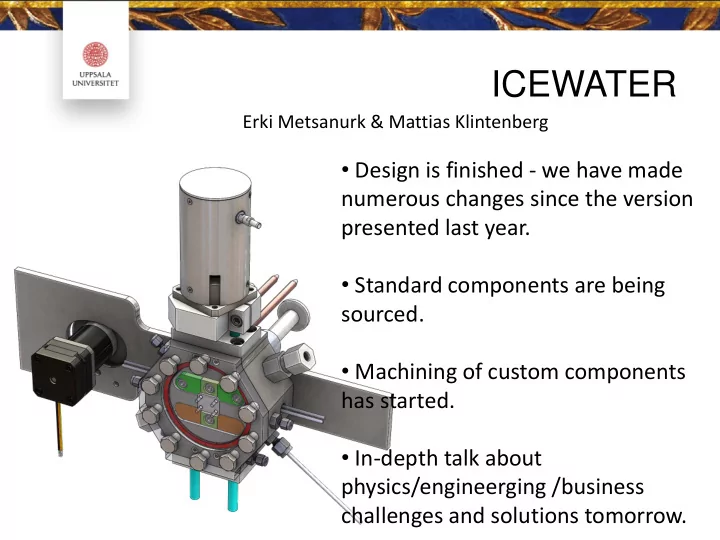
ICEWATER Erki Metsanurk & Mattias Klintenberg Design is finished - we have made numerous changes since the version presented last year. Standard components are being sourced. Machining of custom components has started.


slide-1
SLIDE 1

ICEWATER

  • Design is finished - we have made

numerous changes since the version presented last year.

  • Standard components are being

sourced.

  • Machining of custom components

has started.

  • In-depth talk about

physics/engineerging /business challenges and solutions tomorrow.

Erki Metsanurk & Mattias Klintenberg

slide-2
SLIDE 2

EURAD programme was accepted by the EC:

  • ~60 M€, 5y programme on research related to

radioactive waste management in the context of deep geological repositories.

  • Started 2019-06-01.
  • Managed by ANDRA (France)
  • One R&D work package (out of 7) on spent fuel

characterization lead by UU and SKB.

EURAD

Peter Jansson

slide-3
SLIDE 3

Nuclear data @ Uppsala?

3

Nuclear physics model codes Nuclear physics experiments End-user applications Nuclear data evaluation Co-variances and uncertainty quantification

slide-4
SLIDE 4

 Main goal: perform accurate measurements of

cross-sections in neutron-induced reactions.

 To be used at neutron research facility NFS

(Neutrons For Science) at GANIL (Caen, France).

 Development and upgrade of the detection setup

“Medley”, for different projects:

 Commissioning of the NFS neutron beam.  LIONS (Light ION production Studies).

 Reactor aging

 FISHES (FISsion vs Hydrogen Elastic Scattering).

 Reactor and criticality physics

The ongoing development of PPACs (Parallel Plate Avalanche Counters) and of the general setup led to different publications and student projects:

 D. Tarrío et al., “Characterization of PPACs’ time resolution for fission

studies”. Presented at the Int. Conf. On Nuclear Data 2019, Beijing (China). Submitted to EPJ Web of Conf. (2019).

 L. Lehtilä, “Implementation and characterization of Silicon detectors for

studies on neutron-induced nuclear reactions”, M.Sc. Thesis, 2019.

 K. Nakano, “Measurement of first Townsend coefficient of C3F8 for

characterization of PPAC”, internal report (2018). Visiting Ph.D. student from Kyushu University (Japan).

 Several projects for undergraduate students.

Development of the Medley setup for NFS

The renovated Medley chamber will be sent to NFS by the end of 2019 A PPAC detector
slide-5
SLIDE 5

Medley -> NFS@GANIL

Stephan Pomp

Goal: Use the Medley setup at the Neutrons For Science (NFS) facility at GANIL (Caen, France): Perform studies of the fission process and light-ion production (dosimetry, gas production, etc.). Status: After many years of delay NFS finally starts commissioning during 2020. Medley has been dismantled, partly adjusted and renovated for NFS, cleaned, etc., and is ready for shipping. Next: Medley will be shipped to NFS end of Nov. Installation and first use in the commissioning is planned for Spring 2020.

Main compontents of Medley: ready to be packed for shipping

slide-6
SLIDE 6

VERDI 2E-2v fission fragment spectrometer Collaboration with Lanzouh University

Fission yields Frisch Grid Ionization chamber Current characterization experiments at TANDEM lab in UU VERDI at JRC, Geel Belgium

slide-7
SLIDE 7

Fission yields @ IGISOL

  • Measurements of

independent and isomeric fission yields.

  • Separate and identify

nuclides based on mass. Highlight 2019

  • Successful measurement
  • f isomeric yield ratios of

19 isotopes in proton induced fission of 238U.

Q/M selection 𝜠M/M ≈ 106 Q/M selection 𝜠M/M ≈ 500

134mI 134I 134Te 238U(p,f)

slide-8
SLIDE 8

Evaluation and Uncertainty Quantification

Henrik Sjöstrand

  • Focus 2019, model defects and unrecognized systematic

uncertainties. – More information by Henrik Sjöstrand, Machine learning regression for reactor-relevant nuclear data tomorrow at 11.05 – Continuation of MÅBiL funded research

  • Code system available under GitHub

(http://www.nucleardata.com/) (open access)

  • Methods applied to iron with relevance for reactor aging

and for criticality analysis.

  • Results presented at ND 2019 – Beijing and as

contributions to NEA – WPEC

slide-9
SLIDE 9

Future developments of GET

Peter Andersson, Vikram Rathore, Lorenzo Solis

  • Higher spatial resolution

(hundreds of microns) is envisioned for next generation GET system.

  • Improved data collection rate can

be achieved by – Using a multiple channel segmented detector – Optimized collimator geometry – Reduced cooling time of fuel prior to PIE

  • A new detector concept has been

developed, with multiple detector channels, for faster interrogation, which in turn allows for higher resolution.

9

Gamma ray energy True localization probability (method 1) Full energy efficiency (method 1) True localization probability (method 2) Full energy peak efficiency (method 2) 662 keV 85.0(4) % 42.5(4) % 99.78(8) % 26.3(3) % 1173 keV 90.8(2) % 32.9(2) % 99.96(2) % 18.1(2) % 1332 keV 91.6(2) % 30.4(2) % 99.96(2) % 16.5(2) % 1596 keV 92.7(4) % 27.5(4) % 100(0) % 14.3(3) %

slide-10
SLIDE 10

Nuclear Safeguards – Research

Sophie Grape, Erik Branger, Zsolt Elter, Vaibhav Mishra, Ane Håkansson, Li Pöder Balkeståhl

  • Erik Branger defended his thesis October 12, 2018 and

currently is postdoc in the research group.

  • Viabhav Mishra is a new Ph.D. student within
  • safeguards. His research focus lies on verification of

spent fuel prior to encapsulation and novel technical safeguards approaches for Gen IV.

  • The research has during the last year addressed

verification of non-regular fuels and the use of quivers.

  • The work with machine learning techniques

continues now in collaboration with SCK•CEN in Belgium.

slide-11
SLIDE 11
  • We have, within a Horizon2020-project, offered the so-called course in

safeguards (Feb 4-8 in Mol, November 11-15 in Jülich)

  • Collaborators are: SCK•CEN, FZJ and JRC Ispra.
  • In addition to the course, four workshops are offered.

Nuclear Safeguards – Education

Sophie Grape, Erik Branger, Zsolt Elter, Vaibhav Mishra, Ane Håkansson, Li Pöder Balkeståhl

slide-12
SLIDE 12

UGGLA* ̶ Gamma measurements for radioecology

Mattias Lantz, Cecilia Gustavsson

  • HPGe detector in use for biological and

geological samples → interdisciplinary research.

  • Successful completion of school project

Strålande Jord → which attracted huge media interest.

  • Several bachelor and master student

have been educated in gamma measurement techniques → competence development.

  • Established collaboration with FOI

reference lab in Umeå for independent benchmarking → national competence sharing. SGU map of 137Cs (left) and results from mushroom activity obtained in the project Stråland Jord (right).

*Uppsala Generic Gamma LAb

slide-13
SLIDE 13

UGGLA* ̶ ongoing research

  • Transport mechanisms of 137Cs between

soil and fungi → in collaboration with Mycology dept at SLU

  • Dating of lake sediments using 210Pb →

in collaboration with Limnology dept at UU

  • Method development of corrections for

geometric, density and composition variations in extended bio and/or geo samples.

  • Survey of feasibility of using other

radionuclides (i.e. Be-isotopes, 210Po) for ecological applications. SGU map of 137Cs (left) and results from mushroom activity obtained in the project Stråland Jord (right).

*Uppsala Generic Gamma LAb

slide-14
SLIDE 14

NESSA (NEutron Source in uppSAla):

a facility under development Alexander Prokofiev

Envisaged parameters

  • Neutron energy: 14 MeV
  • Neutron yield: up to 5∙1010 n/s
  • Neutron flux: ≥ 109 n/cm2/s
  • Beam spot size: 1 mm…~50 cm

Motivation

Maintain and develop national competence in:

  • nuclear physics
  • neutron physics
  • radiation physics
  • radiation protection
  • detection techniques
  • neutron tomography
  • radiation effects

Project status and time plan

  • Procurement of the neutron generator: the contract

has recently been signed with Adelphi Technology Inc.

  • Design of the radiation protection using the MCNP

code: ready on the concept level

  • Site Acceptance Test: Autumn 2020
  • Availability for external users: starting year 2021

The NESSA bunker @ FREIA hall

NG User area

Contact: Uppsala University, Division of Applied Nuclear Physics, alexander.prokofiev@physics.uu.se

slide-15
SLIDE 15

UU Educational efforts

  • New long-term agreement with

industry concerning contract education for NPP staff

  • 14 weeks/year
  • KKI, the bachelor’s program in

nuclear technology is back with support from industry

  • 29 applicants (12 1st hand) 

5 students

  • Development of new contract

education courses, e.g.,

  • MTO/Human Factors for Nuclear

Safety including Virtual Reality Resources as part of Safety Culture (6 ECTS)

KKI students (and teachers) at the JSI TRIGA-reactor, Ljubljana, october 2019.

slide-16
SLIDE 16

Outreach activities at UU

Listed events since September 2018

 Participation with information and activities about ionizing radiation at popular science events, i.e. SciFest (March) and Kulturnatten (September)  ~10 interviews in public radio and podcasts about nuclear power, ionizing radiation, atomic bombs, Fukushima and Chernobyl  ~25 media entries (newspaper, radio, TV) related to ”Strålande Jord”  ~15 debate articles in newspapers (mainly replies) related to nuclear power and the climate issue  ~5 high school visits/talks/workshops, several high school projects related to ”Strålande jord”  ~10 meetings, interactions and corrections with politicians, reporters and actors (!) sharing information about ionizing radiation and nuclear power  2 wikipedia entries created or updated

slide-17
SLIDE 17