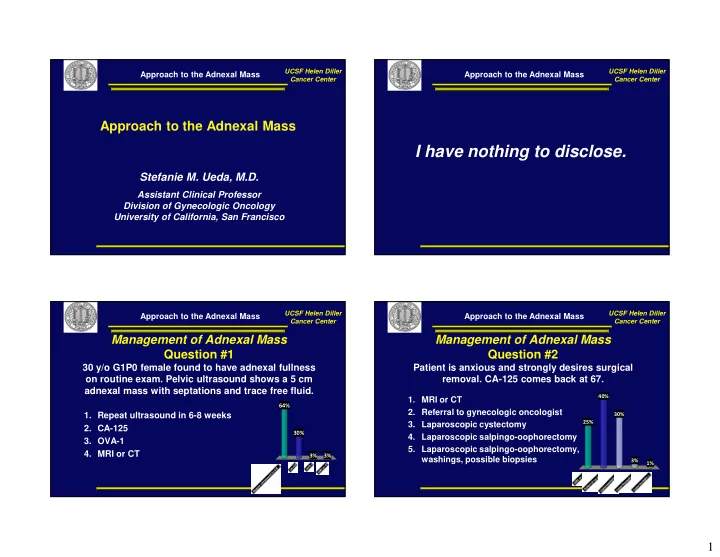
I have nothing to disclose. Stefanie M. Ueda, M.D. Assistant - - PowerPoint PPT Presentation

i have nothing to disclose
SMART_READER_LITE
LIVE PREVIEW

I have nothing to disclose. Stefanie M. Ueda, M.D. Assistant - - PowerPoint PPT Presentation

UCSF Helen Diller UCSF Helen Diller Approach to the Adnexal Mass Approach to the Adnexal Mass Cancer Center Cancer Center Approach to the Adnexal Mass I have nothing to disclose. Stefanie M. Ueda, M.D. Assistant Clinical Professor Division


slide-1
SLIDE 1

1

Approach to the Adnexal Mass

UCSF Helen Diller Cancer Center

Approach to the Adnexal Mass

Stefanie M. Ueda, M.D.

Assistant Clinical Professor Division of Gynecologic Oncology University of California, San Francisco

Approach to the Adnexal Mass

UCSF Helen Diller Cancer Center

I have nothing to disclose.

Approach to the Adnexal Mass

UCSF Helen Diller Cancer Center

Management of Adnexal Mass Question #1

30 y/o G1P0 female found to have adnexal fullness

  • n routine exam. Pelvic ultrasound shows a 5 cm

adnexal mass with septations and trace free fluid.

64% 3% 3% 30%

  • 1. Repeat ultrasound in 6-8 weeks
  • 2. CA-125
  • 3. OVA-1
  • 4. MRI or CT

Approach to the Adnexal Mass

UCSF Helen Diller Cancer Center

Management of Adnexal Mass Question #2

Patient is anxious and strongly desires surgical

  • removal. CA-125 comes back at 67.

25% 40% 1% 3% 30%

  • 1. MRI or CT
  • 2. Referral to gynecologic oncologist
  • 3. Laparoscopic cystectomy
  • 4. Laparoscopic salpingo-oophorectomy
  • 5. Laparoscopic salpingo-oophorectomy,

washings, possible biopsies

slide-2
SLIDE 2

2

Approach to the Adnexal Mass

UCSF Helen Diller Cancer Center

Management of Adnexal Mass Questions #3

55 y/o postmenopausal female found to have adnexal fullness on routine exam. Pelvic ultrasound shows a 4 cm adnexal mass with thin septation.

18% 3% 9% 71%

  • 1. Repeat ultrasound in 6-8 weeks
  • 2. CA-125
  • 3. OVA-1
  • 4. MRI or CT

Approach to the Adnexal Mass

UCSF Helen Diller Cancer Center

Management of Adnexal Mass Question #4

Patient has mild hypertension and no significant family history. She is asymptomatic. CA-125 comes back at 11.

1% 12% 82% 4%

  • 1. OVA-1
  • 2. MRI or CT
  • 3. Repeat ultrasound and tumor marker

in 6-8 weeks

  • 4. Referral to gynecologic oncologist

Approach to the Adnexal Mass

UCSF Helen Diller Cancer Center

The Adnexal Mass

  • Characteristics of Adnexal Masses
  • Diagnostic Tools

– Imaging Modalities – Tumor Markers and Multivariate Assays

  • Approach to Management
  • Referral to Gynecologic Oncologist

Approach to the Adnexal Mass

UCSF Helen Diller Cancer Center

Prevalence of Adnexal Mass

  • 5-10% lifetime risk of requiring surgery for adnexal mass

– Asymptomatic women age 25-401

  • 6.6% with ovarian cyst

– Asymptomatic postmenopausal women2

  • 2.5% simple cyst
  • 84% less than 5 cm and missed on exam
  • Risk of malignancy increases with age

– 6-11% in premenopausal3 – 29-35% in postmenopausal

1Borgfeldt C et al, Ultrasound Obstet Gynecol 1999 2Castillo G et al, Gynecol Oncol 2004 3Norris HJ et al, Cancer 1972

slide-3
SLIDE 3

3

Approach to the Adnexal Mass

UCSF Helen Diller Cancer Center

Clinical Pearls

  • Presence of fever, leukocytosis, or pelvic

tenderness

  • Past medical history, including personal

history of breast cancer

  • Gastrointestinal symptoms particularly if

periumbilical or left lower quadrant pain

  • Hepatic, renal or cardiac disease can

contribute to ascites or elevated CA-125

Approach to the Adnexal Mass

UCSF Helen Diller Cancer Center

Differential Diagnosis

  • Physiologic or functional cysts
  • Ectopic pregnancy
  • Inflammatory Etiologies
  • Endometrioma
  • Benign or malignant neoplasms

– Serous cystadenomas most common – Mucinous cystadenomas more likely to be multiloculated, unilocular, larger

  • Metastasis to ovary

Approach to the Adnexal Mass

UCSF Helen Diller Cancer Center

Diagnostic Evaluation – Pooled Analysis

Diagnostic Tool Sensitivity Specificity Bimanual exam 45% 90% Ultrasound morphology 86-91% 68-83% MRI 91% 87% CT 90% 75% PET 67% 79% CA-125 78% 78%

1Myers ER et al, Agency Healthcare Res 2006

Approach to the Adnexal Mass

UCSF Helen Diller Cancer Center

Pelvic Ultrasonography

  • Normal ovary

– 3.5 x 2 x 1.5 cm in premenopausal – 1.5 x 0.7 x 0.5 cm postmenopausal

  • 173 consecutive cases of women with

pelvic mass1

– Correct diagnosis 42%, incorrect diagnosis in 7% – 92% sensitivity and 97% specificity for endometrioma – 90% sensitivity and 98% specificity for dermoid

1Valentin L et al, Ultrasound Obstet Gynecol 1999

slide-4
SLIDE 4

4

Approach to the Adnexal Mass

UCSF Helen Diller Cancer Center

Normal premenopausal and postmenopausal ovary

Approach to the Adnexal Mass

UCSF Helen Diller Cancer Center

Dermoid Endometrioma

Approach to the Adnexal Mass

UCSF Helen Diller Cancer Center

Diagnosis of Ovarian Cancer by Sonography

Sonographic Findings Sensitivity Specificity Ultrasound morphology 86-91% 68-83% Resistive index 72% 90% Pulsatility index 80% 73% Presence of vessels 88% 78% Morphology and Doppler 86% 91% Doppler technology should be combined with morphology assessment

Approach to the Adnexal Mass

UCSF Helen Diller Cancer Center

Pelvic Ultrasonography

  • Malignancies rich in neovascularization

– Lower resistive and pulsatile indices

  • Gray scale with color Doppler flow better

than either alone

  • Likelihood of malignancy1

– 0.3% of unilocular – 8% of multilocular – 36% of multilocular, solid – 39% of solid

1Granbery S et al, Gynecol Oncol 1989

slide-5
SLIDE 5

5

Approach to the Adnexal Mass

UCSF Helen Diller Cancer Center

Sonographic Characteristics

  • Low to medium echoes in endometrioma
  • Fishnet or reticular pattern in hemorrhagic cyst
  • Hyperechoic nodule with distal acoustic

shadowing suggestive of teratoma

  • Malignant mass
  • Solid but not hyperechoic
  • Papillary
  • Thick septations (>2-3 mm)
  • Color or Doppler flow in solid component

Approach to the Adnexal Mass

UCSF Helen Diller Cancer Center

Multiple septations and solid elements with vascular flow

Approach to the Adnexal Mass

UCSF Helen Diller Cancer Center

CT Use in Adnexal Masses

  • 4.1% asymptomatic women found to have adnexal mass1
  • Mean age 56.2 years
  • 108 unilateral, 10 bilateral
  • Mean size 4.1 cm

– No ovarian cancers among those with incidental mass – 4 cases of ovarian cancer developed after negative CT at 15-44 months follow-up

  • CT should not be used for screening but preferred

technique in the pretreatment evaluation of ovarian cancer to define the extent of disease2

1Pickhardt PH et al, Radiology 2010 2Iyer VR et al, AJR 2010

Approach to the Adnexal Mass

UCSF Helen Diller Cancer Center

Mucinous Borderline Tumor

slide-6
SLIDE 6

6

Approach to the Adnexal Mass

UCSF Helen Diller Cancer Center

Pelvic MRI in Evaluating Adnexal Mass

  • Retrospective cohort of 237 with indeterminate

adnexal mass by ultrasound at tertiary care center

– Sensitivity 95% – Specificity 94.1% – Predicted benign histologic subtype accurately in 56 of 57 women (98.3%) – Predicted malignancy accurately in 23 of 27 women (85.2%) – Offered more detailed patient counseling, surgical referral, and conservative management of benign masses

1Haggert AF et al, Int J Gynecol Cancer 2014

Approach to the Adnexal Mass

UCSF Helen Diller Cancer Center

Endometrioma with hypointensity and fluid levels on T2 (left) and hyperintense blood on T1

Approach to the Adnexal Mass

UCSF Helen Diller Cancer Center

PET/CT Compared to Other Modalities

  • 99 patients underwent PET, ultrasound

technique and T2-weighted MRI

– PET depicted 7 of 12 malignant and 66 of 87 benign tumors – False-negative PET obtained in 5 of 7 Stage I cancer and borderline

  • Sensitivity 58%
  • Specificity 76%

– Sensitivity (83%) and specificity (84%) higher for ultrasound and for MRI (92% & 85%, respectively) – Ultrasound remains method of choice

1Fenchel S et al, Radiol 2002

Approach to the Adnexal Mass

UCSF Helen Diller Cancer Center

Normal premenopausal ovaries with FDG-avidity

slide-7
SLIDE 7

7

Approach to the Adnexal Mass

UCSF Helen Diller Cancer Center

Multimodal Imaging

Sonographic Findings Sensitivity Specificity Sonogram with Doppler 92% 60% MRI 84% PET 80% Combination of all 3 92% 85%

  • 101 patients with asymptomatic adnexal masses

scheduled for laparoscopy

– Preoperative ultrasound, MRI, and PET – Correct classification of 11 of 12 ovarian malignancies – MRI & PET improved specificities but decreased sensitivities – Multimodal imaging may improve accuracy

1Grab D et al, Gynecol Oncol 2000

Approach to the Adnexal Mass

UCSF Helen Diller Cancer Center

CA-125

Clinical Scenario Sensitivity Specificity PPV Stage I 50% Stage II 90% Malignancy in premenopausal 50-87% 26% 73-100% With complex or solid mass on ultrasound 85% 92%

  • Elevated in >80% of advanced ovarian cancers
  • Higher specificity for malignancy if combined with sonography

Approach to the Adnexal Mass

UCSF Helen Diller Cancer Center

Human Epididymis Protein 4 (HE4)

  • Disulfide family of secreted proteins that is

amplified in ovarian cancer

– <140-150 pmol/L for postmenopausal – <70 pmol for premenopausal

  • Increased expression in serous (93%) and

endometrioid subtypes (100%)

  • FDA approval in 2008 to monitor patients

with ovarian cancer for disease progression or recurrence

  • Not elevated in endometriosis

Approach to the Adnexal Mass

UCSF Helen Diller Cancer Center

HE-4 staining more common in serous and endometrioid

  • varian carcinomas, but absent in mucinous
slide-8
SLIDE 8

8

Approach to the Adnexal Mass

UCSF Helen Diller Cancer Center

Meta-Analysis of HE-4

Clinical Scenario Sensitivity Specificity HE-4 in Malignancy 78% 86% CA-125 in Malignancy 80% 75%

  • 45 studies of 10,671 women with ovarian tumors

– Similar performance of HE-4 to CA-125 – Risk of Ovarian Malignancy Algorithm (ROMA), which includes CA-125 and HE-4, shows conflicting results of improving performance over either marker alone

1Lacerda Macedo AC et al, Int J Gynecol Cancer 2014

Approach to the Adnexal Mass

UCSF Helen Diller Cancer Center

OVA-1 (Multivariate Index Assay)

  • 5 biomarkers

– CA-125, transthyretin, apolipoprotein A1, β2 microglobulin, transferrin

  • FDA approval in 2009 to screen women

with pelvic mass

  • High probability of malignancy

– >5.0 in premenopausal – >4.4 in postmenopausal – Assay interference if rheumatoid factor>250 IU/ml

  • r triglyceride >4.5 g/L

Approach to the Adnexal Mass

UCSF Helen Diller Cancer Center

OVA-1 versus CA-125

Clinical Scenario OVA-1 Sensitivity CA-125 Sensitivity Early stage ovarian cancer 94% 61% Premenopausal 82% 29% Postmenopausal 100% 78%

  • 590 scheduled for surgery for ovarian mass

– 27 primary care and specialty sites throughout U.S. – >50% enrolled by non-gynecologic oncologist – Females age 18 or older – High probability of malignancy

  • Premenopausal >5.0
  • Postmenopausal >4.4

1Ueland FR et al, Obstet Gynecol 2011

Approach to the Adnexal Mass

UCSF Helen Diller Cancer Center

Performance in Predicting Ovarian Malignancy

Performance CA-125 (>200) Multivariate Index Physician Assessment Assessment +Assay Sensitivity 69% 93% 75% 96% Specificity 84% 43% 79% 35% PPV 65% 42% 62% 40% NPV 86% 93% 88% 95%

  • Physician assessment + OVA-1 identified 86% of malignancies missed

by CA-125

  • 45% still referred to gynecologic oncologist despite OVA-1 predicting

182 benign tumors

1Ueland FR et al, Obstet Gynecol 2011

slide-9
SLIDE 9

9

Approach to the Adnexal Mass

UCSF Helen Diller Cancer Center

Probability of Malignancy with OVA-1 Score

Approach to the Adnexal Mass

UCSF Helen Diller Cancer Center

Risk of Malignancy Following OVA-1 & Imaging

Clinical Test Sensitivity Specificity Ultrasound or OVA-1 98% 31% CT 97% 22% Ultrasound + OVA-1 68% 75% CT + OVA-1 71% 70%

  • 1110 women with adnexal mass evaluated with ovarian imaging,

biomarker analysis, and surgery at 44 sites – High-risk imaging defined as complex mass with evidence of solid

  • r papillary components

– 24% with ovarian malignancy (45 borderline) – Only 1.6% of tumors malignant if both OVA-1 and imaging low-risk

1Goodrich ST et al, AJOG 2014

Approach to the Adnexal Mass

UCSF Helen Diller Cancer Center

Fine Needle Aspiration of Cystic Mass

  • Limited by concerns for diagnostic accuracy & cyst

rupture

– 235 ovarian cysts by FNA1

  • 56% devoid of diagnostic cells
  • Sensitivity ranges from 35-85%
  • Specificity approaches 100%
  • Risk for re-formation high2

– Randomized, controlled study of 278 women with unilocular cysts 4-7 cm

  • No difference in resolution between those undergoing cyst

puncture and those observed for 6 months

1Mulvany NJ, Acta Cytol 1996 2Zanetta G et al, BMJ 1996

Approach to the Adnexal Mass

UCSF Helen Diller Cancer Center

Decisions Regarding Borderline Tumors

  • Greater tendency to underdiagnose borderline tumors on

frozen section (24-30%)1

– More for mucinous than serous (33% vs. 13%)

  • Upstaging not uncommon with serous borderline tumors

(12-47%) but less likely for mucinous1

– Incomplete staging associated with a higher recurrence rate (11.8% vs. 7.1%) – 24.7% who underwent restaging revealed residual tumor – Stage and sub-classification of extra-ovarian disease into invasive and non-invasive implants together with the presence of postoperative macroscopic residual disease most important prognostic indicators2

1Fischerova D et al, Oncologist 2012 2Seldman JD et al, Human Path 2000

slide-10
SLIDE 10

10

Approach to the Adnexal Mass

UCSF Helen Diller Cancer Center

Serous Borderline Tumors

Approach to the Adnexal Mass

UCSF Helen Diller Cancer Center

Surgical Management of Borderline Tumors

  • Histology and fertility should be considered with careful

intraoperative exploration

– Pelvic washings – Biopsies of omentum & peritoneum – Appendectomy if mucinous

  • Recurrence rate higher after cystectomy (12-58%) than
  • ophorectomy (0-20%)

– Recurrence in the form of invasive disease <1% for early stage disease – Only 15% of unilateral tumors associated with extra-ovarian disease if no other suspicious peritoneal lesions or micropapillary pattern found

1Fischerova D et al, Oncologist 2012

Approach to the Adnexal Mass

UCSF Helen Diller Cancer Center

Bowel mesentery with several small implants Approach to the Adnexal Mass

UCSF Helen Diller Cancer Center

Adnexal Masses in Pregnancy

  • Expectant management

– 51-70% resolve – 10% malignant – Majority borderline tumors or germ cell tumors

  • Surgical intervention

– Optimally early to mid-second trimester – Laparoscopy safe, particularly in those <10 cm

  • Complication rate <2%

– Most pushed out of pelvis

slide-11
SLIDE 11

11

Approach to the Adnexal Mass

UCSF Helen Diller Cancer Center

ACOG Guidelines for Referral to Gynecologic Oncologist

Premenopausal Postmenopausal

Elevated CA-125 (>200) Elevated CA-125 (>35) Ascites Ascites Abdominal or distant metastases Nodular or fixed pelvic mass Abdominal or distant metastases

1ACOG Committee Opinion 477, Obstet Gynecol 2011 2Dodge JE et al, Gynecol Oncol 2012

Malignancy in Premenopausal: Sensitivity 79%, Specificity 70% Malignancy in Postmenopausal: Sensitivity 93%, Specificity 60%.

Approach to the Adnexal Mass

UCSF Helen Diller Cancer Center

Referral to Gynecologic Oncologist

  • Predictive value of guidelines in 1035 women with

pelvic mass1

– Captures 70% of ovarian cancers – 33.8% PPV for premenopausal – 59.5% PPV for postmenopausal – 90% NPV for both groups

  • Lowest sensitivity in premenopausal women with early

stage disease

  • Average delay to definitive or staging surgery ~5

weeks2

– Delay when tumor ruptured affected survival

1Im SS et al, Obstet Gynecol 2005 2Maiman M et al, Obstet Gynecol 1991

Approach to the Adnexal Mass

UCSF Helen Diller Cancer Center

Gynecologic Oncologist Involvement

  • Survey mailed to 3,200 physicians age <64

– Vignette described a 57-year-old symptomatic woman with a suspicious right adnexal mass with ascites – Gynecologic oncologist referral

  • 39.3% of family physicians
  • 51.0% of general internists
  • 66.3% OB-GYNS
  • Factors associated with non-referral

– Medicaid insurance – Providers' weekly average number of patients >91 – Male sex – Rural practice location – Solo practice

1Goff BA et al, Obstet Gynecol 2011

Approach to the Adnexal Mass

UCSF Helen Diller Cancer Center

Decision Analysis for Referral

Strategy Cost # Reoperation CA-125 $933.9 mil 461 OVA-1 $976.9 mil 142 Refer All $939.7 mil Not applicable

  • Compared CA-125 to multivariate index for referral strategy in 81,000

hypothetical patients with complex pelvic mass

  • 91% of patients have appropriate staging with multivariate index approach
  • OVA-1 utilization resulted in more ovarian cancer patients receiving

appropriate initial surgery, but at increased costs

  • Referring all patients avoids the most reoperations at reduced cost

1Kim KH et al, Gynecol Oncol 2012

slide-12
SLIDE 12

12

Approach to the Adnexal Mass

UCSF Helen Diller Cancer Center

Conclusions

  • Pelvic ultrasound remains the optimal diagnostic

tool at initial evaluation

  • MRI may further distinguish tumor characteristics

in indeterminate masses

  • OVA-1 testing may be considered, particularly in

premenopausal women

  • High suspicion for malignancy should lead to

referral to a gynecologic oncologist

Approach to the Adnexal Mass

UCSF Helen Diller Cancer Center

Management of Adnexal Mass Question #1

30 y/o G1P0 female found to have adnexal fullness

  • n routine exam. Pelvic ultrasound shows a 5 cm

adnexal mass with septations and trace free fluid.

75% 0% 25% 0%

  • 1. Repeat ultrasound in 6-8 weeks
  • 2. CA-125
  • 3. OVA-1
  • 4. MRI or CT

Approach to the Adnexal Mass

UCSF Helen Diller Cancer Center

Management of Adnexal Mass Question #2

Patient is anxious and strongly desires surgical

  • removal. CA-125 comes back at 67.

0% 0% 0% 0% 0%

  • 1. MRI or CT
  • 2. Referral to gynecologic oncologist
  • 3. Laparoscopic cystectomy
  • 4. Laparoscopic salpingo-oophorectomy
  • 5. Laparoscopic salpingo-oophorectomy,

washings, possible biopsies

Countdown

10

Approach to the Adnexal Mass

UCSF Helen Diller Cancer Center

Management of Adnexal Mass Questions #3

55 y/o postmenopausal female found to have adnexal fullness on routine exam. Pelvic ultrasound shows a 4 cm adnexal mass with thin septation.

0% 0% 0% 0%

  • 1. Repeat ultrasound in 6-8 weeks
  • 2. CA-125
  • 3. OVA-1
  • 4. MRI or CT

Countdown

10

slide-13
SLIDE 13

13

Approach to the Adnexal Mass

UCSF Helen Diller Cancer Center

Management of Adnexal Mass Question #4

Patient has mild hypertension and no significant family history. She is asymptomatic. CA-125 comes back at 11.

0% 0% 0% 0%

  • 1. OVA-1
  • 2. MRI or CT
  • 3. Repeat ultrasound and tumor marker

in 6-8 weeks

  • 4. Referral to gynecologic oncologist

Countdown

10