I have nothing to disclose Advances Roberto Lucchini, MD Division - - PDF document

i have nothing to disclose
SMART_READER_LITE
LIVE PREVIEW

I have nothing to disclose Advances Roberto Lucchini, MD Division - - PDF document

2/27/2017 Manganese Toxicity: Recent Research I have nothing to disclose Advances Roberto Lucchini, MD Division Occupational Medicine Selikoff Centers for Occupational Health New York, USA Total attendees (417) 261 Webcast Participants


slide-1
SLIDE 1

2/27/2017 1

Manganese Toxicity: Recent Research Advances

Roberto Lucchini, MD Division Occupational Medicine Selikoff Centers for Occupational Health New York, USA

I have nothing to disclose

UCSF_CME/ Presentation Slide / March 10, 2017

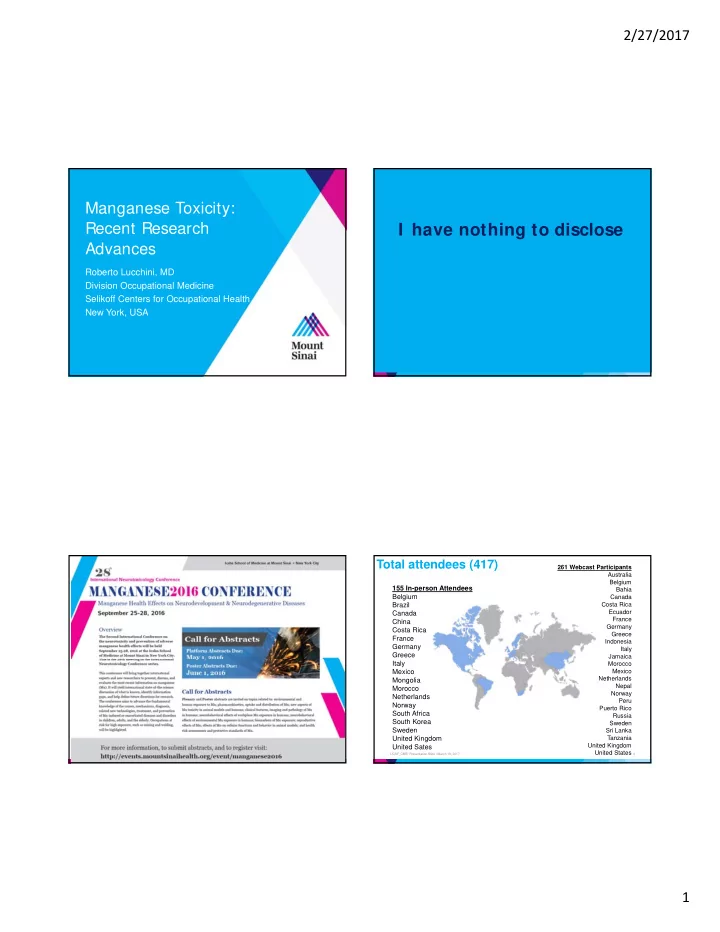
Total attendees (417)

4

155 In-person Attendees Belgium Brazil Canada China Costa Rica France Germany Greece Italy Mexico Mongolia Morocco Netherlands Norway South Africa South Korea Sweden United Kingdom United Sates

261 Webcast Participants Australia Belgium Bahia Canada Costa Rica Ecuador France Germany Greece Indonesia Italy Jamaica Morocco Mexico Netherlands Nepal Norway Peru Puerto Rico Russia Sweden Sri Lanka Tanzania United Kingdom United States

UCSF_CME/ Presentation Slide / March 10, 2017

slide-2
SLIDE 2

2/27/2017 2

Plenaries

 Health Risk Assessment and Protective Standards  Health Effects of Community and Workplace Exposures  Children’s Health and Development  New Aspects of Toxicology in Animal Models and Cellular Functions  Genetic and Mechanistic Influences  Imaging and Biomarkers

UCSF_CME/ Presentation Slide / March 10, 2017 UCSF_CME/ Presentation Slide / March 10, 2017

Documentary Film: Le manganisme (circa 1953) Film by Jean Rodier, J. Boyer and Richard Chenay. Made possible by Centre National du Cinema, Paris

Workplace exposure and standards

UCSF_CME/ Presentation Slide / March 10, 2017

1st Preventive measure for Mn-air exposure

Study in 75 Pennsylvania plants (Tanaka & Lieben, 1969)

▶ 144 workers: air Mn dust/fumes > 5 mg/m3

7 cases & 15 borderline cases of manganism

▶ 48 workers: air Mn dust/fumes < 5 mg/m3

0 cases 1970: 1st Industrial hygiene measure for air-Mn US-OSHA & ACGIH: ceiling value of 5 mg Mn/m³

Harry A. Roels, Université Catholique de Louvain, Belgium

UCSF_CME/ Presentation Slide / March 10, 2017

slide-3
SLIDE 3

2/27/2017 3

2nd Preventive measure for Mn-air exposure

1980s-1990s: Belgium, Canada, Italy & Sweden

  • Independent epidemiologic investigations
  • Mn-air exposures < 1 mg Mn/m³
  • Findings of sub/preclinical CNS changes:

decreased neuropsychological and psychomotor performances, cognitive deficits, and mood disturbances

1995: 2nd Industrial hygiene measure for air-Mn

to prevent sub/preclinical CNS manifestaions ACGIH (TLV-TWA 8h, 1995) : 5 0.20 mg/m3 (total dust) no change US-OSHA (Ceiling, 1970) 5 mg/m³ US-NIOSH (REL-TWA) 1 mg/m³

UCSF_CME/ Presentation Slide / March 10, 2017

3rd Preventive measure for Mn-air exposure

Application of particle size-selective criteria for inhalation of airborne particulate matter (PM)

  • n industrial aerosol containing Mn particles:
  • inhalable fraction : PM < 100 µm
  • respirable fraction: PM < 10 µm

Inhalable Respirable*

EU-SCOEL (2011): 0.2 mg/m³ 0.05 mg/m³ ACGIH (2012/13): 0.2 0.1 mg/m³ 0.02 mg/m³ *Higher neurotoxic potential of fine particles (e.g., welding fume )

UCSF_CME/ Presentation Slide / March 10, 2017

Results of OSHA Compliance Monitoring for Manganese, 2012-2016

5 10 15 20 25 30 35 40 >0.1 >1 >5

Percent of Detectable Samples Mn Exposure (mg/m3) N = 1,886 total N = 62 (3%) > 1 mg/m3 N = 8 (0.4%) > 5 mg/m3

William Perry, Occupational Safety and Health Administration

UCSF_CME/ Presentation Slide / March 10, 2017

Majority are welders, millwrights, blasters  Commercial Industrial Machinery Repair  Transportation Equipment Manufacturers  Auto, Light Duty Vehicle Manufacture  Machinery Manufacturing  Fabricated Metal Products  Primary Metals Manufacture  Specialty Trade Contractors  Heavy and Civil Engineering Construction

I ndustry Sectors Where Mn Exposures Have Been Commonly Found

UCSF_CME/ Presentation Slide / March 10, 2017

slide-4
SLIDE 4

2/27/2017 4

Welders exposure according to Mn forms/ valence

UCSF_CME/ Presentation Slide / March 10, 2017

Highest Full-shift TWA Breathing Zone Exposure to Total Mn Inhalable Fractions (µg/m3)

Oil Refinery Construction: Job Process Sol. 0, 2+ 3+ , 4+ Sum Tank Stick, CS 28 74 250 380 Piping Stick, CS 3.3 38 18 57 Vessels Stick, CS 26 210 52 320

John Howard Director, NIOSH TLV= 100 µg/m3

Asphalt Tank, Respirable Mn (µg/m3) Five Welders

50 100 150 200 250 300 350 400 Sol Mn Mn (0,+ 2) Mn (+ 3,+ 4) Mn (sum) 1 2 3 4 5

TLV 20 ug/ m3

Welders exposure warrant effective exposure control Ventilation improvements May require respiratory protection – high efficiency filtering face-piece (?); PAPR welding helmets

UCSF_CME/ Presentation Slide / March 10, 2017

John Howard Director, NIOSH

Nail Clippings Surrogate: Biomonitoring Welding-Mn Exposure

Manganese (percent control)

Experimental rats were exposed (2mg/rat; 1/week x 28 weeks) to different welding fumes or manganese chloride by intra-tracheal instillation (to overcome superficial contamination of nails that could occur by whole- body inhalation). Brain (striatum), blood and nail clippings were collected and subjected to elemental analysis. Manganese was detected in striatum and nail clippings but not in blood.

UCSF_CME/ Presentation Slide / March 10, 2017

John Howard Director, NIOSH

UCSF_CME/ Presentation Slide / March 10, 2017

Nail Clips for Biomonitoring of Welding-related Mn Exposure

Experimental rats were exposed (2mg/rat; 1/week x 28 weeks) to different welding fumes or manganese chloride by intra-tracheal instillation (to overcome superficial contamination of nails that could occur by whole-body inhalation). Brain regions (striatum and midbrain) and nail clippings were collected and subjected to analysis of manganese content. John Howard Director, NIOSH

slide-5
SLIDE 5

2/27/2017 5 Updating the NIOSH REL!

 NIOSH quantitative risk assessment:

  • Conducted using best available data
  • On subclinical neurobehavioral changes
  • Provides an array of risk levels
  • With two-tier REL (inhalable/respirable)?
  • Peer-reviewed
  • Public input encouraged
  • Considers analytical achievability

 NIOSH topic page: Welding and manganese

www.cdc.gov/niosh/topics/welding/

UCSF_CME/ Presentation Slide / March 10, 2017

Brain I maging in welders

UCSF_CME/ Presentation Slide / March 10, 2017 0.000 0.002 0.004 0.006 0.008 0.010 0.012 0.014 Control Mn-Exposed Workers Mn-Exposed Welders

Caudate Anterior Putamen Posterior Putamen

Average Ki Value, Adjusted for Age *

FDOPA PET including Symptomatic Welders and Mn-Exposed Workers

Criswell SR, Perlmutter JS, Videen TO. Neurology. 2011;76:1296-301.

Average FDOPA PET Ki by region for controls, welders, and workers. * = different from controls, p < 0.01

Criswell et. al, in submission

Susan R. Criswell Washington U Saint Louis

UCSF_CME/ Presentation Slide / March 10, 2017

Increase in UPDRS3 Score Due to Welding Fume Exposure by Years as a Welder

Brad A. Racette Washington U Saint Louis

UCSF_CME/ Presentation Slide / March 10, 2017

slide-6
SLIDE 6

2/27/2017 6

 Cumulative Mn exposure to welding fume at estimated Mn concentrations

(0.14 mg Mn/m3) near some regulatory thresholds appeared to increase progression of parkinsonism in a dose-dependent manner.

 Workers performing Flux-cored arc welding (FCAW) may be at

particularly greater risk of developing progressive parkinsonism.

 More stringent workplace monitoring of Mn exposures, greater use of

personal protective equipment and ventilation, and systematic worker assessment may be indicated to reduce morbidity.

 What do we call this syndrome?

Racette et al. Dose-dependent progression of parkinsonism in manganese- exposed welders. Neurology. 2016 Dec 28.

UCSF_CME/ Presentation Slide / March 10, 2017

Indiana cohort (Lafayette, IN, US) Number Mean airborne Mn [mg/m3] Mean years of exposure Mean age Controls 22 0.007 ± 0.001 35 ± 11 Welders (low exp) 17 0.09 ± 0.03 12 ± 7 39 ± 10 Welders (high exp) 15 0.23 ± 0.19 15 ± 9 43 ± 11

A: Recruitment of welders and controls:

  • From same local truck trailer manufacturer, male only
  • Welders: more than 3 years of welding history

Controls: no exposure history

PD cohort Number Males / females Range of disease onset (years) Mean age (years) PD patients 19 9 F 0.75- 11 63.7 ± 9.1 controls 18 7 F N/A 59.7 ± 10.2

B: Recruitment of PD patients and controls:

  • Patients: Mild PD, recruited from neurological clinic; male and female
  • 12 hours off medication, some patients drug naiive
  • Controls: usually spouses or friends of patients, no exposure history, no neurol or
  • psych. history

Ulrike Dydak, Purdue University

UCSF_CME/ Presentation Slide / March 10, 2017

Mn Toe Nail Levels

*P = 0.0018

Eric Ward, Frank Rosenthal Purdue University

UCSF_CME/ Presentation Slide / March 10, 2017

Exposure versus Toe Nail Mn

UCSF_CME/ Presentation Slide / March 10, 2017

 Mn in Toe nail clippings may serve as reliable biomarker of exposure  It gives information about exposure over the past year, but also on lifetime cumulative exposure  Correlations were adjusted for age, sex, race, cigarette smoking and dietary Mn intake Past year exposure Cumulative exposure

p = 0.002 p = 0.006
slide-7
SLIDE 7

2/27/2017 7

Neurological Exam: UPDRS-I I I

Uniform Parkinson Disease Rating Scale – Part III (motor assessment)

Note: a UPDRS score < 15 is not considered pathological!

5 10 15 20 25 30 35 40

Score

Parkinson Study

PD Controls PD Patients

*p < 0.001

18 19

5 10 15 20 25 30 35 40 UPDRS Score

UPDRS Local Welders

Control Welder 22 31

p = 0.07

Ulrike Dydak, Purdue University

UCSF_CME/ Presentation Slide / March 10, 2017

Significant elevation of UPDRS scores in high exposure group!

2 4 6 8 10 12 14 16 18 UPDRS Score Control Low Exp.Welder High Exp. Welder *p=0.03 **p<0.01 N=22 N=14 N=17 2 4 6 8 10 12 14 16 18 UPDRS Score Control Welder N=22 N=31 p=0.07

 Uniform Parkinson Disease Rating Scale – Part III (motor

assessment)

 By Plant

UCSF_CME/ Presentation Slide / March 10, 2017

R1 (~ Brain Mn) Comparison

No significance was found 0.2 0.4 0.6 0.8 1 1.2 1.4 1.6 GP left GP right SN left SN right FWM left FWM right

R1 relaxation time (1/s))

Comparison of R1 at different brain regions

PD Control

0.2 0.4 0.6 0.8 1 1.2 1.4 1.6 GP left GP right SN left SN right FWM left FWM right R1 relaxation time (1/s)

R1 in different brain regions

welders w control

p=0.0048 p=0.0022 p<0.0001 p=0.0003

Welder Control PD Patient

PD patients - Ctrl Welders - Ctrl

UCSF_CME/ Presentation Slide / March 10, 2017

Correlation of MRI R1 versus past 3 months exposure

Frontal Cortex

R-square 0.5 P-value <0.01

Correlation of Brain Manganese vs Exposure

Relation of R1 relaxation rate correlated significantly with

  • ccupational exposure
  • Correlations were found between

the R1 relaxation rate and Mn exposure over the past 3 months in the regions responsible for behavioral and motor deficits:

  • Inferior Frontal Cortex (R=0.5, p<0.01)
  • Motor Cortex (R=0.4, p=0.02)
  • No correlation is found between R1 and exposure 7-12 months ago
  • No correlation in the Globus Pallidus!

Chien-Lin Yeh, Purdue University

UCSF_CME/ Presentation Slide / March 10, 2017

slide-8
SLIDE 8

2/27/2017 8

Neurobehavioral assessment in community exposure

UCSF_CME/ Presentation Slide / March 10, 2017 UCSF_CME/ Presentation Slide / March 10, 2017

Demographic & Biological Measures by Cohort

Marietta & Cambridge, OH N=410 East Liverpool, OH N=106 Female 46% 61% Caucasian 94% 83% Biological measures GM ± GSD GM ± GSD Hair Mn (ng/g) 416.51 ± 2.44 360.22 ± 2.17 Blood Mn (µg/L) 9.67 ± 1.27 10.06 ± 1.30 Blood Pb (µg/dL) 0.82 ± 1.58 1.13 ± 1.96 Serum Cotinine (µg/L) 0.08 ± 7.84 0.76 ± 6.12

Marietta and Cambridge biomarkers: n=310-370 East Liverpool biomarkers: n=67-98 Erin Haynes, U Cincinnati

UCSF_CME/ Presentation Slide / March 10, 2017

Penalized splines for hair and blood Mn levels in association with WISC-IV outcome measures. All models include both hair Mn and blood Mn, plus ln serum creatinine, blood Pb, and community residence. (A) Full Scale IQ (n = 295), also adjusted for sex, parent’s IQ, parent education, parent confidence t-score. The solid line represents the estimate with the 95% confidence interval indicated by dotted lines. The distributions of Mn levels are indicated by vertical lines on the x-axis.

UCSF_CME/ Presentation Slide / March 10, 2017

slide-9
SLIDE 9

2/27/2017 9

(B) Perceptual Reasoning (n = 298) also adjusted for parent’s IQ; and (C) Processing Speed (n = 272), also adjusted for sex, ln serum ferritin, parent confidence t- score, birth weight. The solid line represents the estimate with the 95% confidence interval indicated by dotted lines. The distributions of Mn levels are indicated by vertical lines on the x-axis.

UCSF_CME/ Presentation Slide / March 10, 2017 UCSF_CME/ Presentation Slide / March 10, 2017

Residents: “We are very concerned” In Chicago, nearly 20,000 people live within a 1-mile radius of SH Bell’s South Avenue O Terminal, which, according to the company’s website, is its second largest warehousing facility. Nearly two-thirds of those people are living below the poverty level, and almost 90 percent are minorities, according to EPA. Of those living within 1 mile of the facility, more than 6,000 are children. “That stretch where the company is, there are homes right across the street from [S.H. Bell]. “said Annmarie Garza, an East Side resident and mother who has been spreading the word about manganese to other parents in the

  • neighborhood. There are some poor people who live there because nobody

else wants to live in front of that. And I worry about their kids, knowing that this company has this stuff coming out.”

UCSF_CME/ Presentation Slide / March 10, 2017

Birgit Clauss Henn, U Boston

UCSF_CME/ Presentation Slide / March 10, 2017

slide-10
SLIDE 10

2/27/2017 10

UCSF_CME/ Presentation Slide / March 10, 2017

The PHIME Cohort Public Health Impact of Metal Exposure

(PI: Roberto Lucchini, Donald Smith, Robert Wright)

  • Cross‐sectional study of 720 children ages 11‐14 yrs
  • Mn measured in environmental & biological samples
  • Neuropsychological & behavioral assessment

SMR Parkinsonism vs. Mn in dust p=0.005

UCSF_CME/ Presentation Slide / March 10, 2017 UCSF_CME/ Presentation Slide / March 10, 2017 UCSF_CME/ Presentation Slide / March 10, 2017

Saliva Mn negatively associated with verbal learning & memory

Linear regression models adjusted for age, sex, SES, ln‐blood Pb; Ln‐transformed saliva Mn. *p<0.10, **p<0.05

Associations between Saliva Mn & California Verbal Learning Test

Adjusted Beta (95% CI) Total words recalled

  • 1.22

(-1.85 to -0.58)** Words recalled after trial 5

  • 0.30

(-0.46 to -0.14)** Words recalled with short recall

  • 0.30

(-0.48 to -0.13)** Words recalled with long recall

  • 0.32

(-0.49 to -0.15)** Errors: perseverations

  • 0.29

(-0.80 to 0.22) Errors: intrusions 0.24 (-0.05 to 0.54)

  • No consistent associations with other biomarkers
slide-11
SLIDE 11

2/27/2017 11

UCSF_CME/ Presentation Slide / March 10, 2017 UCSF_CME/ Presentation Slide / March 10, 2017 UCSF_CME/ Presentation Slide / March 10, 2017 UCSF_CME/ Presentation Slide / March 10, 2017

Mathilda Chiu, Mount Sinai

slide-12
SLIDE 12

2/27/2017 12

UCSF_CME/ Presentation Slide / March 10, 2017 UCSF_CME/ Presentation Slide / March 10, 2017 UCSF_CME/ Presentation Slide / March 10, 2017 UCSF_CME/ Presentation Slide / March 10, 2017

slide-13
SLIDE 13

2/27/2017 13

New Bedford Cohort Study (NBC)

  • 788 newborns enrolled at birth 1993-1998
  • Maternal residence in towns next

to PCB-contaminated New Bedford Harbor

  • Assess relation early life exposure

to PCBs, OC pesticides and metals with child neurodevelopment and growth

49

Susan Korrick, Harvard School PH

UCSF_CME/ Presentation Slide / March 10, 2017

Prenatal Mn and Behavior at Age 8 in the New Bedford Cohort

Prenatal Mn exposures associated with:

  • Increased risk of ADHD-associated behavior on Conners

Behavioral Rating Scale – Teachers only among girls

  • Suggestive decrements on WISC FD (attention/working

memory) only among girls

  • Suggestive evidence that postnatal (not prenatal) Pb

exposure may enhance Mn’s CRS-T and WISC FD associations in girls

  • No association with Continuous Performance Test

measures of attention or impulse control

UCSF_CME/ Presentation Slide / March 10, 2017

Penalized Splines of Cord Blood Manganese & ADHD symptoms at 8 yrs

We do not know very much about the effects of women’s

  • ccupational exposure to Mn
  • Women compose 37% of the Guangxi manganese-exposed

workers healthy cohort (Lv et al, 2014) and 35% of the high exposure category (Wang et al, 2015)

  • In 2010, women made up 21% of workers in manganese mines in

India (Labour Bureau, Government of India, 2012)

  • A Canadian study reported elevated urinary Mn concentrations in

132 women apprentice welders (Arrandale et al, 2014)

We know little about women’s possible Mn exposures in

  • ther occupations.

SEX DI FFERENCES

Donna Mergler, Université du Québec à Montréal

UCSF_CME/ Presentation Slide / March 10, 2017

slide-14
SLIDE 14

2/27/2017 14

UCSF_CME/ Presentation Slide / March 10, 2017

PROGRESS Birth Cohort Programming Research in Obesity, Growth, Environment and Social Stressors

(Pis Robert Wright, Rosalind Wright, Andrea Baccarelli, Martha M. Téllez‐Rojo)

Marcela Tamayo y Ortiz, National Inst Public Health, Mexico

Prenatal Depression and Neurodevelopment

  • Has been linked to lower IQ, negative emotionality, and Bayley II

Mental Development Index scores.

  • Prevalence of depression in pregnant women in the Mexican

Social Security Institute was 23.3% 2

  • National Institute of Perinatology 21.7% of pregnant women have

a probable depressive episode 3

  • 10% of pregnant women suffer from depression (weeks 6 to 10

and in the third trimester of pregnancy) 4

1 Makrides et al 2010, Nulman et al 2012, Nulman et al. 2015, Green at a. 2016, Bhang et al 2016 2Ortega, Lartigue and Figueroa 2001 3Quiñones Delgado and Lopez‐Trejo 2015 4Dossett et al.2008,

Ceballos‐Martínez, et al. 2010), Olhaberry, et al. 2013.

UCSF_CME/ Presentation Slide / March 10, 2017 UCSF_CME/ Presentation Slide / March 10, 2017

Co‐Exposure to Manganese and Depression and Neurodevelopment

  • Could be acting on the same dopamine pathway.
  • No previous studies on their prenatal co‐exposure and child

neurodevelopment.

By NIDA, Quasihuman ‐ Derivative work of File:Dopamine Pathways.png, Public Domain, https://commons.wikimedia.org/w/index.php?curid=19925266

UCSF_CME/ Presentation Slide / March 10, 2017

No Yes p Cognitive 93.2 ± 1.1 88.8 ± 2.3 0.000* Language 91.3 ± 1.2 86.1 ± 2.5 0.000* Motor 94.6 ± 1.2 90.2 ± 2.8 0.002*

60 80 100 120 NO YES Cognitive 60 80 100 120 NO YES Lenguage 60 80 100 120 NO YES Motor

Bayley III Scores by Depression

slide-15
SLIDE 15

2/27/2017 15

UCSF_CME/ Presentation Slide / March 10, 2017

80 85 90 95 100 10 20 30 40 50 10 20 30 40 50

NO YES Cognitive Language Motor Bayley III scores 3rd trimester manganese ug/L

3T Mn and neurodevelopment stratified by depression

UCSF_CME/ Presentation Slide / March 10, 2017

75 80 85 90 95 100 1 3 5 7 9 11 1 3 5 7 9 11

NO YES Cognitive Language Motor Bayley III Cord blood Manganese (ug/L)

CORD blood Mn and neurodevelopment stratified by depression

Genetic influence

UCSF_CME/ Presentation Slide / March 10, 2017 UCSF_CME/ Presentation Slide / March 10, 2017

Does genetics matter for Mn kinetics and toxicity?

Despite under homeostatic control, blood Mn levels in the general population varies considerably (2‐5 times) between individuals. This variation may be due to genetic variations in the SLC30A10 gene, which was recently shown to code for an important cell‐surface localized Mn efflux transporter

(Quadri et al. Am J Hum Genet. 2012; Leyva‐Illades et al. J Neurosci. 2014)

Karin Broberg, Karolinska Inst, Sweden

slide-16
SLIDE 16

2/27/2017 16

UCSF_CME/ Presentation Slide / March 10, 2017

3 adult cohorts - Bangladesh , Andes , Italy N=836

Blood Mn measured in populations world‐wide

PI: Marie Vahter PI: K Broberg/M. Vahter Roberto Lucchini Pregnant women 26 years Men & women 34 years Men & women 69 years

UCSF_CME/ Presentation Slide / March 10, 2017

3 adult cohorts - Bangladesh , Andes , Italy

SLC30A10 genotypes modify blood Mn up to 18%

AA CC CT TT

rs2275707 rs12064812

p=0.012 p=0.027 p=0.023 CC/AC % Blood Mn conc relative reference genotype % Blood Mn conc relative reference genotype

UCSF_CME/ Presentation Slide / March 10, 2017

SLC30A10 and SLC39A8 modify blood Mn up to 60%

Wahlberg et al. in preparation

N=717, adj for age, sex, ferritin, Mn in soil

rs227507 rs12064812 rs13107325 Combined genotypes

GG GA AA AA CA CC n=415 n=225 n=32 n=324 n=299 n=57 TT TC CC CC CT/TT n=561 n=116 Low Medium High n=86 n=548 n=29 % difference p<0.001 p<0.001 p=0.002 p<0.001

Blood Mn SLC30A10 SLC39A8

UCSF_CME/ Presentation Slide / March 10, 2017

SLC30A10 variation influences finger tapping and sway in Italian elderly

rs2275707 AC/CC

  • pen eyes 10% more sway p=0.065

closed eyes 15% more sway p=0.033 rs12064812 CT/CC better speed finger tapping non‐dominant hand 8.7% p=0.084 dominant hand 10.8% p=0.025 SLC30A10 seems to modify Mn toxicity

slide-17
SLIDE 17

2/27/2017 17

UCSF_CME/ Presentation Slide / March 10, 2017

SLC30A10 allele associated with increased Mn in blood ‐ reduced scoring in IQ subtests. SLC30A10 allele associated with reduced Mn in blood ‐ increasing scoring in IQ subtests. No gene‐environment interactions

SLC30A10 variation influences cognitive functions in Italian adolescents

  • 1. What is a good surrogate for biomonitoring

manganese exposure in welders?

UCSF_CME/ Presentation Slide / March 10, 2017

1.

Blood

2.

Urine

3.

Hair

4.

Nail

5.

Saliva

  • 2. What is the current TVL for manganese in

respirable fraction?

UCSF_CME/ Presentation Slide / March 10, 2017

1.

5 mg/ m3

2.

1 mg/ m3

3.

200 µg/ m3

4.

100 µg/ m3

5.

20 µg/ m3

  • 3. What gene can influence the variation of blood

manganese and neurobehavioral performance?

UCSF_CME/ Presentation Slide / March 10, 2017

1.

Alfa-synuclein

2.

Parkin

3.

SLC30A10

4.

Dopamine Receptor D4

5.

ATP13A2