I have no disclosures to report A Patient Centered Approach to - - PDF document

i have no disclosures to report
SMART_READER_LITE
LIVE PREVIEW

I have no disclosures to report A Patient Centered Approach to - - PDF document

I have no disclosures to report A Patient Centered Approach to Abortion Essentials of Womens Health Conference Big Island, Hawaii July 2016 Jennifer Kerns, MD, MS, MPH Assistant Professor, UCSF Department of Obstetrics, Gynecology and


slide-1
SLIDE 1

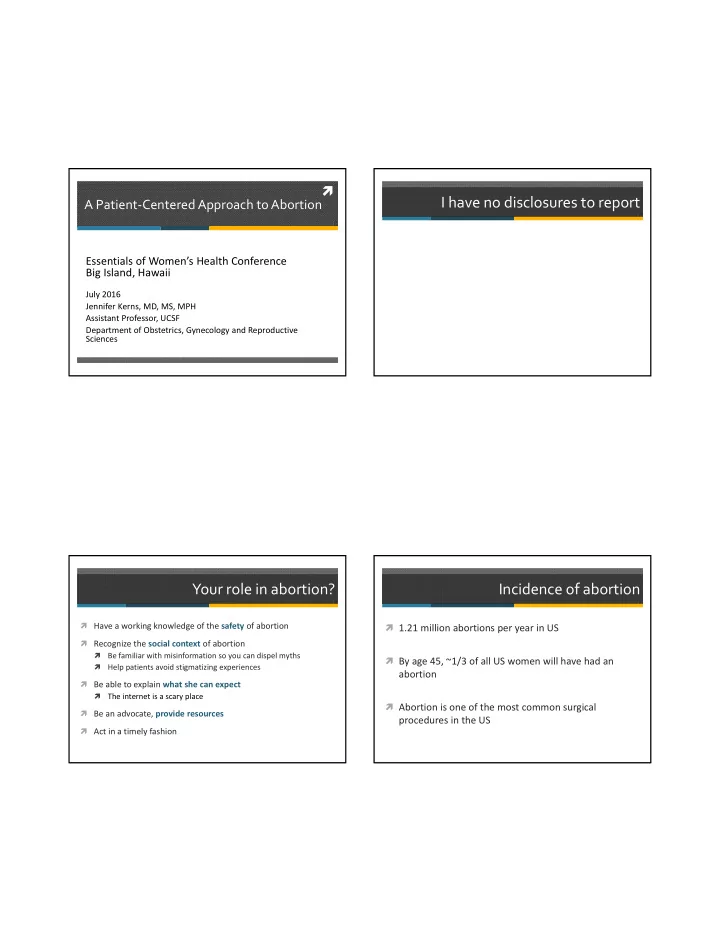
 A Patient‐Centered Approach to Abortion

Essentials of Women’s Health Conference Big Island, Hawaii

July 2016 Jennifer Kerns, MD, MS, MPH Assistant Professor, UCSF Department of Obstetrics, Gynecology and Reproductive Sciences

I have no disclosures to report Your role in abortion?

 Have a working knowledge of the safety of abortion  Recognize the social context of abortion

Be familiar with misinformation so you can dispel myths

Help patients avoid stigmatizing experiences  Be able to explain what she can expect

The internet is a scary place  Be an advocate, provide resources  Act in a timely fashion

Incidence of abortion

 1.21 million abortions per year in US  By age 45, ~1/3 of all US women will have had an

abortion

 Abortion is one of the most common surgical

procedures in the US

slide-2
SLIDE 2

Pregnancies in the US: ~6.4 million/ year

51% 49% 0% 20% 40% 60% 80% 100%

Finer 2011 Contraception

intended unintended

Pregnancies in the US: ~6.4 million/year

51% 49% 0% 20% 40% 60% 80% 100%

Finer 2011 Contraception

½ used birth control

intended unintended

Outcomes of unintended pregnancies:

~ 3.1 million/ year

48% 52% 0% 20% 40% 60% 80% 100% Abortions Births

Finer, 2011 Contraception

% of unintended pregnancies (excluding miscarriages)

Abortions by gestational age

17% 63% 9% 1% 3% 7% 0% 20% 40% 60% 80% 100% <9 9–10 11–12 13–15 16–20 21+

Henshaw adjustments to Strauss et al., 2007 (2004 data)

% of abortions Weeks gestation

slide-3
SLIDE 3

88% 11% 1% 1st Trimester 13-20 Weeks 21+ Weeks

Abortions by gestational age

How safe is abortion? Is it more or less safe than

 Colonoscopy

1/3,333 – 1/33,333

 Penicillin

1/50,000

 Pregnancy

1/8,474

 Being a pedestrian

1/47,273

 As a motorcycle rider

1/89,562

 As an occupant of a pickup truck or van

1/67,182

 Surgical abortion:

1/142,857

And so… Well, weighing risks… it’s personal

slide-4
SLIDE 4

Deaths from abortions after legalization

Number of abortion-related deaths 20 40 60 80 100 120 140 160 180 200 1965 1969 1973 1977 1981 1985 1989 1993 1997 1970: Abortion laws liberalized in 15 states* Roe v. Wade,

  • Jan. 22, 1973

CDC Abortion surveillance

Abortion safety, by gestational age

0.2 0.1 0.4 8.9 3.4 1.7 0.6 2 4 6 8 10 <9 9–10 11–12 13–15 16–20 21+ All abs.

Deaths per 100,000 abortions

Grimes DA, 2006 Bartlett et al., 2004 (1988–1997 data)

Weeks gestation

Causes of abortion‐related deaths

16% 15% 17% 27% 24% 0% 20% 40% 60% 80% 100% Infection Hemorrhage Embolism Anesthesia Other

% of abortion deaths (on average, 8 per year)

Bartlett et al., 2004 (1988–1997 data)

Long‐term safety of abortion

 Abortion does not cause

 Infertility  Ectopic pregnancy  Miscarriage  Breast cancer  Negative mental health outcomes

Boonstra 2006 Steinberg 2012 Melbye 1997

slide-5
SLIDE 5

Who has abortions: economic status

27% <100% of poverty

25%

≥300% of poverty 18% 200–299%

  • f poverty

31% 100–199%

  • f poverty

Jones, 2002

Who has abortions: race/ethnicity

41% White 20% Hispanic 6% Asian/PI 1% Native American 32% Black

Who has abortions: religious identification

27% Catholic 43% Protestant 8% Other 22% None

Who has abortions: prior pregnancies

12% Previous abortion 36% Previous abortion and previous birth 25% Previous birth 27% None

slide-6
SLIDE 6

Methods of induced abortion

1st trimester

(5‐14 weeks)

2nd trimester

(14‐24 weeks)

Surgical

Dilation & curettage (D&C) –Manual suction –Electric suction Dilation and evacuation (D&E) –Standard D&E –Intact D&E

Medical

Medication –Misoprostol + Mifepristone –Misoprostol only Labor induction –Misoprostol +/‐ Mifepristone

Abortion: evidence-based practices

 Antibiotic prophylaxis

 High risk women: RR 0.50, NNT 10  Low risk women: RR 0.64, NNT 35

 Pain control  Vasopressin in paracervical block to reduce bleeding  Immediate contraception  Cervical preparation

Sawaya 1996 Stubblefield 2004 Kapp 2012

1st trimester surgical abortion: uterine aspiration

 Pelvic exam, GC/CT culture, betadine prep  Anesthesia

 IV or PO or SL and/or paracervical block

 Cervical dilation if needed  Aspiration of uterine contents

 manual or electric

 Visual examination of products of conception  Observation, antibiotics, Rhogam prn  Home with contraception

Manual and electric aspirators

Manual uterine aspirator Electric vacuum

slide-7
SLIDE 7

Manual uterine aspiration (MUA): key points

 Safety and efficacy same as

electric

 Quiet  Low‐tech/ low‐resource

 Simple  Portable  Low‐cost  Small

Medical abortion agents

Mifepristone

(RU‐486, Mifeprex)

 Anti‐progesterone  Necrotizes decidua,

softens cervix, increases sensitivity to prostaglandins

Misoprostol

(Cytotec)

 Prostaglandin E1 analog  Uterine contractions

+

1st trimester medication abortion regimen

Evidence‐based & FDA regimen

Mife dose 200 mg Miso dose/ route 800 mcg vaginally or buccally (at home) Miso timing 6‐72 hrs after Mife (FDA 24‐48 hrs after) GA 10 weeks Efficacy 96%‐99% 93% complete in 4 hrs

Medication abortion

 High efficacy (92 – 99.5%)  Extremely safe

 Infection risk 13/100,000  Risk of death 1/100,000

 Counseling is critical

 Bleeding  Pain  Passage of POCs

 Follow up 1‐2 weeks

 Description of cramping/ bleeding  Ultrasound to confirm no sac

slide-8
SLIDE 8

Cervical preparation for 2nd trimester surgical abortion

 Misoprostol  Manual dilators (Pratt)

 at time of procedure

 Osmotic Dilators

 Laminaria or Dilapan  1‐15 dilators placed  Expand and create radial pressure  Left in cervix for 6 – 48hrs

2nd trimester surgical abortion: D&E

 History, exam, STI screening  Cervical dilation (1.5 or 2 cm) with osmotic dilators  IV sedation  Evacuation of fluid with suction  Evacuation of fetus with forceps  Ultrasound guidance  Inspection of POCs  Recovery, antibiotics, Rhogam  Contraception

Dilation & extraction (D&X, or intact D&E)

 “Partial‐Birth Abortion” coined by anti‐abortion groups

through focus groups

 Led to Federal Abortion Ban in 2008  Risk mgmt, feticidal injections, cessation of services

 Goal to minimize uterine instrumentation and deliver

an intact fetus

 Cervical dilation usually requires 2 days  No evidence of increased risk

Standard D&E Induction

Anesthesia Local + IV sedation IV narcotics, regional

Duration 1‐3 days 6‐11 hours (mife + miso)

Location Outpatient Inpatient (L&D, wards)

Cost $3530 ($1K ‐ $5K) $5029 ($3K ‐ $9K)

Contact Usually none Patient’s decision with fetus

Providers Specialized training No extra training

Fetal autopsy Less accurate? More accurate

Involvement

patient < provider

patient > provider

slide-9
SLIDE 9

Case 1: Josie Rosie

 32yo para 1 comes into your office complaining of lower

abdominal pain. She has her 5yo son with her.

 You order a UPT (because you always order a UPT).  It’s positive!

Congratulations! Is this news surprising? Is this something you were hoping for?

Options counseling for Josie Rosie

 How to start the conversation:

“We are happy to take care of you no matter what you decide.”  Normalize unintended pregnancy. Because it’s normal.  Options… abortion, continuation, adoption

“Would you like to hear about these options now?”  Follow up with the patient if she needs time to think  You talk to her a week later and she tells you she’s decided on

abortion because her 5yo son has autism and she wants to be able to care for him.

Reasons given for abortion

Concern for/ responsibility to other individuals……………………………74% Cannot afford a baby now…………………………………………………………….73% Would interfere w/school, job, ability to care for others…..............69% Would be a single parent/ having relationship problems………………48% Has completed childbearing…………………………………………………………38%

Finer et al., 2005 (2004 data)

Josie Rosie’s 1st trimester abortion

 Know your local

abortion providers

 Help connect her –

don’t make her do the research

http://prochoice.org/think‐youre‐pregnant/find‐a‐provider/

slide-10
SLIDE 10

Abortion training ObGyn residency programs

Josie Rosie’s 1st trimester abortion

 Know your local abortion providers  Give anticipatory guidance about the procedure

(aspiration vs medical)

 Know the local restrictions

 Tell her about what she can expect (24 hr waiting period?

Parental consent? Mandatory ultrasound?)

 Guttmacher Institute website for all state‐level restrictions

 Follow up with the patient to ensure she made an appt

 Assist with any barriers in getting an appt

What happens if Josie can’t get the abortion she wants

 Women denied an abortion are:

More likely to be in poverty

More likely to stay tethered to abusive partners

More likely to experience anxiety afterwards

Disproportionate effects of restrictions

slide-11
SLIDE 11

Structural barriers to abortion access

 Mandatory waiting period (24‐hr, 48‐hr)  Parental consent or notification  Mandatory ultrasound  Mandatory counseling  Gestational age restrictions  Medicaid funding  Restricting insurance coverage  Abortion reporting requirements  Refusal to provide contraceptive

services

 Crisis pregnancy centers

Guttmacher Institute

Access to abortion

 35% of US women have no abortion provider in their

county

 Half of all ob‐gyn residencies routinely offer abortion

training

Most graduated ob/gyns don’t offer abortions  60% of D&E patients couldn’t obtain an early abortion

  • Transportation
  • Raising funds
  • Finding a provider
  • Obesity
  • Substance abuse

Foster 2008 Contraception Allen 2004 Contraception Eastwood 2006 Obstet Gynecol

Reasons for abortions after 16 weeks

Woman did not realize she was pregnant 71% Difficulty making arrangements for abortion 48% Afraid to tell parents or partner 33% Needed time to make decision 24% Hoped relationship would change 8% Pressure not to have abortion 8% Something changed during pregnancy 6% Didn’t know timing was important 6% Didn’t know she could get an abortion 5% Fetal abnormality diagnosed late 2% Other 11%

Torres and Forrest, 1988

Josie Rosie’s follow‐up

 Medically, there is usually no need for a f/u appt  But… some patients may want to be seen

 Reassurance  Normalization  Contraception  Support

 backline: https://www.yourbackline.org/

slide-12
SLIDE 12

Pro‐choice is just patient‐centered care

 Practice this in all aspects of care around abortion  Contraceptive counseling  Abortion method (surgical vs medical in 1st or 2nd trimester)  Presentation of risks

Encourage and invite patients to determine their own threshold for risk tolerance

We provide the information… they decide!

Last thoughts

 Be an advocate and be vocal – we can help prevent unintended

pregnancies with contraception, but we can also help decrease abortion stigma

 Abortion is safe and common and is experienced by women of

all walks of life. Be prepared to talk about it with your patients!

 Trust women – practice patient‐centered care with abortion Innovating Education in Reproductive Health (IERH) Video courses

http://innovating‐education.org/

Finding an Abortion Provider

http://prochoice.org/think‐youre‐ pregnant/find‐a‐provider/