Contraception and I have no disclosures to report depression - - PowerPoint PPT Presentation

contraception and
SMART_READER_LITE
LIVE PREVIEW

Contraception and I have no disclosures to report depression - - PowerPoint PPT Presentation

10/18/2017 Disclosures Contraception and I have no disclosures to report depression Jennifer Kerns , MD, MS, MPH Associate Professor UCSF, Division of ZSFG October 18, 2017 What do depression and What is the percentage of US women 15-44


slide-1
SLIDE 1

10/18/2017 1

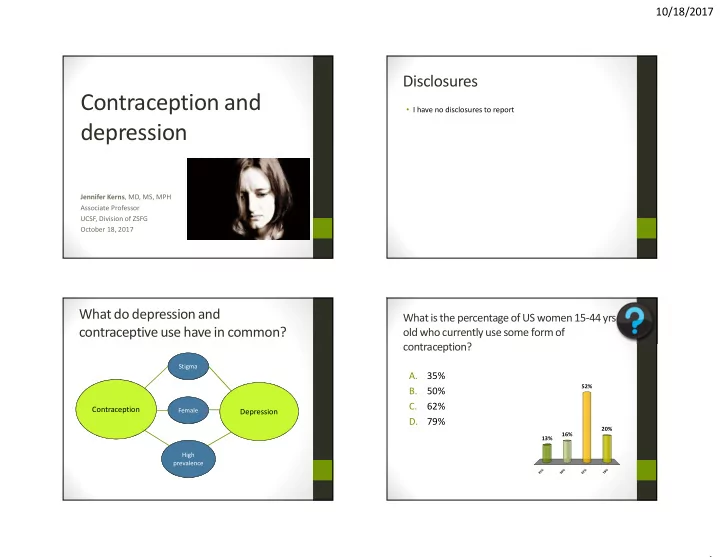
Contraception and depression

Jennifer Kerns, MD, MS, MPH Associate Professor UCSF, Division of ZSFG October 18, 2017

Disclosures

  • I have no disclosures to report

What do depression and contraceptive use have in common?

Contraception Depression

Stigma High prevalence Female

A. 35% B. 50% C. 62% D. 79%

What is the percentage of US women 15-44 yrs

  • ld who currently use some form of

contraception?

3 5 % 5 % 6 2 % 7 9 %

13% 20% 52% 16%

slide-2
SLIDE 2

10/18/2017 2

Prevalence of any contraceptive use, 2011-2013

CDC/NCHS 2011-2013

A. Pill… female sterilization… male condom B. Male condom… pill… IUDs and implants C. Female sterilization… male condom… pill D. IUDs and implants… pill… male condom

What methods of contraception are most commonly used to least commonly used among women in the US?

Pill… female sterilization... Male condom… pill… IUD... Female sterilization… ma.. IUDs and implants… pill...

43% 6% 8% 42%

Method mix Who is most likely to use which method?

Pill …

  • higher education
  • older age
  • white

Female sterilization…

  • lower education
  • older age
  • Hispanic
  • non-Hispanic black

IUDs and implants…

  • Hispanic >white>black
  • 25-34 age group
slide-3
SLIDE 3

10/18/2017 3

Epidemiology of major depressive disorder

  • Lifetime prevalence (10 countries)

~ 3% to 17%

  • Annual prevalence rate US 6.7%
  • Lifetime prevalence rate US 16.5%
  • Women (2x as high as men)
  • Younger adults
  • Frequently undetected in the absence
  • f screening
  • ~ 10% to 47% of cases undetected

Andrade et al. Int J Methods Psychiatr Res 2003 Kessler et al. Arch Gen Psychiatry 2005 Pignone et al. Ann Intern Med 2002

RISK FACTORS

  • Prior depressive episode
  • Family history
  • Female gender
  • Childbirth
  • Childhood trauma
  • Stressful life events
  • Poor social support
  • Serious medical illness
  • Dementia
  • Substance abuse

0% 2% 4% 6% 8% 1991/1992 2001/2002 POINT PREVALENCE in US

Depression: diagnosis and natural history

  • Untreated depression
  • Poorer quality of life
  • Increased risk of suicide
  • Poorer outcomes when co-
  • ccurring w/ medical conditions
  • Few patients discuss depressive

symptoms – more often present w/ somatic symptoms

  • Estimated 50% of patients w/

major depression are identified

DMS-5, Major Depression Tylee and Gandhi. Prim Care Companion J Clin Psychiatry 2005 Simon et al. NEJM 1999 Mitchell et al. Lancet 2009

 5 symptoms  present most of the day  nearly every day  at least 2 weeks

  • Depressed mood*
  • Loss of interest or pleasure in most
  • r all activities*
  • Insomnia or hypersomnia
  • Change in appetite or weight
  • Psychomotor retardation or agitation
  • Low energy
  • Poor concentration
  • Thoughts of worthlessness or guilt
  • Recurrent thoughts about death or

suicide

Hormones and depression

  • Over-production of corticotropin releasing

hormone excess activity of HPA axis

  • Higher concentration of inflammatory

markers

  • Abnormal functioning of neurotransmitters

(serotonin, norepi, dopamine, GABA, glutamate)

  • Estrogen modulates serotonergic function
  • Progestins with low androgenicity may be

more favorable with mood symptoms

Joffe et al. Biol Psychiatry 1998 Schaffir et al. Eur J Contraception Reprod Health Care 2016

Etiology of depression

Wittenborn et al. Psychological Medicine 2015
slide-4
SLIDE 4

10/18/2017 4

Depression in pregnancy

  • Prevalence of unipolar depression in pregnancy is

7% (12% including major or minor)

  • Genetic susceptibility, hormonal changes,

psychological and social factors

  • Risk factors include unintended or unwanted

pregnancy

  • Associated w/ adverse pregnancy and neonatal
  • utcomes

Gregoriadis et al. J Clin Psychiatry 2013

  • Pearlstein. Best Pract Res Clin Obstet Gynaecol 2015

A. Systematic reviews & meta-analyses B. Prospective cohort studies using large registry-based database studies C. Meta-analyses & randomized controlled trials (RCTs) D. Prospective observational studies & RCTs E. All studies with a control group

Which types of studies yield the highest level of evidence?

(choose the best answer)

S y s t e m a t i c r e v i e w s & m e . . . P r

  • s

p e c t i v e c

  • h
  • r

t s t u d i . . M e t a

  • a

n a l y s e s & r a n d

  • m

. . . P r

  • s

p e c t i v e

  • b

s e r v a t i

  • n

a . . . A l l s t u d i e s w i t h a c

  • n

t r

  • l

. . .

9% 7% 11% 17% 56%

How can we assess causal association?

Bradford Hill criteria

  • Strength (effect size)
  • Consistency (reproducibility)
  • Specificity
  • Temporality
  • Biological gradient
  • Plausibility
  • Coherence
  • Experiment
  • Analogy

Hill et al. Proc R Soc Med 1965

Systematic review of CHC and depression

  • Included studies w/ estrogen-progestin method
  • Studies had to measure mood, affect, or diagnosis of

depression

  • Very few RCTs or prospective studies
  • Heterogeneity of mood measurement and HC formulations

Schaffir et al. Eur J Contraception Reprod Health Care 2016

Standardized screening tools Self-report Interview Mood changes, non standardized Ethinyl estradiol dose Progestin type and dose Consistency of dose (mono vs triphasic) Administration (transdermal, oral, vaginal)

slide-5
SLIDE 5

10/18/2017 5

Studies of HC and depression

  • 1 RCT: LNG-only pill vs. LNG/EE pill vs. placebo
  • Lowest incidence of depression in LNG-only group
  • No difference in depression by 3 months across groups
  • 4 large retrospective observational studies (3 HC, 1 COC)
  • 3 showed no association between HC and depression
  • 1 showed lower depression among HC users
  • 7 other observational studies – no difference or HC is protective
  • 1 pilot study (n=58) showed higher depression scores among COC

users

Toffol et al. Hum Reprod 2011 Toffol et al. Contraception 2012 Oddens et al. Contraception 1999 Graham et al. Contraception 1995 Keyes et al. Am J Epidemiol 2013 Oinonen et al. J Psychosom Res 2001 Duke et al. Contraception 2007 Svendal et al. J Affect Disord 2012 Berenson et al. AJOG 2008 Marriott et al. J Psychosom Res 1986 Natale et al. Biol Rhythm Res 2006 Almagor et al. J Psychosom Res 1991 Kulkarni et al. Aust Fam Physician 2005

Dose and dose consistency – do they matter?

  • Older studies (when EE doses were higher) reported a

greater prevalence of depression

  • Inconsistent results from more recent studies
  • RCT of 20 vs 30 mcg EE  higher depr w/ lower dose
  • RCT of 25 vs 35 mcg EE (+ norgestimate), triphasic
  • No difference in depression
  • Improved premenstrual sx’s w/ 25 mcg pill
  • Triphasic vs monophasic pills  more mood changes
  • Changing dose, not total progestin that matters
  • Also fewer symptoms w/ continuous use

Akerlund et al. Br J Obstet Gynaecol 1993 Warner et al. J Psychosom Res 1988 Greco et al. Contraception 2007 Bancroft et al. J Psychosom Res 1993 Walker et al. Psychosom Med 1990

Does route of administration matter (pill, patch ring)?

  • Vaginal ring vs COCs  fewer depressive symptoms
  • RCT of patch users vs desogestrel pill
  • Patch associated with higher emotional well being
  • Prospective observational study patch vs LNG pill (teens)
  • No difference in mood
  • RCT of patch vs ring
  • No difference in mood swings

Sabatini et al. Contraception 2006 Sucato et al. J Pediatric Adolesc Gynecol 2011 Lopez et al. Cochrane Database Syst Rev 2013 Creinin et al. Obstet Gynecol 2008 Urdl et al. Eur J Obstet Gynecol Reprod Biol 2005

What about type of progestin?

  • RCT comparing desogestrel vs LNG pills
  • More positive affect changes w/ desogestrel
  • Observational study of gestodene COC vs other COC
  • Switchers  improved depression & mood
  • 2 RCTs of drospirenone COC vs LNG COC
  • Improved mood and affect in drospirenone group
  • Observational studies of drospirenone  improved mood

Shahnazi et al. Iran Red Crescent Med J 2014 Borenstein et al. J Reprod Med 2003 Deijen et al. Contraception 1992 Skrzypulec et al. Eur J Contracept Reprod Health Care 2008 Kelly et al. Clin Drug Investig 2010 Zimmerman et al. Contraception 2015 Sangthawan et al. Contraception 2005

slide-6
SLIDE 6

10/18/2017 6

Adolescents and older women

  • Prospective observational study in Sweden (N=1250)
  • Any HC use associated w/ lower depression scores
  • Prospective observational study of CHC starters
  • Mood initially decreased, then improved compared to baseline

after achieving stable, long term use

  • Adolescents rx’ed COCs for dysmenorrhea had no

difference in depression

  • 2 studies of older women starting COCs
  • 1 found equal proportion of women with mood changes
  • 1 found depression decreased by half over the 1 yr long study

Kristjandottir et al. Eur J Contracept Reprod Health 2013 Joffe et al. AJOG 2003 Ott et al. Arch Sex Behav 2008 Trossarelli et al. Contraception 2005 O’Connell et al. Contraception 2007

Women with existing depression

  • Conflicting results
  • 1 study: history of adverse mood changes w/ COCs is

predictive of an underlying mood disorder

  • Other studies: women w/ depression experience

improvement in depressive symptoms with use of HC

Joffe et al. AJOG 2003 Young et al. Psychoneuroendocrinology 2007 Segebladh et al. Contraception 2009 Ernst et al. Eur J Contracept Reprod Health Care 2002 Stidham Hall et al. Contraception 2012 Huber et al. Clin Drug Investig 2008

Depo medroxyprogesterone (DMPA), IUDs, implants

  • No increase in hospitalizations among women w/ BPD

using DMPA, sterilization or IUDs

  • LNG-IUDs and depo not assoc w/ worse clinical outcomes

in depressed women

Pagano et al. Contraception 2016 Toffol et al. Contraception 2012 Elovainioet al. Int J Behav Med 2007

  • The. Study.
  • Danish Sex Hormone Register Study – ongoing cohort study of

all women living in Denmark

  • Women ages 15-34 yrs, 2000-2013
  • Excluded all women w/ depression, cancer, infertility, DVT
  • Exposure: prescribed and redeemed antidepressant med
  • Reference group: non-users (former and never HC users)
  • Outcome: redeemed rx; first discharge diagnosis
  • Covariates: age, education, PCOS, endometriosis, BMI (if

formerly pregnant)

  • Censored during pregnancy and 6 months after delivery

Skovlund et al. JAMA Psychiatry 2016

slide-7
SLIDE 7

10/18/2017 7

National register study

  • > 1 million women (6.8 million person-years observation)
  • Mean age = 24.4 yrs (LNG-IUS users older)
  • Mean f/u = 6.4 yrs
  • Women using DMPA, implants, and 50 mcg EE pills more likely

to have low education

  • Any COC

RR = 1.2 (1.22 – 1.25)

  • Progestin-only use

RR = 1.3 (1.27 – 1.40)

  • Patch

RR = 2.0 (1.76 – 2.18)

  • Vaginal ring

RR = 1.6 (1.55 – 1.69)

Skovlund et al. JAMA Psychiatry 2016

Crude incidence 1st use anti-depressant: 2.2/100 PY’s Hospital diagnosis: 0.3/100 PY’s

HC and depression, by age and contraception method

Skovlund et al. JAMA Psychiatry 2016

Effect among adolescents

1st use antidepressants RR (95% CI) Diagnosis of depression RR (95% CI) All COCs 1.8 (1.75 – 1.84) 1.7 (1.63 – 1.81) Varying progestin 1.4 - 2.2 1.5 – 2.0 POPs 2.2 (1.99 – 2.52) 1.9 (1.49 – 2.53) Patch 3.1 (2.56 – 3.71) 2.8 (1.86 – 4.23) Ring 2.9 (2.60 – 3.16) 2.7 (2.18 – 3.38) LNG-IUS 3.1 (2.47 – 3.84) 3.2 (2.08 – 5.03) *Adjusted for age, calendar year, educational level, endometriosis, PCOS

Critique of the study

  • Outcome ascertainment – rx and redemption
  • Outcome was not depression, not uniformly assessed
  • Adjustment for confounders
  • Onset of menarche
  • Genetic predisposition
  • Administrative database studies
  • Not designed for epidemiologic research
  • Journals love them  narrow CIs and small p-values
  • Yield excellent precision, but not necessarily validity
  • RR < 2 likely due to bias in cohort studies
  • Damage from false alarms

Karina and Sivakumaran.JAMA Psychiatry 2015 Grimes et al. Hum Reprod 2015

slide-8
SLIDE 8

10/18/2017 8

What to do now?

  • Treat your patient as a person
  • Patient-centered counseling – talk about it!
  • Screen for depression
  • Ask about past experiences w/ contraception
  • Counseling for women w/ depression
  • Might get better, might get worse
  • Counseling around progestin choice
  • If unfavorable mood symptoms, switch the progestin
  • Do not withhold and counsel against contraception

Thank you!

Remember if you ever have questions about contraception… Call the family planning pager! (415) 443-6318 Or contact any of the Family Planning Fellows:

Sanithia Williams, 2nd year fellow Shokofeh Dianat, 1st year fellow Elissa Serapio, 1st year fellow …and Katie Brown & Chantal Lunderville (pre-fellows, coming in July 2018)

(Or any of the FP attendings) jennifer.kerns@ucsf.edu

Progestins

  • First generation
  • Norethindrone acetate
  • Ethynodiol diacetate
  • Lynestrenol
  • Norethynodrel
  • Second generation
  • Levonorgestrel
  • di-Norgestrel
  • Third generation
  • Desogestrel
  • Gestodene
  • Norgestimate
  • Unclassifed
  • Drospirenone
  • Cyproterone acetate