Outline Diagnosis and assessment Lupus for the Internist: - - PDF document

outline
SMART_READER_LITE
LIVE PREVIEW

Outline Diagnosis and assessment Lupus for the Internist: - - PDF document

5/26/16 Outline Diagnosis and assessment Lupus for the Internist: Contraception Advances in Internal Medicine 2016 Cardiovascular disease Vaccinations and infectious complications Sarah Goglin, MD Advances in treatment


slide-1
SLIDE 1

5/26/16 1

Lupus for the Internist: Advances in Internal Medicine 2016

Sarah Goglin, MD Assistant Professor of Medicine University of California, San Francisco

Outline

  • Diagnosis and assessment
  • Contraception
  • Cardiovascular disease
  • Vaccinations and infectious complications
  • Advances in treatment

What is SLE?

  • Autoimmune disease characterized by the

production of autoantibodies

  • Involvement of multiple organ systems
  • Heterogeneous disease pattern
  • Characterized by flares and periods of

quiescence

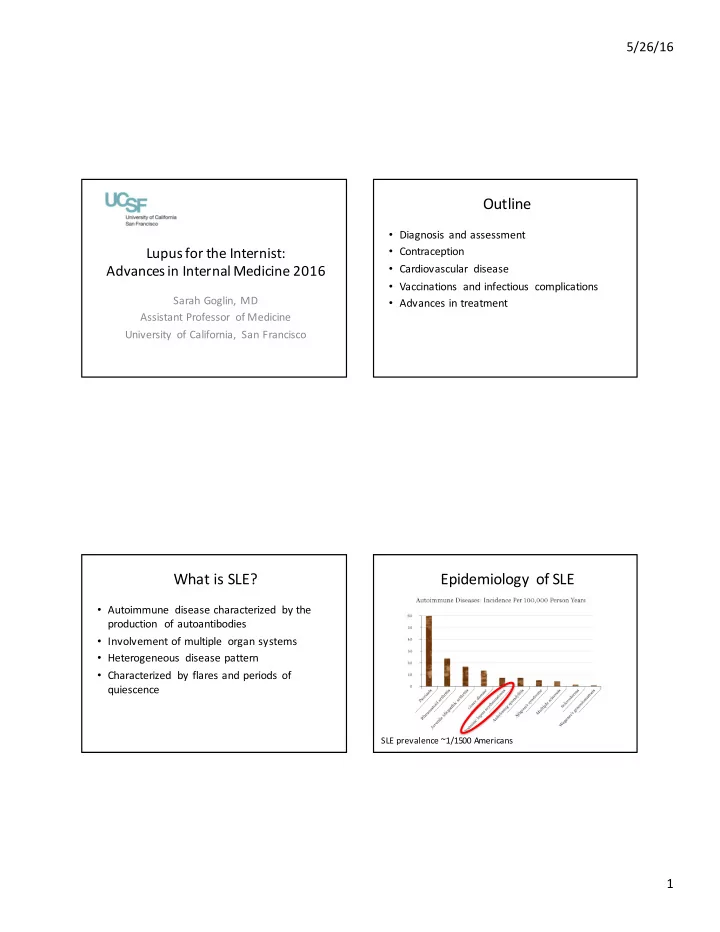
Epidemiology of SLE

SLE prevalence ~1/1500 Americans

slide-2
SLIDE 2

5/26/16 2

Diagnosis and Assessment Case

  • 27 year old woman

presents with two months

  • f erythematous rash on

hands and joint pain

  • Labs reveal mild

lymphopenia, normal CRP, and elevated ESR

  • ANA >1:640 speckled

pattern

  • C3 and C4 low

Choosing Wisely – ABIM/ACR

Yazdany, J. Arthritis Care & Research. 2013 March; 65(3): 329–339.

1997 ACR Classification Criteria

  • Malar rash
  • Discoid rash
  • Photosensitivity
  • Oral ulcers
  • Arthritis
  • Serositis
  • Renal disorder
  • Neurologic disorder
  • Hematologic disorder: hemolytic anemia, leukopenia,

lymphopenia, or thrombocytopenia

  • Immunologic disorder: anti-dsDNA, anti-Sm, ACL IgG/IgM
  • Anti-nuclear antibodies

Mucocutaneous Internal organ Lab

slide-3
SLIDE 3

5/26/16 3

  • 1. Malar Rash
  • 1. Malar Rash
  • 2. Discoid Rash
  • 2. Discoid Rash
slide-4
SLIDE 4

5/26/16 4

  • 3. Photosensitivity
  • 3. Photosensitivity
  • 4. Oral Ulcers
  • 5. Arthritis
slide-5
SLIDE 5

5/26/16 5

  • 6. Serositis
  • 7. Renal Disorder
  • 8. Neurological Disorder
  • 9. Hematologic disorder
  • Hemolytic anemia
  • Leukopenia (<4K)
  • Lymphopenia (<1.5K)
  • Thrombocytopenia

(<100K)

slide-6
SLIDE 6

5/26/16 6

  • 10. Immunologic
  • Anti-phospholipid antibody
  • Anti-dsDNA
  • Anti-Sm
  • (False + test for syphilis)
  • 11. Positive ANA

False positive rate in healthy controls: 3% (ANA 1:320) to 30% (ANA 1:40)

Case

  • You refer your patient to rheumatology for a

new diagnosis of lupus based on positive ANA, dsDNA, hypocomplementemia, leukopenia, specific lupus rash, and arthritis

  • What other tests are critical in triaging this

patient?

Lupus Nephritis

  • ~30% of patients with SLE have evidence of

nephritis at time of diagnosis

  • Overall, prevalence of lupus nephritis is ~50-

60% in first ten years after diagnosis

  • Screen for renal involvement in ALL patients

with lupus at time of diagnosis and in follow up with urinalysis and urine protein and urine creatinine (spot is fine)

Hahn, B. Arthritis Care & Research. 2012 June; 64(6): 797-808.

slide-7
SLIDE 7

5/26/16 7

Case

  • Her urinalysis reveals 1+ protein, 5-10 RBCs

and spot UPCR is 0.7 g/g

  • Does she need further work up for these

findings?

Lupus Nephritis

  • Indications for renal biopsy

– Increasing serum Cr – Proteinuria ≥1.0 g per 24h – Proteinuria ≥0.5 g per 24h plus hematuria – Proteinuria ≥0.5 g per 24h plus cellular casts

Hahn, B. Arthritis Care & Research. 2012 June; 64(6): 797-808.

Case

  • Y
  • ur patient is diagnosed with focal proliferative

(class III) lupus nephritis and is started on Cellcept, prednisone, and hydroxychloroquine

  • 6 months later, routine labs reveal a white blood

cell count of 1.9K

  • Y
  • u advise her to:
  • A. Stop Cellcept and recheck labs in 1-2 weeks
  • B. Increase prednisone to 20 mg
  • C. Stop hydroxychloroquine
  • D. Get blood cultures drawn

Lupus Flare versus Infection

Lupus Flare Infection Leukopenia, thrombocytopenia Leukocytosis, thrombocytosis Normothermic Fever, shaking chills Elevated ESR, normal CRP Elevated ESR and elevatedCRP Decreased C3 and C4 Unchanged C3 and C4 from prior Increased dsDNA Unchanged dsDNA from prior Specific signs of lupus activity (e.g. arthritis, rash) Localizing signs of infection

slide-8
SLIDE 8

5/26/16 8

Case

  • She is feeling well, with no evidence of

infection or lupus activity. Her dsDNA and C3 levels are unchanged and platelet count and hematocrit are normal.

Side Effects of SLE Treatments

Medication Side Effects Steroids T

  • o numerous to list

Hydroxychloroquine Retinal damage Methotrexate Liver damage, bone marrow suppression, infection Azathioprine Bone marrow suppression, infection Mycophenolate Bone marrow suppression, infection Cyclophosphamide Bone marrow suppression, infection Belimumab Infection, GI

Case

  • You advise her to:
  • A. Stop Cellcept and recheck labs in 1-2 weeks
  • B. Increase prednisone to 20 mg
  • C. Stop hydroxychloroquine
  • D. Get blood cultures drawn

Contraception

slide-9
SLIDE 9

5/26/16 9

Case

  • She returns to you for follow up and is not

using contraception. She is sexually active with her husband. She asks you what you recommend for contraception.

  • You recommend:
  • A. Nuva-ring
  • B. IUD
  • C. Depo Provera
  • D. Need more information

Contraception and Lupus

  • Fertility is preserved!
  • Many of our patients are on teratogenic

medications (Cellcept, ace inhibitors, etc)

  • Patients with active SLE or significant end
  • rgan damage (e.g. CKD) are at increased risk

for adverse outcomes during pregnancy

  • Appropriate counseling about contraceptive

methods is critical

Buyon J. Ann Intern Med. 2015;163(3):153-16 3. Tedeschi S. Clin Rheumatol. 2016 May 11. [Epub ahead of print]

Contraception and Lupus Contraception and Lupus

  • Antiphospholipid antibody status

– APL antibodies include lupus anticoagulant, anti- cardiolipin IgG and IgM, and anti-beta-2 glycoprotein I IgG and IgM – APL positivity is a contraindication to estrogen- containing methods, regardless of whether patient has had previous thrombosis – Progestin-only or non-hormonal methods are recommended

  • Effects on bone density

– Concern about Depo Provera, especially in patients with chronic steroid exposure

  • SammaritanoLR. Lupus. 2014 Oct;23(1

2):124 2-5.

slide-10
SLIDE 10

5/26/16 10

Case

  • You recommend:
  • A. Nuva-ring
  • B. IUD
  • C. Depo Provera
  • D. Need more information

Cardiovascular Disease Case

  • Y
  • ur patient presents to the ED with chest pain

radiating to the neck. EKG shows ST depressions in the inferolateral leads. Her troponin is elevated.

  • What is the most likely cause of her cardiac

ischemia?

  • A. Myocarditis
  • B. Coronary artery vasculitis
  • C. Pericarditis
  • D. Atherosclerotic coronary artery disease

Cardiovascular Disease and Lupus

CVD is a leading cause of mortality in patients with SLE

slide-11
SLIDE 11

5/26/16 11

Cardiovascular Disease and Lupus

  • All-cause mortality has declined in SLE has

declined over the past 20 years, but the risk of death due to CVD remains unchanged

  • Management of traditional modifiable risk

factors is important, but we do not how much this mitigates this risk

Bjornal L. J Rheumatol. 2004 Apr;31(4):713-9. ForsNieves CE. Curr RheumatolRep. 2016 Apr;18(4):21.

Cardiovascular Disease and Lupus

  • Traditional risk assessment tools

underestimate risk of CVD in lupus patients

  • Modified Framingham risk score in which item

is multiplied by 2 more accurately predicts CAD in patients with lupus

  • This may better highlight the population to

target for intensive risk factor modification; however, we don’t know if acting on this multipler risk calculation impacts outcomes

  • Urowitz. J Rheumatol. 2016 May;43(5):875-9.

Case

  • Y
  • ur patient presents to the ED with chest pain

radiating to the neck. EKG shows ST depressions in the inferolateral leads. Her troponin is elevated.

  • What is the most likely cause of her cardiac

ischemia?

  • A. Myocarditis
  • B. Coronary artery vasculitis
  • C. Pericarditis
  • D. Atherosclerotic coronary artery disease

Vaccinations and Infectious Complications

slide-12
SLIDE 12

5/26/16 12

Case

  • Your patient, who is on Cellcept, has read
  • nline that vaccines may not be safe for her to
  • get. What do you tell her?

Vaccinations and Lupus

  • Infections are a significant cause of death in

lupus patients

  • Strongly recommend annual inactivated flu

vaccine, PCV13 (Prevnar), and PPSV23 (Pneumovax) in all patients on immunosuppression, regardless of age, according to ACIP guidelines

  • Live vaccines should be avoided in patients on

immunosuppressive medications

MMWR, October 12, 2012, Vol 61, #40

Invasive Pneumococcal Disease

Meningitis 6.3% Pneumonia (NPD) 66.5% Bacteremia 19.2 % Invasive Pneumococcal Disease (IPD) 10-40% fatality

Pneumococcus and Lupus

Shea K. Open Forum Infect Dis. 2014 March.

Pneumococcal pneumonia Invasive pneumococcal disease

slide-13
SLIDE 13

5/26/16 13

New ACIP/CDC/ACP 2015 Guidelines Recommend 2 Vaccines

Case

You receive a message from your patient: “I’ve developed a painful rash and I’m worried it may be due to lupus.”

Zoster and Lupus

Murray S. PLoS One. 2016 Jan; 11(1).

Zoster and Lupus

Yun, H. Arthritis and Rheumatology. 2016 Mar 18. [Epub ahead of print]

slide-14
SLIDE 14

5/26/16 14

Advances in Treatment Case

  • Your patient asks you if you’ve heard anything

about the lupus medication she has seen commercials about on TV. She thinks it starts with a “B”.

Biologic Therapies in Lupus

Best Practice & Research Clinical Rheumatology, 29 (6), 2015, 794–809

B-cell targeted therapy

  • Belimumab
  • Rituximab
  • Multiple other drugs in various phases of

investigation

slide-15
SLIDE 15

5/26/16 15

Belimumab for the Treatment of Lupus

  • Belimumab is the first

medication approved for the treatment of lupus in 50 years

  • Effect modest and

primarily seen in mucocutaneous and joint disease

  • No role in treatment of
  • rgan-threatening lupus
  • Main side effects are GI

and infection

Furie, R. Arthritis and Rheumatism. 2011 Dec; 63(12): 3918-3330. Navarra, S. Lancet. 2011 Feb; 377(9767): 721-731..

Rituximab for the Treatment of Lupus

  • Two RCT

s in patients with moderate to severe lupus (EXPLORER) and patients with class III/I lupus nephritis (LUNAR) did not meet their primary endpoints

  • However, there were significant issues with trial

design, populations recruited, choice of endpoints, etc.

  • Many centers, including ours, have had good

success in using rituximab off-label in patients with refractory lupus nephritis

Merrill, J. Arthritis and Rheumatism. 2010 Jan; 62(1): 222-233. Rovin, B. Arthritis and Rheumatism. 2012 Apr; 64(4): 1215-1226.

Targeting Interferon in Lupus Summary

  • Check ANA and subserologies only in appropriate clinic setting, not

for diffuse pain or fatigue without other objective clinical evidence

  • f disease
  • Screen for lupus nephritis in all patients at diagnosis and in follow

up with UA and UPCR

  • Contraception is critical – remember APL and bone density

considerations

  • Most common side effects of many medications used to treat SLE

are bone marrow suppression and infection

  • Cardiovascular disease is a leading cause of mortality in SLE patient

s

  • Vaccinate SLE patients against S. pneumoniae with both PCV13 and

PPSV23

  • Zoster incidence appears to rising, prevention currently limited by

ability to administer live vaccine to our patients