Randomized comparison of an ultrathin strut cobalt-chromium - - PowerPoint PPT Presentation

randomized comparison of an ultrathin strut cobalt
SMART_READER_LITE
LIVE PREVIEW

Randomized comparison of an ultrathin strut cobalt-chromium - - PowerPoint PPT Presentation

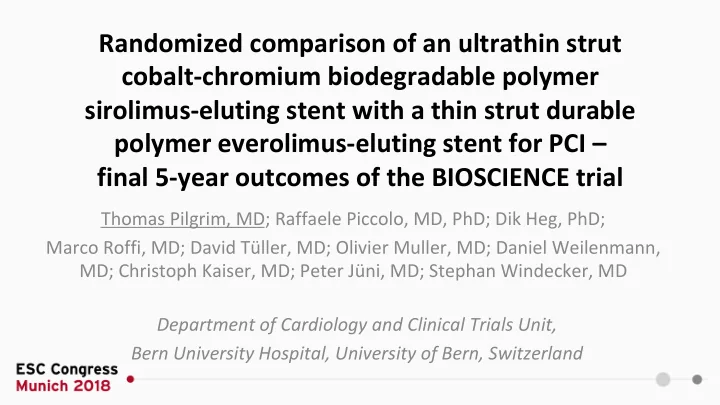
Randomized comparison of an ultrathin strut cobalt-chromium biodegradable polymer sirolimus-eluting stent with a thin strut durable polymer everolimus-eluting stent for PCI final 5-year outcomes of the BIOSCIENCE trial Thomas Pilgrim, MD;


slide-1
SLIDE 1

Randomized comparison of an ultrathin strut cobalt-chromium biodegradable polymer sirolimus-eluting stent with a thin strut durable polymer everolimus-eluting stent for PCI – final 5-year outcomes of the BIOSCIENCE trial

Thomas Pilgrim, MD; Raffaele Piccolo, MD, PhD; Dik Heg, PhD; Marco Roffi, MD; David Tüller, MD; Olivier Muller, MD; Daniel Weilenmann, MD; Christoph Kaiser, MD; Peter Jüni, MD; Stephan Windecker, MD Department of Cardiology and Clinical Trials Unit, Bern University Hospital, University of Bern, Switzerland

slide-2
SLIDE 2

BIODEGRADABLE POLYMERS IN EARLIER GENERATION DES

Landmark Analysis for Definite Stent Thrombosis

LEADERS trial

Serruys PW et al, JACC Interv 2013

Safety benefit of BP BES vs DP SES related to reduction in very late stent thrombosis (1-5 years).

0-1 year: RR 0.99 (95% CI 0.51-1.95) 1-5 years: RR 0.26 (95% CI 0.10-0.68) p for interaction = 0.022

slide-3
SLIDE 3

BIODEGRADABLE POLYMER DRUG-ELUTING STENTS

PLATFORM POLYMER/DRUG

SS C

BIOMATRIX NOBORI DESYNE BD ULTIMASTER TIVOLI SYNERGY

C C P

112 μm 81 μm 80 μm 80 μm 74-81 μm

Biolimus A9 (15.6 μg/mm) Novolimus (65 μg/14mm) Sirolimus (3.9 μg/mm) PDLLA/PCL Sirolimus (8 μg/mm) Everolimus (113 μg/ 20 mm; 56 μg/ 20 mm) PLA PLA PLGA PLGA

ORSIRO

C

60-80 μm

Sirolimus (1.4 μg/mm2) PLLA

MISTENT

C

64 μm

Sirolimus PLGA

Time: drug relase kinetics / biodegradation of polymer

3 months 9 months *List not comprehensive

Length of the bars represents time to biodegradation of the polymer/elution of the drug; bar thickness represents polymer thickness & drug dosage, respectively.

slide-4
SLIDE 4

ULTRATHIN STRUT (≤65 μM) VERSUS THIN STRUT DES

Meta-Analysis of 10 RCTs including 11,658 patients

16% reduction in TLF (RR=0.84; 95% CI 0.72-0.99) driven by lower rate of MI (RR=0.80; 95% CI 0.65-0.99).

Bangalore S et al, Circulation 2018

slide-5
SLIDE 5

ORSIRO ‒ BP SES XIENCE ‒ DP EES

Cobalt-Chromium, L-605

PLATFORM

Cobalt-Chromium, L-605 60 μm

≤3.0 mm

POLYMER DRUG

Silicon carbide layer Biodegradable Durable Sirolimus

(1.4 μg/mm2)

Everolimus

(1.0 μg/mm2)

PLLA: poly-L-lactic acid

PBMA/PVDF-HFP

STENT PLATFORMS

80 μm 81 μm

>3.0 mm

slide-6
SLIDE 6

1056 patients allocated to DP EES (1545 lesions) 27 lost to follow up 15 refused follow-up 1014 follow up information for clinical primary endpoint available up to 5 years 909 followed up and alive

105 followed up and died

1063 patients allocated to BP SES (1594 lesions) 44 lost to follow up 25 refused follow-up 994 follow up information for clinical primary endpoint available up to 5 years 855 followed up and alive

139 followed up and died

1063 analysed for primary clinical endpoint 69 censored at time-point of refusal or loss to

follow-up

1056 analysed for primary clinical endpoint 42 censored at time-point of refusal or loss to

follow-up

2119 patients included

PATIENT FLOW CHART

slide-7
SLIDE 7

BP SES (n=1,063) DP EES (n=1,056)

Age (years) — mean ± SD 66.1 ± 11.6 65.9 ± 11.4 Male gender — n (%) 818 (77%) 816 (77%) Diabetes mellitus — n (%) 257 (24%) 229 (22%) Hypertension — n (%) 728 (69%) 706 (67%) Hypercholesterolemia — n (%) 712 (67%) 716 (68%) Renal Failure (GFR<60 ml/min) — n (%) 151 (15%) 130 (13%) Left ventricular ejection fraction (%) — mean ± SD 55.7 ± 12.1 55.9 ± 12.6 Indication — n (%) Unstable angina 78 (7%) 74 (7%) Non ST-segment elevation MI 288 (27%) 284 (27%) ST-segment elevation MI 211 (20%) 196 (19%) Stable angina 325 (31%) 332 (31%)

BASELINE CHARACTERISTICS

slide-8
SLIDE 8

DUAL ANTIPLATELET TREATMENT

98 84 15 8 99 82 15 8

20 40 60 80 100 At Discharge At 1 Year At 2 Years At 5 Years

BP SES DP EES %

*differences between groups statistically not significant

slide-9
SLIDE 9

5 10 15 20 1063 959 885 830 786 740 BP-SES 1056 966 914 866 827 797 DP-EES Number at risk 1yr 2yr 3yr 4yr 5yr

Years since PCI Target Lesion Failure (%)

TARGET LESION FAILURE

RR (95% CI) = 1.07 (0.88-1.31) P = 0.49

18.8% - DP EES 20.2% - BP SES

P noninferiority = 0.0004 RR (95% CI) = 0.99 (0.71-1.38)

Pilgrim T et al, Lancet 2014

6.7% - BP SES 6.7% - DP EES

slide-10
SLIDE 10

5 10 15 20 1063 1063 959 959 885 885 830 830 786 786 740 740 BP-SES BP-SES 1056 966 914 866 827 797 DP-EES Number at risk 1yr 2yr 3yr 4yr 5yr 5 10 15 20 1063 1008 958 913 879 846 BP-SES 1056 1016 986 950 923 904 DP-EES Number at risk 1yr 2yr 3yr 4yr 5yr 5 10 15 20 1063 980 918 868 835 799 BP-SES 1056 982 944 905 872 846 DP-EES Number at risk 1yr 2yr 3yr 4yr 5yr 5 10 15 20 1063 975 902 848 800 757 BP-SES 1056 992 938 890 852 822 DP-EES Number at risk 1yr 2yr 3yr 4yr 5yr

COMPONENTS OF THE PRIMARY ENDPOINT

Target Lesion Failure (%) Cardiac Death (%) Target Vessel MI (%) Clinically dirven TLR (%) RR (95% CI) = 1.07 (0.88-1.31) RR (95% CI) = 1.10 (0.80-1.50) RR (95% CI) = 0.91 (0.65-1.28) RR (95% CI) = 1.10 (0.83-1.45)

BP SES DP EES

TARGET LESION FAILURE CARDIAC DEATH TARGET VESSEL MI CLINICALLY DRIVEN TLR

18.8% 20.2% 7.5% 8.6% 7.1% 6.3% 10.0% 10.8%

slide-11
SLIDE 11

DEFINITE STENT THROMBOSIS

Definite Stent Thrombosis (%) Years since PCI

0-1 year: RR (95% CI) = 2.25 (0.69-7.32) 1-5 years: RR (95% CI) = 0.61 (0.24-1.54) P for interaction = 0.08

0.9% - BP SES 0.4% - DP EES 0.7% - BP SES 1.2% - DP EES

slide-12
SLIDE 12

14.1 8.6 0.5 5.3 10.3 7.5 0.1 2.8 2 4 6 8 10 12 14 16 All-cause mortality Cardiac death Vascular, non-cardiac death Non-cardiovascular death

BP-SES DP-EES

HR (95% CI) 1.36 (1.06-1.75) P=0.017 HR (95% CI) 1.93 (1.22-3.06) P=0.005

ALL-CAUSE & NON-CARDIOVASCULAR MORTALITY

HR (95% CI) 1.10 (0.80-1.50) HR (95% CI) 5.05 (0.59-42.97) %

slide-13
SLIDE 13

0.1 1 10 P-value for interaction Hazard Ratio (95%CI) 123 (087-173) 098 (077-126) Yes No Diabetes Hazard Ratio (95%CI) 104 (078-141) 111 (085-145) Yes No ACS 074 (043-125) 115 (093-143) Yes No STEMI 104 (081-132) 114 (080-161) Yes None Off-label use 114 (092-142) 080 (049-128) Yes None

  • 74/257

124/806 BP-SES 89/577 109/486 25/212 173/851 129/629 67/427 165/812 31/244 57/229 132/827 DP-EES 85/554 104/502 31/196 158/860 130/646 59/407 152/828 37/225

  • Small vessel

≥ P-value 09005 (N=1063) (N=1056) Events/ Patients Events/ Patients 02439 04604 07786 01936 02535 04764 07633 03499 02406

  • 03070

07743 01204 06800 01796

  • STRATIFIED ANALYSIS OF 1° EP - TARGET LESION FAILURE

Diabetes ACS STEMI Off-label Small vessels

slide-14
SLIDE 14

META-ANALYSIS OF FIVE RCTS COMPARING ORSIRO BP SES VS. XIENCE DP EES

23% reduction of myocardial infarction in patients treated with BP SES compared with DP EES (RR=0.77; 95% CI 0.63-0.95).

n = 4765 patients

PRISON IV. Teeuven K et al, JACC Cardiovasc Interv 2017 BIOFLOW IV/V. Kandzari DE et al, Lancet 2017 BIOFLOW II. Lefèvre T et al, JACC Cardiovasc Interv 2018

slide-15
SLIDE 15

CONCLUSION I

  • The final five-year outcomes of the randomized controlled

BIOSCIENCE trial demonstrate comparable outcomes of ultrathin strut biodegradable polymer sirolimus-eluting stents and thin strut durable polymer everolimus-eluting stents with regards to the composite of target lesion failure.

slide-16
SLIDE 16

CONCLUSION II

  • Higher rates of all-cause and non-cardiovascular mortality in

patients treated with biodegradable polymer sirolimus-eluting stents warrant careful observation in ongoing studies.

  • A trend towards a differential in timing of definite stent

thrombosis may reflect an effect of the biodegradable polymer.

  • Lower rates of myocardial infarction in a meta-analysis of BP SES

versus DP EES may be related to the ultrathin strut thickness.

slide-17
SLIDE 17

The Lancet, published online August 28, 2018