I have no disclosures to report A systematic approach to acute pelvic - - PDF document

i have no disclosures to report
SMART_READER_LITE
LIVE PREVIEW

I have no disclosures to report A systematic approach to acute pelvic - - PDF document

My stomach hurts! I have no disclosures to report A systematic approach to acute pelvic pain Essentials of Womens Health Conference Big Island, Hawaii July 2016 Jennifer Kerns, MD, MS, MPH Assistant Professor, UCSF Department of Obstetrics,


slide-1
SLIDE 1

 My stomach hurts!

A systematic approach to acute pelvic pain Essentials of Women’s Health Conference Big Island, Hawaii

July 2016 Jennifer Kerns, MD, MS, MPH Assistant Professor, UCSF Department of Obstetrics, Gynecology and Reproductive Sciences

I have no disclosures to report HAPPY JULY 4th!

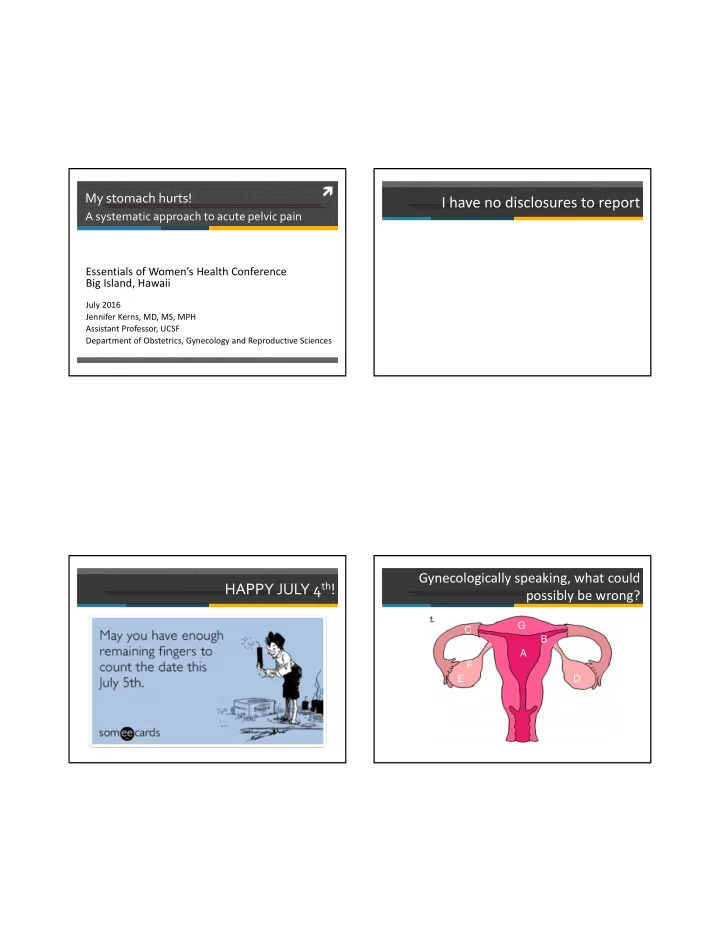
Gynecologically speaking, what could possibly be wrong?

A B C D E F G

slide-2
SLIDE 2

Gynecologically speaking, what could possibly be wrong?

A B C D E F G

  • A. Intrauterine pregnancy
  • B. PID
  • C. Ectopic pregnancy
  • D. Tubo‐ovarian abscess
  • E. Ruptured ovarian cyst
  • F. Torsion
  • G. Fibroids

Case 1: Miranda Amanda

 It’s 4:00 – you think your last patient is a no‐show, and then…

she shows up.

 New patient, scheduled for pap.  You walk in the room and she’s holding her lower belly.  She tells you that she’s had this pain for the last few days and it

started right after she had sex.

 You ask her more about the pain…

Case 1: Miranda Amanda’s pain

 Constant, started more mild, now more painful, across entire

lower abdomen

 She was able to go to work yesterday, but was in pain  Reports the pain 6/10  Nothing makes it better or worse  Some nausea, no vomiting, no diarrhea, unsure about fever/

chills

 No vaginal discharge, no vaginal bleeding

Case 1: Miranda Amanda’s history

 29 yo G0  3 lifetime partners – currently with partner for 6 months  Has had LNG‐IUS for 2 years ‐ amenorrheic  Had chlamydia age 15 and was treated  Appendectomy at age 10

slide-3
SLIDE 3

Case 1: Miranda Amanda’s DDx

 Ectopic pregnancy  Ectopic pregnancy  Ectopic pregnancy

Check UPT before you go any further!

 UPT negative! What now for the DDx?

Pelvic inflammatory disease (PID), +/‐ tubo‐ovarian abscess (TOA)

Other adnexal mass

Ruptured ovarian cyst

Fibroids

More data on Miranda Amanda

 Temp 38.0, otherwise normal vitals  Diffusely tender to palpation across entire lower abdomen  On pelvic exam, IUD strings visible, no discharge or bleeding, nl

appearing cervix, +cervical motion tenderness, +adnexal tenderness L>R

 What’s 1st on your differential? What’s after that?

Pelvic inflammatory disease:

what where why who when how

 Spectrum of inflammatory disorders  Endocervical canal = barrier

Vaginal flora upper tract  Sexually transmitted pathogens can disrupt this barrier  chlamydia or gonorrhea infection 15% progress to PID  Risk factors: age 16‐24, hx of STI/PID, multiple partners

CDC 2015 Sexually Transmitted Diseases Treatment Guidelines

cervicitis endometritis salpingitis Tubo-ovarian abscess (TOA) peritonitis

Diagnosis of PID

 Wide variation in presentation imprecise clinical findings  Clinical dx PID 65‐90% PPV for salpingitis (via laparosc)  Even mild cases can lead to infertility

 infertility=17%, recurrent PID=14%, CPP=37%  Infertility assoc w/ delay in treatment

 Low threshold for diagnosis

 Favor  sensitivity (and false pos)

Peipert et al. AJOG 2011 Ness et al. AJOG 2002 Gaitan et al. Infec Dis Obstet Gynecol 2002 Weisenfeld Obstet Gynecol 2012

slide-4
SLIDE 4

Criteria for diagnosis of PID – NEW!!

 Initiate presumptive treatment

Sexually‐active young women or women at risk of STIs

Pelvic or lower abdom pain w/ no other known cause

CMT or uterine tenderness or adnexal tenderness

Additional (optional) criteria

Temp > 101 (38.4)

Mucopurulent discharge, friability

++ WBCs on saline wet mount of vag fluid

 ESR, CRP

+ chlamydia or gonorrhea

Further workup

 Ultrasound?

Yes: diagnosis of TOA, consideration of other etiologies

No: if pt is afebrile & access to usg difficult

 STI testing: GC, CT, HIV, consider syphilis  Indications for hospitalization:

High fever

Unable to tolerate Pos (n/v)

Can’t r/o surgical emergency (e.g. appy, torsion)

TOA

Pregnancy

Outpatient mgmt failed

Treatment of PID: oral regimens

★★ Ceftriaxone 250mg IM OR Cefox 2g IM (+probenicid 1g PO) ★★Doxy 100mg BID x14 days (Metronidazole) 500mg BID x14 days

฀Azithro

500mg IV QD x2 days

฀Azithro

250mg PO QD x14 days (Metronidazole) 500mg PO BID x14 days

฀Levofloxacin/ ofloxacin/ moxifloxacin

(Metronidazole) 500mg BID x14 days

  • For cephalosporin allergy
  • Only if low risk for GC
  • If GC +, treat based on

sensitivities or consult ID

Treatment of PID: parenteral regimens

★★ Cefotetan 2g IV q12 or ★★ Cefoxitin 2g IV q6 ★★Doxy 100mg IV or PO BID ★★ Clindamycin 900mg IV q8 ★★Gentamicin (daily dosing or q8) For TOA………………………………………………

Complete 14 days w/ doxy alone 100mg bid

  • r clinda alone 450mg qid

Complete 14 days w/ doxy alone 100mg bid Complete 14 days w/ doxy + clinda doxy + metronidazole

slide-5
SLIDE 5

Follow‐up after PID

 Re‐examine patient in 48 hours  If no improvement, consider

 hospitalization  ultrasound (80% treatment failures bc of undiagnosed TOA)  medication change

 Test and treat partner(s)!

Drainage of TOA

 Early drainage may result in higher efficacy  Transvaginal, transrectal, transgluteal, percutaneous  Consult radiology/ interventional radiology  More successful if

unilocular,

early in development

>5cm

Most likely to be injured by fireworks? Good news about fireworks!

slide-6
SLIDE 6

Case 2: Fernanda Amanda:

Miranda Amanda’s twin sister

Add‐on, same day appt for a patient with pelvic pain

You know her well because you delivered her first baby 3 months ago – uncomplicated NSVD

Other relevant history…

h/o dermoid cyst, Lapx left salpingo‐oophorectomy 3 years ago

BMI 40

Exclusively breastfeeding, no menses since delivery 

Her pain

“excruciating”, constant but w/ episodes of incr intensity

started right after sex yesterday

+ n/v

Fernanda Amanda’s exam

 Difficulty walking into exam room  Vitals normal except HR 105  +guarding, +rebound, +peritoneal signs  Diffuse tenderness w/ abdom and pelvic exam, R>L

No masses felt but limited by pt’s BMI of 40  (Most likely) DDX at this point?  But first, rule out…?

  • 1. Torsion
  • 2. Ruptured hemorrhagic cyst
  • 3. Fibroids
  • 4. PID/ TOA
  • 1. Appendicitis
  • 2. Ectopic pregnancy

Fernanda Amanda’s workup

 Transvaginal ultrasound obtained  Radiologist calls in a panic:

“There’s no flow to the right ovary!”  Your next step is to…

Rush her to the OR?

Ask if they see an adnexal mass  7cm solid and cystic mass on R ovary, no free fluid, L ov WNL

Consistent with dermoid

Uterus 11 x 7 x 5 w/ 5cm intramural fibroid at fundus

  • 1. Torsion
  • 2. Ruptured hemorrhic cyst
  • 3. Fibroids
  • 4. PID/ TOA

Adnexal (ovarian) torsion

 Complete or partial rotation of ovary or tube on its ligaments  Often results in impedance of blood flow pain  Risk increases w/ size of mass  More likely w/ benign masses  More common in pregnancy

Varras et al. Clin Exp Obstet Gynecol 2004 Pansky et al. Obstet Gynecol 2007 Houry et al. Ann Emerg Med 2001

slide-7
SLIDE 7

Torsion diagnosis

 How is the diagnosis of ovarian torsion made?

1.

Torsion is a clinical diagnosis

1.

Ultrasound is the best way to diagnose torsion

1.

CT is the best way to diagnose torsion

Ultrasound to diagnose torsion

 Studies small, most retrospective  Study of 199 women with acute pelvic pain:  Skill & experience required (sensitivity and specificity in practice

are lower than in research studies)

 Other studies: sensitivity 43%, specificity 92% for absent venous

flow

Finding Sensitivity Specificity Tissue edema 21% 100% Absent intra‐ovarian vascularity 52% 91% Absent arterial flow 76% 99% Absent venous flow 100% 97% Nizar, J Clin US 2009

Fernanda Amanda’s treatment

 Prompt surgical evaluation/ treatment  Untwist ovary + remove cyst… no salpingo‐oophorectomy!  Exceptions?

Post menopausal women

Concern for malignancy

Technically difficult (pregnancy…)  Prevention for the future?

Ovarian suppression

Harkins et al. J Minim Invasive Gynecol 2007 Bider et al. Surg Gynecol Obstet 1991 Mashiach et al. Fertil Steril 1990 Oelsner et al. Fertil Steril 1993

  • OCPs
  • Depo
  • Nexplanon

How long before the ovary dies?

 Depends on degree of ischemia  One study in children… median

time from onset of pain:

 Viable ovary = 14 hrs  Non‐viable ovary = 27 hrs

 Early diagnosis is critical to save ovarian function.  Call gyn early (even before ultrasound if high suspicion).

slide-8
SLIDE 8

Fernanda Amanda’s fibroid

 Fibroids rarely cause acute or severe pain  Acute pain

 degenerating  twisting on a pedicle  prolapsing through the cervix

 Torsion of fibroid

 presentation=adnexal torsion but u/s shows solid mass

 Prolapsing fibroid

 Waves of crampy abdominal pain + bleeding  Easily diagnosed on speculum exam

Degenerating fibroid

 Risk factors

 very large fibroids (>10cm)  pregnancy

 Onset gradual, not acute  Exam

 localized tenderness over the fibroid  no peritoneal signs  can have low grade fever, incr WBC  Usg shows fibroid; cystic changes can suggest degeneration

Case 3: Leandra Amanda

the younger sister

 24yo G0, sudden onset pain after sex, brought in by friend  Pt is doubled over, crying  Pain started on left, now all over lower abdomen  Worse w/ movement and lying flat  No relevant PMH  What’s on the differential?

 Rule out an ectopic!

More data for Leandra Amanda

 UPT negative  Normal vitals  TTP across lower abdomen, +guarding  Normal labs (hct = 35, repeat = 34)  Usg: ++ free fluid in pelvis, collapsed cyst

 Usg can be normal (no collapsed cyst seen and/or minimal

free fluid)

slide-9
SLIDE 9

Ruptured hemorrhagic cyst

 Common!  Most likely cyst: Corpus luteum cyst, follicular cyst  Less likely cyst: dermoid, endometrioma, TOA  Usually occurs in luteal phase  Pain is from blood

accumulating within ovary stretching capsule

causing peritoneal irritation  Anti‐coagulated / bleeding disorder (VWD) = risk  OCP use (or other methods of ovarian suppression) = risk

Leandra Amanda’s diagnosis and treatment

 Ruptured hemorrhagic cyst is often diagnosis of exclusion  Outpatient treatment if stable hct and pain controlled w/

  • ral meds

 Inpatient treatment if unstable or unable to control pain

 Transfusion if hct drops and pt unstable  Diagnostic laparoscopy if no improvement in 24‐48 hours

to r/o torsion or other pathology

Prevention for Leandra Amanda

 Ovulation suppression!  OCPs

 High dose (50mcg) most effective, but risks > benefits  Modern, lower dose pills: evidence is mixed and benefit is

modest (25% decrease) at best  Implant—some ovulation suppression  Depo‐provera – reliable ovulation suppression

Take‐aways

 Always order a pregnancy test

 Have a low threshold to treat PID  Leave an IUD in place, and only remove if no improvement

with PID treatment

 Clinical diagnosis crucial – usg supportive  Prompt evaluation and treatment for torsion  Supportive treatment for hemorrhagic cyst  Remember prevention (and contraception)

slide-10
SLIDE 10

Don’t let the sun set on an…

Ectopic Ovarian torsion Unstable ruptured hemorrhagic cyst THANK YOU!