i D = d r i = i n . : radix point r : base or radix - - PDF document

i d d r i i n radix point r base or radix dp 1 the most
SMART_READER_LITE
LIVE PREVIEW

i D = d r i = i n . : radix point r : base or radix - - PDF document

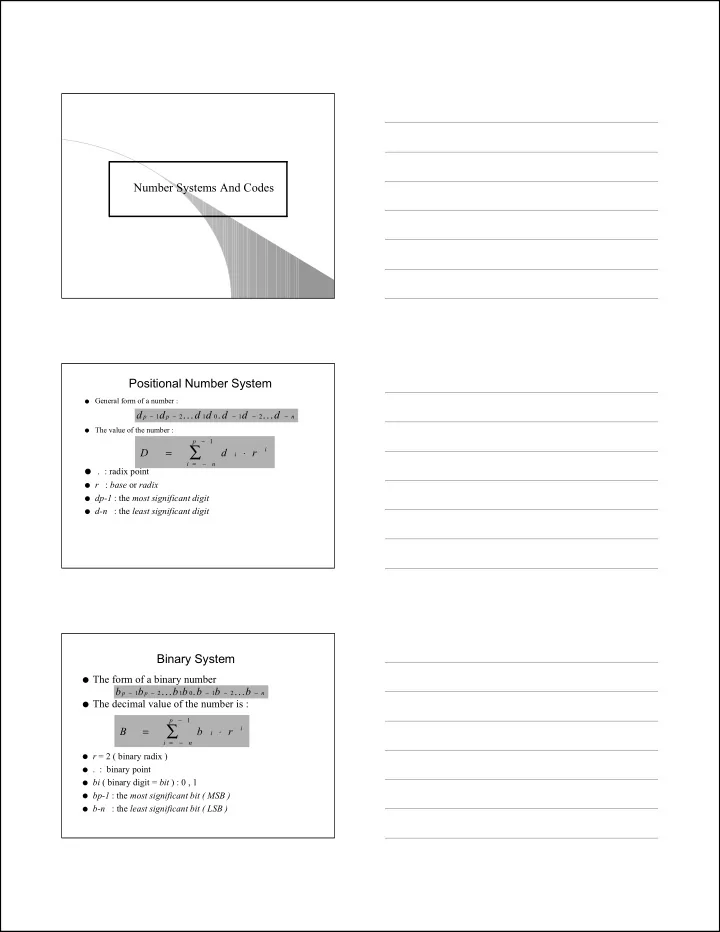
Number Systems And Codes Positional Number System General form of a number : d d ... d d . d d ... d p 1 p 2 1 0 1 2 n The value of the number : p 1 i D = d r i = i n


slide-1
SLIDE 1

Number Systems And Codes Positional Number System

  • General form of a number :
  • The value of the number :
  • . : radix point
  • r : base or radix
  • dp-1 : the most significant digit
  • d-n : the least significant digit

d d d d d d d

p p n − − − − − 1 2 1 1 2

... . ... D d r

i i n p i

= ⋅

= − −

1

Binary System

  • The form of a binary number
  • The decimal value of the number is :
  • r = 2 ( binary radix )
  • . : binary point
  • bi ( binary digit = bit ) : 0 , 1
  • bp-1 : the most significant bit ( MSB )
  • b-n : the least significant bit ( LSB )

B b r

i i n p i

= ⋅

= − −

1

b b b b b b b

p p n − − − − − 1 2 1 1 2

... . ...

slide-2
SLIDE 2

Binary,Decimal,Octal and Hexadecimal Numbers

0 0 0 0 1 1 1 1 2 10 2 2 3 11 3 3 4 100 4 4 5 101 5 5 6 110 6 6 7 111 7 7 8 1000 10 8 9 1001 11 9 10 1010 12 A 11 1011 13 B 12 1100 14 C 13 1101 15 D 14 1110 16 E 15 1111 17 F

Decimal Binary Octal Hexadecimal

General Positional Number Conversion

  • radix-r to decimal :
  • decimal to radix-r :
  • Successive division of D by r
  • The remainder of the long divsion will give the digits

starting from the least significant digit

D d r

i i n p i

= ⋅

= − −

1

Binary Addition

  • Binary addition table :

0 0 0 0 1 1 0 0 1 0 1 0 0 1 1 0 1 1 0 0 1 0 1 0 1 0 1 1 1 0 0 1 1 1 1 1 1

carry(in) x y x+y carry(out)

slide-3
SLIDE 3

Binary Subtraction

  • Binary Subtraction table :

0 0 0 0 1 1 1 0 1 0 1 0 0 1 1 0 0 1 0 0 1 1 1 0 1 0 1 1 1 0 0 0 1 1 1 1 1

borrow(in) x y x-y borrow(out)

Two’s Complement Representation

  • The MSB represents the sign bit ( 0 = +ve , 1 = -ve )
  • To calculate the negative number :

1- Complement all bits of the positive number ( one’s complement) 2- Add 1

  • For n-bit number the decimal value =
  • The range for n-bit is :
  • Advantages :

1- Only one zero 2- Addition and subtraction can be performed directly

  • Disadvantage : One extra negative number ( not symmetric )

B b b

i i n i n n

= ⋅       − ⋅

= − − −

2 1 1

2 2 from to

n n

− + −

− −

( ) ( ) 2 2 1

1 1

Comparison ( n=4 )

  • 8 - - 1000
  • 7 1111 1000 1001
  • 6 1110 1001 1010
  • 5 1101 1010 1011
  • 4 1100 1011 1100
  • 3 1011 1100 1101
  • 2 1010 1101 1110
  • 1 1001 1110 1111

0 0000 or 1000 0000 or 1111 0000 1 0001 0001 0001 2 0010 0010 0010 3 0011 0011 0011 4 0100 0100 0100 5 0101 0101 0101 6 0110 0110 0110 7 0111 0111 0111

Decimal Signed Magnitude One’s Complement Two’s Complement

slide-4
SLIDE 4

Decimal Codes ( Table )

0 0000 0000 0011 0100001 1000000000 1 0001 0001 0100 0100010 0100000000 2 0010 0010 0101 0100100 0010000000 3 0011 0011 0110 0101000 0001000000 4 0100 0100 0111 0110000 0000100000 5 0101 1011 1000 1000001 0000010000 6 0110 1100 1001 1000010 0000001000 7 0111 1101 1010 1000100 0000000100 8 1000 1110 1011 1001000 0000000010 9 1001 1111 1100 1010000 0000000001

Decimal BCD(8421) 2421 Excess-3 Biquinary 1-out-of-10

Gray Code

  • One bit changes between two successive code words
  • Binary Code and Gray Code ( n = 3 ) :

0 000 000

1 001 001 2 010 011 3 011 010 4 100 110 5 101 111 6 110 101 7 111 100

Decimal Binary Code Gray Code

ASCII Table

  • b6b5b4

000 001 010 011 100 101 110 111 b3b2b1b0 0000 SP 0 @ ‘ 0001 ! 1 A a 0010 “ 2 B b 0011 # 3 C c 1111

  • The Code for a is 1100001