SLIDE 1 Sorting Lower Bound Radix Sort
http://www.cs.auckland.ac.nz/software/AlgAnim/radixsort.html
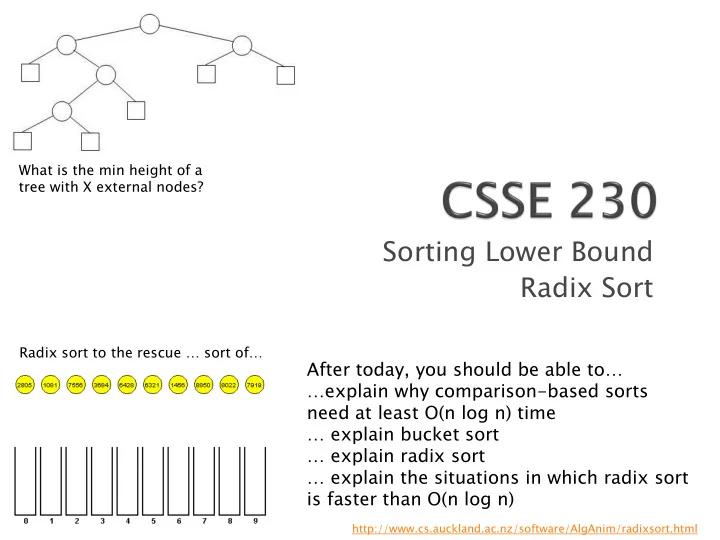
What is the min height of a tree with X external nodes? Radix sort to the rescue … sort of…
After today, you should be able to… …explain why comparison-based sorts need at least O(n log n) time … explain bucket sort … explain radix sort … explain the situations in which radix sort is faster than O(n log n)
SLIDE 2 EditorTree evals due last night – late is better
than never on these, though!
Doublets demo Questions on HW8? The sounds of sorting. Radix sort later.
- https://www.youtube.com/watch?v=kPRA0W1kECg
SLIDE 3
We can’t do much better than what we already know how to do.
SLIDE 4
Lower bound for best case? A particular algorithm that achieves this?
SLIDE 5
Want a function f(N)
such that the wo worst t case e runnin nning g time for all sorting ing algo gorithms ithms is Ω(f(N)) (N))
How do we get a handle on
“all sorting algorithms”?
Tricky!
SLIDE 6 We can’t list all sorting algorithms and
analyze all of them
But we can find a uniform
presentation ation of any sorting algorithm that is based on comp mparing aring elements of the array to each
SLIDE 7 The problem of sorting N elements is at least
as hard as determining their ordering
- e.g., determining that a3 < a4 < a1 < a5 < a2
- sorting = determining order, then movement
So any lower bound on all "order-
determination" algorithms is also a lower bound on "all sorting algorithms"
SLIDE 8 Let A be any comp
mparison arison-bas based ed algo gori rithm thm for sorting an array of distinct elements
We can draw an EBT that corresponds to the
comparisons that will be used by A to sort an array of N elements
rt decision cision tree ee
- Internal nodes are comparisons
- Externals nodes are orderings
- Different algorithms will have different trees
Q1 Q1
SLIDE 9
Minimum number of external nodes in a sort
decision tree? (As a function of N)
Is this number dependent on the algorithm? What’s the height of the shortest EBT with
that many external nodes?
No comparison-based sorting algorithm, known or not yet discovered, can ever do better than this!
Q2 Q2-4
SLIDE 10
Ω(N log N) is the best we can do if we
compare items
Can we sort without comparing items?
SLIDE 11 Observation:
- For N items, if the range of data is less than N, then
we have duplicates
O(N) sort: Bucket sort
- Works if possible values come from limited range
- Example: Exam grades histogram
A variation: Radix sort
Q5 Q5
SLIDE 12
A picture is worth 103 words, but an animation is
worth 210 pictures, so we will look at one.
http://www.cs.auckland.ac.nz/software/AlgAnim
/radixsort.html (good but blocked)
https://www.youtube.com/watch?v=xuU-
DS_5Z4g&src_vid=4S1L- pyQm7Y&feature=iv&annotation_id=annotation_ 133993417 (video, good basic idea, distracting zooms)
http://www.cs.usfca.edu/~galles/visualization/R
adixSort.html (good, uses single array)
Q6 Q6-7
SLIDE 13 It is O(kn)
- Looking back at the radix sort algorithm, what is k?
Look at some extreme cases:
- If all integers in range 0-100 (so, many duplicates if
N is large), then k = _____
- If all N integers are distinct, k = ____
Q8 Q8-10 10
SLIDE 14 Used an appropriate combo of mechanical, digital, and human effort to get the job done.
http://en.wikipedia.org/wiki/IBM_card_sorter
SLIDE 15 From the University of Rochester, my PhD
alma mater, come Sorting Dances!
Bubble Sort: https://www.youtube.com/watch?v=WuGvUFvG7yo
Merge Sort: https://www.youtube.com/watch?v=nK_o13c-0lk Shell Sort: https://www.youtube.com/watch?v=C_XggdqSLyw Should we dance on the Quad next class?