Hydrogen: Background Info & R&D Needed Hydrogen: Background - - PowerPoint PPT Presentation

hydrogen background info r d needed hydrogen background
SMART_READER_LITE
LIVE PREVIEW

Hydrogen: Background Info & R&D Needed Hydrogen: Background - - PowerPoint PPT Presentation

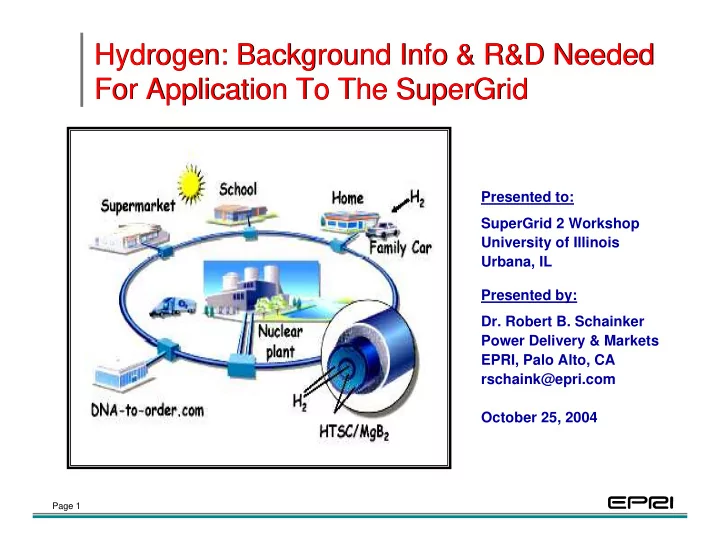
Hydrogen: Background Info & R&D Needed Hydrogen: Background Info & R&D Needed For Application To The SuperGrid For Application To The SuperGrid Presented to: SuperGrid 2 Workshop University of Illinois Urbana, IL Presented


slide-1
SLIDE 1

Page 1

Presented by:

  • Dr. Robert B. Schainker

Power Delivery & Markets EPRI, Palo Alto, CA rschaink@epri.com October 25, 2004

Hydrogen: Background Info & R&D Needed For Application To The SuperGrid Hydrogen: Background Info & R&D Needed For Application To The SuperGrid

Presented to: SuperGrid 2 Workshop University of Illinois Urbana, IL

slide-2
SLIDE 2

Page 2

Hydrogen: Properties Hydrogen: Properties

  • Liquefies at 20.27 K (at 1 Atm.)
  • Boils at 20.27 K (for para-hydrogen) and 20.38 for ortho-hydrogen)
  • Nucleus spin of two atoms in H2 molecule are in different directions
  • Dielectric constant, ε = 1.228 at 20.4 K

[Note: Liquid Nitrogen, ε = 1.454 at 70 K, N2 Liquefies at 77.4 K]

  • Dielectric breakdown: below critical electric field gradient, hydrogen is

an insulator. At present, the breakdown electric field values have a 25% level of scatter, and it depends on pressure changes from 1 to 5 Atm at 20 K. Hydrogen in the gaseous phase, like the liquid, is an insulator below the breakdown voltage, and it follows Paschen’s dielectric law, which states the breakdown voltage does not change as long as the product of its density and the gap distance is held

  • constant. The breakdown voltage is in the range of 250 to 300 volts at

a Paschen’s ρ•d of 10-7g/cm2.

slide-3
SLIDE 3

Page 3

Hydrogen: Two States Hydrogen: Two States

Para-hydrogen

  • Anti-parallel nuclear spin of two atoms in H2 molecule
  • Even quantum numbers
  • Lower energy state than Ortho-hydrogen

Ortho-hydrogen

  • Parallel nuclear spin of two atoms in H2 molecule
  • Odd quantum numbers
  • Higher energy state than Para-hydrogen

Comparisons

  • At 20C temperature, “Normal” Hydrogen has an equilibrium

concentration of 75% Ortho and 25% Para

  • Conversion of Ortho to Para is an exothermic temperature

dependant process. Engineering design for worst case failure conditions have to accommodate for this exothermic reaction.

  • Enthalpy, Thermal Conductivity, and Specific Heat Capacity show

large differences for Ortho-hydrogen and Para-hydrogen

  • Density properties vary less than 0.7%, which is maximum for

“Normal” hydrogen at very low cryogenic temperatures

slide-4
SLIDE 4

Page 4

Para-Hydrogen Equilibrium % Para-Hydrogen Equilibrium %

At 20 K, most of the hydrogen is in the “Para” opposite spin state

25% Para 100% Para

0 K 300 K

slide-5
SLIDE 5

Page 5

Slush Hydrogen Slush Hydrogen

  • Slush Hydrogen is the name given to a homogenous mixture of

coexisting solid and liquid phases of hydrogen.

  • If the slush mixture is 60% solid by mass, the density will be

11.5% greater than the pure liquid at its normal boiling point, thus slush hydrogen is used by NASA as a preferred hydrogen fuel.

  • Slush hydrogen can be produced in a number of ways. The

method used quite often is the so-called freeze thaw method, where ullage over the liquid is pumped to lower pressures causing a solid layer to form at the surface. The pumping is then stopped, and a solid layer partially melts at the edge of the container and settles into the liquid. The cycle is repeated until the desired amount of solid is formed. Some issues remain in controlling the solid particle sizes, especially for pumping

  • purposes. The disadvantage of this approach is that the vapor
  • ver the liquid must be pumped down to very low pressures,

which increases the likelihood of leaks.

slide-6
SLIDE 6

Page 6

Hydrogen: Safety Hydrogen: Safety

  • There are many rules and standards used by NASA and

the oil, gas, and air products industry, if used properly, allow hydrogen to be used safely, at cryogenic and non- cryogenic temperatures.

  • Hydrogen is colorless, odorless, and at temperatures

higher than 6 K, it is lighter than air (at STP)

  • Mixtures of hydrogen with air or oxygen are highly

flammable over a wide range of compositions. The flammability limit range, by weight, as a percentage of Hydrogen is 4 to 75%.

  • Leakage In Pipeline and Valves Has To Be Designed Into

Any Engineering Applications Using Hydrogen

  • Monitoring, Detection, and Fixing Leaks Has To Be Part

Of Any Operational and Maintenance Practices For Applications Using Hydrogen

*R &D Needed

* *

slide-7
SLIDE 7

Page 7

Application of Hydrogen To The SuperGrid: Hydrogen Dielectric Coolant Topic Application of Hydrogen To The SuperGrid: Hydrogen Dielectric Coolant Topic

Cryogenics - Observations

  • Excellent Dielectric, But Choice of Pressure, Temperature and

Engineering Margins Need To Be Determined. Note: MgBr2 Is Superconducting Below 39 K.

  • Cryogenic Container/Pipeline Issues Need To Be Identified and

Resolved Via Engineering and Testing Programs

  • Imbrittlement of Pipeline Material Is an Issue That Needs to Be

Further Addressed, Especially at Cryogenic Temperatures.

  • Pumping, Operational and Maintenance Issues Need To Be

Identified and Resolved Via Engineering and Testing Programs

  • Hydrogen Cryogenic Systems Are Available Today, but Not at

the Scale Needed for the SuperGrid, But This Should Not Be a Major Problem. In Fact, for the SuperGrid, Economy of Scale Principles Will Lower Per Unit Costs to Bring Hydrogen to Cryogenic Temperatures.

*R &D Needed

* * * *

slide-8
SLIDE 8

Page 8

Application of Hydrogen To The SuperGrid: Electrolysis Topic Application of Hydrogen To The SuperGrid: Electrolysis Topic

Production of Hydrogen From Electrolysis - Observations

Teledyne Electrolyzer H2 (5720 scfh) & O2 (2860 scfh) Delivered at 230 psi

  • Yes, electrolysis works and is commercially

available today at low pressure (up to about 230 psia)

  • Electrolysis at high pressure (1500 psia to

10,000 psia) is the most efficient way to produce hydrogen, but no such systems are commercially available today. A few pilot scale demos have been built (e.g.,Mitsubishi, Proton). These units do not use the “concentrator” cell approach which should be “best” for SuperGrid application.

(Mechanical compression to these pressures has been done, but

too much energy is lost in the process and depends on the final pressure needed.)

*R &D Needed

*

Proton Unit (3000 psi)

slide-9
SLIDE 9

Page 9

Note: 30 bar = 435 psi (and we may need 1500 psi)

“High” Pressure Electrolyzers From Norsk Hydro “High” Pressure Electrolyzers From Norsk Hydro

slide-10
SLIDE 10

Page 10

Note: Output pressure of H2 and O2 is about 200 psi

Electrolyzers From Norsk Hydro Electrolyzers From Norsk Hydro

slide-11
SLIDE 11

Page 11

Demineralized Water

O2

H2

+

- Water+O2

P P H2 O2 C Electrolysis cell P H2

HP Electrolyzer Concept (by Mitsubishi) HP Electrolyzer Concept (by Mitsubishi)

slide-12
SLIDE 12

Page 12

1 2 3 4 5 6 7 200 400 600 800 1000 Pressure(kgf/cm2)

P o w e r p e r 1 0 N m 3 / h ( k W )

HP Electrolysis

  • Recip. Compr.
  • Diaph. Compr.

5,000 psi 10,000 psi

High Pressure Electrolysis Can Improve Efficiency by at least 50%

Comparison of Power Consumed To Produce HP Hydrogen Comparison of Power Consumed To Produce HP Hydrogen

slide-13
SLIDE 13

Page 13

Application of Hydrogen To The SuperGrid: Hydrogen Energy Storage Topic Application of Hydrogen To The SuperGrid: Hydrogen Energy Storage Topic

The pipeline can store a tremendous amount of energy by

  • perating between two different pressure levels.

GWH's Stored In 300 Mile Hydrogen Pipeline, From 10% Increase In Pressure Level (Electrolyzer Eff.= 0.9, and Pipeline Radius = R)

2 4 6 8 10 12 14 16 18 1000 1500 2000 2500 3000 Initial Pressure, Psia Stored Energy, GHW's

GWH's for R=1.5 ft GWH's for R=1.0 ft GWH's for R=0.75 ft GWH's for R=0.5 ft

slide-14
SLIDE 14

Page 14

U.S. Pipeline Technology That Hydrogen and the SuperGrid Can Build On U.S. Pipeline Technology That Hydrogen and the SuperGrid Can Build On

Oil Pipelines Natural Gas Pipelines Note: About 1/3 of existing natural gas pipelines can be used to transport hydrogen without costly retrofits (welds need upgrading in another 1/3 of the pipelines).

slide-15
SLIDE 15

Page 15

  • Compressed Gas Storage Tanks
  • New tank materials (carbon fiber based) allow

hydrogen to be stored at high pressure (5k to 10k psi); Cost is high, today.

  • Liquid Hydrogen
  • Mass stored is high; Liquefaction cost is high.
  • Chemical Hydrides
  • Pure and alloyed metals can combine with H2; Cool to absorb

H2, heat to release H2; Per cent stored is about 5-10%, by weight.

  • Gas-On Solid Adsorption
  • Adsorb H2 on Activated Carbon; Cost is very high; Percent

adsorbed in high; Percent stored is about 70%, by weight.

  • Microsheres/Nano-Tubes
  • Glass spheres store H2 at high temperature & pressure; Cool to

store and heat to release H2. Basic R&D is progressing.

  • Carbon Nano-tubes store H2. Basic R&D is progressing. Today,

percent stored is about 5-10%, by weight.

  • Compressed Gas Storage Tanks
  • New tank materials (carbon fiber based) allow

hydrogen to be stored at high pressure (5k to 10k psi); Cost is high, today.

  • Liquid Hydrogen
  • Mass stored is high; Liquefaction cost is high.
  • Chemical Hydrides
  • Pure and alloyed metals can combine with H2; Cool to absorb

H2, heat to release H2; Per cent stored is about 5-10%, by weight.

  • Gas-On Solid Adsorption
  • Adsorb H2 on Activated Carbon; Cost is very high; Percent

adsorbed in high; Percent stored is about 70%, by weight.

  • Microsheres/Nano-Tubes
  • Glass spheres store H2 at high temperature & pressure; Cool to

store and heat to release H2. Basic R&D is progressing.

  • Carbon Nano-tubes store H2. Basic R&D is progressing. Today,

percent stored is about 5-10%, by weight.

Methods To Store Hydrogen Methods To Store Hydrogen

Time (Hr) Load (MW)

slide-16
SLIDE 16

Page 16

  • Integrated Hydrogen-Superconductor System Design Trade-off Studies

Need To Define Temperature, Pressure, and Operating Voltage For SuperGrid System

  • Fundamental Properties Of Hydrogen Need Further Identification and

Verification Under Real World Conditions Where Impurities Will Be Present

  • Proper Coating, Splices, Joints, Electrical Grounding, and Materials For The

SuperGrid Hydrogen Pipeline Need Further Definition and Solution(s)

  • Leak Detection, Leak Location, and Field Repair/Maintenance Of SuperGrid

Hydrogen Pipeline Need Development and Testing Appropriate

  • For The Integrated SuperGrid Design A Pilot-Scale Testing Program(s) Is

Needed To Provide Data For Engineering Designers

  • Development of High Pressure Electrolyzer (with High Efficiency) is a Key

Enabling Technology. Electrolysis at High Pressure is Not the issue; Rather the Container and “Plumbing” is the Technical/Engineering

  • Challenge. High Pressure Fuel Cells Are Also Needed To Directly Use The

High Pressure Hydrogen In The Hydrogen Pipeline.

  • Integrated Hydrogen-Superconductor System Design Trade-off Studies

Need To Define Temperature, Pressure, and Operating Voltage For SuperGrid System

  • Fundamental Properties Of Hydrogen Need Further Identification and

Verification Under Real World Conditions Where Impurities Will Be Present

  • Proper Coating, Splices, Joints, Electrical Grounding, and Materials For The

SuperGrid Hydrogen Pipeline Need Further Definition and Solution(s)

  • Leak Detection, Leak Location, and Field Repair/Maintenance Of SuperGrid

Hydrogen Pipeline Need Development and Testing Appropriate

  • For The Integrated SuperGrid Design A Pilot-Scale Testing Program(s) Is

Needed To Provide Data For Engineering Designers

  • Development of High Pressure Electrolyzer (with High Efficiency) is a Key

Enabling Technology. Electrolysis at High Pressure is Not the issue; Rather the Container and “Plumbing” is the Technical/Engineering

  • Challenge. High Pressure Fuel Cells Are Also Needed To Directly Use The

High Pressure Hydrogen In The Hydrogen Pipeline.

Hydrogen Applied To SuperGrid: Summary of Key Issues Needing Resolution Hydrogen Applied To SuperGrid: Summary of Key Issues Needing Resolution
slide-17
SLIDE 17

Page 17

The Vast Networks Of Electrification Are The Greatest Engineering Achievement Of The 20th Century.

  • - U.S. National Academy of Engineering

The Vast Networks Of Electrification Are The Greatest The Vast Networks Of Electrification Are The Greatest Engineering Achievement Of The 20 Engineering Achievement Of The 20th

th Century.

Century.

  • - U.S. National Academy of Engineering

U.S. National Academy of Engineering

Opportunity:

We Can Implement Wise Decisions To Continue To Stand On The Shoulder’s Of “Giants” To Provide Immense Public Benefits We Can Create The We Can Create The 21 21st

st Century

Century Greatest Achievement Greatest Achievement

slide-18
SLIDE 18

Page 18

Bottom-Line: On a Per Pound basis, Hydrogen contains about a factor of 3 times more energy than any fossil fuel. However, with its low mass density at one atmosphere, it has high storage costs, based on present day technology. *At 1 Atm. Of Pressure, 14.7 psi)

Thermal Energy Content Of Various Fuels Thermal Energy Content Of Various Fuels

Heating Value

Fuel Type BTU's/Pound* Hydrogen 61,100 Methane 23,900 Propane 21,700 Diesel Oil 19,500 Fuel Oil 18,700 Gasoline 20,750 Alcohol 11,620 Crude Oil (Tx) 19,460 Kerosene 19,810

1 BTU (British Thermal Unit) is the amount of heat needed to raise one pound of water one degree F.

Appendix

slide-19
SLIDE 19

Page 19

Hydrogen: Phase Diagram Hydrogen: Phase Diagram

Appendix

slide-20
SLIDE 20

Page 20

Para-Hydrogen Density Vs Press. & Temp. Para-Hydrogen Density Vs Press. & Temp.

Appendix

slide-21
SLIDE 21

Page 21

  • Hydrogen Is a Difficult and Unsafe Fuel

to Use

No: Hydrogen has been and can be used safely IF

appropriate codes, standards, and guidelines are

  • followed. Hydrogen has been and can be used safely

by NASA and the oil/gas industry for many years. “Town gas,” a near 50-50 mixture of hydrogen and carbon monoxide, was widely used earlier in this century before it was replaced by natural gas. A recent study suggests the Hindenburg accident was not caused by a hydrogen explosion. It was likely caused by paint used on the skin of the airship, which contained the same component as rocket fuel.

Hydrogen: Myths Hydrogen: Myths

Appendix