
SLIDE 1
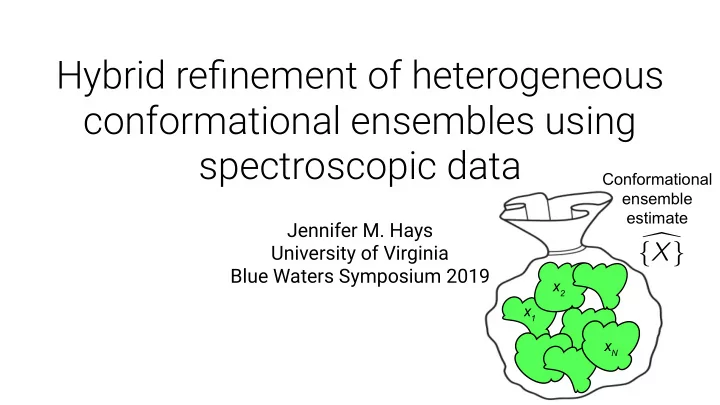
x1 x2 xN
Conformational ensemble estimate
Hybrid refinement of heterogeneous conformational ensembles using spectroscopic data
Jennifer M. Hays University of Virginia Blue Waters Symposium 2019
Hybrid refinement of heterogeneous conformational ensembles using - - PowerPoint PPT Presentation
Hybrid refinement of heterogeneous conformational ensembles using spectroscopic data Conformational ensemble estimate Jennifer M. Hays University of Virginia Blue Waters Symposium 2019 x 2 x 1 x N Proteins exhibit a broad range of
x1 x2 xN
Conformational ensemble estimate
Jennifer M. Hays University of Virginia Blue Waters Symposium 2019
http://www.ibs.fr/research/research-groups/protein-dynamics-and-flexibility-by-nmr-group-m-blackledge/
Experimental data tend to come in two varieties:
SAXS).
the atomic coordinates (DEER, FRET). Sparse labels from DEER Single structure prediction from SAXS
Jeschke, Protein Science, 2017 Duhovny, Kim, & Sali, BMC Structural Biology, 2012
Experimental data tend to come in two varieties:
SAXS).
the atomic coordinates (DEER, FRET).
Lot’s of great work has been done to leverage ensemble average quantities These data are harder to deal with!
Update conformational estimate with resulting ensemble (2) Sample N distanc- es from the experi- mental distribution. Refine each confor- mation Xn against one distance dn Conformational ensemble estimate x1 x2 xN (1) Draw N conformations from with replacement
1 2 N
...
d2 dN d1
PDEER(d)
Compare estimated distributions to experiment
Hays, Cafiso, & Kasson, JPC Letters, 2019
Update conformational estimate with resulting ensemble (2) Sample N distanc- es from the experi- mental distribution. Refine each confor- mation Xn against one distance dn Conformational ensemble estimate x1 x2 xN (1) Draw N conformations from with replacement
1 2 N
...
d2 dN d1
PDEER(d)
Compare estimated distributions to experiment Target Training Convergence Production
Iteration 1: 5 targets Distance Probability Iteration 2: 10 targets (aggregate) Iteration 100: 500 targets (aggregate) Resample a subset of weighted by
B)
Time (ns) Distance (nm)
A)
Hays, Cafiso, & Kasson, JPC Letters, 2019
Ubias = α dMD dtarget
SNARE
Dawidowski and Cafiso, Biophys J., 2013
ergence
2 4 6 2 4 6 2 4 6 0.00 0.25 0.50 0.75 1.00 0.00 0.25 0.50 0.75 1.00 0.00 0.25 0.50 0.75 1.00
A)
BRER restrained−ensemble EBMetaD
196/228 105/216 52/210
Probability B)
Distance (nm)
0.000 0.025 0.050 0.075 0.100 052/210 105/216 196/228
Divergence
ained−ensem
*** p < 0.001 B)
Distance (nm)
*** *** ***
Dawidowski and Cafiso, Biophys J., 2013 Hays, Cafiso, & Kasson, JPC Letters, 2019
A) C)
Habc H3
210 105 52 196 216 228 228 196 Open state Partially
B)
2 4 6 2 4 6 2 4 6 0.0 0.2 0.4 0.6 0.8
Distance(nm) Probability 52/210 196/228 105/216
216 Linker
Hays, Cafiso, & Kasson, JPC Letters, 2019
I use Blue Waters because…
node-hours
Hays, Cafiso, & Kasson, JPC Letters, 2019 Hays et al., Ang. Chemie, 2018