
SLIDE 1
Hadron spectroscopy at Jefferson Lab M.Battaglieri - INFN GE
M.Battaglieri INFN -GE Italy
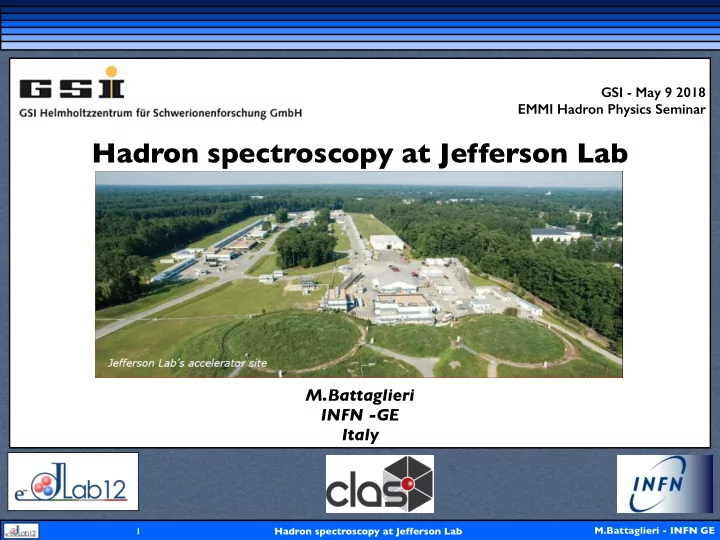
Hadron spectroscopy at Jefferson Lab
1
GSI - May 9 2018 EMMI Hadron Physics Seminar
Hadron spectroscopy at Jefferson Lab M.Battaglieri INFN -GE Italy - - PowerPoint PPT Presentation
GSI - May 9 2018 EMMI Hadron Physics Seminar Hadron spectroscopy at Jefferson Lab M.Battaglieri INFN -GE Italy 1 M.Battaglieri - INFN GE Hadron spectroscopy at Jefferson Lab Jefferson Lab Primary Beam: Electrons Beam Energy: 12
Hadron spectroscopy at Jefferson Lab M.Battaglieri - INFN GE
M.Battaglieri INFN -GE Italy
1
GSI - May 9 2018 EMMI Hadron Physics Seminar
Hadron spectroscopy at Jefferson Lab M.Battaglieri - INFN GE
2
nucleon → quark transition baryon and meson excited states
Variable Energy and Intensity
Hadron spectroscopy at Jefferson Lab M.Battaglieri - INFN GE 3
CLAS12
CHL-2
Upgrade magnets and power supplies
add Hall D (and beam line)
Enhance equipment in existing halls
Beam Power: 1MW Beam Current: 90 µA Max Pass energy: 2.2 GeV Max Enery Hall A-C: 10.9 GeV Max Energy Hall D: 12 GeV
GLUEX
Hadron spectroscopy at Jefferson Lab M.Battaglieri - INFN GE
mesons
Quarks are confined inside colorless hadrons they combine to 'neutralize' color force
baryons q q q q q
4
Hadron spectroscopy at Jefferson Lab M.Battaglieri - INFN GE 5
S1 S2 L (qq angular momentum)
Consider light quarks: u,d,s
and orbital angular momentum L Constituent Quark Model
→ nonet (8⨁1) of degenerate states
JPC= 0-+ ⇒ (π,K,η,η’) 1-- ⇒ (ρ,K*,ω,Φ) 1+- ⇒ (b1,K1,h1,h1’) ...
Not all the JPC combinations are allowed: ¡ 0++ 0+- 0-+ 0-- 1++ 1+- 1-+ 1-- 2++ 2+- 2-+ 2-- 3++ 3+- 3-+ 3-- …
S=S1+S2 J= L+S P = (-1) L+1 C= (-1) L+S
Hadron spectroscopy at Jefferson Lab M.Battaglieri - INFN GE 6
and the origin of confinement
found in jet production
carries information about the gluons that bind quarks
spectrum?
(qq angular momentum)
Exotic nonets
glueball regular meson hybrid tetraquarks
Search for non-standard states with explicit gluonic degrees of freedom hybrid mesons
q q
Not-allowed JPC = 0-- , 0+- , 1-+ , 2+- ... Unambiguous experimental signature for the presence of gluonic degrees of freedom in the spectrum of mesonic states
the JLab 12 GeV upgrade
Hadron spectroscopy at Jefferson Lab M.Battaglieri - INFN GE
Exotics ρ Standard mesons
J.Dudek et al Phys.Rev.D82 (2010) 034508 J.Dudek et al., Phys. Rev. D84, 074023 (2011) 7
Pion mass = 700 MeV 1--
term of CQM + Gluon field
Lattice size
pion mass
JPC=1-+ operator
JgPgCg=1+- in P-wave
Hadron spectroscopy at Jefferson Lab M.Battaglieri - INFN GE 8
Hadron spectroscopy at Jefferson Lab M.Battaglieri - INFN GE 9
★ Production rate for exotics is expected comparable as
for regular mesons
regular mesons @ Eg = 5GeV X = a2 Exotic meson @ Eg = 8GeV X = p1(1600)
Need spin-flip for exotic quantum number No spin-flip for exotic quantum number
★ Linear polarization acts like a filter to disentangle the
production mechanisms and suppress bg
. Page et al. PR A57 1998 6771
Hadron spectroscopy at Jefferson Lab M.Battaglieri - INFN GE 10
photons
electrons in electrons out diamond crystal Performance (0.5 - 0.95) Ebeam → 6 < Eg < 11 GeV (10MeV resolution) Photon Flux ~ 107 - 108 g/s 30cm LH target → L ~ 1031 cm-2s-1 Linear pol ~ 50% - 15% (collective)
Well established technique: Hall-B polarized photon beam
Hadron spectroscopy at Jefferson Lab M.Battaglieri - INFN GE 11
photons
electrons in electrons out diamond crystal Performance (0.5 - 0.95) Ebeam → 6 < Eg < 11 GeV (10MeV resolution) Photon Flux ~ 107 - 108 g/s 30cm LH target → L ~ 1031 cm-2s-1 Linear pol ~ 50% - 15% (collective)
Well established technique: Hall-B polarized photon beam
Hadron spectroscopy at Jefferson Lab M.Battaglieri - INFN GE 12
e e’ N gv
Forward Tagger CLAS12
Complementary to Hall-D (GLUEX) ★ Electron scattering at “0” degrees (2.5O - 4.5O)
➤ ¡low Q2 virtual photon ⇔ real photon
★ Photon tagged by detecting the scattered electron at low angles
➤ ¡High energy photons 6.5 < Eg < 10.5 GeV
★ Quasi-real photons are linearly polarized
➤ ¡Polarization ~ 70% - 10% (measured event-by-event)
★ High Luminosity (unique opportunity to run thin gas target!)
➤ ¡Equivalent photon flux Nγ ~ 5 108 on 5cm H2 (L=1035 cm-2s-1)
★ Multiparticle hadronic states detected in CLAS12
➤ ¡High resolution and excellent PID (kaon identification)
Hadron spectroscopy at Jefferson Lab M.Battaglieri - INFN GE
FT-Trck: MicroMegas
electron angles and polarization plane Saclay + OhioU+Jlab
FT-Hodo: Scintillator tiles
veto for photons EdinburghU+JMU+NSU+Jlab
FT-Cal: PbWO4 calorimeter
electron energy/momentum Photon energy (ν=E-E') Polarization ε-1 ≈1 + ν2/2EE’ INFN-GE, INFN-RM2, INFN-TO, JLab 13 The CLAS12 detector The FT installed in CLAS12
Hadron spectroscopy at Jefferson Lab M.Battaglieri - INFN GE 14
Hall-D - GlueX Detector Hall-B - CLAS12 Detector
Hadron spectroscopy at Jefferson Lab M.Battaglieri - INFN GE 15
γ p p Exo%c ¡state ¡ JPC
in ¡term ¡of ¡par/al ¡waves ¡
amplitudes ¡
parametrize ¡amplitudes: ¡Isobar ¡ Model, ¡Dispersion ¡Rela/ons, ¡…
Step1: decompose to PW Step2: extract resonance parameters
Hadron spectroscopy at Jefferson Lab M.Battaglieri - INFN GE 16
t
dominant production mechanism
critical to disentangling JPC of observed states in exotic hybrid search
ɣp→π0p
2
) c (GeV/
0.2 0.4 0.6 0.8 1 1.2 1.4 1.6 1.8 2
Σ
0.2 0.4 0.6 0.8 1 1.2 1.4 <9.0 GeV
γ
GlueX 8.4<E =10 GeV
γ
E SLAC
π p → p γ
(a)
2.6% Norm. Uncert.
ɣp→4γp
with multiple neutrals particles
P h y s . R e v . C 9 5 , 4 2 2 1 ( R ) F i r s t G L U E X p u b l i c a t i
!
Hadron spectroscopy at Jefferson Lab M.Battaglieri - INFN GE M.Battaglieri - INFN GE 17
M(π+π−) spectrum below 1.5 GeV:
MB, R.DeVita A. Szczpaniak et al Phys.Rev.Lett. 102:102001,2009 MB, R.DeVita A. Szczpaniak et al Phys.Rev. D80:072005,2009
γ p → p π π
Hadron Spectroscopy at CLAS and CLAS12
First observation of the f0(980) in a photoproduction experiment
Hadron spectroscopy at Jefferson Lab M.Battaglieri - INFN GE
18
γ p → p k k
S-wave P-wave S-wave cross section P-wave cross section
MKK range 1.0195±0:0225 GeV MKK range 1.0195±0:0225 GeV
S-wave P-wave
Method:
P-wave: pomeron, s-wave: rho, omg t-exch
. Szczepaniak Acta Phys.Polon. B36 (2005) 3889-3896
2k amplitudes provided by JPAC
Y00 Y10 Y20 Y11
Hadron spectroscopy at Jefferson Lab M.Battaglieri - INFN GE 19
γ p → p k k
g11 data set
Procedure:
independent way and compare to the previous CLAS6 analysis
and sub-leading waves
In preparation
Hadron spectroscopy at Jefferson Lab M.Battaglieri - INFN GE 20
Reference reaction γ p → (n) π+ π+ π-
✴ Possible evidence of exotic meson π1(1600)
in π−p → p π−π−π+ (E852-Brookhaven)
✴ Not confirmed in a re-analysis of a higher
statistic sample
✴ Now confirmed by Compass ✴ Simple final state with low bg
Compass: PRL 104, 241803 (2010)
Hadron spectroscopy at Jefferson Lab M.Battaglieri - INFN GE 21
Reference reaction γ p → (n) π+ π+ π-
✴ Possible evidence of exotic meson π1(1600)
in π−p → p π−π−π+ (E852-Brookhaven)
✴ Not confirmed in a re-analysis of a higher
statistic sample
✴ Now confirmed by Compass ✴ Simple final state with low bg
γ p → n π+ π+ π-
momentum conservation
γ p → Δ++ π+ π- π-
momentum conservation
A.Tsaris, P.Eugenio (FSU)
Hadron spectroscopy at Jefferson Lab M.Battaglieri - INFN GE 22
γ p → n π+ π+ π-
photoproduction experiment
behaviour and consistent with non- resonant non interfering wave relative to a resonant π2(1670)
PWA in CLAS is feasible! Needs to have higher energy and statistics and test other final states ➜ CLAS12
Hadron spectroscopy at Jefferson Lab M.Battaglieri - INFN GE 23
γ p → n π+ π+ π-
isobar channels:
a2 → ρ π (D-wave) a1 → ρ π (S-wave) a1 → ρ π (D-wave) π2 → ρ π (P-wave) π2 → ρ π (F-wave) π2 → f2 π(S-wave) π2 → f2 π (D-wave) π1 → ρ π (P-wave) (exotic)
and P .Guo
acceptance/ resolution distortion
PWA in CLAS12 is feasible!
D.Glazier (U of Glasgow)
Hadron spectroscopy at Jefferson Lab M.Battaglieri - INFN GE 24
γ p → p ω → p πππ
Spin density matrix
meson-meson interaction
Data (full Intensity)
γ p → p η’→ p π π η → p f1(1285) η
amplitudes provided by JPAC Analysis in collaboration with JPAC
Hadron spectroscopy at Jefferson Lab M.Battaglieri - INFN GE 25
γ p → p η π
a0(980) a2(1320) a2(1700) Double Regge
V.Mathieu (ECT*) and A.Szczepaniak (IU&JLab)
parameters
Needs higher energy, higher statistics ➜ CLAS12
Hadron spectroscopy at Jefferson Lab M.Battaglieri - INFN GE 26
e p → e’ p π0 (γ p → p π0)
simulation
provided by JPAC (V.Mathieu)
in the CLAS12-FT
High level physics analysis is starting soon!
photoproduction!)
2018 CLAS12 DATA 2 photon invariant mass at 10.6 GeV
PRELIMINARY
Hadron spectroscopy at Jefferson Lab M.Battaglieri - INFN GE 27
5-quark bound state Hadronic molecule
Λb → J/ψpK−
Hadron spectroscopy at Jefferson Lab M.Battaglieri - INFN GE 28
Electro-production can be used to explore the hadron structure at different wavelengths (Q2)
A drop of the transverse helicity amplitudes A1/2(Q2) faster than for ordinary three quark states, because of extra glue- component in valence structure A suppressed longitudinal amplitude S1/2(Q2) in comparison with transverse electro-excitation amplitude Q3G Q3G
CLAS12 will map out the full meson/baryon spectrum and its evolution in Q2
Hadron spectroscopy at Jefferson Lab M.Battaglieri - INFN GE 29
✴ Experiment ✴ Theory
✴ Analysis tools
Hadron spectroscopy at Jefferson Lab M.Battaglieri - INFN GE 30
★ LMD (Light Mesons Decay) WG ★ HASPECT (HAdron SPEctroscopy CenTer) WG
★ JPAC (Joint Physics Analysis Center) ★ CLAS/PANDA Joint Activity Board
Present:
Future:
★ PyPWA project
Hadron spectroscopy at Jefferson Lab M.Battaglieri - INFN GE 31
Global strategy:
✴Creation of twin and parallel centers for both
analysis and theory development
✴Collaboration and exchanges: personnel, short
visits, ...
✴Coordination via Joint Physics Analysis Center ✴Creation of a “Hadron spectrum” working group
V.Mathieu
Common funding plans:
HaSP-STRONG2020
proposals
Hadron spectroscopy at Jefferson Lab M.Battaglieri - INFN GE 32
✴ Comprehensive meson spectroscopy program at JLab (Gluex & MesonEx) ✴ Exotics and strangeness-rich mesons search with CLAS12 detector exploiting
excellent resolution and particle ID
✴ Bremsstrahlung and Low Q2 electron scattering to produce a high intensity,
linear polarized, real (Hall-D) and quasi-real (Hall-B) photon beam
✴ Experience in PWA gained with CLAS6 will be valuable for CLAS12 and GLUEX ✴ Expected abundant and precise data requires a solid PWA analysis framework ✴ Continuous interaction between JLab WGs (HASPECT, LMD, JPAC) and the
High-performance detectors, high intensity e/γ beams, strong analysis framework are the ingredients to make JLab a leading facility in modern hadron spectroscopy
Hadron spectroscopy at Jefferson Lab M.Battaglieri - INFN GE 33