HVS Consortium Single Phase Far Detector: ITF & installation - - PowerPoint PPT Presentation

hvs consortium single phase far detector itf installation
SMART_READER_LITE
LIVE PREVIEW

HVS Consortium Single Phase Far Detector: ITF & installation - - PowerPoint PPT Presentation

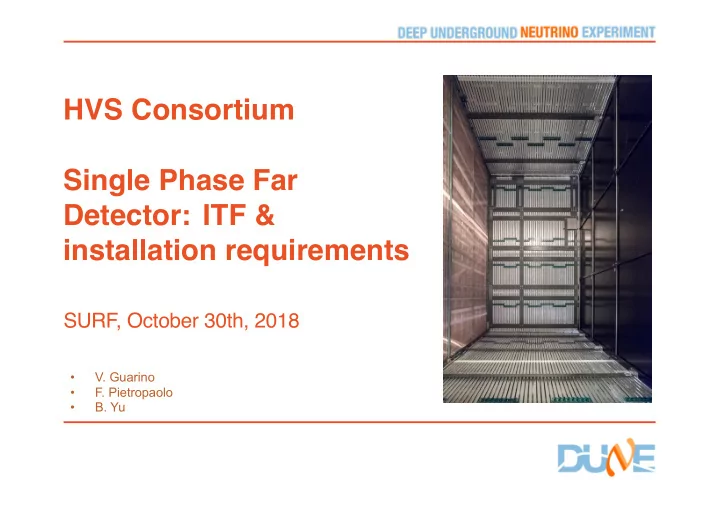
HVS Consortium Single Phase Far Detector: ITF & installation requirements SURF, October 30th, 2018 V. Guarino F. Pietropaolo B. Yu DUNE SP HV System ~7 m From ProtoDUNE to DUNE Far detector 6m CPA panels FC End walls


slide-1
SLIDE 1

HVS Consortium Single Phase Far Detector: ITF & installation requirements

SURF, October 30th, 2018

  • V. Guarino
  • F. Pietropaolo
  • B. Yu
slide-2
SLIDE 2

DUNE SP HV System

10/30/18 ITF and Installation Workshop 2

  • 100 CPA modules, 12m high
  • 600 1.15x2m2 resistive panels
  • 200 top/bottom FC modules
  • equipped with Ground Planes
  • 64 End-wall FC modules
  • Each 1.5m tall
  • Same modularity as ProtoDUNE SP

From ProtoDUNE to DUNE Far detector

FC End walls

6m ~7 m

CPA panels FC top/bottom modules

12m

slide-3
SLIDE 3

HV design changes from ProtoDune

  • Top/Bottom FC modules basically unchanged
  • CPA basically unchanged except now is 12m tall
  • End Wall Modules basically unchanged.
  • Lessons learned from installation (Docdb 8246)
  • SS on SS thread galling – silver plate?
  • Quality of slip nuts
  • FC Hinge hole tolerance
  • FC diagonal brace?
  • Connection between GPs – need to notch spacer
  • GP isolation between FCs
  • Move EW lifting point to coincide with CG (allowing also for a possible

use of bent profiles)

10/30/18 ITF and Installation Workshop 3

(Docdb 6260)

slide-4
SLIDE 4

Voltage New Power Supply 1 day Current

Lessons from initial NP04 operation

  • Early operation revealed PS / HV

filters induced instabilities:

  • New PS replaced
  • New HV filter design/construction started
  • With new PS, operation at the

nominal voltage at 180 kV randomly affected by two kind of instabilities.

  • Fast discharges:
  • Tens per day recorded of the DCS fast

acquisition

  • ALL of THEM report a current signal on at

least one GP

  • Total charge from PS correspond to total

charge on GP’s

  • Excess sustained current streams:
  • Few per day
  • Current signal ALWAYS on ONE GP (UP-

US-BL) & Beam Plug Termination

  • Only a fraction of the PS current visible on

UP-US-BL & BPT

10/30/18 ITF and Installation Workshop 4

slide-5
SLIDE 5

Lessons from initial NP04 operation

  • NO excess noise recorded on APA electronics with any HV instability
  • Some excess activity recorded on Photon Detectors close to affected GP
  • nly in coincidence with streamers
  • NO evidence of direct relation with LAr purity (maybe stream quenching)
  • Very likely NO instability current from EW to GD
  • Investigation of origin of streamer still on-going
  • CPA to ground path through the FRP surface
  • End Wall supports?
  • CPA hangers?
  • HV Feed-through?
  • Mitigation in HVS design
  • Increase GP distance from FC
  • Reduce number of GP-FC FRP spacers

10/30/18 ITF and Installation Workshop 5

slide-6
SLIDE 6

GP-FC design upgrade

  • Presently under study and test:
  • Reduce the number of spacers connecting

the FRP I-beam to the GP I-beam

  • Place the spacers as far as possible from

the high field region

  • Stability calculation and mockup tests

underway

  • Same concept for top and bottom FC
  • Also under study:
  • Move the I-beam above the GP
  • use metal instead of FRP for the GP I-

beam (reduce plastic in high field region)

  • Alternative concepts to decouple GP’s

10/30/18 ITF and Installation Workshop 6

slide-7
SLIDE 7

ITF Requirements

  • Store ~1 month of Components.
  • CPA
  • Crates ~ 4.3m x 1.5m x 1m (800 lbs) – 1 Pair of CPAs per crate
  • Storage for up to ~16 crates
  • 2 crates per week need to be delivered to SURF
  • 50 crates in total
  • Crates delivered to ITF in 20ft Containers
  • Top/bottom FC
  • Ground Planes will be removed during shipping
  • Crates ~ 3.9m x 2.5m x 1.2m (1100 lbs)
  • 4 FC modules per crate
  • 8 GP modules per crate
  • storage of up to ~16+8 crates – total 50+25 crates
  • 2+1 crates per week delivered to Surf
  • Crates delivered to ITF in 20ft containers
  • End Wall FC
  • Crates ~ 3.9m x 2.5m x 1m - 4 FC modules per crate
  • 8 crates at the beginning of installation + 8 crates at the end

10/30/18 ITF and Installation Workshop 7

slide-8
SLIDE 8

ITF Requirements

  • Minimal activities at ITF
  • Visual Sample Inspection
  • With the above shipping

scheme, no repackaging into underground crates foreseen

  • Space Requirements
  • ~500m2 needed for storage
  • clean room (~100 m2) to host

FC modules for visual/electrical inspection

10/30/18 ITF and Installation Workshop 8

  • Facility Requirements
  • Loading dock
  • Forklift
  • 1 ton crane
  • Work benches/Testing stations
  • Desks/network access
  • Personal
  • 2-3 ITF personnel
  • HV people shared with

underground activities

slide-9
SLIDE 9

HV Installation What is needed from facilities/TC?

  • Personnel to deploy CPA/FC inside the cryostat (?)
  • 1 ton bridge crane for assembling CPA and mounting top FC
  • 2 scissor lifts -- power available for charging their batteries
  • Storage space in drifts for 2 CPA crates and 2 FC crates
  • Storage space in cleanroom for a tool box, a cabinet for

supplies, lifting fixtures.

  • Supports off of the north wall for CPA assembly fixture
  • Platform in front of west TCO that is level with the cryostat floor

and can accommodate a scissors lift

10/30/18 ITF and Installation Workshop 9

slide-10
SLIDE 10

HVS consortium will provide…

  • Personnel for assembling CPA/FC modules in cleanroom
  • expect 4-5 people in the shift team
  • 8 shifts/week: (3 for assembly+1 for deployment) x 2
  • CPA assembly fixture
  • Lifting fixtures for CPA and FC
  • Equipment for testing CPA/FC before insertion into

cryostat

  • Portable cranes to deploy bottom FC modules

10/30/18 ITF and Installation Workshop 10

slide-11
SLIDE 11

Detector Assembly and Installation

  • HVS consortium will provide the assembly personnel
  • Two CPA/FC assemblies will be constructed per week
  • Three shifts are expected to be needed for each CPA/FC

assembly

  • CPA crates will hold six 4m long modules – 1 crate needed for

each CPA/FC assembly

  • FC crates will hold 4 FC modules – 1 crate needed for each

CPA/FC assembly + ½ crate of GP

  • GP attachment to FC performed in clean room
  • Three CPA modules, each 4m long, are connected using a

fixture.

  • FC modules attached to CPA pair on TCO beam

10/30/18 ITF and Installation Workshop 11

slide-12
SLIDE 12

Installation Sequence

  • Current Plan is to install one row of

detectors at a time, deploy the top and bottom FC

  • CPA installation can occur much faster than APA

installation

  • FC deployment blocks further access to APAs and

cables

  • Serial installation does limit exposure of APAs
  • Proposed installation is to install complete rows
  • f APA/CPA and deploy FC’s at the end
  • Floor is kept in place until bottom FCs deployed
  • Extensive access to APA and cables
  • Similar to ProtoDune installation sequence
  • More efficient use of manpower?
  • Less interference with APA

10/30/18 ITF and Installation Workshop 12

slide-13
SLIDE 13

CPA Unpacking & Assembly

10/30/18 ITF and Installation Workshop 13

Boxed CPA lowered into SAS and moved to Assy Fixture in CR Boxed CPA in position. 1/3 panel being raised from crate CPA panels placed into fixture

slide-14
SLIDE 14

CPA Unpacking & Assembly

10/30/18 ITF and Installation Workshop 14

Assembled CPA panel placed onto TCO Beam

slide-15
SLIDE 15

Top/bottom FC Unpacking & Assembly

10/30/18 ITF and Installation Workshop 15

Top FC Panels installed as the CP array hangs under the TCO beam Crated FC Panels and GP assembly lowered into SAS and moved into Clean Room GP assembly remounted on FC panels

slide-16
SLIDE 16

Bottom FC Deployment

  • Brought in the cryostat on a cart or

hanging from the TCO beam

  • Mounted to CPA’s when the latter is in

its final place using a fixture

  • Deployed immediately using fixture in

the same manner as ProtoDune SP

  • Left and right FC’s on same CPA could

be deployed simultaneously

10/30/18 ITF and Installation Workshop 16

slide-17
SLIDE 17

Top FC Deployment

  • Top FC hung from CPAs outside

cryostat similar to PDune

  • Fixture mounted to top of APA DSS

beam for raising FC similar to PDune

  • Lift point is offset from DSS beam so

that lift rope/cable avoids cable trays which cause torque on DSS beam

  • Torque offset by APA weight and winch
  • n ground

10/30/18 ITF and Installation Workshop 17

slide-18
SLIDE 18

EndWalls installation

10/30/18 ITF and Installation Workshop 18

  • 4” aluminum beam (35 lbs) placed across

DSS beams to support winches

  • EW modules packaged in a “toaster” crate
  • EWs raised in place, winches and beam

removed

slide-19
SLIDE 19

Summary

  • HV system is very similar to that of ProtoDune.
  • GP distance may increase from 20 to 30/40 cm
  • Little work to be performed at ITF other than storage and visual

inspection

  • In the scheme where one row of detectors is assembled at a time and

the top and bottom FC are deployed, 2 CPA and 2 x 4 FC modules a week need to go underground

  • Downstream End-Wall fully installed before CPA/APA installation,

upstream after full top/bottom deployment

10/30/18 ITF and Installation Workshop 19