THE STELLAR AND GASEOUS HALO OF M51 Aaron E. Watkins In - - PowerPoint PPT Presentation

the stellar and gaseous halo of m51
SMART_READER_LITE
LIVE PREVIEW

THE STELLAR AND GASEOUS HALO OF M51 Aaron E. Watkins In - - PowerPoint PPT Presentation

THE STELLAR AND GASEOUS HALO OF M51 Aaron E. Watkins In collaboration with: J. Christopher Mihos 1 Paul Harding 1 Matthew Bershady 2 1) Case Western Reserve University 2) University of Wisconsin -- Madison INTRODUCTION TO M51 Historically


slide-1
SLIDE 1

THE STELLAR AND GASEOUS HALO OF M51

Aaron E. Watkins

In collaboration with:

  • J. Christopher Mihos1

Paul Harding1 Matthew Bershady2

1) Case Western Reserve University 2) University of Wisconsin -- Madison

slide-2
SLIDE 2

INTRODUCTION TO M51

  • Historically important galaxy

pair -- spirals, interactions, gas tidal response, &c.

  • Nearby: D ~ 8.5 Mpc
  • About the system:

– Disk mass ratio ~1/3 -- 1/2 (e.g.,

Smith et al. 1990, Salo & Laurikainen 2000, &c.)

– Gas-rich Sc disk (M51a) + gas-

poor SAB disk (M51b)

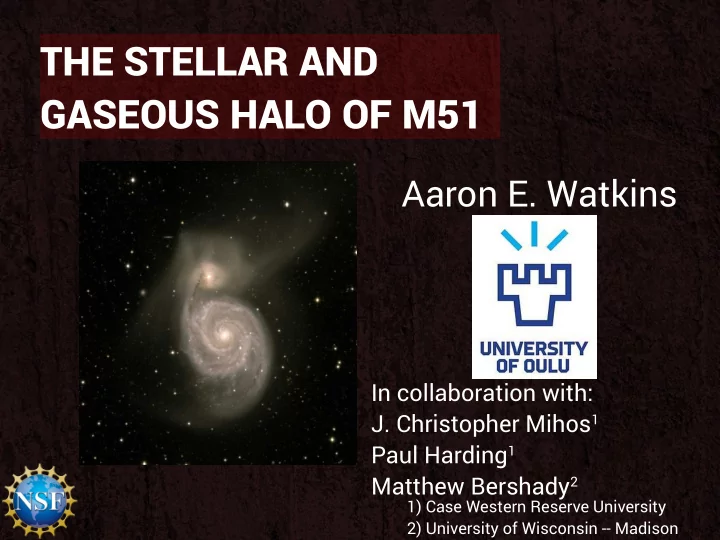
Hubble Heritage Archive M51a M51b

slide-3
SLIDE 3

OBSERVATIONS

  • Full mosaic ~2°x2°

(focal plane f.o.v. ~1.5°x1.5°)

  • Exposure times:

31x1200s (B), 39 x 900s (V)

  • μlimit ~ 30

mag/arcsec2 (B)

  • Burrell Schmidt Telescope (recall Chris Mihos' talk)

This one

slide-4
SLIDE 4
  • East/West

Streams:

  • B-V~0.75 (same

as M51b)

  • coherent (disk
  • rigin), caustic?
  • μ~25.5--26
  • L

, B ⊙ ~ 4x10⁷

(each)

RESULTS

Watkins + 2015 10´ (~25 kpc)

slide-5
SLIDE 5
  • Northwest Plume:
  • B-V~0.8 (color of
  • uter disks;

Watkins+14, 16)

  • Still coherent

despite length (~30 kpc end to end)

  • μ~27.5--28
  • L

, B ⊙ ~ 108

RESULTS

Watkins + 2015 10´ (~25 kpc)

slide-6
SLIDE 6
  • Northeast Plume:
  • μ~29, no good

color constraint

  • Related to

'crown'?

  • South Plume
  • μ~29
  • Accreted?
  • Both L

, B ⊙ ~ 5x10⁶

RESULTS

Watkins + 2015 10´ (~25 kpc)

slide-7
SLIDE 7

HALO GAS CONTENT

  • System surrounded by

tidally stripped gas

  • No obvious stellar

counterpart to any extended HI

  • 2015: follow-up deep

narrowband imaging with Burrell Schmidt

  • Interesting discovery...!

21 cm observations from Rots + 1990

slide-8
SLIDE 8

Hα NARROWBAND IMAGE

Watkins + 2018

slide-9
SLIDE 9

Hα NARROWBAND IMAGE

Watkins + 2018

32 kpc

slide-10
SLIDE 10

SPARSEPAK SPECTRUM

Watkins + 2018

Vhel ~ 640 km/s VM51~460 km/s

slide-11
SLIDE 11

LINE RATIOS

  • log(NII / Hα) ~ +0.17
  • log(SII / Hα) ~ -0.10
  • log(OI / Hα) ~ -0.77

BPT Diagrams from: Singh + 2013

slide-12
SLIDE 12

FATE OF GAS IN MERGERS

  • M51, ionization only
  • "Hanny's Voorwerp":

similar origin object (?), but embedded HII regions!

  • In some AGN hosts,

halo stars might form literally "in-situ"

IC 2497 Green = OIII 5007 Orange = Hα+NII

slide-13
SLIDE 13

SUMMARY

  • In the M51 system, the "stellar halo" observed

with deep imaging appears mainly to originate with both galaxies' disks

  • Gaseous tidal debris is also abundant, and

energetic phenomenon (AGN? shocks?) ionized a swath of it

  • Energetic winds/shocks: how often can this

energy injection form literally "in-situ" halo stars?