Huntingtons Disease 1) signal transmission between NS - - PDF document

huntington s disease
SMART_READER_LITE
LIVE PREVIEW

Huntingtons Disease 1) signal transmission between NS - - PDF document

3/8/16 March 7, 2016 Synaptic T ransmission Refresher (cont) Crawdad Lab Exercise 8 Synaptic transmission Huntingtons Disease 1) signal transmission between NS components and effectors 2) A


slide-1
SLIDE 1

3/8/16 1

March 7, 2016 Synaptic T ransmission Refresher (cont) Crawdad Lab Exercise 8

axon! Synaptic ¡input

Synaptic ¡transmission

1) ¡signal ¡transmission ¡between NS ¡ ¡components ¡and ¡effectors 2) ¡A ¡site ¡of ¡plasticity ¡for learning ¡and ¡memory 3) ¡A ¡site ¡of ¡action ¡for ¡disease, psychoactive ¡drugs

Nervous System Disease Presentations Next Week- Mon and Weds Due Thursday- RP Lab Results, lab Due Monday, Ma rch 14

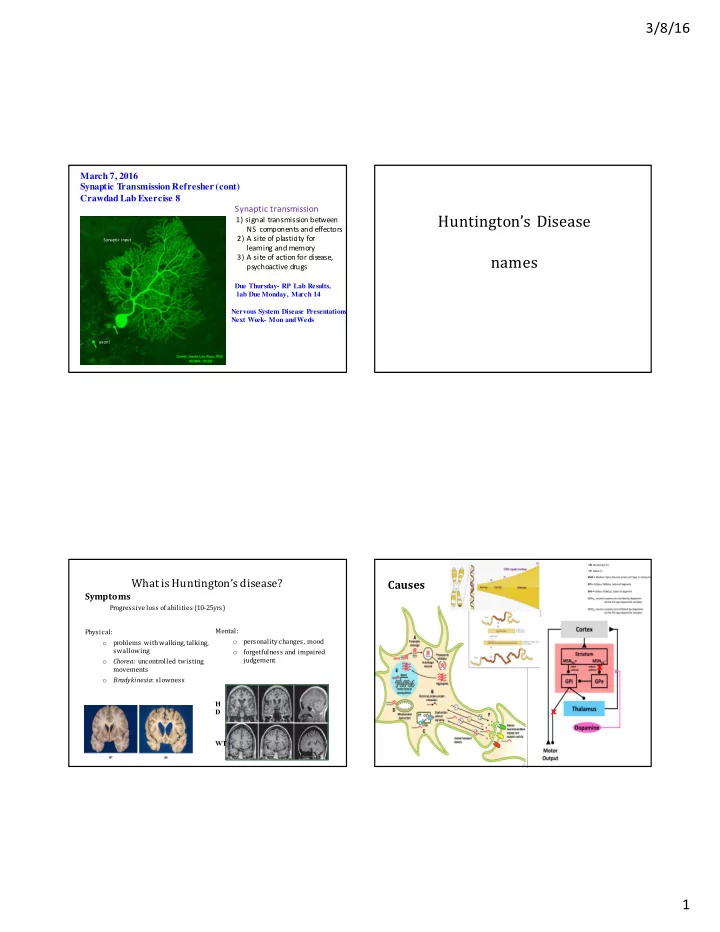
Huntington’s ¡Disease names

What ¡is ¡Huntington’s ¡disease?

Symptoms

Progressive ¡loss ¡of ¡abilities ¡(10-­‐‒25yrs) Physical:

  • problems ¡with ¡walking, ¡talking, ¡

swallowing

  • Chorea: ¡uncontrolled ¡twisting ¡

movements

  • Bradykinesia: ¡slowness ¡

Mental:

  • personality ¡changes, ¡mood
  • forgetfulness ¡and ¡impaired ¡

judgement H D WT

Causes

X X

slide-2
SLIDE 2

3/8/16 2

Treatment

  • No ¡cure
  • Support ¡ groups ¡and ¡therapy:

speech, ¡physical, ¡occupational

  • Medications ¡to ¡reduce ¡Chorea:
  • ­‐‒ tetrabenazine ¡(2008)
  • ­‐‒ dopamine ¡blockers
  • gene ¡therapy

H D WT

Symptoms

Multiple ¡Sclerosis ¡(MS)

Disease ¡ Pathology

  • Currently ¡not ¡curable
  • High-­‑dose ¡corticosteroids

– Reduce ¡inflammation ¡in ¡CNS ¡(exacerbations)

  • Disease-­‑Modifying ¡Medication ¡

– Suppress ¡the ¡immune ¡system – Prevent ¡immune ¡cells ¡from ¡getting ¡into ¡the ¡brain

  • Rehabilitation ¡

– Help ¡patients ¡maintain ¡functions

  • Emotional ¡support

Treatments ¡ for ¡MS ¡ ¡

slide-3
SLIDE 3

3/8/16 3

Sim5-­‑ Neuromuscular ¡ Junction

Multi-­‑terminal Poly-­‑neuronal Inhibition Often ¡ no ¡APs Uni-­‑terminal Uni-­‑neuronal Excitation ¡ Only

Neuromuscular ¡Innervation

Mammals Arthropods

Crawdad ¡labs ¡8 ¡and ¡9 Crayfish ¡NMJ ¡as ¡a ¡model ¡for ¡human ¡brain ¡fast ¡synapses

See ¡Synapse ¡Tutorial ¡on ¡class ¡web ¡site ¡for ¡review Crayfish ¡NMJ ¡preparation Steps ¡in ¡ionotropic chemical ¡synaptic ¡ transmission Lab ¡8 ¡focuses

  • n ¡2 ¡steps-­‑

1 2

slide-4
SLIDE 4

3/8/16 4

Lab ¡8-­‑

1 2

Synaptic ¡Inhibition

Synaptic ¡Integration-­‑ Activate ¡tail ¡input

Map ¡Muscle ¡Innervation ¡Patterns

(Also ¡better ¡ distinguish ¡number ¡of ¡axons ¡in ¡nerve ¡3)

“Minis” Quantal nature ¡of ¡transmitter ¡release

Record ¡spontaneous ¡transmitter ¡release

Synapse ¡tutorial MEPPs, ¡page ¡11, ¡12

slide-5
SLIDE 5

3/8/16 5

Reduce ¡[Ca]o

Record ¡evoked ¡transmitter ¡release Normally ¡around ¡300 ¡quanta ¡at ¡NMJ/AP (could ¡be ¡only ¡a ¡few ¡at ¡central ¡synapses) Spontaneous ¡“mini” ¡and ¡evoked ¡potentials-­‑quantal steps

Quantal content: ¡m ¡= ¡mean ¡EPP/mean ¡MEPP Spontaneous ¡“mini” ¡synaptic ¡potentials

Quantal hypothesis ¡of transmitter ¡release

Post ¡synaptic ¡depolarization ¡ results ¡from ¡the ¡coordinated ¡ release ¡of ¡transmitter ¡packets ¡ (quanta) ¡from ¡the ¡vesicles as ¡the ¡AP ¡enters ¡the ¡terminal

Physical ¡evidence ¡for ¡vesicle ¡fusion ¡for ¡transmitter ¡release

4-­‑AP ¡broadens ¡presynaptic ¡AP

slide-6
SLIDE 6

3/8/16 6

Fusion ¡of ¡vesicles to ¡membrane Ca++ channels Note ¡“omega” ¡figure

Squid ¡giant ¡synapse ¡as ¡a ¡ model ¡system

EPSP giant ¡axon ~1 ¡mm Presynaptic ¡axon

George ¡Augustine, ¡Marine ¡ Biological ¡Laboratory, ¡2008 Technical ¡help-­‑ Bruce ¡Johnson

Block ¡transmitter ¡release ¡with ¡presynaptic ¡Ca buffer ¡or ¡Cadium

Synapse ¡tutorial

  • p. ¡17, ¡19

Presynaptic Ca ¡injection ¡causes transmitter ¡release ¡and ¡Ca ¡indicator ¡dye shows ¡presynaptic Ca ¡entry

slide-7
SLIDE 7

3/8/16 7

Any ¡depolarization ¡will ¡cause ¡transmitter ¡release, ¡even ¡high ¡Kout-­‑ triggers ¡opening ¡of ¡voltage-­‑gated ¡Ca ¡channels

What ¡is ¡the ¡role ¡of ¡the ¡AP ¡in ¡ transmitter ¡release? provides ¡ trigger ¡and ¡timing for ¡calcium ¡entry Synapse ¡tutorial

  • p. ¡21