
SLIDE 1
Huntington Beach Police Department
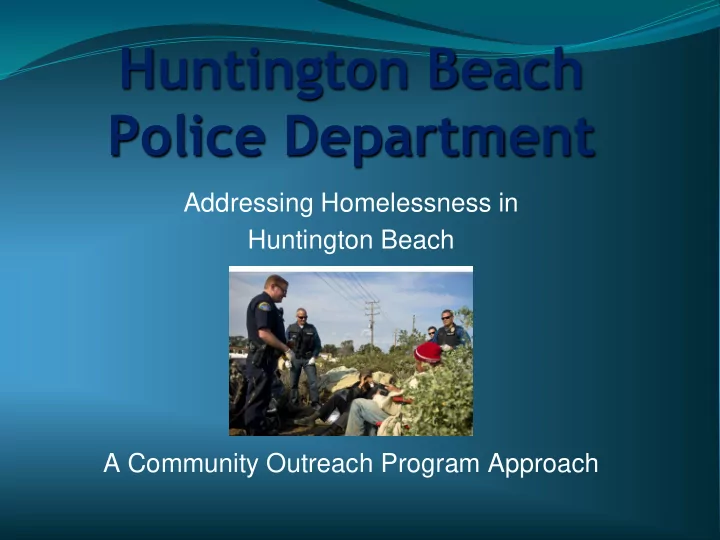
Addressing Homelessness in Huntington Beach A Community Outreach Program Approach
Huntington Beach Police Department Addressing Homelessness in - - PowerPoint PPT Presentation
Huntington Beach Police Department Addressing Homelessness in Huntington Beach A Community Outreach Program Approach Huntington Beach Police Outreach Team In 2012 HBPD Officers noticed an increase in calls for service, specifically related
Addressing Homelessness in Huntington Beach A Community Outreach Program Approach
In 2012 HBPD Officers noticed an increase in calls for
service, specifically related to transients. The transients we receive calls on are typically ones we have multiple contacts with. Common complaints include:
Fire Department /EMS Public Works Parks Department Business owners Residents Visitors Health Care Agencies Mental Health Care Homeless community Social Services
Mental Health Issues Criminal history Addictions Recent separations By choice Lack of jobs
Report states 0.14% of the population Orange County is homeless.
This would correlate to approximately 266 homeless residents in Huntington Beach based upon a population of 190,000.
The report indicates that 40% of homeless subjects are unsheltered
and 60% are sheltered. This would correlate to about 106 unsheltered and 160 sheltered homeless individuals in Huntington Beach.
The report shows the average age is 48. We believe based on our contacts that we have identified
approximately 212 homeless in our City including those living out of vehicles.
Common locations where homeless congregate generating calls for service
Community parks Santa Ana River Channel (Brookhurst St / Hamilton Ave) Beach Blvd / Atlanta Ave Beach Blvd/ Garfield Ave Beach Blvd / Center Ave (405 Off ramp) Beach Blvd / Talbert Ave HB Sports Complex – Central Park Magnolia St / Adams Ave Magnolia St/ Garfield Ave PCH / Warner Ave Main Street 100 – 300 blocks PCH/ 9th St – Grass park area Pier Plaza
2014 Central Park and Bartlett Park
In 2014, Public works spent over $131,000 to clean up just two city parks: Central Park and Bartlett Park. Bartlett Park took over 3060 employee hours and 1000 volunteer hours to clean up camps and trash due to transients encampments. The Police Department responded to 193 calls for service at Central Park (not including the library) and 54 calls for service in Bartlett Park alone.
Bartlett Park – Before Clean Up
HBPD developed a working group / outreach program to help identify
problems and solutions. (ancillary to their patrol assignment)
Collaborate with non-profit, faith based, and government services. Develop a way for citizens to donate food, clothing, money, etc. Educate the public on homeless issues. Obtain support from County Mental Health and local hospitals. Network with other cities in the county to understand their successes/failures.
Recognizing that homelessness is not a crime, the goal of the Community Outreach Program will be to assist both residents, non-residents, business owners, and the homeless population in maintaining a quality of life the City of Huntington Beach. This will be done through cooperative efforts involving non-governmental
Conduct outreach patrols too identify locations where subjects congregate who may be in need of assistance. Develop rapport with a community that may be apprehensive about working with law enforcement. Identify common factors leading to homelessness. Provide assistance information to those in need. Coordinate resources to assist those in need of assistance including social services and mental health. Identify locations and facilities lacking sanitary conditions and coordinate resources to rectify the situations. Identify locations where the enjoyment of facilities is restricted due to prohibited conduct. Seek compliance with applicable laws and regulations through education and enforcement. Work with private businesses, residents, City, State, and County agencies, to reduce blight and unsanitary
conditions.
Deter criminal activity by conducting highly visible activities and educating people about various laws.
Phase I - Beginning in September of 2012, Huntington Beach Police Officers conducted
received complaints. These interviews were not criminal investigations, but merely outreach interviews to help determine causal factors leading to homelessness in Huntington Beach, to identify what resources people need, identify what resources are beneficial, and to provide assistance information. Phase II – Concurrently with Phase I, we educated those we came in contact with regarding laws and regulations that all people are subject too in the City of Huntington Beach.
Phase III-Currently we are in contract with Coast to Coast. We conduct bi-monthly outreaches with volunteers to identify individual
needs.
We conduct two additional outreaches a month without the volunteers. We have identified a resource list and have been utilizing a variety of
assistance sources to obtain, food, shelter, housing, identification and banking needs.
Actively trying to obtain funds for immediate assistance needs (emergency
hotel, bus tickets, food).
Educating all citizens to the challenges of homelessness.
needs.
issues, strategies and obtain training.
remaining by the end of 2015)
Since April 1, 2014 we have contacted 27 homeless individuals. We have worked with non-profit organizations and had 4 persons housed. We have offered 5 additional housing opportunities that were rejected by the homeless individual (3 females and 2 males-(1) Vet). Participated in a fund raiser to assist the officers in times of fund needed for emergencies. Asked for volunteers from our community and provided training to 4 persons willing to participate with the outreach. Received 20 meals & 50 bus passes to hand out to the homeless from BCIS during our outreach.
People are comfortable with their lifestyle choices.
Shelters will not accept people with addictions or serious medical conditions.
Programs require cooperation, time, personnel, and resources.
People do not feel safe in shelters.
Developmental Program participants have to be willing participants to benefit from programs.
Results:
Males : 100 (85%) Females: 18 (15%) Claimed to be disabled – 33 (28%) Claimed Veteran Status – 12 (10%) Claimed Mental Illness – 47 (40%) Claimed to receive some gov’t assistance – 63 (53%) Claimed they do not receive gov’t assistance – 44 (37%) Claimed to be an alcoholic – 41 (35%) Claimed to have a street drugs addiction – 32 (27%)
5150 WIC-The county system statistically releases a 5150 WIC candidate after 11.5 hours. This means the officer/citizens will deal with the same issues day in & out without a long term solution. The most recent county training explained that if the dangerous act or threat occurred while the person was under the influence, the staff will not keep a hold on them. The thought is once the drugs/alcohol wear off, the threat is no longer present even if an addict. There is a shortage of beds at the mental health facilities, therefore most hold requests are not honored. Arrests- Most of the criminal activity by the homeless are nuisance type misdemeanor crimes. The County does not accept misdemeanor offenses into their jails, therefore they are cited out within a few hours from City jail. Many citizens are afraid to make citizen arrests and just want the police to “do something” but do not want to get involved. Proposition 47 made illegal drugs a misdemeanor. Housing-There are limited number of housing options for the homeless. Many refuse to enter a check in/check out
Orange County Community Court
HOMELESS OUTREACH COURT The Homeless Outreach Court is convened at four community locations. The goal of the Court is to resolve the infractions, low-level misdemeanor offenses, and outstanding warrants of homeless individuals, while providing them with links to necessary supportive services. The program is a collaborative effort of the Superior Court, the Public Defender, the Public Law Center, the Veterans Administration, the Health Care Agency, the County Department of Housing and Community Services, local law enforcement agencies, and several homeless services providers from the community. Participation in agency programs and community service are substituted for the traditional court sanctions of fines and custody. OPPORTUNITY COURT Opportunity Court is a voluntary program for non–violent drug offenders who have been sentenced to and are engaged in the Proposition 36 (P.C. 1210) program but, as a result of their chronic, persistent mental illness are unable to comply with the requirements of the P.C. 1210 program. The participants must have a diagnosis of schizophrenia, bi-polar disorder, or major depressive disorder and are supported by readily available psychiatric services. Opportunity Court program involves frequent court appearances, weekly meetings with the Probation Officer and Health Care Coordinator, regular drug and alcohol testing, residential substance abuse treatment, and attendance at individual and group counseling sessions – all of which are based on the Drug Court model. Participants are also assisted in accessing medical services, employment counseling, job training and placement, government benefits, and housing. RECOVERY COURT Funded by a grant obtained by the Orange County Sheriff’s Department through the Mentally Ill Offenders Crime Reduction Act (MIOCR), the Recovery Court is a voluntary program for misdemeanor offenders suffering from chronic and persistent mental illness. The participants must have a diagnosis of schizophrenia, bi-polar disorder, or major depressive disorder. The program provides participants with psychiatric services which may be initiated in the jail. Once the offender is released from custody they are provided with on-going psychiatric services and mental health counseling, drug and alcohol abuse counseling, residential treatment, and assistance in accessing medical services, employment counseling, job training and placement, government benefits, and housing. The program involves frequent court appearances, regular drug and alcohol testing, meetings with the Recovery Court support team, and direct access to specialized services. VETERANS COURT Veterans Court offers a therapeutic alternative and support services to US military service personnel who become involved with the criminal justice system, and who are in need of effective mental health treatment to address issues such as Post Traumatic Stress Disorder “PTSD”, Traumatic Brain Injury “TBI” and other serious mental health problems. Veterans Court, which opened in November 2008 at the Community Court building, is a collaborative partnership with the Veterans Administration, which has funded a full-time case manager, and with other State and local veteran service providers. WIT COURT WIT “Whatever It Takes” Court is a voluntary program for non-violent offenders who have been diagnosed as chronically, persistently mentally ill and are homeless or at risk of
Through services funded by the Mental Health Services Act (Proposition 63) the participants are provided with mental health counseling, psychiatric services, drug and alcohol abuse counseling, residential treatment, safe housing, family counseling and peer mentoring. Clients are also assisted in accessing medical services, employment counseling, job training and placement, government benefits, and housing. The program involves frequent court appearances, regular drug and alcohol testing, meetings with the WIT Court support team, and direct access to specialized services.