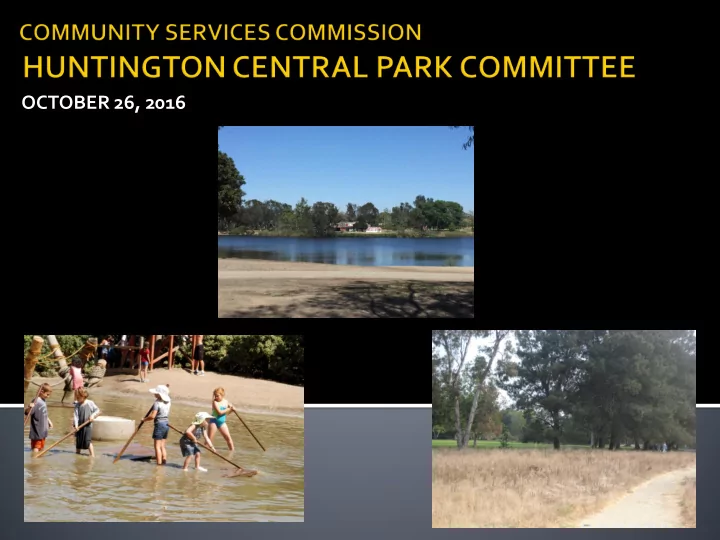
OCTOBER 26, 2016 CITY OF HUNTINGTON BEACH P.O. BOX 190 2000 Main - - PowerPoint PPT Presentation

october 26 2016 city of huntington beach
SMART_READER_LITE
LIVE PREVIEW

OCTOBER 26, 2016 CITY OF HUNTINGTON BEACH P.O. BOX 190 2000 Main - - PowerPoint PPT Presentation

OCTOBER 26, 2016 CITY OF HUNTINGTON BEACH P.O. BOX 190 2000 Main Street California 92648 COMMUNITY SERVICES DEPARTMENT (714) 536-5486 To: Community Services Commission From: Roy Miller, Commissioner Date: August 19, 2016 Subject: CONDITION


slide-1
SLIDE 1

OCTOBER 26, 2016

slide-2
SLIDE 2

CITY OF HUNTINGTON BEACH

P.O. BOX 190 2000 Main Street California 92648

COMMUNITY SERVICES DEPARTMENT

(714) 536-5486 To: Community Services Commission From: Roy Miller, Commissioner Date: August 19, 2016 Subject: CONDITION OF CENTRAL PARK STATEMENT OF ISSUE: On August 8, 2016 the Community Services Commissioners received an email from Dave Dominguez’s office regarding an article submitted by Shari Engel entitled “Central Park is Dying.” The article describes the deteriorating condition of Central Park and how concrete solutions are needed. The article also expresses the importance of maintaining Central Park and the conditions that exist such as:  Failing asphalt paths with large cracks  Old rusted trash cans with old metal supports falling over  Trees that have never been pruned or maintained properly  Ineffective irrigation systems  Homeless encampments due to overgrown/unmaintained areas  Huge grass areas destroyed by ground squirrel infestation  Invasive passion vines taking sunlight away so trees and bushes die  Deteriorating restrooms  Recently planted young trees that are dead RECOMMENDED ACTION: I propose that the Community Services Commission directs the Huntington Central Park Committee to address the conditions of Central Park and report to the Community Services Commission their findings.

slide-3
SLIDE 3

 1968 – Parks & Recreation Commission

recommendation to Council for $6 million park bond

 Bond to fund 32 neighborhood parks and one

regional central city park of 147 acres

 1969 - Bond passed with a 74.3 percent “yes”

vote

 Based on a recommendation from Donald

Shipley to purchase former dump sites for parks, City purchased land at Talbert and Goldenwest – which became the nucleus for HCP development

slide-4
SLIDE 4
  • 1969 – 1971 – Additional land acquired using

bond funds

  • Phase I totaled 147 acres
  • City owned 58 acres and received a Federal Grant

to purchase remaining 89 acres

  • Phase II – City received another Federal Grant to

purchase 50 additionall acres

  • Remaining acres were purchased through direct

negotiations with land owners to acquire the current total of 344 acres

slide-5
SLIDE 5
  • Located in Center of City
  • Shipley met with reps from Audubon Society,

Sierra Club and Nature Conservancy to consider acquiring undeveloped land in the area

  • Adjacent areas were viewed favorably due to

spring-fed water ponds

slide-6
SLIDE 6

Excerpt from Project Narrative:

Central City Park will be a community park. It will be passive with an emphasis on a natural landscape. There will be beautiful large groves of trees and generous open space. Walks and paths will wind in and out of the trees taking people to hills and valleys in the park. There will be views to the lakes and distant mountains. The ocean will be seen from the bluffs while dinning at the restaurant in the park.

slide-7
SLIDE 7

Excerpt from Project Narrative (continued):

Parking will be minimal but, conveniently located. It will be concentrated on the periphery of the park. Landscaping will bring all parts of the park together forming beautiful settings for buildings and delightful areas for people to play and relax. Music in the amphitheater and art at the library will expand the park’s appeal. A beautiful garden in a quarry and nature walks through insolated meadows will create worlds apart from the suburbs.

slide-8
SLIDE 8

Excerpt from Project Narrative (continued):

The meadows in spring will have wildflowers, the trees beautiful blossoms. Birds and small animals will find refuge and food in the plants of the park. Migrating ducks will have breeding and feeding grounds isolated for their

  • protection. Nature buildings will allow man to view

nature’s world. Warm clear days will see softball and football on the lawns. Children will play nearby. A shelter will offer protection for picnics if a drizzle should happen by. All the park will come active on holidays – a boat ride, a golf game, lunch at the lake, a bike ride or a dinner as the day ends.

slide-9
SLIDE 9

Excerpt from Project Narrative (continued):

For the camper of Huntington Beach a site will be near. There will be places for tents, fires and groups to sing. An area down the trail will have fishing and canoe practice pond. The children will see, feel and begin to understand animals in the nearby animal farm. The park will be fun; it will be colorful, changing and

  • exciting. There will be areas for every person, animal

and bird. It will be a part of the city and the city part of it.

slide-10
SLIDE 10
  • Landscape Architect - EDAW
  • April 28, 1972 – City breaks ground on park

development

  • Originally planted with 22,000 shrubs, & 12,000

trees

  • Over a mile of natural trails
  • Over 6 miles of pathways
  • June 15, 1974 – Park Dedication
slide-11
SLIDE 11
  • Alvin M. Coen Campground
  • Adventure Playground
  • Amphitheatre
  • Bandstand
  • Central Library
  • Disc Golf Course
  • Dog Park
  • Equestrian Center
  • Former Gun Range Area
  • Group Picnic Area (McCraken

Meadow)

  • Henry A. Kaufman Picnic Area
  • Huntington Lake
  • Jack Green Nature Area
  • Jake R. Stewart Picnic Area
  • Kathy May’s Lakeview Café
  • Matney Mesa
  • Ocean View Estates
  • Open Space Conservation
  • Park Bench Café
  • Parks Yard
  • Shipley Nature Center
  • Sports Complex
  • Sr. Center in Central Park
  • Sully Miller Lake
  • Talbert Lake
  • Youth Shelter
slide-12
SLIDE 12
  • 1986 – Survey of residents to

determine amenities in undeveloped portions of the park

  • Resident’s preferences ranged from

passive to active uses

  • 1991 - Council established Huntington

Central Park Task Force

  • 1992 – Council approval of land use

designations for the park

slide-13
SLIDE 13
  • 1992 – Updates for Sports Complex,

Urban Forrest

  • 2012 – New Senior Center, Therapeutic

Riding Center

  • 2016 – Raptor Foraging Habitat Area
slide-14
SLIDE 14
  • 1992 – Land designations approved by

Council

  • Designation Categories:
  • L – Recreation/Low Intensity
  • M – Recreation/Medium Intensity
  • H – Recreation/High Intensity
  • E – Environmental Sensitive Areas
  • O - Operations
slide-15
SLIDE 15
slide-16
SLIDE 16

Land Use Designations Environmental Sensitive Areas

Limited development, for public use, that does not

adversely impact identified scientific, ecological, cultural or aesthetic features.

Recreation/Low Intensity

Open Space developed for low intensity or passive-type

recreational activities.

Recreation/Medium Intensity

Open Space developed for medium intensity or semi-

active recreational activities.

Recreation/High Intensity

Developed areas for high intensity or active type

recreational activities. This designation includes structural and/or support facilities.

Operations

Land set aside for maintenance/operational facilities.

Legend A Amphitheater AP Adventure Playground DB Desiltation Basin ED Earthen Dam GP Group Picnic HP Handicap Play Area JG Jack Green Nature Area R Restaurant YS Youth Shelter

slide-17
SLIDE 17

Raptor Foraging Habitat Area

slide-18
SLIDE 18
  • Landscaping along Goldenwest St.
  • Permanent Parking Lot
  • Tot Lot Safety Surfacing
  • Jack Green Area Clean-up
  • HCP East Rehabilitation
  • High Mast Light Pole Replacement
slide-19
SLIDE 19
  • Failing asphalt paths with large cracks
  • Old rusted trash cans with old metal supports falling over
  • Trees that have never been pruned or maintained properly
  • Ineffective irrigation systems
  • Homeless encampments due to overgrown/unmaintained

areas

  • Huge grass areas destroyed by ground squirrel infestation
  • Invasive passion vines taking sunlight away so trees and

bushes die

  • Deteriorating restrooms
  • Recently panted young trees that are dead.