Humanoid Robot Soccer 101 Thomas Rfer Cyber-Physical Systems German - - PowerPoint PPT Presentation

humanoid robot soccer 101
SMART_READER_LITE
LIVE PREVIEW

Humanoid Robot Soccer 101 Thomas Rfer Cyber-Physical Systems German - - PowerPoint PPT Presentation

Humanoid Robot Soccer 101 Thomas Rfer Cyber-Physical Systems German Research Center for Artificial Intelligence (DFKI) 1 RoboCup 2013: SPL Semifinal 2 RoboCup 2013: Statistics UPennalizers UChile Robotics Team 36 TJArk SPQR Team


slide-1
SLIDE 1

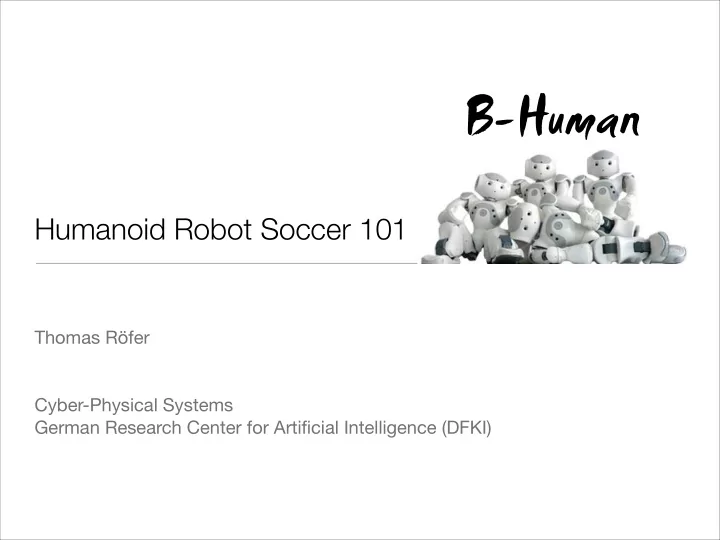
Thomas Röfer Cyber-Physical Systems German Research Center for Artificial Intelligence (DFKI)

Humanoid Robot Soccer 101

1
slide-2
SLIDE 2

RoboCup 2013: SPL Semifinal

2

slide-3
SLIDE 3

RoboCup 2013: Statistics

30 11 9 7 13 1 22 15 9 1 7 2 7 8 2 11 4 22 62 22 5 2 4 1 6 4 8 11 9 8 1 40 15 5 3 12 1 4 10 1 28 7 9 5 12 26 18 3 90 6 9 7 8 3 22 11 17 25 34 11 4 2 1 8 16 3 27 12 12 7 13 2 5 11 1 6 5 14 1 4 8 10 1 15 1 7 4 16 14 4 15 16 7 18 8 1 8 11 2 5 3 15 26 26 9 5 13 8 32 5 12 2 2 5 14 15 11 12 14 1 4 3 9 6 12 8 7 8 13 18 10 17 11 12 1 10 2 27 6 25 18 22 1 16 19 5 3 54 12 1 11 5 1 1 14 1 1 7 17 2 10 2 6 1 6 3 7 7 16 4 16 27 21 4 17 10 2 7 39 36 12 8 Goals Out by Ball Holding Fallen Robot Illegal Defender Inactive Player Leaving the Field Request for PickUp Player Pushing Playing with Hands Austin Villa Austrian Kangaroos B-Human Bembelbots Berlin United Cerberus DAInamite Dutch Nao Team Edinferno Kouretes Mi-Pal Nao Devils Dortmund Nao-Team HTWK Northern Bites NTU RoboPAL RoboCanes RoboEireann rUNSWift SPQR Team TJArk UChile Robotics Team UPennalizers

3

slide-4
SLIDE 4

Standard Platform League

  • Aldebaran Robotics NAO
  • 21-25 degrees of freedom
  • Height 57cm, weight 5 kg
  • Different sensors, on-board PC (1.6GHz Atom)
  • Soccer Competition
  • 5 vs. 5
  • Robots are fully autonomous
  • Field size 9 m x 6 m

4

slide-5
SLIDE 5

60 Hz 100 Hz

s

Controlling a Soccer Robot Cognition Motion

  • Perception: What do I see now?
  • World Modeling
  • Where am I?
  • Where are objects currently not perceived?
  • What speeds do objects have?
  • Behavior Control: What to do?
  • Sensing: What am I feeling?
  • Motion Control: Walking, kicking, standing up, looking

5

slide-6
SLIDE 6

Perception

6

slide-7
SLIDE 7

Perception: Grid-based Scanning and Specialists

7

slide-8
SLIDE 8

Perception: Determining Distance

distance from size distance from bearing

8

slide-9
SLIDE 9

Sensing

  • Center of Mass
  • Ground contact
  • Falls (with direction)
  • Robot is falling
  • Torso pose
  • Camera poses

9

slide-10
SLIDE 10

Sensing: Torso Pose

  • Unscented Kalman Filter
  • Forward kinematics
  • Calibrated gyroscopes
  • Compensation for gyroscope’s bias drift

10

slide-11
SLIDE 11

Sensing: Calibrating Camera Pose

  • Before calibration
  • Misplaced camera
  • Backlash in joints
  • After calibration
  • Camera roll / tilt
  • Overall body roll

11

slide-12
SLIDE 12

Perception and Sensing: Synchronization

  • Rolling shutter (CMOS technology exposes pixel-by-pixel)
  • Time differences between images and joint angles
  • Correction
  • Using head joint 


velocities

  • Only perceptions, not 


whole image

Image taken by Bioloid robot

12

slide-13
SLIDE 13

World Modeling: Self-Localization, Ball

  • Self-localization
  • Particle filter with 16 


Unscented Kalman Filters

  • Side confidence and own side model
  • Use ball for disambiguation
  • Ball modeling
  • 6 Kalman Filters for static ball
  • 6 Kalman Filters for rolling ball

13

slide-14
SLIDE 14

World Modeling: Obstacles

  • Sonar-based
  • Overlapping measurement areas
  • 2-D evidence grid of

measurement history

  • Vision-based
  • Edges between field 


and robots

  • Obstacle wheel

14

slide-15
SLIDE 15

Motion Control

  • Walking
  • Kicking
  • “Special actions”
  • Getting up
  • Head control
  • Scan interesting points on the field
  • Hard-coded modes

15

slide-16
SLIDE 16

Motion Control: Walking

16

  • Omni-directional
  • Modeling single support phase 


as linear inverted pendulum

  • Balancing with difference between observed and planned COM
slide-17
SLIDE 17

Motion Control: Walking and Kicking

92°/s 31cm/s 22cm/s 12cm/s

17

slide-18
SLIDE 18

Motion Control: Balanced Dynamic Kicks

18

  • Modeled as a sequence of Bezier curves
  • 2x foot positions, 2x foot rotations, 


2x arm positions

  • Transitions continuous in place and

gradient

  • Control points are adapted during kick
  • Balancing based on
  • Preview of COM
  • Gyroscopes
slide-19
SLIDE 19

Motion Control: Balanced Dynamic Kicks

19

slide-20
SLIDE 20

Behavior Control: Hierarchical State Machines (Options)

20

slide-21
SLIDE 21

Behavior Control: States and Decision Trees

21

slide-22
SLIDE 22

Behavior Control: CABSL – C-based Agent Behavior Specification Language

  • Directly compiled by C++ compiler
  • Modeling behavior with hierarchical state

machines (options)

  • Each option contains states
  • Each state contains
  • conditional transitions to other states
  • actions (C++, calls to other options)
  • Each option can only switch its state once

per execution cycle

22

  • ption(goaliePlaying) {

initial_state(stayInGoal) // ... state(getToBall) { transition { if(ball.notSeenFor > 500 || ball.distance > 600) goto returnToGoal; else if(ball.distance < 150) goto clearBall; } action { GoToBall(); } } }

slide-23
SLIDE 23

Behavior Control: CABSL – Special States and Symbols

  • initial_state (mandatory): Option returns to this state when it

was not executed in the previous cycle

  • target_state: Caller's symbol action_done becomes true if

the last sub option it called reaches this state

  • aborted_state: Caller's symbol action_aborted becomes

true if the last sub option it called reaches this state

  • option_time: How long since entering the initial_state?
  • state_time: How long since entering the current state?

23

slide-24
SLIDE 24

Behavior Control: Team Play

  • Roles: Striker, supporter, breaking supporter, defender, keeper
  • Global world model
  • Global ball for role switching
  • Teammate positions for path 


planning

  • Joint actions
  • Kick-off, passing
  • Synchronized ball tracking and searching

24

slide-25
SLIDE 25

Behavior Control: B-Human 2013

25

slide-26
SLIDE 26

Conclusions

  • Doing the right things
  • Grid-based vision
  • Probabilistic world modeling (often based on textbook methods)
  • Hierarchical state machines for behavior control
  • Balanced walks and kicks
  • Doing things right
  • Keeping 60Hz/100Hz
  • Synchronization and calibration

26

E x e r c i s e : w w w . t z i . d e / s p l / b i n / v i e w / W e b s i t e / H S S 2 1 3