Optimizing Interdependent Skills for Simulated 3D Humanoid Robot - - PowerPoint PPT Presentation

optimizing interdependent skills for simulated 3d
SMART_READER_LITE
LIVE PREVIEW

Optimizing Interdependent Skills for Simulated 3D Humanoid Robot - - PowerPoint PPT Presentation

Optimizing Interdependent Skills for Simulated 3D Humanoid Robot Soccer Daniel Urieli, Patrick MacAlpine, Shivaram Kalyanakrishnan, Yinon Bentor, Peter Stone UT Austin Villa The University of Texas at Austin Goal Creating and integrating a

slide-1
SLIDE 1

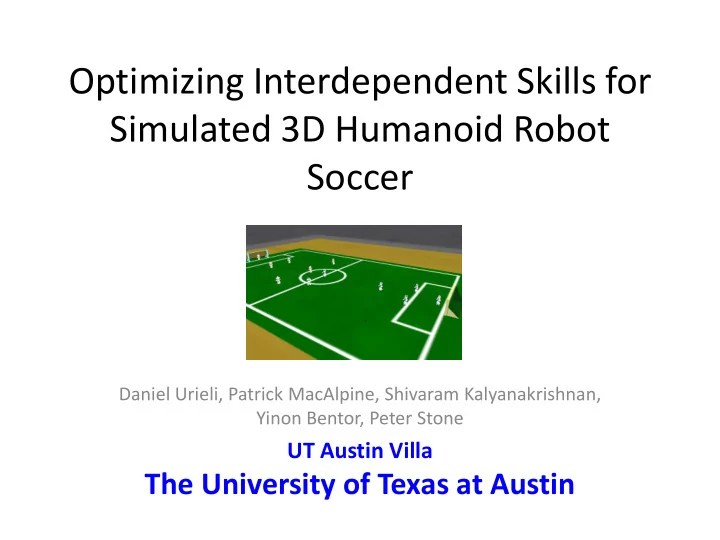
Optimizing Interdependent Skills for Simulated 3D Humanoid Robot Soccer

Daniel Urieli, Patrick MacAlpine, Shivaram Kalyanakrishnan, Yinon Bentor, Peter Stone

UT Austin Villa

The University of Texas at Austin

slide-2
SLIDE 2

Goal

Creating and integrating a set of motion skills for a 3D simulated robot soccer player

slide-3
SLIDE 3

Background

  • Simspark simulation
  • Based on ODE engine
  • Robot model: Aldebaran’s Nao
  • Message-based interaction with

simulator

  • 22 degrees of freedom
  • Communication between agents – 20

bytes messages

  • A robot is operated by joint torques
  • We wrapped it with a PID controller
slide-4
SLIDE 4

Contributions

– A skill learning architecture for a humanoid robot soccer agent

  • Fully deployed in Robocup 2010
  • Learning rather than hand-coding more

than 100 parameters

  • A significant building block in our agent,

which is competitive with top-8 agents of Robocup 2010

– Sheds light on designing fitness functions for constraining an evolutionary learning process – A new successful application of the CMA-ES algorithm

slide-5
SLIDE 5

The Need for A Learning Architecture

  • Skills needed by a soccer playing robot:

Walk-front Walk-back Walk-diagonally Walk-sideways Turn Kick Goalie-dive More…

  • Coding each skill by hand might be tedious and sub-optimal
  • On top of it, a skill design need to account for cooperation with other skills

– A robot running full speed forwards need to be able to stop and turn without falling….

  • Calls for a skill learning architecture
slide-6
SLIDE 6

A Framework for Optimization through Learning

  • Open loop joints control
  • Repeatedly execute 4 control frames

Each frame specifies direct joint angles

SKILL WALK_FRONT KEYFRAME 1 reset ARM_LEFT ARM_RIGHT … setTarget JOINT1 $jointvalue1 JOINT2 $jointvalue2 setTarget JOINT3 4.3 JOINT4 52.5 ... wait 0.08 KEYFRAME 2 ...

Skills Description Language

slide-7
SLIDE 7

Running Massive Amounts of Jobs in Parallel

  • Our framework uniformly implements several evolutionary algorithms for

parameters learning

  • Evaluations are done in parallel using Condor (www.cs.wisc.edu/condor) - an open

source software for parallel computing

  • Repeatedly:
  • A complete learning experiment contains 15,000-50,000 runs

– For instance, 100 generations x 100 population x 5 averaging runs – Using condor, we run 100 simulations in parallel, 25 seconds per simulation – Wall clock time is 5-7 hours, for a total CPU time of ~350 hours

Based on the fitness values, create population of the next generation Send to condor for real-time fitness evaluation of parameters

condor

Parameters-sets population

slide-8
SLIDE 8

Optimizing individual skills

  • Goal: optimize the set of joint angles for maximum speed
  • A fitness of a set of joint angles:

The agent’s displacement in the desired direction

  • Inherently accounts for falls and non-straight walks
  • Measured over 15 seconds
  • Extensively compared several learning algorithms:

– Hill-Climbing, Cross-Entropy Method, Genetic Algorithm and CMA-ES CMA-ES learning curve

slide-9
SLIDE 9

CMA-ES

  • A stochastic, derivative-free, evolutionary numerical optimization

method for non-linear or non-convex problems

  • Each generation, candidates are sampled from a multidimensional

Gaussian, and evaluated for their fitness

  • Two main principles for parameter adaptation:
  • Mean maximizes the likelihood of previously successful

candidates, Covariance maximizes the likelihood of previously successful search steps (Natural Gradient Decent)

  • Evolution paths are recorded and used as an information source

Found out to be extremely effective in our domain

slide-10
SLIDE 10

Results – Individual Skills

slide-11
SLIDE 11

Front Walk

slide-12
SLIDE 12

Back Walk

slide-13
SLIDE 13

Kick

slide-14
SLIDE 14

Optimizing Sequences of Skills

  • Problem: fast locomotion skills, when integrated directly into the

robot, result in frequent falls.

slide-15
SLIDE 15

Optimizing Sequences of Skills

  • Problem: fast locomotion skills, when integrated directly into the

robot result in frequent falls.

  • An example skill execution log (32ms decision cycle):

Skills are interdependent: Learn them together

  • Skills dependencies graph:
slide-16
SLIDE 16

Idea 1: Optimize skills in conjunction

  • Want both speed and stability under these transitions:
  • Change the fitness evaluation method:

– Evaluation method should include all skill transitions – But still reflect how good the currently-learned skill is

  • An ideal fitness evaluation: Full Game results

– But too noisy

  • An effective alternative:

– The time-to-score on an empty field – No noise caused by other players – Robot moves in a realistic scenario of skill transitions – Evaluated based on its ultimate objective

slide-17
SLIDE 17

A Problem

  • So far, optimized under these constraints
  • The need to transition smoothly from every skill

to every skill limits our max-speed

  • Can we relax some constraints, thus achieving

faster speeds?

slide-18
SLIDE 18

Idea 2: Skill Decoupling

  • It turns out we can further optimize speed, by

adding additional, less-constrained skills.

Add new skills, constrained by

  • nly one skill
slide-19
SLIDE 19

Putting it all together

Agent A0 – initial seed Agent A1 – WalkFront_S

  • ptimized

Agent A2 – WalkFront_F

  • ptimized

Agent A3 – WalkBack_S

  • ptimized

Agent A4 – WalkBack_F

  • ptimized

Agent A5 – Decision thresholds tuned

slide-20
SLIDE 20

A0 vs. A5

A0 A5

slide-21
SLIDE 21

Results – Agents Improvements

Full 6x6 game results

slide-22
SLIDE 22

Results – Time-To-Score Measure

slide-23
SLIDE 23

Results – Full Games

Goal Differential (stderr)

slide-24
SLIDE 24

Future Work

  • Extend the scope of learning within our agent:

– Waiting times between frames – Replace hand-coded skills: fine positioning, getting up – Decision thresholds

  • Alternative parameterizations: closed-loop, inverse

kinematics

  • Extend to real robots?
slide-25
SLIDE 25

Related Work

  • N. Hansen. The CMA Evolution Strategy: A Tutorial, January 2009.
  • N. Shafii, L. P. Reis, and N. Lao. Biped walking using coronal and

sagittal movements based on truncated Fourier series, January 2010.

  • J. E. Pratt. Exploiting Inherent Robustness and Natural Dynamics in

the Control of Bipedal Walking Robots. PhD thesis, Massachusetts Institute of Technology, Cambridge, MA, USA, June 2000.

  • N. Kohl and P. Stone. Machine learning for fast quadrupedal

locomotion, 2004.

slide-26
SLIDE 26

Summary

  • We presented a learning architecture for a simulated humanoid

robot soccer player

  • Optimized over 100 parameters
  • Used 2 ideas for improving speed while maintaining stability:

– Optimizing under constraints – Skills decoupling

  • A main building block in our agent, which is competitive with

Robocup 2010 top-8 teams

  • Found a new, successful application for the relatively new, CMA-ES

algorithm