SLIDE 1
1
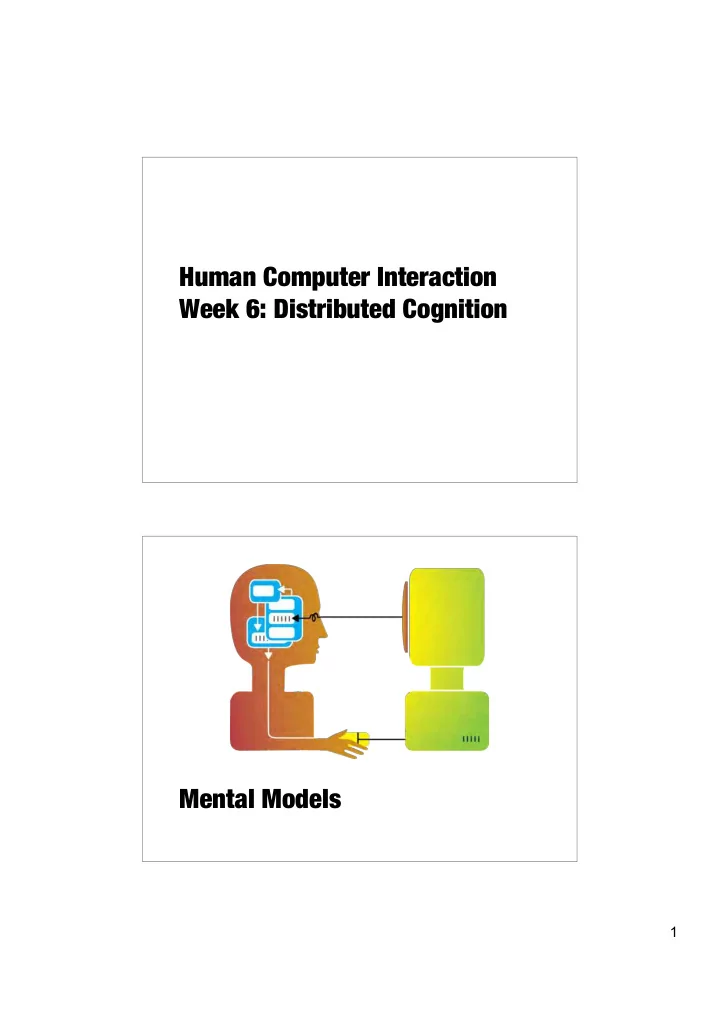
Human Computer Interaction Week 6: Distributed Cognition Mental Models
SLIDE 2
2
Distributed Cognition Work is more than the activity of a single individual working alone and without tools.
SLIDE 3
3
Two distinguishing principles
1.Boundaries of the unit of analysis for cognition 2.Range of mechanisms assumed to constitute cognitive processes
Task: Sorting a deck of cards
SLIDE 4 4
Three ways that cognition is ‘distributed’
- Socially
- Internal / External
- Through time
Functional system
SLIDE 5 5
Functional system
- The system is constrained by the set of
resources appropriated into the resolution of the problem.
- The system, not the individuals
performs the task.
Practical Task: Cognitive Processes in the Library
- In groups, see if you can identify cognitive
processes in the setting of the library.
- Map out the information flows through these
processes.
- How is the information represented and
transformed.
- Can you find examples of ‘cognitive
artefacts’ or other concepts from this week’s lecture and readings?
- For the discussion next week, prepare a
presentation to show to the rest of the class.
SLIDE 6
6
Cognitive artefacts Embodied Cognition
SLIDE 7
7
Embodied Cognition
Minds are not passive representational engines, whose primary function is to create internal models of the external world. The relations between internal processes and external ones are far more complex, involving coordination at many different time scales between internal resources—memory, attention, executive function—and external resources—the objects, artifacts, and at-hand materials constantly surrounding us.
Socially Distributed Cognition
SLIDE 8
8
Culture and Cognition Culture and Cognition
SLIDE 9 9
Critical Questions
- Is computation an appropriate
metaphor for all activities?
Readings
- Y. Rogers, "A Brief Introduction to
Distributed Cognition", Discussion Paper Interact Lab, School of Cognitive and Computing Sciences, University of Sussex, 1997
- Hollan, J., Hutchins, E., and Kirsh, D.
“Distributed Cognition: Toward a New Foundation for Human-Computer Interaction”, ACM Transactions on Human- Computer Interaction, Vol. 7, No. 2, June 2000, pp 174-196.
SLIDE 10 10
Image Credits
- http://www.flickr.com/photos/tim-owen/3330644976
- http://www.flickr.com/photos/oneeighteen/1346919647
- http://www.flickr.com/photos/oneeighteen/2891585120
- http://www.edunetconnect.com/cat/timemachine/images/ma
ttang.gif
Image Credits
- http://www.flickr.com/photos/36122696@N08
- Herb Kawainui Kane
- http://www.flickr.com/photos/idi0tech/1444716026
- http://www.science.uva.nl/museum/pictures/reiss3.jpg
SLIDE 11 11
Image Credits
- http://www.flickr.com/photos/eob/78714830