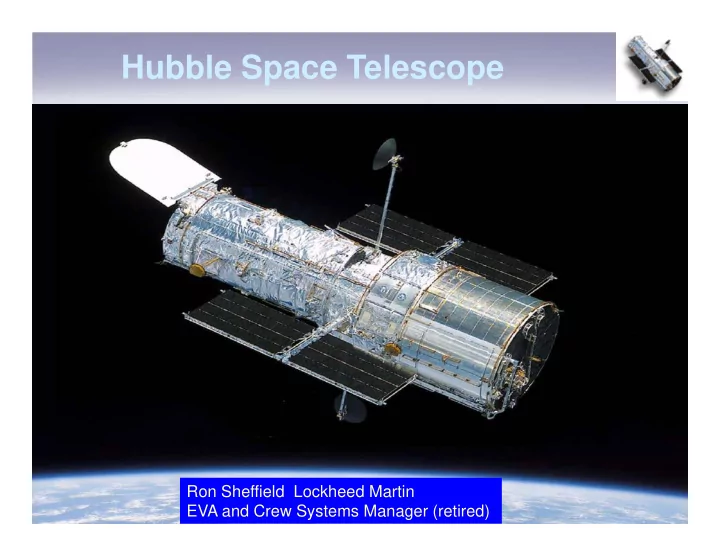
SLIDE 1 Hubble Space Telescope
Ron Sheffield Lockheed Martin EVA and Crew Systems Manager (retired)
SLIDE 2 Hubble Space Telescope
- I am going to give you an overview of the
Hubble Space Telescope
–Its history, –its dimensions and characteristics, –its servicing missions with emphasis on SM4 –its science results, –and some historical HST space shots.
SLIDE 3 Hubble Space Telescope
- The contract to build HST was awarded in Oct 1977. It was a two part contract-
- ne for spacecraft and one for the mirror.
- In 1977, all components were to be designed to be replaced on-orbit.
- Reduction in funds in 1980 and 1983 reduced Orbit Replacement Units (ORUs)
to 14 different types. Total number was 24 ORUs boxes in 1985.
- In 1985, I was assigned to make as many HST components as possible
serviceable on-orbit.
- When we launched in 1990, 94 types of electronic boxes and mechanisms, and
all connectors were made to be serviceable on orbit.
- All 94 ORUs were EVA enhanced with nomenclature, serial number, orientation,
connector map, connector identification, and powered-on connector decals.
- The HST was designed to have an on orbit life span of 15 years.
- The HST has been on orbit for 21 years as of April 25, 2011.
2
SLIDE 4 HST Dimensions and Characteristics
- The HST is 43.5 feet long and 14 feet in diameter.
– The size of a regular yellow school bus
- The HST mirror is 2.4 meters in diameter (94 inches).
- HST weighs almost 26,500 pounds.
– Exactly 126.83 times my weight
- HST is 325 nautical miles above the earth.
– San Francisco to Los Angeles
- HST has taken pictures out to 13+ billion light years.
– Distance light travels in one light year=5,878,000,000,000 miles
- HST pointing accuracy is .0000019 degrees plus
– Able to hit a dime with a laser at 400+ miles
- HST is designed for servicing
– Has 4 Aft shroud large doors, 10 Equipment Section Doors, 7 Optical Telescope Assembly Bay door, 224 of handrails and 31 foot restraints – 94 types of ORUs have been designed for replacement on orbit
SLIDE 5
Data Management Unit Decals
SLIDE 6
Exploded View of HST
SLIDE 7 HST Dimensions and Characteristics
- HST orbits the earth approximately every 94-97 minutes at
a speed of 17,500 MPH. (Mach 25)
- In 21 years the HST has made 117,400+ trips around earth.
- HST was designed for external temperature ranges from -150F
to +200F. The temperature for the mirror and focal plane structure is 70 degrees to prevent warping and distortion.
- Power is provided by two rigid Solar Arrays and 2 Batteries.
- HST operates 24 hours 365 days a year.
- There are over 60,000 pictures of the HST satellite and space
support hardware.
– 25,000 pictures taken before launch and 35,000 to date from the servicing missions.
SLIDE 8 Hubble Space Telescope Servicing Missions
The HST missions are:
25-29 April 1990
17-21 December 1993
11-21 December 1997
19-27 December 1999
1-12 March 2002
11-24 May 2009
I have trained 40 astronauts to do these missions. There were 4 women and 11 are in the Astronaut Hall of Fame.
SLIDE 9 Hardware Replaced on Servicing Missions
- Deployment Mission (STS-31) Deployment of HST
- 1st Servicing Mission (STS 61) Restored HST Vision
– 3 Rate Sensor Units, Solar Arrays, Wide Field Camera, & Corrective Optics Space Telescope Axial Replacement
- 2nd Servicing Mission (STS 82) Expanded HST’s
Universe – Near Infrared Camera and Multi-Object Spectrometer, Space Telescope Imagining Spectrograph, 1 RSU, 1 Reaction Wheel, & 1 Solid State Tape Recorder.
- 3-A Servicing Mission (STS-103) To the Rescue
– 3 RSUs, Fine Guidance Sensor, Main Computer, Thermal Protection Kit, Transmitter, Electronics Control Unit, Voltage Improvement Kits
SLIDE 10 Hardware Replaced on Servicing Missions
- 3-B Servicing Mission (STS-109) Better Than Ever
– 2 Solar Arrays, 1 Wide Field Camera 2, Advanced Camera for Surveys, Cooling Radiator for STIS, Power Control Unit, New Outer Bay Layer Thermal Cover
- 4th Servicing Mission (STS-125) The Last One
– Purpose is to extend life and increase science – 3 RSUs, 2 Ni H2 Batteries, STIS (Repair), 1 Fine Guidance Sensor, 1 Wide Field Camera 3, 1 Cosmic Origins Spectrograph, Advanced Camera for Surveys (Repair), Scientific Instrument Control and Data Handling, Soft Capture Mechanism, New Outer Bay Layer Thermal Cover
SLIDE 11
SLIDE 12
The STS-125 SM4 Patch
Keeping with tradition, SM4 Crewmembers, with previous HST experience, were assigned to the mission STS-125 was flown on the Atlantis shuttle
SLIDE 13
SM4 Crew Members
SLIDE 14
SLIDE 15
Neutral Buoyancy Training
SLIDE 16 NBL Facility at Houston
202 ft in length 102 ft wide HST mockup Shuttle mockup
SLIDE 17 HST Mockup inside Shuttle mockup inside NBL
HST Mockup Shuttle Mockup
SLIDE 18
SLIDE 19
SLIDE 20
SLIDE 21
ce Support Equipment remove from Atlantis after mission
SLIDE 22
Inside Shuttle Cockpit
SLIDE 23
SLIDE 24
SLIDE 25
SLIDE 26
Grapple of HST
SLIDE 27
Captured and Secured
SLIDE 28
SLIDE 29
SLIDE 30
SLIDE 31
SLIDE 32 PCU on-orbit change-
SLIDE 33 Ground STIS Trainer
SLIDE 34
On-orbit Helmet camera
SLIDE 35 STIS MEB Cover removed Bad board
SLIDE 36
SLIDE 37
SLIDE 38
Sunrise On-orbit
SLIDE 39
SLIDE 40
SLIDE 41
SLIDE 42
SLIDE 43
SLIDE 45
SLIDE 46
Shuttle Returning to KSC
SLIDE 47 HST Scientific Discoveries
- HST compared to earth-based telescopes:
– Sees celestial objects that are 50 times fainter. – Provides images that were 10 times sharper – Sees objects that are 7 times further away.
- HST has established the age of the universe at about
13.75 billion light years.
- HST has proven there are black holes.
- HST has discovered that something exists called “dark
energy” that pushes galaxies apart and “dark matter’ that pulls galaxies together.
- HST has discovered over 100 extra-solar planets.
- In HST’s 21 years on orbit has taken
– 880,000 observations – 570,000 images of 29,000 celestial objects – 117,400 trips+ around the earth
SLIDE 48 HST Science Data
- HST has produced nearly 38 terabytes of data enough to fill
two collections in the US Library of Congress.
- Every month HST generates more than 80 gigabits of data.
- 7700 scientists worldwide are registered users of the
Hubble data archive.
- Every day astronomers world wide withdraw over 50,000
gigabytes from the HST archive – This is three times the ingress rate of new data
- Astronomers using HST data have published more than 7,500
scientific papers
SLIDE 49 Deepest Image Ever Taken – Hubble Ultra Deep Field
49
SLIDE 50
Over 500 Extremely Distant Proto-Galaxies Discovered In Hubble Ultra-Deep Field
SLIDE 51
Proto-Galaxy That Emitted Its Light 13 Billion Years Ago
SLIDE 52 Hubble telescope's top five greatest space photographs
- The Sombrero Galaxy - 28 million light years from Earth - was voted best picture taken
by the Hubble telescope. The dimensions of the galaxy, officially called M104, are as spectacular as its appearance. It has 800 billion suns and is 50,000 light years across.
SLIDE 53
Hubble telescope's top five greatest space photographs
The Ant Nebula, a cloud of dust and gas whose technical name is Mz3, resembles an ant when observed using ground-based telescopes. The nebula lies within our galaxy between 3,000 and 6,000 light years from Earth.
SLIDE 54 Hubble telescope's top five greatest space photographs
- In third place is Nebula NGC 2392, called Eskimo because
it looks like a face surrounded by a furry hood. The hood is, in fact, a ring of comet-shaped objects flying away from a dying star. Eskimo is 5,000 light years from Earth.
SLIDE 55
Hubble telescope's top five greatest space photographs
At four is the Cat's Eye Nebula, which looks like the eye of disembodied sorcerer Sauron from Lord of the Rings.
SLIDE 56 Hubble telescope's top five greatest space photographs
- The Hourglass Nebula, 8,000 light years away, has a
pinched-in-the-middle look because the winds that shape it are weaker at the centre. It is also called the Eye of God.
SLIDE 57
Celestial Butterfly
First Hubble Pictures After Servicing Mission
SLIDE 58
100,000 Stars in Omega Centauri
First Hubble Pictures After Servicing Mission
SLIDE 59
Stephan's Quintet
First Hubble Pictures After Servicing Mission
SLIDE 60
SLIDE 61
SLIDE 62
SLIDE 63
SLIDE 64