
SLIDE 1
The James Webb Space Telescope Knox Long STScI
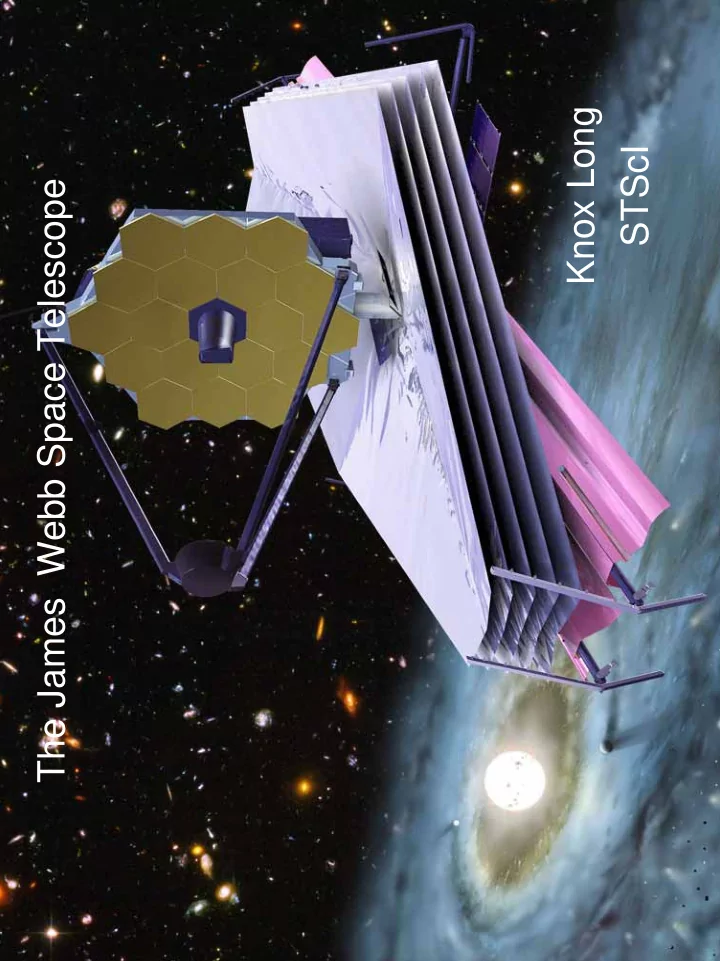
Knox Long STScI The James Webb Space Telescope JWST Successor to - - PDF document
Knox Long STScI The James Webb Space Telescope JWST Successor to HST Introduction Webb Science Webb Hardware Summary Hubble Space Telescope HST has made and continues to make huge impact on astronomy and the
The James Webb Space Telescope Knox Long STScI
continues to make huge impact on astronomy and the public
– Cosmic distance scale – Accelerating universe & dark energy – Supermassive BH in Galaxy centers
– installation of new instruments and repair of old ones will make Hubble even more capable than presently
telescope
wavelengths, namely in the infrared
– Peer further back in time – Peer deep into regions of space hidden by dust – Study cool objects like planets – Learn about objects in another wavelength band
The Eagle Nebula as seen in the infrared The Eagle Nebula as seen by HST
108
1600 1700 1800 1900 2000
Galileo
Year of observat ions
Telescopes alone Phot ographic & elect ronic det ect ion
Huygens eyepiece Slow f rat ios Short ’s 21.5” Herschell’s 48” Rosse’s 72” Phot ography Mount Wilson 100” Mount Palomar 200” Soviet 6-m
Sensitivity Improvement
106 104 102
Adapted from Cosmic Discovery, M. Harwit
1010
CCDs HST J WST
Big Telescopes with Sensitive Detectors in Space
1610 1665 1796 1926
telescope
primary mirror
– Provides needed sensitivity – Image quality similar to Hubble
position called L2, which is well beyond the moon
– This allows the telescope and its instruments to be very cold (<50 K)
and observe for at least 5 years
– 0.6-5 µm imaging – 40 Mpix camera
– 0.6-5 µm spectrograph, using 8 Mpix detector – Up to 100 objects at once – Long slit & IFU spectroscopy
– 5-28 µm imaging – Slit and IFU spectroscopy – 3 Mpix detector
– (R~100) narrow band imaging – 12 Mpix camera
Big Bang
Particle Physics
Now
Atoms & Radiation First Galaxies Galaxies Evolve Planets, Life & Intelligence 300,000 years 3 minutes 1 billion years 13.7 billion years 400 million years
Patchy Absorption
Redshift
Wavelength Wavelength Wavelength
Lyman Forest Absorption Black Gunn- Peterson trough
z<zi z~ zi z> zi
Neutral IGM
.
What Webb will do
surveys to find objects emerging from darkness
spectra to study gas
Neutral gas absorbs UV light --> Observed as IR light because of Redshift
constant enough to use R=5 imagery to determine the redshift of galaxies
Yan et al 2004 Z~2.7 object
How did galaxies evolve to what we see today?
The Hubble Sequence
By Merging!
What Webb will do
see how their shape changes with redshift
there rate at which stars form
stars?
masses in low-mass stars?
Deeply embedded protostar Agglomeration & planetesimals Mature planetary system Circumstellar disk
The Eagle Nebula as seen by HST The Eagle Nebula as seen in the infrared
clouds
by “Nature”
– MC have many rotating clumps – Disks forms around the clumps – Stellar mass builds from disk
destroys disk in high mass objects
– low mass “companions” in gravitational well collide to form high mass stars
reveal these massive young stars forming
Bonnell et al. 2004
t: 0.66 1.3 1 10 25 many M 4-8
Visible (HST) Spitzer (24 μm) JWST (20 μm) Fomalhaut
related to our Solar System?
established?
Spitzer image
Webb will obtain images and spectra of
– comets, – Kuiper Belt Objects, and – the outer planets and their moons
– Coronagraphy
Titan
exoplanets transiting the parent star
– Shape of light curve measures radius and temperature distribuion – Webb will image many more
– Determine atmospheric composition – May show whether they are habitable
Science Instruments Spacecraft Sunshield Telescope
Webb is 7 tons and fits inside an Ariane 5 shroud This remarkable feat is enabled by:
Astronaut
Hubble @ LEO in 2000
QuickTime™ and a Sorenson Video 3 decompressor are needed to see this picture.
Arianne Launch Movie
sun, not the earth
– For Hubble, about about 50% of the heat load on a satellite is due to the earth and it comes from all angles – Sunshield protects telescope from the earth, sun, and moon.
– Earth will not get in the way every 95 minutes
Laplace (1749-1827)
Rotate and latch primary mirror chords Latch secondary mirror support structure OTE in folded configuration Deploy secondary mirror Rotate and latch primary mirror chords Latch secondary mirror support structure OTE in folded configuration Deploy secondary mirror Rotate and latch primary mirror chords Latch secondary mirror support structure OTE in folded configuration Deploy secondary mirror
Secondary Mirror 2 Flight Spares Pathfinder Mirror Be fabrication Primary Mirror Segments
6.6 m
For more Webb information see our websites: www.jwst.nasa.gov, www.stsci.edu/jwst Deployment Movie
May 10 - 12 Next week
Edwin Hubble
Chandrasekhar
Lyman Spitzer
– Junior senator from Virginia?
James Webb,
NASA 1961-1968 when went to moon
FGS MIRI NIRSpec NIRCam
colors at one time
– 2’x2’ & 2’x2’ – 0.6 μm < λ < 2.4 μm – 2.6 μm < λ < 5 μm
– Wide-field imaging – Coronagraphy
– 3.5’ Large FOV Imaging Spectrograph – 4 x 175 x 384 element Micro-Shutter Array – 2 x 2k x 2k Detector Array – Fixed slits and IFU for backup, contrast – SiC optical bench & optics
spectrograph
– 1.9 x 4 arcmin – 5-28 μm – R=5 filter set – Coronagraph
– Conventional slit spectrograph as
– Integral field spectrograph obtain spectrum of every pixel in a small field
– All
1 . 3 a r c m i n 1.7 arcmin
band imager
– R~100