
SLIDE 1
https://www.facebook.com/Facilitating-Authentic-Participation/
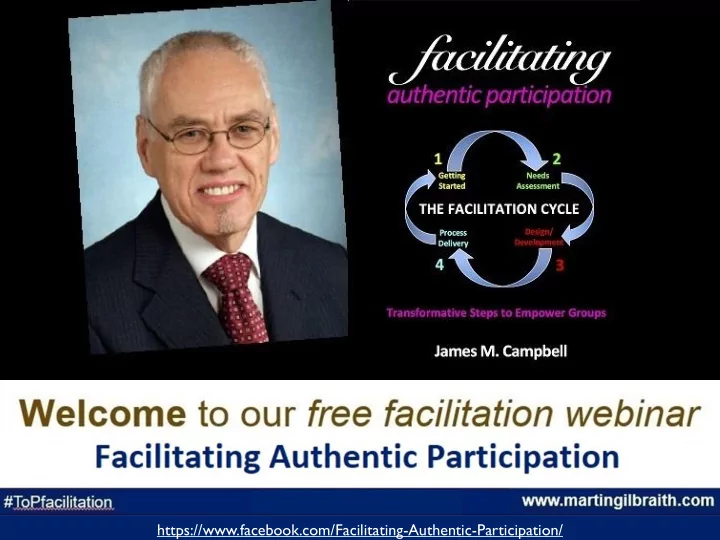
https://www.facebook.com/Facilitating-Authentic-Participation/ - - PowerPoint PPT Presentation
https://www.facebook.com/Facilitating-Authentic-Participation/ PARTICIPATION THROUGH HISTORY Platos Magna Charta Republic curbed power of Elite/male absolute ruler Roman Republic share power with Govern in Representational Govt.
https://www.facebook.com/Facilitating-Authentic-Participation/
Plato’s Republic Elite/male Govern in Direct Democracy Roman Republic Representational Gov’t. Magna Charta curbed power of absolute ruler— share power with elite—1215 Renaissance, Reformation and Counter Reformation 16th-17th Centuries Renaissance—focus on human in this world Reformation & Counter Reformation—radical change in the religious world view. Focus on the individual—man in personal relation with God/made in God’s image—all equal before
Value of the individual and the need to respect that value Age of Reason/Enlightenment 18th Century Secular Revolution—Secular articulation of the new religious world view. Question of
power reside in a society? American and French Revolution invented Liberal Democracy— ”Bill of Rights” and “The Declaration of the Rights of Man” Participation is a human right—20th Century Participation in the decision-making is part of being a human being. Your humanity is reduced if you are denied that right. “Universal Declaration of Human Rights”
PARTICIPATION THROUGH HISTORY
PHASE ONE INTIAL CONTACT & GAINING ENTRY PHASE 2 CONTRACTING PHASE 3 COLLECTING DATA PHASE 4 MAKING SENSE OF THE DATA AND DIAGNOSING THE PROBLEM PHASE 5 DESIGN & DEVELOP THE PROGRAM
THEORY INPUT
PHASE 6 DELIVER THE PROCESS PHASE 7 DISENGAGING
INTERNATIONAL RELIEF ORGANSATION Country Office
New Country Director Current Country Director New Primary Support Country Former Primary Support Country International Organisation Office Other Funding Offices Austria France United Kingdom UNHCR
WHO KNOWS The people working with the problem have the most information—unless we accept them as part of the client system we will not get far. WHO CARES While the manager with the problem is obvious there may be many others who care who have to be considered as part
WHO CAN Do something about solving the problem? People who have decision-making authority or control resources and/or finances are key.
FACILITATION—BRIDGING THE GAP, MEETNG THE NEED
Where people are Where people want to get to Programme design is about enabling this journey The journey How to get there Needs assessment Programme design
Objective Translate into Outputs Products