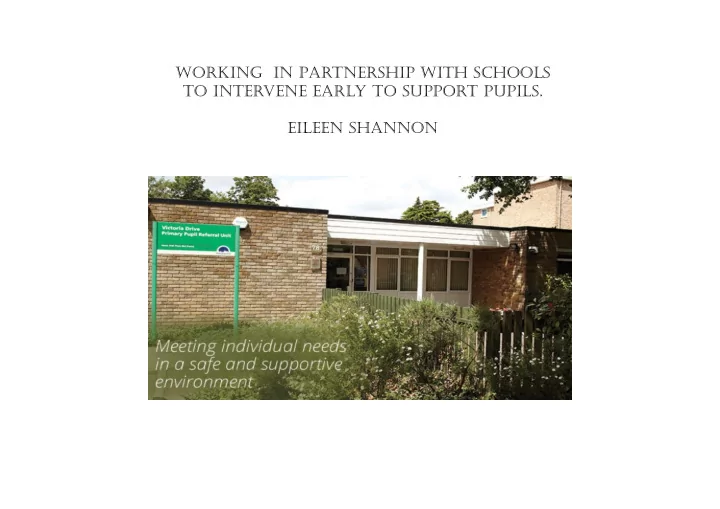
SLIDE 1
How we
SLIDE 2 Context
- Wandsworth is an Inner London Borough in South London.
- Migration: Wandsworth has the highest migration rates of any London borough
- Black and Minority Ethnic groups: 29% of population
- Deprivation: 21% of population live in poverty.
- There are sixty- two primary schools.
- Approximately 29 000 children 0- 15
SLIDE 3 Unique Pupil Numbers
The unique pupil number ( UPN ) is a 13- character code that identifies each pupil in the local-authority-maintained school system. The guide is for schools and local authorities, and provides information on UPNs , including: guidelines on maintaining UPNs. data protection.
SLIDE 4 Victoria Drive Primary Pupil Referral Unit
- Statutory duty to provide full time education for pupils of statutory school age who have been
permanently excluded from their mainstream school.
- The number of children being excluded from schools in England is rising, after falling for years.
- It works out as eight in every 10,000 primary aged children in England( Department for Education 2016 )
- Most permanent exclusion occur due to violent and aggressive behaviour
- At Victoria Drive PRU, we are showing a different trend- numbers of permanent exclusions within
Wandsworth primaries is decreasing.
2013- 14 2014- 15 2015- 16 2016- 17 2017- 18 2018- 19 2019- 2020 5 4 3 2 2
SLIDE 5
DfE Exclusion guidelines (2015)
Disruptive behaviour can be an indication of unmet needs. Where a school has a concern about a pupil’s behaviour it should try to identify whether there are any causal factors and intervene early in order to reduce the need for subsequent exclusion.
SLIDE 6 Social, emotional and mental Health Difficulties (SEMHDs)
Definition in the SEND Code of Practice; 0-25 Years 2014
- These difficulties may include
becoming withdrawn or isolated, as well as displaying challenging, disruptive or disturbing behaviour. These behaviours may reflect underlying mental health difficulties such as anxiety or depression, self-harming, substance misuse, eating disorders
- r physical symptoms that are
medically unexplained. Other children and young people may have disorders such as attention deficit disorder, attention deficit hyperactive disorder or attachment disorder.
- Schools and colleges should
have clear processes to support children and young people, including how they will manage the effect of any disruptive behaviour so it does not adversely affect
SLIDE 7 Individual barriers to learning for pupils with SEMHD
Overcome
Get away from me!!!
Please help me, I don’t know what to do!
SLIDE 8 Barriers for pupils with SEMHDs
Poor English and Maths skills
New arrivals Cognitive processing
Tired Hungry Divorce New sibling Family‘s relationshi p with school
SEND identified need- ADHD, ASD, ODD etc.
Attachm ent difficultie s/ disorder Parent/ Carer mental Health Looked After Child
Developme ntal miles stones not met
Mental Health High mobilit y Communicati
difficulties
Physical and sensory difficulti es
Cultural differen ces Systems and Percepti
Developmental trauma
SLIDE 9 Referring a Pupil
- The pupil is referred via a Victoria Drive PRU Referral Form.
- A member of the team observes the pupil in school
- The pupil is presented at the monthly Victoria Drive PRU Referral Panel
and a decision is made as to the type of support the pupil will receive.
- The school completes a ‘Baseline Checklist’ to give updated
information on the learning levels of the pupil and the Social, Emotional and Mental Health needs of the child using the Boxall Profile.
- The parent/carer is invited to meet with the staff at Victoria Drive PRU
to set up the support for their child.
- Other agencies are contacted for information and a multi-professional
network is created. This is also the Team Around the Child (TAC).
- Support is usually for two terms, but this can be negotiable depending
- n the needs of the child.
SLIDE 10
What does support look like?
Implementation
SLIDE 11
SLIDE 12
Curriculum
Talk for Writing Reading Maths- Number PSHE ( Health and Relationships) On line Safeguarding Outdoor Learning
SLIDE 13
Small groups
Pupils attend PRU two sessions a week- 9am-11.30am 1pm-3pm Pupils work in small groups of six with one teacher and one Teaching Assistant. Pupils learn through a topic based curriculum. The focus is on three areas –Writing, Reading and Number. Individual pupils work towards personalised targets.
SLIDE 14
Therapeutic Support
Play Therapist Playground Flip Out Swimming Future Skills
SLIDE 15 Learning and Sports Mentor Mentor
- The Learning Mentor works with the pupil either in their own
school or at the PRU for one session per week.
- The Learning Mentor provides support for;
low self-esteem, bullying issues, preparation for transferring to a new Key Stage / School, safeguarding issues feelings
- The sports mentor engages the child through sport and helps them
to re-track.
- All work is tailored to the pupil’s individual needs, concerns and
difficulties.
SLIDE 16 Family Support Worker/ THRIVE- Early Help
Many families are in crisis. We support families with facing up to the challenges
mediating between school and home, moving children to a new school and providing a space to listen.
SLIDE 17
In school support
The outreach teacher provides support to the child in their own school. This support is provided to children who need to remain in their own schools. Nurture Groups are well established.
SLIDE 18
Advice and Consultation
A teacher is allocated to work alongside the staff in a school – usually during one visit per week. The teacher offers advice and consultation, suggesting ideas and strategies to support a particular child or group of children in class.
SLIDE 19
Support to Head Teachers
The Headteacher is available to offer consultation, advice and support to Primary Head Teachers across the London borough of Wandsworth. This support can offer new and creative ways of thinking about, understanding the needs of and delivering the curriculum to pupils with Social, Emotional and Mental Health Difficulties.
SLIDE 20 Education and Health Care Support
The EHCP Support Team comprises one Teacher and one full time equivalent Higher Level Teaching Assistant to support pupils with an Education, Health Care Plan( EHCP), where the primary need has been identified as Social, Emotional and Mental Health Difficulties (SEMHD). We also have a teacher who support MLD children across the borough. This team works in schools to:-
- Provide an understanding of the legal implications of supporting pupils with SEMHD.
- Provide advice and consultation.
- Identify individual targets.
- Support the Teachers and Teaching Assistants who are working with the individual pupil.
- Provide direct intervention / teaching with some of the individual pupils.
- Liaise with external agencies.
- Attend Annual Review Meetings and other relevant meetings.
- Provide written reports.
SLIDE 21 Child and Adolescent and Mental Health Services.(CAMHS)
The Clinical Psychologist and Counselling Psychologist work at Victoria Drive Pupil referral unit (PRU) and out in Wandsworth primary schools. This work includes:-
- Observe individual pupils.
- Provide consultation.
- Carry out Cognitive and Psychometric Assessments on pupils.
- Work directly with pupils, their families and other professionals involved in the case.
- Provide written reports and advice for all pupils referred or assessed.
- Liaise with external agencies and attend relevant meetings.
- Deliver cognitive behaviour therapy in our , “ Mind and Mood, “ groups.
The Systemic Family Therapist works at Victoria Drive Pupil referral unit (PRU) and out in Wandsworth primary schools. This work includes:-
- Observe individual pupils.
- Provide consultation.
- Provide therapeutic support for pupils and their families.
- Provide advice and support for the team around the cases.
- Provide written reports for all referrals.
- Liaise with external agencies and attend relevant meetings.
- Deliver Cognitive Behaviour Therapy and Emotional Literacy
groups.
SLIDE 22
Impact
2018-19- 126 children received support at the PRU Three received “Managed Moves.” Ten received EHCPs Four moved to specialist provision. No permanent exclusions upheld by disciplinary committees and Independent Review Panel REU data shows downward trend of FTE.
SLIDE 23 Summary
- SEMHDs are underlying needs that manifest
in external behaviours
- Schools have a legal obligation to identify the
needs
- Identify needs strategically
- Implement strategies for each need
- Start as early as possible
- Work with the pupil and family
SLIDE 24
Research from DfE
“Alternative Provision Market Analysis” October 2018 www.gov.uk/government/publications (P57 Victoria Drive PRU) head@victoriapru.wandsworth.sch.uk Thankyou