How to change from conventional to ethical investments: Practical - - PowerPoint PPT Presentation

how to change from conventional to ethical investments
SMART_READER_LITE
LIVE PREVIEW

How to change from conventional to ethical investments: Practical - - PowerPoint PPT Presentation

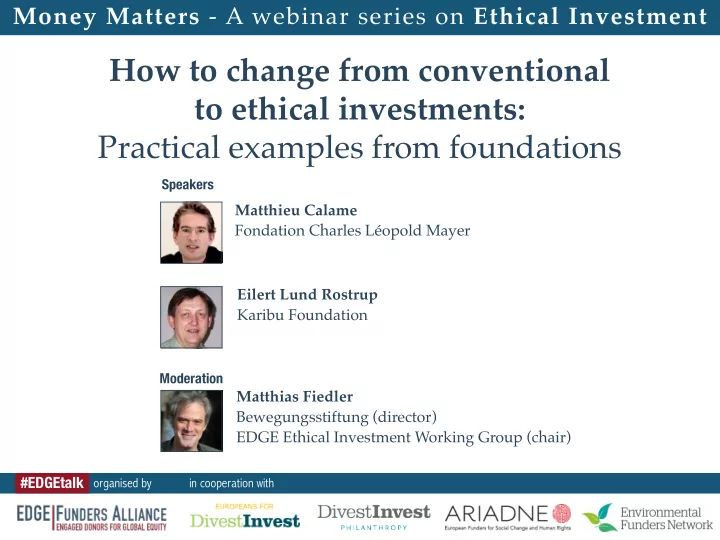
Money Matters - A webinar series on Ethical Investment How to change from conventional to ethical investments: Practical examples from foundations Speakers Matthieu Calame Fondation Charles Lopold Mayer Eilert Lund Rostrup Karibu


slide-1
SLIDE 1

Money Matters - A webinar series on Ethical Investment

  • rganised by

in cooperation with

How to change from conventional to ethical investments: Practical examples from foundations

Matthieu Calame Fondation Charles Léopold Mayer

Speakers

Eilert Lund Rostrup Karibu Foundation

Moderation

Matthias Fiedler Bewegungsstiftung (director) EDGE Ethical Investment Working Group (chair) #EDGEtalk

slide-2
SLIDE 2

Investng for change? A critcal approach

Mathieu Calame

Directeur

New philanthropy, Development and Social Investing Session 12 : Impact investing – Generating financial returns through – Achieving social, environmental and economic objectives April 2016

slide-3
SLIDE 3

New philanthropy, Development and Social Investing - Session 12 : Impact investing, Generating financial returns through Achieving social, environmental and economic objectives - April 2016

a) Short presentation of the FPH b-1) a matter of consciousness, the dilemma of philanthropy: good actions with grey money, b-2) a quick state of the art: ESG, SRI, impact investing... c) what we have done as a funder, how do we aim to improve, d) a critical approach. The overpromise : why it can't be enough in comparison to the stake (social, environmental, political), e) a forecast of the future: where may the systemic change come from?

slide-4
SLIDE 4

New philanthropy, Development and Social Investing - Session 12 : Impact investing, Generating financial returns through Achieving social, environmental and economic objectives - April 2016 From philosophical roots... The foundation is part of the European humanist tradition. We believe in the possibility of a social and moral progress of human societies. Our values:

  • social, cultural and intellectual emancipation of individuals; the conscience of their dignity and rights;
  • the development of their sense of individual and collective responsibilities, towards their contemporaries and

toward the future generations; the conscience of their duties;

  • the development of their capacity of collective organization and action in economic, social and political fields; the

conscience of their social nature;

  • their fulfillment; the conscience of their legitimate aspiration to happiness.

... To the present stake : the planet Boundaries The global interdependences change the relationships between societies, individuals and between humanbeings and nature. In this context the foundation made the choice to contribute to the emergence of a global community capable of driving three major mutations:

  • to conceive new forms of governance;
  • to adopt common ethical principles;
  • to implement the transition toward more sustainable societies.

a) Short presentation of the FPH

We aim (and claim) to be a transformativ philanthropy

slide-5
SLIDE 5

New philanthropy, Development and Social Investing - Session 12 : Impact investing, Generating financial returns through Achieving social, environmental and economic objectives - April 2016

a) Short presentation of the FPH

A general pattern Strengthening and sustaining Civil society for advocating for a just transition. Three modes of action:

  • the encouragement of networking of actors through the development of citizens’ alliances, and of regional, socio-

professional and thematic networks

  • the development of analysis and proposals focusing on governance, ethics, and alternatives to development;
  • the social and political promotion of these proposals and their wide circulation through collective tools and methods.

Our economic means

  • our own endowment : 380 millions of CHF
  • our annual budget : 10 millions of CHF
slide-6
SLIDE 6

New philanthropy, Development and Social Investing - Session 12 : Impact investing, Generating financial returns through Achieving social, environmental and economic objectives - April 2016

Each Social System has its own philanthropy : In most societies many forms of philanthropy are present.

Aristocracy Theocracy Socialism Etatism Capitalism Evergetism (Mecenus) Religious foundation mutualism Wellfare statePrivate foundation

b-1) A matter of consciousness - 1

slide-7
SLIDE 7

New philanthropy, Development and Social Investing - Session 12 : Impact investing, Generating financial returns through Achieving social, environmental and economic objectives - April 2016

The dilemma of philanthropy and transforming philanthropy:

  • good actions with grey money,
  • we are part of the system we want to change : contradiction or

hypocrisy ? On the path to change there are fifty shades of grey

  • duty of transparency,
  • duty of improvement,
  • duty of humility.

b-1) A matter of consciousness - 2

slide-8
SLIDE 8

New philanthropy, Development and Social Investing - Session 12 : Impact investing, Generating financial returns through Achieving social, environmental and economic objectives - April 2016

The Jungle of SRI

  • the old concept of exclusion (tobacco, weapons…),
  • the concept of ESG,
  • Best in class and the problem of ranking,
  • the impact investing.

b-2) A quick state of the art - 2 Evaluation and assessment, a broad issue : availability and meaning of data

slide-9
SLIDE 9

New philanthropy, Development and Social Investing - Session 12 : Impact investing, Generating financial returns through Achieving social, environmental and economic objectives - April 2016

  • Assets management
  • improvement of the real estate (conversion to organic farming, insulation of apartment

buildings)

  • Activity
  • improvement of the real estate (insulation and eco-conception of our office-building)
  • evaluation of our carbon footprint, reduction of journeys and flights, reduction of the scope of

salaries)

  • Grants
  • we consider them to be fair (?)

c) What we have done - 1

slide-10
SLIDE 10

New philanthropy, Development and Social Investing - Session 12 : Impact investing, Generating financial returns through Achieving social, environmental and economic objectives - April 2016

Investing or investing? I only fuel real economy when I buy a share or a bound at the moment of its emission (second market creates no activity but it helps investment to become liquid). 4 types of investments

  • illegal,
  • immoral,
  • old fashion,
  • transformative.

c) What we have done - 2

slide-11
SLIDE 11

New philanthropy, Development and Social Investing - Session 12 : Impact investing, Generating financial returns through Achieving social, environmental and economic objectives - April 2016

The former theory of responsible investing

  • long term ownership of the share,
  • only ''real'' economy,
  • a moderate return (~ 4,5%)

From divest/invest to general assessment

  • the opportunity of the Divest/Invest movement,
  • a broader assessment (social, environmental...)

c) What we have done - 3

slide-12
SLIDE 12

New philanthropy, Development and Social Investing - Session 12 : Impact investing, Generating financial returns through Achieving social, environmental and economic objectives - April 2016

c) What we have done - 4 Value-chain approach

slide-13
SLIDE 13

New philanthropy, Development and Social Investing - Session 12 : Impact investing, Generating financial returns through Achieving social, environmental and economic objectives - April 2016

c) What we have done - 5 Value-chain approach

slide-14
SLIDE 14

New philanthropy, Development and Social Investing - Session 12 : Impact investing, Generating financial returns through Achieving social, environmental and economic objectives - April 2016

c) What we have done - 6 Where are we?

Germany 3 Belgium 1 Denmark 3 Spain 2 France 9 Ireland 1 Netherlands 1 Portugal 1 UK 3 Sweden 2 Switzerland 6 China 14 South Korea 4 India 1 Japan 1 Malaysia 1 Singapore 2 Taiwan 1 USA 1 USA

19

Japan 19

Direct investments Indirect investments

Canada 1

slide-15
SLIDE 15

New philanthropy, Development and Social Investing - Session 12 : Impact investing, Generating financial returns through Achieving social, environmental and economic objectives - April 2016

c) What we have done - 7

10,8% 1,9% 0,3% 6,6% 1,4% 18% 5,6% 24,8% 3,4% 16,3% 1,4% 9,2%

Food industry Textile & luxury goods Retail Energy Electronics Transports Industrial equipment & materials Pharmaceuticals, cosmetics Financial services IT Services Other services Conglomerates, investment funds

slide-16
SLIDE 16

New philanthropy, Development and Social Investing - Session 12 : Impact investing, Generating financial returns through Achieving social, environmental and economic objectives - April 2016

c) What we have done - 8

slide-17
SLIDE 17

New philanthropy, Development and Social Investing - Session 12 : Impact investing, Generating financial returns through Achieving social, environmental and economic objectives - April 2016

c) What we have done - 9

DIRECT INVESTMENTS

Company Country Activities Key raw materials

(based on publc daa)

Turnover

CHF

Capital

CHF

% of FPH shares Food manufacturing companies

Nestlé

Switzerland

Food manufacturer: Coffee / Sweets / Chocolate / Dairy products/ Baby milk / Bottled water/ Animal foodstuffs/ Nutrition Coffee / Cocoa / Milk/ Sugar / Palm

  • il / Soy / Bottled water / Cereals /

Vanilla / Hazelnuts / Shea butter / Meat / Fish / Phosphate / Potassium / Paper / Cardboard / Plastic 92 billion 215 billion 2.0% Want want China China Food manufacturer: Rice cakes/ Dairy products / Hot drinks / Snacks / Wine Rice / Sugar / Palm oil / Milk/ Aromatic herbs / Wine / Paper / Cardboard / Plastic 3.7 billion 18.5 billion 0.2% Lindt

Switzerland

Chocolate manufacturer Cocoa / Milk / Sugar / Soy - Vanilla / Phosphate / Potassium / Paper 2.6 billion 11 billion 2.4%

Ingredient manufacturing companies

CHR Hansen Holding Denmark Manufacturer of natural ingredients: probiotics, enzymes, colouring agents lactic ferments, cultures Enzymes / Colouring agents / Lactic ferments 0.9 billion 4.9 billion 1.4%

Food manufacturing and retail companies

Jeronimo Martins Portugal Retailer, and manufacturer of Unilever products Olive oil/ Milk / Sugar / Tea / Sunflower oil / Rapeseed oil / Palm

  • il / Vegetables / Aromatic herbs/

Paper / Cardboard 124.8 billion 89.8 billion 1.4%

Retail and mass catering

Sodexo France Mass catering All agricultural produce 22.2 billion 11.1 billion 1,8%
slide-18
SLIDE 18

New philanthropy, Development and Social Investing - Session 12 : Impact investing, Generating financial returns through Achieving social, environmental and economic objectives - April 2016

c) What we have done - 10

INDIRECT INVESTMENTS

Company Country Activities Key raw materials

(based on available info)

Turnover

CHF

Capital

CHF

% of FPH shares

Coca Cola United States Beverage manufacturer: soft drinks, energy drinks, bottled water Water / Orange / Apple/ Tropical fruit/ Plastic / Aluminium / Glass 43.6 billion 83.5 billion 2.53%

slide-19
SLIDE 19

New philanthropy, Development and Social Investing - Session 12 : Impact investing, Generating financial returns through Achieving social, environmental and economic objectives - April 2016

c) What we have done - 11 Key brands linked to these food industry companies are:

  • Nestlé : Nestlé, Nescafé, Nespresso, Dolce Gusto, Ricoré, Nestea, Nesquik, Kit Kat,

Lion, Crunch, Smarties, Quality Streets, Blédina, Nido, Herta, Maggi, Buitoni, Perrier, Vittel, San Pellegrino Coca-cola : Coca-Cola, Fanta, Sprite, Minute Maid, Innocent Jeronimo Martins : Maizena, Planta, Flora, Knorr, Lipton Ice Tea, Alsa, Ben & Jerry’s

slide-20
SLIDE 20

New philanthropy, Development and Social Investing - Session 12 : Impact investing, Generating financial returns through Achieving social, environmental and economic objectives - April 2016

c) What we have done - 12

slide-21
SLIDE 21

New philanthropy, Development and Social Investing - Session 12 : Impact investing, Generating financial returns through Achieving social, environmental and economic objectives - April 2016

d) what we have done - 13

slide-22
SLIDE 22

New philanthropy, Development and Social Investing - Session 12 : Impact investing, Generating financial returns through Achieving social, environmental and economic objectives - April 2016

c) What we have done - 14

ESTIMATED CARBON FOOTPRINT OF FPH SHAREHOLDINGS

SECTOR Overall carbon footprint

(per tonne of CO2 equivalent)

Food industry 16 783 Clothing/luxury goods 1 505 Department stores 4 683 Energy 1 239 Electronics 4 610 Transports 2 055 Pharmaceuticals / cosmetics 3 140 Equipment / Industry 8 269 Financial Services 1 043 IT Services 2 946 Other services 372 TOTAL 46 645

slide-23
SLIDE 23

New philanthropy, Development and Social Investing - Session 12 : Impact investing, Generating financial returns through Achieving social, environmental and economic objectives - April 2016

c) What we have done - 15

By comparison with the previous estimates, one tonne of carbon dioxide equivalent corresponds to:

  • 6 months of gas central heating for a 3-room flat in Paris
  • 1 Paris -New York return plane trip
  • 80 Paris-London return train trips
  • 10 Paris-London return plane trips
  • 7 000 km of city driving in a small car (Twingo…)
  • 4 200 km of city driving in a 4x4

Furthermore, according to the French Environmental Agency (Ademe) studies, a French household emitted approximately 14 tonnes of CO2 per year in 2013.

slide-24
SLIDE 24

New philanthropy, Development and Social Investing - Session 12 : Impact investing, Generating financial returns through Achieving social, environmental and economic objectives - April 2016

d) what we have done - 16

slide-25
SLIDE 25

New philanthropy, Development and Social Investing - Session 12 : Impact investing, Generating financial returns through Achieving social, environmental and economic objectives - April 2016

The ongoing discussions

  • going out of investment funds,
  • the board is defining the ''red lines'' and ESG targets,
  • maybe invest more in real estate,
  • engage the discussion with the assets managers,
  • engage the discussion with other foundations,
  • evaluate the capacity to invest in s&ms companies (risk, liquidity…),
  • be an active stakeholder (attend the GA),
  • invest in renewable energy,

etc.

  • reduce the return on investment (less than 3%).

c-2) What we have done and next steps

slide-26
SLIDE 26

New philanthropy, Development and Social Investing - Session 12 : Impact investing, Generating financial returns through Achieving social, environmental and economic objectives - April 2016

  • Green economy degrowth and sustainable growth
  • is a growth of 1,5% sustainable ?

d) A critical approach 1

20 40 60 80 100 120 140 160 180 200

production réelle et masse monétaire

population massemonétaire

Population 0,075 %, money 3 % Consumption/head : stable

slide-27
SLIDE 27

New philanthropy, Development and Social Investing - Session 12 : Impact investing, Generating financial returns through Achieving social, environmental and economic objectives - April 2016

The overpromise : Creation of Money by the European Central Bank : 60 billion euros per month Cost of the CAP : 58 billion euro per year Each year the ECB produces 12,4 times the budget of the CAP d) A critical approach 2

slide-28
SLIDE 28

New philanthropy, Development and Social Investing - Session 12 : Impact investing, Generating financial returns through Achieving social, environmental and economic objectives - April 2016

  • Due to the level of the crisis, this is not an economic question anymore.

This is a political one.

  • Private actors will never be able to replace public authorities in the

management of complex societies,

  • Only politic can deal with such a crisis,

We have to move from ethics to civic Private actors (companies, foundations, individuals) as a first moral responsibility have to stop weakening the public authorities. State will come back with two possibilities:

  • authoritarian (Trump)
  • ecokeynesian (Sanders)

e) A forecast of the future : where may systemic change come from ?

slide-29
SLIDE 29

CASE STUDY:

KARIBU FOUNDATION

OSLO, NORWAY

Eilert L. Rostrup Director rostrup@karibu.no

slide-30
SLIDE 30
  • 1. Background and history
  • 2. Profile of our investments
  • 3. Changing to ethical investments
  • 4. Challenges and obstacles
  • 5. What comes next?

Goal of presentation: to provide a short “case study” of a small family foundation in

  • Norway. In particular, to lift up some of the challenges and obstacles that remain in
  • ur process of changing from conventional to ethical investments.
slide-31
SLIDE 31
  • 1. Background and history

■ Karibu was founded in 1986 by a woman who wanted to «do good» ■ Karibu offered financial recourses to support projects that could not easily be funded with government funding and/or sponsors’ contributions ■ Karibu aim to give opportunities for networks in the Global South that provide alternatives to the dominant power and neo-liberal economic structures in the world. Karibu identity is based on the values of the World Social Forum ■ Karibu funds often support information and advocacy initiatives, documentation processes, conferences, travel support to ensure that these voices are ‘at the table’, broad civil-society initiatives and mobilizations, South-South networking efforts

slide-32
SLIDE 32

2.Profile of our investments

■ Original gift was approx. USD 14m (value per today) ■ Conservative placement/investment of funds for many years (savings accounts, small amounts in stocks) ■ Majority of investments in stocks in Norwegian markets (very fossil fuel based economy) ■ In later years, concrete steps were taken to think long-term return and strategic finance management (setting up of finance committee, funds management plan) ■ External funds manager identified (small foundation/few staff – need for external competence)

Asse Assets ts St Strategic gic Weight ht De Degrees of

  • f freedom

freedom Money Markets 35% 0%- 45% Government-guaranteed bonds 15% 0% - 25% Other bonds / credit bonds 20% 0% - 30% Norwegian and intern. equity funds 30% 0% – 40%

slide-33
SLIDE 33

Obje jective: :

The foundation will manage its capital taking into consideration returns, security, risk diversification and liquidity, to increase its capital and ability to meet the statutory obligations

Risk: k:

■ Capital Investments should be put together on the basis of a long-term profile with a high degree of security, the highest possible return and with the greatest possible predictability, based on the Trust's ability to bear financial risk, applicable laws, regulations and statutes. It should only be invested in highly liquid assets ■ The allocations are customized to the investment framework, strategic emphasis and degrees of freedom with adequate diversification of industries, nationally and internationally. ■ The interest rate risk should be at a duration of 2-5 years. At locations with longer duration should be as a consequence of specific market outlook and relevant justification for the investment. ■ The Fund will use a minimum of 2-3 managers to spread portfolio and the risk and the broadest possible market understanding.

Ethi hical f l frame me:

Efforts should be made to have a continuous ethical value based placement of the fund's assets, and this is communicated on an ongoing basis in meetings with external investments managers (negative screening)

Karibu investment guidelines

slide-34
SLIDE 34
  • 3. Changing to ethical investments

■ Founder has a history of «impact investing» / using the funds «for good» – Grant making and the business concept should contribute to the collective good – Founder’s company also earmarked for a period a special fund for support to experimental production for climate/environmental protection products (electric cars, green energy, etc.), long before most of such funds were available. Sadly, no returns on investments - fund was eventually emptied. Contributions gave opportunity for new ideas to be tested, so there are no regrets. ■ For many years «ethical investments» was understood as solely «negative screening», but gradually more reflection on interconnectedness between partners’ political involvement and our actual investment for generating funds for grants to same partners (ex: investments in companies like Caterpillar vrs partners supporting BDS against Israeli

  • ccupation in Palestine)

■ Question raised: Karibu grants supported issues related to human rights, economic justice, environmental protection, etc., but were our investments contributing to making the causes our partners were working against worse? ■ October 2013: Visit of Ellen Dorsey (Wallace Global Fund) and Mark Randazzo (EDGE) on «Divest / Invest» was a key factor/inspiration for initating development of new «ethical investment guidelines»

slide-35
SLIDE 35

Ne New w ethi hical investme ment nt g guideli line nes ( (Jan 2 n 2014)

■ Ethical considerations in investments means for Karibu also to consider positions taken by partners. This means that ‘ethical’ includes human rights, social, economic justice and political issues. In addition to the issue of climate change and concern for future generations, which is explicitly mentioned. ■ It must be more than negative screening of investments, - Karibu investments should ”also actively be understood as part of the green, social and human rights prudent financial management”. ■ The investments should both ‘do good’ and generate income. ■ Karibu should continue to use external investment managers. The ethical investment guidelines must be implemented through the annual meetings with investment manager where the portfolio is critically analysed and discussed. ■ Aim for Karibu to divest from fossil fuels in the next 5 years (2014-2018)

slide-36
SLIDE 36

4.Process: Challenges and Obstacles

■ Karibu has taken initial steps towards changes in investments, but has hit a number of challenges and roadblocks (3 in particular): CHALLENGE 1: Norwegian markets and economy ■ High climate awareness and activism in Norway, but slow processes of challenging our oil economy ■ Norway, a country with an oil/gas-economy – 100 years ago we were the second poorest country in Europe (agriculture, fisheries,limited industrial development) – Norwegian wealth today (and also source for the financial capacity of foundations, development donors, etc.) is based on the tremendous wealth gained through oil and gas industry in the North Sea – Capacity to sustain social welfare system in Norway is based on the wealth from fossil fuels, leading to reluctance to fundamentally challenge investments in extractive industries ■ Result lt: W : We ha have no not f found nd ‘r ‘regula lar e equity f y fund nds’ i ’ in t n the he ma market i in N n Norway t y tha hat c can o n offer t the he f fossil l free i investme ment nts w we a are lo looki king ng f for. .

slide-37
SLIDE 37

CHALLENGE 2: Investment management in Norwegian CSOs ■ We have not found Norwegian CSOs that have managed to find equity funds that offer fossil free investments in the Norwegian market (ex: a big Norwegian dev. organisation was forced to manage investments themselves (approx. 15 mill USD investments) when they wanted to divest from an equity fund were fossil extraction companies were included- after some time the organisation found ethical equity funds outside the country) ■ Karibu, as many other small foundations, is without the capacity/competence to invest our funds by

  • urselves. Need for external professional assistance or joint approach with other CSOs.

■ The options available are more or less as our present investment in an equity fund. Today we have 25% investment in fossil fuels – Investments related directly to production ca 10% – Investments related to service for the extractive industries ca 8% – Investments related to shipping / transport ca 7% ■ Karibu has found an option with 100% fossil free (production), but international investments (Global Ethics Fund). Karibu placed 1/7 of our investments in this option. Still too early to know of returns … ■ Various and (for Karibu) too limited understandings of “ethics” in these ‘ethical’ equity funds (less/ no fossil fuels, but investment in companies involved in human rights/international law violations, ex: Caterpillar involved in Israeli occupation and settlements) ■ Result lt: : In o In order f for K Karibu t to fully lly ini nitiate our

  • ur ethi

hical investme ment nt p pla lan, n, we we ne need t to conne nnect t to othe her CSO i investors t to pu put mo more weight ht t to dema mand nds t to the he investme ment nt ma market

slide-38
SLIDE 38

CHALLENGE 3: Moving others to work together

■ Spent last 1½ year trying to network with other Norwegian investors in order to understand their reflections and processes, as well as to explore possible joint initiatives

– We have attended some workshops/meetings organised by banks and investment manager companies. We have raised the issue of fossil-free investments, but just been calmly informed that such equity funds are not available in the Norwegian market. Other small investors have then expressed common experiences in trying to shift investments – Karibu was key initiator of a two-days conference in October 2015 to let finance managers of ecumenical NGOs come together and discuss ethical investments; policies, practices and strategies. A participating ‘service provider’ for church based financial management in Norway (used by many church-based investors), offered 3-4 different equity funds (also ‘ethical’),but had so far no perspective of including fossil industries in their understanding of ‘ethical’. After Karibu raised the issue at the conference this is hopefully about to change – Not managed to find other ‘cluster’ of investors among CSOs (outside of the church based investor’s environment) with aspirations for ethical investment. Only some few individual investors (like Trondheim University, and others). – Karibu invited by biggest church based investment fund in Norway (Portfolio of approx. 304 mill USD) to connect (as they have) to Church Investors Group in UK (http://www.churchinvestorsgroup.org.uk/). Ethical investments has high profile in the network. – Also initiated talks the commercial company owned by our founder’s family. They are moving more and more into ‘impact investment’ as a concept for the business. Talks will explore if Karibu should be part of that process and if that would give enough ‘space’ for Karibu to implement its strategy for ethical investment of its capital.

■ RESUL ULT: : Va Various ‘ ‘explo loratory t talks lks’ a ’ and nd ini nitiatives tak taken en f for possible le jo joint nt ini nitiatives, , bu but slo low pr proce cess ss wit with ma many cha halle lleng nges … …

slide-39
SLIDE 39
  • 5. What comes next?

Challenges in the coming years…

■ How can Karibu implement fossil-free investment during the next years (2017 - 2018)? ■ How can Karibu build more networks in Norway on ethical investments? ■ How can Karibu further define implications of ‘ethical investment’ with the inclusion and active participation of its partner network?

slide-40
SLIDE 40

Money Matters - A webinar series on Ethical Investment

use chat box and icons to interact click on if you want to take the floor

  • rganised by

in cooperation with

How to change from conventional to ethical investments: Practical examples from foundations discussion

#EDGEtalk

slide-41
SLIDE 41

Money Matters - A webinar series on Ethical Investment

  • rganised by

in cooperation with

#EDGEtalk

Monday, 13 June 2017 15h - 16h CEST (Brussels time)

On the road to ethical investment: deepening the discussion - exploring needs, challenges and possible solutions to get going

#EDGEtalk

Next

Registration open!