ANNUAL REPORT 2019 HOTEL PROPERTY INVESTMENTS 1 ANNUAL REPORT 2019 - - PDF document

annual report 2019
SMART_READER_LITE
LIVE PREVIEW

ANNUAL REPORT 2019 HOTEL PROPERTY INVESTMENTS 1 ANNUAL REPORT 2019 - - PDF document

ANNUAL REPORT 2019 HOTEL PROPERTY INVESTMENTS 1 ANNUAL REPORT 2019 | Hotel Property Investments Comprising Hotel Property Investments Trust (ARSN 166 484 377) and Hotel Property Investments Limited (ABN 25 010 330 515) and their controlled


slide-1
SLIDE 1

ANNUAL REPORT 2019 | Hotel Property Investments

1

ANNUAL REPORT 2019

Comprising Hotel Property Investments Trust (ARSN 166 484 377) and Hotel Property Investments Limited (ABN 25 010 330 515) and their controlled entities

HOTEL PROPERTY INVESTMENTS

slide-2
SLIDE 2

ANNUAL REPORT 2019 | Hotel Property Investments

3 2 CONTENTS

Directors’ report .......................................................... 5 Auditor’s independence declaration .......................... 26 Consolidated statement of profjt or loss and other comprehensive income .............................................. 27 Consolidated statement of fjnancial position ............ 28 Consolidated statement of changes in equity ........... 29 Consolidated statement of cash fmows ...................... 30 Notes to the consolidated fjnancial statements ........ 31 Directors’ declaration ................................................ 64 Independent auditor’s review report ......................... 65

Front cover: Chancellors Tavern Page 2: The Regatta Hotel

slide-3
SLIDE 3

ANNUAL REPORT 2019 | Hotel Property Investments

5 4

DIRECTORS’ REPORT

Cleveland Sands Hotel

slide-4
SLIDE 4

ANNUAL REPORT 2019 | Hotel Property Investments DIRECTORS’ REPORT

7 6

MICHAEL TILLEY

INDEPENDENT NON-EXECUTIVE CHAIRMAN Appointed 19 November 2013 Michael Tilley is a highly experienced executive having spent over 30 years advising and managing leading companies in fjnancial services, life insurance and funds management in Australasia. He has served as Managing Director and Chief Executive Offjcer of Challenger Financial Services, Chairman and Chief Executive Offjcer of Merrill Lynch Australasia, and as a partner at Deloitte Touche Tohmatsu. Michael was a non-executive Director at Orica Ltd from November 2003 until January 2014 where he was the Chairman of Orica’s Safety, Health & Environment Committee and a member of the Audit and Risk and Corporate Governance and Nominations Committees. Michael is a former member of the Takeovers Panel and has previously served as a non-executive Director of Incitec Ltd. Michael was appointed non-executive Chairman of Tubi Limited in June 2013. He holds a Post Graduate Diploma in Business Administration from Swinburne University and is a Fellow of The Australian Institute of Company Directors.

RAYMOND GUNSTON

INDEPENDENT NON-EXECUTIVE DIRECTOR Appointed 19 November 2013 Raymond Gunston has over 30 years of corporate and fjnancial services experience in the public and private sectors, specialising in fjnance, treasury, mergers and acquisitions, and accounting. Raymond is currently a non-executive Director of Sigma Healthcare Limited, where he is also a member of the People and Remuneration Committee and Chairman of the Risk Management and Audit Committee. He was formerly Chief Financial Offjcer of Tatts Group Limited and Director of many of the Tatts Group’s subsidiary and associate companies and is currently General Manager – Infrastructure, Major Projects and Investment at the Australian Football League. Raymond has a Bachelor of Commerce (Honours) from the University of Melbourne and a Diploma of Education. Raymond is a Fellow Certifjed Practicing Accountant and a Graduate Member of the Australian Institute of Company Directors. Raymond is Chairman of HPI Group’s Board Audit and Risk Committee and the Responsible Entity Compliance Committee.

LACHLAN EDWARDS

INDEPENDENT NON-EXECUTIVE DIRECTOR Appointed 19 November 2013 Lachlan Edwards is the founder of the advisory business Faraday Associates, having been the Co-Head of the advisory businesses at Lazard in Australia from 2013 until June 2018. Lachlan has extensive experience in capital markets and has been a senior level advisor to Governments, boards, executive teams and creditors in Australia and Europe. He has previously held board positions including Director of NM Rothschild & Sons, a Governor of the English National Ballet in London, and Director at the University & Schools Club in Sydney. Lachlan was a Managing Director of Goldman Sachs between 2006 and 2013 and was previously at Rothschild in both Sydney and London for 15 years. Lachlan currently serves on the board of the Bell Shakespeare Company and as Chairman of the Turnaround Management Association in Australia. Lachlan has a Bachelor of Economics degree from the University of Sydney and a Graduate Diploma in Applied Finance & Investments from the Securities Institute of Australia and is a Member of the Australian Institute of Company Directors. Lachlan is a member of the HPI Group’s Board Audit and Risk Committee and the Human Resources Committee.

INTRODUCTION

The Directors of Hotel Property Investments Limited as Responsible Entity (the “Responsible Entity”) for the Hotel Property Investments Trust (“the Trust”) present the consolidated fjnancial report of Hotel Property Investments Trust, Hotel Property Investments Limited (“the Company”) and their controlled entities (together “the HPI Group”) for the year ended 30 June 2019. The units in the Trust and the shares in the Company are stapled and cannot be traded or dealt with separately. The Responsible Entity is incorporated and domiciled in Australia. The registered

  • ffjce of the Responsible Entity is Suite

2, Level 17, IBM Centre, 60 City Road, Southbank, Victoria, 3006.

CORPORATE GOVERNANCE

A copy of HPI Group’s Corporate Governance Statement is available on HPI Group’s website at www.hpitrust.com.au/ cms/corporate_governance

DIRECTORS AND OFFICERS

The members of the Board of Directors and the Offjcers of the Company in offjce during the year and since the end of the year are listed on the following pages.

slide-5
SLIDE 5

ANNUAL REPORT 2019 | Hotel Property Investments DIRECTORS’ REPORT

9 8

GISELLE COLLINS

INDEPENDENT NON-EXECUTIVE CHAIRMAN Appointed 19 April 2017 Giselle Collins is a company Director with signifjcant executive experience in property, tourism and fjnancial services. Giselle has previously chaired the boards of Aon Superannuation Pty Ltd (as Trustee for Aon Master Trust), The Travelodge Hotel Group and the Heart Research Institute, and served on the boards of Big4 Holiday Parks and the Royal Australian Institute of Architects. Giselle is currently Chairman of Darwin Hotel Pty Ltd, as nominee for Indigenous Business Australia. Giselle also sits on the boards of Generation Life Pty Ltd, subsidiary of ASX listed Generation Development Group Ltd and the Royal Botanic Gardens and Domain Trust board. Giselle has a Bachelor of Economics degree from the University of Sydney and a Graduate Diploma in Applied Finance & Investments from the Securities Institute of Australia and is a Graduate Member of the Australian Institute of Company Directors. Giselle is a member of HPI Group’s Board Audit and Risk Committee and the Human Resources Committee.

JOHN RUSSELL

INDEPENDENT NON-EXECUTIVE DIRECTOR Appointed 23 May 2013 John Russell is an experienced executive having worked across large and small public and private companies and multiple industries, including an extensive background in hospitality and gaming. He was most recently Chief Executive Offjcer of Redcape Group Limited and has enjoyed senior executive roles at Australian Leisure and Hospitality Group Limited (ALH) and Tabcorp Holdings Limited. John joined Redcape Group from Customers Limited where he was Managing Director & Chief Executive

  • Offjcer. Previously he was Chief Financial Offjcer of

ALH and has served as General Manager Strategy & Operations at AWB Limited and Group General Manager Operations at Tabcorp. John holds an Honours Degree in Economics and a Master of Business Administration from the University

  • f Adelaide and is a Graduate Member of the Australian

Institute of Company Directors. John is the Chairman of HPI Group’s Human Resources Committee.

DON SMITH

MANAGING DIRECTOR AND CHIEF EXECUTIVE OFFICER Appointed 1 October 2018 as Managing Director and Chief Executive Offjcer Don Smith was appointed Managing Director and Chief Executive Offjcer of HPI in October 2018 and brings more than 20 years of property and funds management experience with listed and unlisted companies. Most recently, Don has been a member of the management team at OSK Property and prior to that held a range of roles at Vicinity Centres and Colonial First State. Don is also a Board Member and Chairman of Melbourne Athenaeum Incorporated, a not-for-profjt cultural institution. Don holds a Bachelor of Applied Science – Planning and a Graduate Diploma - Banking and Finance.

BLAIR STRIK

CHIEF FINANCIAL OFFICER AND COMPANY SECRETARY Appointed 26 April 2017 as Chief Financial Offjcer and 19 May 2017 as Company Secretary Blair Strik joined HPI Group in April 2017 as Chief Financial Offjcer and has over 15 years’ experience in the property industry, professional services and treasury. Prior to joining the HPI Group, Blair held senior fjnance positions with the Industry Superannuation Property Trust for over 9 years, building on experience from previous roles at Rio Tinto and KPMG. Blair holds a Bachelor of Business from Swinburne University of Technology and is a member of Chartered Accountants in Australia and New Zealand.

DAVID CHARLES

MANAGING DIRECTOR AND CHIEF EXECUTIVE OFFICER Retired 1 October 2018

slide-6
SLIDE 6

ANNUAL REPORT 2019 | Hotel Property Investments DIRECTORS’ REPORT

11 10 PRINCIPAL ACTIVITIES

The principal activity of the HPI Group is real estate investment in the pub sector in Australia. There has been no signifjcant change in the nature of the principal activity during the year.

SIGNIFICANT CHANGES IN STATE OF AFFAIRS

There are no signifjcant changes to the state of affairs of the HPI Group.

DISTRIBUTIONS AND DIVIDENDS

For the year ended 30 June 2019 the HPI Group paid an interim distribution of 9.8 cents per stapled security for the half year ended 31 December 2018 and has declared a fjnal income distribution of 10.1 cents per stapled security to be paid on 6 September 2019. The aggregate income distribution of 19.9 cents per security consists

  • f 19.7 cents from trading operations and 0.2 cents from

capital to ensure that the total distribution is the greater

  • f the taxable income of the Trust or adjusted funds

from operations. No provisions for, or payments of dividends from The Company have been made during the year (2018: nil).

MATTERS SUBSEQUENT TO THE END OF THE FINANCIAL YEAR

No item, transaction or event has occurred subsequent to 30 June 2019 that is likely in the opinion of the Directors of the Responsible Entity to signifjcantly affect the operations of the HPI Group, the results of those

  • perations, or the state of affairs of the HPI Group in

future fjnancial periods.

REVIEW AND RESULTS OF OPERATIONS

The HPI Group is an Australian Real Estate Investment Trust (“AREIT”) and listed on the Australian Securities

  • Exchange. Its principal activity is real estate investment

in the pub sector in Australia.

CURRENT YEAR PERFORMANCE

The HPI Group recorded a total profjt after tax for the year of $49.2 million. Operating revenues and expenses included rental income from investment properties of $46.8 million, property cost recoveries of $4.3 million, property outgoing costs of $7.3 million, other trust and management costs of $3.8 million, and fjnancing expenses

  • f $13.0 million. Additionally, there was a fair value gain
  • n investment property of $20.6 million and a realised

gain on sale of The Wickham Hotel of $1.6 million. At 30 June 2019, the Investment Properties have been valued by Directors. In accordance with the HPI Group policy, Directors valuations have been determined by reference to the current net income, including allowance for contracted rental growth for each property and the specifjc circumstances of each property. Half of the 43 properties were independently valued in December 2018 and the remaining properties were independently valued in December 2017. Market capitalisation rates applied at 30 June 2019 remained constant at their previous independent valuation level. The current average capitalisation rate is 6.42%. Adjusting profjt after tax for fair value adjustments, non-cash fjnance costs and other minor items, the distributable earnings of the HPI Group were $29.1

  • million. Adjusting further for maintenance capex of $0.3

million the Adjusted Funds from Operations (AFFO) was $28.8 million.

FINANCIAL POSITION

At 30 June 2019 the HPI Group’s net assets were $426.9 million representing net assets per stapled security of $2.93 (June 2018: $2.79). Major assets and liabilities included investment property of $708.5 million, borrowings of $263.2 million and a provision for payment of distributions of $14.7 million. During the period investment property values increased by $8.3 million resulting mainly from fair value gains of $20.6 million and capital additions of $1.1 million partially

  • ffset by the sale of the Wickham Hotel with a fair value
  • f $12.0 million. Loans have decreased by $12.7 million

primarily due to sale of the Wickham Hotel. At 30 June 2019, the HPI Group’s total borrowing facilities of $304.0 million were drawn to $264.7 million, including $230.0 million under the US Private Placement (“USPP”) and $34.7 million under the Common Terms Deed (“CTD”) facility, of which $130 million or 49.1% of drawn debt is on fjxed interest

  • terms. The CTD expiry has been extended from August

2020 to June 2024.

RISK MANAGEMENT

The HPI Group’s business of investing directly in freehold property exposes it to certain risks which the HPI Group actively monitors and seeks to manage. The Company’s Board Audit and Risk Committee (“BARC”) assists the Board in fulfjlling its responsibilities relating to the oversight of the HPI Group’s risk profjle. During the period the BARC and the Company’s Board reviewed and updated the Risk Management framework, including the risk matrix. Interest rate risk, market risk and regulatory risk are considered the key risks for the HPI Group. Further material risks include credit availability, tenant credit risk, valuation risk, property liquidity risk, succession planning, and the possible adverse impacts of infmation. The Company’s Board concluded that the material risks to which the HPI Group is exposed remain consistent with those previously identifjed, and continues to maintain a level of fjxed rate debt or interest rate hedging to mitigate interest rate risk, and to continually monitor the Queensland regulatory environment.

BUSINESS STRATEGIES AND PROSPECTS

The HPI Group’s key fjnancial goal is to improve cash distributions to stapled security holders whilst maintaining the key attributes of the HPI Group

  • business. Distribution growth may be achieved
  • rganically from contracted annual rent increases

across the portfolio and by prudent management of fjnancing charges, management fees and other costs of the Trust. Further distribution growth may arise from development opportunities undertaken on surplus land

  • r with Queensland Venue Company (a joint venture

between Coles Group and Australian Venue Company) (“QVC”) as it pursues its retail liquor and hotels strategy, or through accretive acquisitions. The HPI Group will continue to pursue acquisition

  • pportunities which meet its investment criteria,

namely that target properties be in good condition, in key regional or metropolitan locations with potential for long term growth, and leased to experienced tenants on favourable lease terms. The HPI Group expects to improve the quality of its existing property portfolio by diligently managing those properties in co-operation with its tenants and trading

  • ut of lesser quality properties in the portfolio as

markets create value opportunities over time.

slide-7
SLIDE 7

ANNUAL REPORT 2019 | Hotel Property Investments DIRECTORS’ REPORT

13 12

DISTRIBUTIONS

For the year ended 30 June 2019 the HPI Group will distribute 100% of its Taxable Income. Due to the sale of The Wickham Hotel, Taxable Income is greater than Adjusted Funds From Operations (“AFFO”), which is calculated as profjt for the year adjusted for fair value movements, other one off and non-cash items, tax, and maintenance capital expenditure. The following statement reconciles the profjt after income tax to the AFFO and the distribution. 2019 $’000 Profjt after income tax for the year 49,238 Plus/(Less): Adjustments for non-cash items Net fair value increments to investment properties (20,617) Straight line lease adjustment 1,410 Gain on sale of investment properties (1,586) Share-based payments expense 78 Non-cash fjnance costs 574 Income tax expense 13 Total adjustments for non-cash items (20,128) Distributable earnings 29,110 Less maintenance capital expenditure (301) Adjusted funds from operations 28,809 Taxable income adjustment 233 Distribution provided for 29,042 2019 Cents Earnings and distribution per stapled security Basic and diluted earnings 33.7 Earnings available for distribution per security 19.7 Interim distribution per security 9.8 Final distribution per security 10.1 Total distribution per security 19.9

DIRECTORS’ INFORMATION

DIRECTORSHIPS OF LISTED ENTITIES WITHIN THE LAST THREE YEARS

The following Directors held directorships of other listed entities within the last three years and from the date appointed up to the date of this report unless otherwise stated: Director Directorships of listed entities Type Appointed Resigned Raymond Gunston Sigma Healthcare Limited Non-executive July 2010

  • Michael Tilley

Tubi Limited1 Non-executive June 2013

  • 1 Tubi Limited was listed on the Australian Stock Exchange in June 2019.

SPECIAL RESPONSIBILITIES OF DIRECTORS

The following are the special responsibilities of each Director:

  • Michael Tilley is Chairman of the Board
  • Raymond Gunston is Chairman of the BARC and the Responsible Entity Compliance Committee (“RECC”)
  • John Russell is Chairman of the Human Resources Committee (“HRC”)
  • Lachlan Edwards and Giselle Collins are members of the BARC and HRC

DIRECTORS' INTERESTS IN STAPLED SECURITIES

The following Directors and their associates held or currently hold the following stapled security interests in the HPI Group: Name Role Number held at 1 July 2018 Net Movement Number held at 30 June 2019 Michael Tilley Independent non-executive Chairman 1,100,714

  • 1,100,714

Raymond Gunston Independent non-executive Director 125,714

  • 125,714

Lachlan Edwards Independent non-executive Director 172,510

  • 172,510

John Russell Independent non-executive Director 56,450

  • 56,450

Giselle Collins Independent non-executive Director 20,000

  • 20,000

Don Smith Managing Director & Chief Executive Offjcer

  • 10,000

10,000

MEETINGS OF DIRECTORS

The number of meetings of the Company’s Board of Directors held and of each Board Committee held during the year ended 30 June 2019 and the number of meetings attended by each Director at the time the Director held offjce during the year were: Board BARC RECC HRC Eligible Attended Eligible Attended Eligible Attended Eligible Attended Michael Tilley 10 10

  • Raymond Gunston

10 10 4 4 4 4

  • Lachlan Edwards

10 10 4 4

  • 2

2 John Russell 10 10

  • 2

2 Giselle Collins 10 10 4 4

  • 2

2 David Charles 2 2

  • Don Smith

8 8

slide-8
SLIDE 8

ANNUAL REPORT 2019 | Hotel Property Investments DIRECTORS’ REPORT

15 14

EXECUTIVE REMUNERATION STRATEGY AND STRUCTURE

FIXED REMUNERATION Fixed remuneration is the guaranteed salary component for executives and includes superannuation. Fixed remuneration is set having regard to the employee’s responsibilities, experience, skills and performance, as well as to the external market and internal relativities. The Board has set fjxed remuneration at a level it believes is reasonable in relation to the market. The remuneration of the CEO and CFO was benchmarked against both comparable ASX-listed real estate investment trusts and similar sized ASX-listed general market companies. VARIABLE REMUNERATION Variable remuneration is intended to provide a link between total remuneration outcomes of KMPs and the HPI Group’s achieved performance refmecting, in particular, the value created for Securityholders. The Board considered whether a short-term incentive should be included in executive remuneration and determined that the interests of Securityholders is currently best served if all of the performance-based remuneration are focused on longer-term outcomes. This determination was made given the nature of the current HPI business model, with its long-term leases and built-in annual rental adjustments, meaning that available fjnancial performance metrics are largely too predictable for a STI based on such measures to provide a purposeful incentive. The Board has therefore determined that 100% of executive variable remuneration be in the form of a LTI.

PERFORMANCE - BASED REMUNERATION - HPI RIGHTS PLAN

Under the LTI Plan, participants receive annual grants

  • f Rights over HPI Securities. Each Right may be

exercised to provide one HPI Security if the performance conditions attached to that Right are satisfjed and the executive remains employed with the HPI Group until the vesting outcomes have been determined. To further maximise the alignment of interests between executives and Securityholders, for the period between vesting and exercise of a Right, the Company will remunerate the executive an amount equivalent to the distributions paid on a Security over that same period for each Right that vests. The Board has determined that HPI’s relative Total Shareholder Return (“TSR”), as assessed over 3-year performance periods, and in relation to a comparator group consisting of comparable ASX-listed real estate investment trusts will be the only performance metric used in the LTI plan. The comparator grouping is selected to align with the complexity, size and nature of

  • perations of the Group.

To maximise alignment with the returns experienced by Securityholders, the Board has imposed a gateway requirement that the HPI Group’s TSR over each 3-year performance period be positive before any Rights are able to vest under the LTI plan. This ensures that Rights cannot vest to executives when Securityholders have lost value over a performance period, even where HPI’s relative TSR against the comparator group would

  • therwise result in some or all Rights vesting.

The number of Rights to be granted to executives under annual LTI grants is determined by dividing the annual LTI component of the executive’s remuneration by the weighted average closing price for HPI Securities

  • ver the 20 trading days following release of HPI’s

audited statutory accounts for the prior fjnancial year. No consideration is payable by executives to acquire

  • r exercise Rights granted under the LTI plan. In the

event of a capital reconstruction, the Board may adjust the rights attaching to Rights, including the number

  • f Securities that may be acquired on exercise of

the Rights on any basis it sees fjt and at its absolute

  • discretion. Rights expire on the earlier of fjve years after

grant date (or the next business day) and the occurrence

  • f any earlier lapsing or forfeiture event.

REMUNERATION REPORT - AUDITED

This report provides details on the remuneration structure, decisions and outcomes for the year ended 30 June 2019 for Key Management Personnel (“KMP”)

  • f the HPI Group. KMP includes the non-executive

directors, the Managing Director & Chief Executive Offjcer (“CEO”) and the Chief Financial Offjcer & Company Secretary (“CFO”).

REMUNERATION GOVERNANCE

The remuneration arrangements for non-executive directors are distinct and separate from those for

  • executives. The Board determines the fees payable to

non-executive directors within the aggregate amount approved by Securityholders, currently set at a maximum of $900,000 per annum, and which can only be increased by the passing of an ordinary resolution of Security holders. The HRC assists the Board by recommending to the Board policies and practices which enable the HPI Group to attract, develop, retain and motivate high calibre directors and executives. The HRC reviews and makes recommendations on policies for remuneration, development, retention and termination of KMPs. The Board appoints members to the HRC from time to time and reviews the composition of the HRC annually. The HRC consists of at least three directors and is comprised solely of non-executive directors with a majority being independent (including the Chairman). The HRC facilitates a Board performance assessment and review annually, and makes recommendations to the Board on remuneration packages and policies applicable to KMPs. The number of meetings held by the HRC and the members’ attendance is set out above.

EXECUTIVE REMUNERATION PHILOSOPHY AND LINK TO BUSINESS STRATEGY OBJECTIVES

The Board’s overall objective is to ensure that executive remuneration is effective in attracting, motivating and retaining high calibre executives to allow the HPI Group to generate sustainable growth in value for Securityholders, and that in doing so refmects the Group’s risk culture and organisational values. More specifjcally, the executive remuneration framework is intended to:

  • Provide fair remuneration outcomes for executives

having regard to relevant market remuneration levels and their ability, experience and contribution to the HPI Group’s sustainable long-term performance;

  • Be suffjciently closely linked to the HPI Group’s

sustained growth performance to provide alignment with the interests of Securityholders;

  • Ensure that remuneration and remuneration
  • utcomes are determined on a clear and transparent

basis; and

  • Take account of specifjc circumstances applying to

the HPI Group to achieve the right balance between fjxed and variable remuneration and the right timeframes and performance measures used to assess variable remuneration outcomes. A mix of fjxed and performance-related remuneration is provided to achieve these objectives. Under the current business model, the Board considers it appropriate that all performance-based rewards be provided through the equity-based long-term incentive plan (“LTI”), with no annual bonus or short-term incentive (“STI”). The weighting to fjxed pay is refmective of the steady and predictable nature of HPI’s current business.

SERVICES FROM REMUNERATION CONSULTANTS

No advice was sought from remuneration consultants by the HRC during the year.

slide-9
SLIDE 9

ANNUAL REPORT 2019 | Hotel Property Investments DIRECTORS’ REPORT

17 16

Rights granted under the LTI Plan will vest if the following vesting conditions are met:

  • HPI’s Total Shareholder Return (TSR) measured over

the three years (the Performance Period) is positive;

  • HPI’s TSR measured over the Performance

Period is ranked at or above the 50th percentile

  • f the comparator group of ASX-listed real estate

investment trusts; and

  • The executive remains continuously employed by the

Company from the Grant Date until the date on which the Board makes a determination as to whether the Vesting Conditions applicable to those Rights have been met. The proportion of the Rights that vest will then be determined according to HPI’s relative TSR percentile ranking against the comparator group companies over the Performance Period, as follows:

  • Below the 50th percentile of the peer group: no

Rights in the grant vest;

  • At the 50th percentile of the peer group: 50% of the

Rights in the grant vest;

  • Between the 50th and 75th percentile of the peer

group: Rights vest on a straight- line basis between 50% and 100%; and

  • At or above the 75th percentile of the peer group:

100% of the Rights in the grant vest. Rights will be forfeited if they do not vest or upon cessation of employment, except in the case where a participant ceases employment with the HPI Group for reasons including ill-health, total and permanent disability, death, redundancy, retirement or sale of the business, in which case unvested rights will vest pro rata according to the extent to which the relevant performance period has been completed at the date employment ceases, and having regard to the extent to which performance conditions have been achieved, as determined by the Board. For participants whose employment are terminated by the HPI Group all rights, entitlements, and interests in any Rights, including vested but unexercised Rights will be forfeited. For participants leaving for any other reason the Board has the discretion to permit some or all of the unvested Rights held by an executive to vest. Executives may only deal with Rights in accordance with the HPI Group’s Securities Trading Policy and are not permitted to hedge or otherwise deal with Rights prior to vesting. DETAILS OF RIGHTS GRANTED TO EXECUTIVES Number of rights granted during the year ended 30 June 2019 Grant date Fair value per right at grant date Expiry date Don Smith Blair Strik 63,333 31,666 19 December 2018 19 December 2018 $1.10 $1.10 19 December 2023 19 December 2023 Number of rights granted during the year ended 30 June 20181 Grant date Fair value per right at grant date Expiry date Blair Strik 32,419 18 October 2017 $1.40 18 October 2022

1 Rights previously granted to David Charles under the LTI were forfeited in full upon retirement in October 2018.

EXECUTIVE SERVICE AGREEMENTS

The details of executive service agreements as at 30 June 2019 are: Executive CEO – Don Smith Contract Duration No fjxed date Remuneration Fixed remuneration $425,000 p.a. (including superannuation) LTI annual grant value $200,000 p.a. delivered in Rights over Securities and based on performance and continued service Total Remuneration $625,000 p.a. (68% fjxed; 32% at-risk) Termination by Executive 6 month notice Termination by Company for cause No notice Termination by Company (other circumstances) 6 month notice Post - employment restraints 6 month non-compete Executive CFO – Blair Strik Contract Duration No fjxed date Remuneration Fixed remuneration $325,000 p.a. (including superannuation) LTI annual grant value $100,000 p.a. delivered in Rights over Securities and based on performance and continued service Total Remuneration $425,000 p.a. (76% fjxed; 24% at-risk) Termination by Executive 3 month notice Termination by Company for cause No notice Termination by Company (other circumstances) 3 month notice Post - employment restraints 6 month non-compete

slide-10
SLIDE 10

ANNUAL REPORT 2019 | Hotel Property Investments DIRECTORS’ REPORT

19 18

REMUNERATION OF THE COMPANY'S DIRECTORS

Board / Committee Role Fees per annum1 $ Board Chairman

2

Non-executive Director 75,000 Board Audit and Risk Committee (BARC) Chairman 20,000 Member 10,000 Human Resources Committee (HRC) Chairman 10,000 Member 2,500

1 Fees are exclusive of superannuation. 2 During the year the Chairman of the Company elected not to receive director’s fees.

Directors of the Company may also be reimbursed for all reasonable travel and other expenses properly incurred in attending Board meetings or any meetings of committees of Directors of the Company, in attending general meetings of the Company, and otherwise in connection with the Company’s business.

CONSEQUENCES OF PERFORMANCE ON SHAREHOLDER WEALTH

The following indicators will be considered when assessing the HPI Group's performance and benefjts for shareholder wealth. 2019 2018 2017 2016 2015 Distributable profjt ($m) 28.8 28.6 28.6 26.7 23.8 Distributions paid or payable ($m) 29.0 28.6 46.9 26.7 23.8 Distributions per stapled Security from trading operations (cents) 19.7 19.6 19.6 18.3 16.3 Distributions per stapled Security from trust capital (cents) 0.2

  • 12.5
  • Change in share price (cents)

28.0 16.0 2.3 51.7 49.8 Total Securityholder return (percent) 15% 12% 11% 28% 34%

KEY MANAGEMENT PERSONNEL TRANSACTIONS - AUDITED

MOVEMENTS IN SECURITIES The movement during the year in the number of Securities in Hotel Property Investments Limited held, directly, indirectly or benefjcially, by each KMP, including their related parties, is as follows: Held at 1 July 2018 Received on exercise

  • f options

Other changes* Held at 30 June 2019 Don Smith

  • 10,000

10,000 Blair Strik 1,000

  • 1,000

* Other changes represent shares that were purchased or sold during the year.

Details of non-executive directors’ Security holdings are included under the heading “Directors’ Information”. MOVEMENTS IN OPTIONS AND RIGHTS Opening performance rights Granted as remuneration Forfeited / lapsed Vested Closing Don Smith

  • 63,333
  • 63,333

Blair Strik 32,419 31,666

  • 64,085

David Charles 129,944

  • (129,944)
  • Quest Griffjth
slide-11
SLIDE 11

ANNUAL REPORT 2019 | Hotel Property Investments DIRECTORS’ REPORT

21 20

DETAILS OF REMUNERATION

Details of the remuneration of the KMPs for the current year and the comparative year are set out in the following tables. REMUNERATION DETAILS 1 JULY 2018 TO 30 JUNE 2019 Short term Post- employment Leave entitlements Termination benefjts Share-based payments Total Proportion of remuneration performance related Value of options as proportion of remuneration Salary & Fees STI cash bonus Non-monetary benefjts Total Super- annuation benefjts Options and rights $ $ $ $ $ $ $ $ $ % % Independent non-executive Director Michael Tilley (Chairman)

  • Raymond Gunston

95,000

  • 95,000

9,025

  • 104,025
  • Lachlan Edwards

87,500

  • 87,500

8,313

  • 95,813
  • John Russell

85,000

  • 85,000

8,075

  • 93,075
  • Giselle Collins

87,500

  • 87,500

8,313

  • 95,813
  • CEO

Don Smith (Current) 300,000

  • 300,000

18,750

  • 14,536

333,286

  • 4.4%

David Charles (Former) 328,4911

  • 3,668

332,159 7,791 122,2553

  • 5

462,205

  • CFO

Blair Strik 300,062

  • 3,668

303,730 24,938

  • 23,917

352,585

  • 6.8%

1,283,553

  • 7,3362

1,290,889 85,205 122,255

  • 38,4534

1,536,802

  • 1 Includes $175,000 payment for past services rendered to HPI by David Charles.

2 Non-monetary benefjts relate to car parking through November 2018. 3 Leave entitlements refmect long service leave and annual leave paid by HPI to David Charles upon retirement. 4 The value of option and rights refmects the amounts recognised in the consolidated statement of profjt or loss and other comprehensive income at fair value for the year. Refer to the share-based payment accounting policy in note 3. Refer to note 22 for reversal of accumulated share-based payment expenses related to David Charles upon his retirement in October 2018. 5 Accumulated share-based payment expenses related to David Charles was reversed upon his retirement in October 2018. Refer note 22.

slide-12
SLIDE 12

ANNUAL REPORT 2019 | Hotel Property Investments DIRECTORS’ REPORT

23 22

REMUNERATION DETAILS 1 JULY 2017 TO 30 JUNE 2018 Short term Post- employment Other long term Termination benefjts Share-based payments Total Proportion of remuneration performance related Value of options as proportion of remuneration Salary & Fees STI cash bonus Non-monetary benefjts Total Super- annuation benefjts Options and rights $ $ $ $ $ $ $ $ $ % % Independent non- executive Director Michael Tilley (Chairman)

  • Raymond Gunston

95,000

  • 95,000

9,025

  • 104,025
  • Lachlan Edwards

85,000

  • 85,000

8,075

  • 93,075
  • John Russell

74,174

  • 74,174

7,038

  • 81,212
  • Giselle Collins

85,000

  • 85,000

8,075

  • 93,075
  • CEO

David Charles 404,951

  • 8,475

413,426 20,049

  • 37,705

471,180

  • 8.0%

CFO Blair Strik 248,701

  • 8,475

257,176 20,049

  • 11,997

289,222

  • 4.0%

992,826

  • 16,9502

1,009,776 72,311

  • 49,7021

1,131,789

  • 1 The value of option and rights refmects the amounts recognised in the consolidated statement of profjt or loss and other

comprehensive income at fair value for the year. Refer to the share-based payment accounting policy in note 3. 2 Non-monetary benefjts relate to car parking

slide-13
SLIDE 13

ANNUAL REPORT 2019 | Hotel Property Investments DIRECTORS’ REPORT

25 24 INDEMNIFICATION AND INSURANCE OF OFFICERS AND AUDITORS

The Constitution of the Company provides that subject to and to the extent permitted by the Corporations Act 2001, the Company must indemnify or enter into and pay premiums on a contract insuring any current or former Offjcer of the Company and/or its Related Bodies Corporate against any liability incurred by that person in that capacity, including legal costs. The Company has agreed to indemnify the following current Non- executive directors of the Company; Michael Tilley, Raymond Gunston, Lachlan Edwards, John Russell and Giselle Collins. During the fjnancial year, the HPI Group paid an insurance premium of $366,774 (2018: $203,689) in respect of the Directors and Offjcers of the Company. No insurance premiums were paid out of the HPI Group with regards to insurance cover for the auditors of the HPI Group. As long as the Directors and Offjcers of the Responsible Entity and its Compliance Committee act in accordance with the Constitution and Corporations Act, they remain indemnifjed out of the assets of the HPI Group against losses incurred while acting on behalf of the HPI Group. The auditors of the HPI Group are in no way indemnifjed out of the assets of the HPI Group.

NON-AUDIT SERVICES

During the year KPMG, the HPI Group's auditor has performed certain other services in addition to the audit and review of the fjnancial statements, including the audit of the scheme’s compliance plan and the Australian Financial Services Licence (“AFSL ”) held by the Company. The Company's Board has considered these services provided by the auditor as audit services and in accordance with advice provided by resolution of the BARC, is satisfjed that the provision of those services by the auditor is compatible with, and did not compromise the auditor independence requirements of the Corporations Act 2001. Details of the amounts paid or payable to the auditor of the HPI Group, KPMG for all services provided during the year are set out below. $ Audit and review of fjnancial statements 180,556 AFSL audit 9,513 Compliance Plan audit 9,931 Total payable to KPMG 200,000

LIKELY DEVELOPMENTS

The HPI Group will continue to review the portfolio with a view to increasing distributions, whether by divesting assets and recycling the proceeds into higher returning assets, or by acquiring new assets at appropriate prices.

LEAD AUDITOR’S INDEPENDENCE DECLARATION

A copy of the Lead auditor's independence declaration as required under section 307C of the Corporations Act 2001 is set out on page 26 and forms part of the Directors' Report for the year ended 30 June 2019.

ENVIRONMENTAL REGULATION

Whilst the HPI Group is not subject to signifjcant environmental regulation in respect of its property activities, the Directors are satisfjed that adequate systems are in place for the management of its environmental responsibility and compliance with the various license requirements and regulations. Further, the Directors are not aware of any material breaches of these requirements.

ROUNDING OF AMOUNTS

The HPI Group is of a kind referred to in Instrument 2016/191 issued by the Australian Securities and Investments Commission, relating to the rounding of amounts in the directors’ report and fjnancial report. Amounts in the directors’ report and fjnancial report have been rounded off to the nearest one thousand dollars, in accordance with that Instrument, except where otherwise indicated. Signed in accordance with a resolution of the Directors

  • f Hotel Property Investments Limited.

Michael Tilley Director Melbourne Dated this 20th day of August 2019

Everton Park Hotel

slide-14
SLIDE 14

ANNUAL REPORT 2019 | Hotel Property Investments

27 26 CONSOLIDATED STATEMENT OF PROFIT OR LOSS AND OTHER COMPREHENSIVE INCOME

2019 2018 Note $’000 $’000 REVENUE Rent from investment properties 46,847 46,117 Revenue from outgoings recovered 4,296 4,136 Total revenue 51,143 50,253 Other income Fair value adjustment to investment properties 13 20,617 21,172 Gain on sale of investment properties 1,586

  • Finance revenue

15 9 Sundry income

  • 20

Total other income 22,218 21,201 Total income from operating activities 73,361 71,454 OPERATING EXPENSES Investment property outgoings and expenses (7,293) (6,687) Other expenses 8 (3,787) (3,124) Total expenses from operating activities (11,080) (9,811) Profjt from operating activities 62,281 61,643 Non-operating expenses Realised loss on derivative fjnancial instruments

  • (45)

Finance expenses 9 (13,030) (13,204) Total non-operating expenses (13,030) (13,249) Profjt before tax 49,251 48,394 Tax expense 14 (13) (7) Profjt for the year 49,238 48,387 Other comprehensive income Total comprehensive income 49,238 48,387 Profjt/(loss) for the year attributable to: Unitholders of the Trust 52,300 50,902 Shareholders of the Company (3,062) (2,515) Total comprehensive income attributable to the stapled security holders of HPI 49,238 48,387 Basic and diluted earnings per security (cents) 24 33.74 33.15 The above consolidated statement of profjt or loss and other comprehensive income should be read in conjunction with the accompanying notes.

AUDITOR’S INDEPENDENCE DECLARATION

KPMG, an Australian partnership and a member firm of the KPMG network of independent member firms affiliated with KPMG International Cooperative (“KPMG International”), a Swiss entity. Liability limited by a scheme approved under Professional Standards Legislation.

Lead Auditor’s Independence Declaration under Section 307C of the Corporations Act 2001

To the Directors of Hotel Property Investments Limited, being the responsible entity of the Hotel Property Investment Trust

I declare that, to the best of my knowledge and belief, in relation to the audit of Hotel Property Investments Limited, being the responsible entity for Hotel Property Investments Trust for the financial year ended 30 June 2019 there have been: i. no contraventions of the auditor independence requirements as set out in the Corporations Act 2001 in relation to the audit; and ii. no contraventions of any applicable code of professional conduct in relation to the audit. KPMG Rachel Milum Partner Melbourne 20 August 2019

KPM_INI_01 PAR_SIG_01 PAR_NAM_01 PAR_POS_01 PAR_DAT_01 PAR_CIT_01
slide-15
SLIDE 15

ANNUAL REPORT 2019 | Hotel Property Investments

29 28 CONSOLIDATED STATEMENT OF FINANCIAL POSITION

2019 2018 Note $’000 $’000 ASSETS Current assets Cash and cash equivalents 10 586 1,240 Trade and other receivables 11 369 353 Other current assets 12 404 299 Total current assets 1,359 1,892 Non-current assets Investment property 13 708,500 700,220 Plant and equipment 182 250 Deferred tax assets 14 84 93 Total non-current assets 708,766 700,563 TOTAL ASSETS 710,125 702,455 LIABILITIES Current liabilities Trade and other payables 15 5,149 5,615 Employee benefjt liabilities 16 94 159 Provisions 19 14,740 14,302 Total current liabilities 19,983 20,076 Non-current liabilities Loans and borrowings 17 263,234 275,644 Employee benefjt liabilities 16 1 7 Total non-current liabilities 263,235 275,651 TOTAL LIABILITIES 283,218 295,727 NET ASSETS 426,907 406,728 EQUITY Contributed equity 20 262,640 262,640 Retained earnings 21 164,708 144,512 Reserves 22 (441) (424) TOTAL EQUITY 426,907 406,728 The above consolidated statement of fjnancial position should be read in conjunction with the accompanying notes.

CONSOLIDATED STATEMENT OF CHANGES IN EQUITY

Contributed Equity Retained Earnings Reserves Total Equity Note $’000 $’000 $’000 $’000 Balance at 1 July 2018 262,640 144,512 (424) 406,728 Total comprehensive income for the year Profjt for the year

  • 49,238
  • 49,238

Total comprehensive income for the year

  • 49,238
  • 49,238

Transactions with owners in their capacity as

  • wners recognised directly in equity

Distribution to stapled security holders 21

  • (14,302)
  • (14,302)

Provision for distribution to stapled security holders 21

  • (14,740)
  • (14,740)

Share-based payment transactions 22

  • (17)

(17) Total transactions with owners

  • (29,042)

(17) (29,059) Balance at 30 June 2019 262,640 164,708 (441) 426,907 Balance at 1 July 2017 262,640 124,729 (169) 387,200 Total comprehensive income for the year Profjt for the year

  • 48,387
  • 48,387

Total comprehensive income for the year

  • 48,387
  • 48,387

Transactions with owners in their capacity as

  • wners recognised directly in equity

Distribution to stapled security holders 21

  • (14,302)
  • (14,302)

Provision for distribution to stapled security holders 21

  • (14,302)
  • (14,302)

Share-based payment transactions 22

  • 49

49 Purchase of Treasury shares 22

  • (304)

(304) Total transactions with owners

  • (28,604)

(255) (28,859) Balance at 30 June 2018 262,640 144,512 (424) 406,728 The above consolidated statement of changes in equity should be read in conjunction with the accompanying notes.

slide-16
SLIDE 16

ANNUAL REPORT 2019 | Hotel Property Investments

31 30 CONSOLIDATED STATEMENT OF CASH FLOWS

2019 2018 Note $’000 $’000 Cash fmows from operating activities Rent and outgoings from investment properties 57,791 55,483 Payments to suppliers (16,793) (13,380) Interest receipts 15 9 Income tax refunded/(paid) 35 (57) Other income from investment properties

  • 20

Net cash from operating activities 31 41,048 42,075 Cash fmows from investing activities Payment for acquisition of investment properties

  • (20,243)

Proceeds from disposal of investment properties 14,000

  • Payment for additions to investment properties

(1,103) (486) Payment for plant and equipment additions (10) (3) Payment for treasury shares

  • (304)

Net cash from / (used in) investing activities 12,887 (21,036) Cash fmows from fjnancing activities Proceeds from borrowings 38,545 284,200 Repayments of borrowings (51,280) (262,750) Payment of borrowing costs (13,250) (12,444) Payment for swap termination

  • (1,180)

Payment of distributions (28,604) (28,760) Net cash used in fjnancing activities (54,589) (20,934) Net increase/(decrease) in cash held (654) 105 Cash and cash equivalents at the beginning of the year 1,240 1,135 Cash and cash equivalents at the end of the year 10 586 1,240 The above consolidated statement of cash fmows should be read in conjunction with the accompanying notes.

NOTES TO THE CONSOLIDATED FINANCIAL STATEMENTS

Cleveland Sands Hotel

slide-17
SLIDE 17

ANNUAL REPORT 2019 | Hotel Property Investments

33 32

NOTES TO THE CONSOLIDATED FINANCIAL STATEMENTS

NOTES TO THE CONSOLIDATED FINANCIAL STATEMENTS

Note 1 Reporting entity 33 Note 2 Basis of preparation 33 Note 3 Signifjcant accounting policies 35 Note 4 Determination of fair values 42 Note 5 Financial risk management 43 Note 6 Stapling 44 Note 7 Auditor’s remuneration 45 Note 8 Other expenses 45 Note 9 Finance expenses 45 Note 10 Cash and cash equivalents 45 Note 11 Trade and other receivables 46 Note 12 Other current / non-current assets 46 Note 13 Investment property 46 Note 14 Taxes 50 Note 15 Trade and other payables 51 Note 16 Employee benefjt liabilities 51 Note 17 Loans and borrowings 51 Note 18 Derivative fjnancial instruments 53 Note 19 Provisions 53 Note 20 Contributed equity 53 Note 21 Retained earnings 54 Note 22 Reserves 55 Note 23 Net assets per stapled security 55 Note 24 Earnings per stapled security 56 Note 25 Distributions 56 Note 26 Operating leases 57 Note 27 Group entities 57 Note 28 Parent entity 58 Note 29 Related parties 59 Note 30 Financial instruments 59 Note 31 Statement of cash fmows – additional information 62 Note 32 Contingent assets 63 Note 33 Contingent liabilities 63 Note 34 Commitments 63 Note 35 Segment information 63 Note 36 Subsequent events 63

NOTE 1 REPORTING ENTITY

The consolidated fjnancial report of Hotel Property Investments as at and for the year ended 30 June 2019 comprises Hotel Property Investments Trust (the “Trust”), Hotel Property Investments Limited (the “Company”) and their controlled entities (together "the HPI Group"). The Trust is a registered managed investment scheme under the Corporations Act 2001. The Company is a company limited by shares under the Corporations Act 2001. The responsible entity of the Trust is Hotel Property Investments Limited (the “Responsible Entity”). The units of the Trust and the shares of the Company are stapled such that the units and shares cannot be traded separately. The Trust is a limited life trust which terminates on 31 December 2061 unless it has been terminated prior to that date by the Responsible Entity under the provisions contained in the constitution. As a result of the stapling of the Trust and the Company and the public quoting of the HPI Group on the Australian Securities Exchange (ASX) with new stapled security holders on 10 December 2013, the HPI Group has been determined to be a disclosing and reporting entity. The principal activity of the HPI Group is real estate investment in the pub sector in Australia. There has been no signifjcant change in the nature of the principal activity during the year. In accordance with clause 5.1 of the Stapling Deed, the Trust and the Company each agree to provide fjnancial accommodation to all members of the HPI Group. The Trust is a for profjt entity.

NOTE 2 BASIS OF PREPARATION

  • A. COMPLIANCE STATEMENT

The consolidated fjnancial statements are general purpose fjnancial statements which have been prepared in accordance with Australian Accounting Standards (AASBs) adopted by the Australian Accounting Standards Board (AASB) and the Corporations Act 2001. The consolidated fjnancial report also complies with the International Financial Reporting Standards (IFRS) and the interpretations adopted by the International Accounting Standards Board (IASB).

  • B. BASIS OF MEASUREMENT

The fjnancial statements have been prepared on the historical cost basis, except for the following that are measured at fair value:

  • investment property, including investment property held for sale at reporting date;
  • share-based payment arrangements; and
  • trade receivables

The methods used to measure fair values are discussed further within the relevant notes. The consolidated fjnancial report as at and for the year ended 30 June 2019 was approved by the Directors on 20 August 2019.

  • C. FUNCTIONAL AND PRESENTATION CURRENCY

These fjnancial statements are presented in Australian dollars, which is the HPI Group's functional currency. The HPI Group is of a kind referred to in ASIC Corporations (Rounding in Financial/Director's Reports) Instrument 2016/191 and in accordance with that instrument, amounts in the fjnancial report have been rounded off to the nearest thousand dollars, unless otherwise stated.

slide-18
SLIDE 18

ANNUAL REPORT 2019 | Hotel Property Investments

35 34

NOTES TO THE CONSOLIDATED FINANCIAL STATEMENTS

  • D. USE OF ESTIMATES

In preparing these consolidated fjnancial statements, management has made estimates and assumptions that affect the application of the Group's accounting policies and the reported amounts of assets, liabilities, income and

  • expenses. Actual results may differ from these estimates.

Estimates and underlying assumptions are reviewed on an ongoing basis. Revisions to accounting estimates are recognised in the year in which the estimate is revised and in any future periods affected. ESTIMATION UNCERTAINTIES Information about estimation uncertainties and assumptions that have a signifjcant risk of resulting in a material adjustment in the year ended 30 June 2019 are described in the following notes: Note 4(a) and Note 14 - investment property Note 3(l) and Note 31 - fjnancial instruments

  • E. WORKING CAPITAL

As at 30 June 2019, the HPI Group had an excess of current liabilities over current assets of $18.6 million. Notwithstanding this the fjnancial report has been prepared on a going concern basis as the Directors believe the HPI Group will continue to generate operating cash fmows and has suffjcient undrawn committed debt facilities to meet current liability obligations, and that the net current defjcit does not impact the underlying going concern assumption applied in preparing these fjnancial statements.

NOTE 3 SIGNIFICANT ACCOUNTING POLICIES

  • A. BASIS OF CONSOLIDATION

SUBSIDIARIES Subsidiaries are entities controlled by the Trust or the Company. The fjnancial statements of subsidiaries are included in the consolidated fjnancial statements from the date that control commences until the date that control ceases. TRANSACTIONS ELIMINATED ON CONSOLIDATION Intra-group balances and transactions, and any unrealised income and expenses arising from intra-group transactions, are eliminated in preparing the consolidated fjnancial statements. BUSINESS COMBINATIONS Business combinations are accounted for by applying the acquisition method as at the acquisition date, which is the date on which control is transferred to the HPI Group. The HPI Group controls an entity when it is exposed to,

  • r has rights to, variable returns through its power over the entity. The consideration transferred in the acquisition

is generally measured at fair value, as are the identifjable net assets acquired. Any goodwill that arises is tested annually for impairment. Any gain on a bargain purchase price is recognised in profjt or loss immediately. Transaction costs are expensed as incurred, except if related to the issue of debt or equity securities. The accounting standards require that an acquirer is identifjed in a business combination. In a stapling transaction, judgement is applied to determine the acquirer as outlined in Note 6. Non-controlling interests are measured at their proportionate share of the acquiree's identifjable net assets at the acquisition date. Changes in the HPI Group's interest in a subsidiary that do not result in a loss of control are accounted for as equity transactions.

  • B. REVENUE RECOGNITION

Revenue is measured based on the consideration specifjed in a contract and when the HPI Group transfers control

  • ver a product or service to the customer. Revenue recognised but not received at balance date is recognised as a
  • receivable. The following specifjc recognition criteria must also be met before revenue is recognised:

RENTAL INCOME Rental income from operating leases is recognised on a straight-line basis for those leases with fjxed annual rent

  • increases. An asset is recognised to represent the portion of operating lease revenue in a reporting year relating to

fjxed increases in operating lease rentals in future periods. This receivable is considered to be a component of the relevant property investment carrying value. FINANCE REVENUE Interest revenue is recognised on an effective interest rate method as it accrues. OUTGOINGS AND OTHER REVENUE Outgoings recoverable from tenants and other revenue are recognised when the right to receive the revenue has been established.

The Boatshed Restaurant at The Regatta Hotel

slide-19
SLIDE 19

ANNUAL REPORT 2019 | Hotel Property Investments

37 36

NOTES TO THE CONSOLIDATED FINANCIAL STATEMENTS

  • C. FINANCE INCOME AND FINANCE EXPENSES

Finance revenue comprises interest income on bank deposits. Finance expenses comprise interest expense, amortised borrowing costs and write off of deferred borrowing costs and other costs associated with unused debt facilities. Borrowing costs that are not directly attributable to the acquisition, construction or production of a qualifying asset are recognised in profjt or loss using the effective interest method.

  • D. TAX

Under current Australian income tax legislation, the Trust is not liable to income tax, provided:

  • unit holders are presently entitled to all the Trust’s income at each year end; and
  • the Trust only invests in land primarily for deriving rental income or units that invest in land primarily for the

purpose of deriving rental income. The Company and its wholly owned subsidiaries are liable to corporate income tax, have formed a tax consolidated group and will be subject to tax at the current corporate income tax rate of 30% (2018: 30%) The HPI Rights Plan Trust, a subsidiary of the Company, is subject to income tax at the top marginal tax rate. For the year ending 30 June 2019 this rate is 47% (2018: 47%).

  • E. GOODS AND SERVICES TAX

Revenues, expenses and assets are recognised net of the amount of goods and services tax (GST), except where the amount of GST incurred is not recoverable from the Australian Taxation Offjce (ATO). In these circumstances the GST is recognised as part of the cost of acquisition of the asset or as part of an item of expense. Receivables and payables are stated with the amount of GST included. The net amount of GST recoverable from, or payable to, the ATO is included as a current asset or liability in the statement of fjnancial position. Cash fmows are included in the statement of cash fmows on a gross basis. The GST components of cash fmows arising from investing and fjnancing activities which are recoverable from, or payable to, the ATO are classifjed as operating cash fmows.

  • F. EMPLOYEE BENEFITS

Short-term employee benefjts are expensed as the related service is provided. A liability is recognised for the amount expected to be paid if the Company has a present legal or constructive obligation to pay this amount as a result of past service provided by the employee and the obligation can be estimated reliably.

  • G. SHARE-BASED PAYMENT TRANSACTIONS

The initial fair value of a share-based payment is established at grant date. The awards granted to employees are recognised as an expense, with a corresponding increase in the share-based payment reserve over the period during which the employees become unconditionally entitled to the awards. The amount recognised as an expense is adjusted to refmect the number of awards for which the related service and non-market performance are expected to be met.

  • H. REPURCHASE AND REISSUE OF ORDINARY SHARES (TREASURY SHARES)

When shares recognised as equity are repurchased, the amount of the consideration paid, which includes directly attributable costs, is recognised as a deduction from equity. Repurchased shares are classifjed as treasury shares and are presented in the treasury share reserve. When treasury shares are sold or reissued subsequently, the amount received is recognised as an increase in equity and the resulting surplus or defjcit on the transactions is presented within contributed equity.

  • I. INVESTMENT PROPERTY

Investment property is property held to earn rental income or for capital appreciation or for both, but not for sale in the ordinary course of business, use in the production or supply of goods or services or for administrative purposes. Investment properties are measured initially at cost. Subsequent to initial recognition, investment properties are stated at fair value, which is the amount for which an asset could be exchanged between knowledgeable, willing parties in an arm’s length transaction and refmects market conditions at the reporting date. Any gain or loss on disposal of investment property (calculated as the difference between the net proceeds from disposal and the carrying amount of the item) is recognised in profjt or loss. The HPI Group policy is to independently value at least one third of all properties each fjnancial year. A greater number of valuations may be sought if the Board determines that circumstances have arisen that warrant it. The remainder of properties will be valued by the Directors. Where external valuation capitalisation rates have deteriorated, the Directors will apply the average market capitalisation expansion to the market capitalisation rates

  • f the remaining investment properties in determining the Directors’ valuations. Where external valuation market

capitalisation rates have improved, the Directors will maintain the existing capitalisation rate and use the present net rent in determining the Directors’ valuations. The Directors will also take into consideration any property nuances, specifjc market factors, property location, and change in weighted average lease expiry before deciding on the fjnal Directors’ valuation.

  • J. ASSETS HELD FOR SALE

Properties that are expected to be recovered primarily through sale rather than through continuing use are classifjed as held for sale. These assets are reclassifjed from investment property to assets held for sale at the fair value as at the previous reporting year. Any subsequent gains or losses on re-measurement are recognised in profjt

  • r loss.
  • K. PLANT & EQUIPMENT

RECOGNITION AND MEASUREMENT Items of plant and equipment are measured at cost less accumulated depreciation and accumulated impairment losses. Cost includes expenditure that is directly attributable to the acquisition of the asset. Purchased software that is integral to the functionality of the related equipment is capitalised as part of that equipment. Gains and losses on disposal of an item of plant and equipment are determined by comparing the proceeds from disposal with the carrying amount of plant and equipment and are recognised net within other income in the profjt

  • r loss.

DEPRECIATION Depreciation is calculated over the depreciable amount, which is the cost of an asset, or other amount substituted for cost, less its residual value. Depreciation is recognised in the profjt or loss on a straight-line basis over the estimated useful lives of each part

  • f an item of plant and equipment, since this most closely refmects the expected pattern of consumption of the

future economic benefjts embodied in the asset. The estimated useful lives of property, plant and equipment for current and comparative periods are as follows:

  • Furniture and fjttings:

5 years

  • Computer hardware and software:

5-7 years

  • Offjce equipment:

15 years

slide-20
SLIDE 20

ANNUAL REPORT 2019 | Hotel Property Investments

39 38

NOTES TO THE CONSOLIDATED FINANCIAL STATEMENTS

  • I. FINANCIAL INSTRUMENTS

NON-DERIVATIVE FINANCIAL ASSETS The HPI Group initially recognises receivables and deposits on the date that they are originated. All other fjnancial assets (including assets designated at fair value through profjt or loss) are recognised initially on the trade date at which the HPI Group becomes a party to the contractual provisions of the instrument. The HPI Group derecognises a fjnancial asset when the contractual rights to the cash fmows from the asset expire, or it transfers the rights to receive the contractual cash fmows on the fjnancial asset in a transaction in which substantially all the risks and rewards of ownership of the fjnancial asset are transferred. Any interest in transferred fjnancial assets that is created or retained is recognised as a separate asset or liability. Financial assets and liabilities are offset, and the net amount presented in the statement of fjnancial position when, and only when, the HPI Group has a legal right to offset the amounts and intends either to settle on a net basis or to realise the asset and settle the liability simultaneously. The HPI Group has the following non-derivative fjnancial assets: Loans and receivables Loans and receivables are fjnancial assets with fjxed or determinable payments that are not quoted in an active market. Such assets are recognised initially at fair value plus any directly attributable transaction costs. Subsequent to initial recognition, loans and receivables are measured at amortised cost using the effective interest method, less any impairment losses. Cash and cash equivalents Cash and cash equivalents comprise cash balances held at year end that are subject to an insignifjcant risk of changes in their fair value and are used by the HPI Group in the management of its short-term commitments. NON-DERIVATIVE FINANCIAL LIABILITIES Financial liabilities (including liabilities designated at fair value through profjt or loss) are recognised initially on the trade date at which the HPI Group becomes a party to the contractual provisions of the instrument. The HPI Group derecognises a fjnancial liability when its contractual obligations are discharged or cancelled or expire. Financial assets and liabilities are offset, and the net amount presented in the statement of fjnancial position when, and only when the HPI Group has a legal right to offset the amounts and intends either to settle on a net basis or to realise the asset and settle the liability simultaneously. The HPI Group's non-derivative fjnancial liabilities are loans and borrowings and trade and other payables. Such fjnancial liabilities are recognised initially at fair value plus any directly attributable transaction costs. Subsequent to initial recognition these fjnancial liabilities are measured at amortised cost using the effective interest rate method. DERIVATIVE FINANCIAL INSTRUMENTS The HPI Group may hold derivative fjnancial instruments to hedge its interest rate risk exposure. Embedded derivatives are separated from the host contract and accounted for separately if certain criteria are met. Derivatives are initially recognised at fair value; any directly attributable transaction costs are recognised in profjt or loss as incurred. Subsequent to initial recognition, derivatives are measured at fair value, and changes therein are generally recognised in Other Comprehensive Income (OCI) and accumulated in the hedging reserve. Cash fmow hedges When a derivative is designated as a cash fmow hedging instrument, the effective portion of changes in the fair value

  • f the derivative is recognised in other comprehensive income (OCI) and accumulated in the hedging reserve. Any

ineffective portion of changes in the fair value of the derivative is recognised immediately in profjt or loss. The amount accumulated in equity is retained in OCI and reclassifjed to profjt or loss in the same period or periods during which the hedged item affects profjt or loss. If the hedging instrument no longer meets the criteria for hedge accounting, expires or is sold, terminated or exercised, or the designation is revoked, then hedge accounting is discontinued prospectively. If the forecast transaction is no longer expected to occur, then the amount accumulated in equity is reclassifjed to profjt or loss. ISSUED UNITS AND ISSUED SHARES Issued units in the Trust are classifjed as equity. Incremental costs directly attributable to the issue of units are recognised as a deduction from equity. Issued shares in the Company are classifjed as equity.

Fitzys Loganholme

slide-21
SLIDE 21

ANNUAL REPORT 2019 | Hotel Property Investments

41 40

NOTES TO THE CONSOLIDATED FINANCIAL STATEMENTS

  • M. IMPAIRMENT

NON-DERIVATIVE FINANCIAL ASSETS A fjnancial asset not classifjed as at fair value through profjt or loss is assessed at each reporting date to determine whether there is objective evidence that it is impaired. A fjnancial asset is impaired if objective evidence indicates that a loss event has occurred after the initial recognition of the asset, and that the loss event had a negative effect

  • n the estimated future cash fmows of that asset that can be estimated reliably.

Objective evidence that fjnancial assets (including equity securities) are impaired can include default or delinquency by a debtor, restructuring of an amount due on terms that the HPI Group would not consider otherwise, indications that a debtor or issuer will enter bankruptcy, adverse changes in the payment status of borrowers or issuers and observable date indicating that there was a measurable decrease in the expected cash fmows from a group of fjnancial assets. The HPI Group allocates each exposure to credit loss risk based on data that is determined to be predictive of the risk of loss and apply experienced credit judgement. An impairment loss in respect of a fjnancial asset measured at amortised cost is calculated as the difference between the asset’s carrying amount and the present value of the estimated future cash fmows discounted at the asset's original effective interest rate. Losses are recognised in profjt or loss and refmected in an allowance account. When the HPI Group considers that there were no realistic prospects of recovery of the asset, the relevant amounts are written off. If the amount of impairment loss subsequently decreased and the decrease was related objectively to an event occurring after the impairment was recognised, then the previously recognised impairment loss will be reversed through profjt or loss. NON-FINANCIAL ASSETS The carrying amounts of the HPI Group's non-fjnancial assets, other than investment property, are reviewed at each reporting date to determine whether there is any indication of impairment. If any such indication exists, then the asset's recoverable amount is estimated. An impairment loss is recognised if the carrying amount of an asset or its related cash-generating unit (CGU) exceeds its estimated recoverable amount. The recoverable amount of an asset or CGU is the greater of its value in use and its fair value less costs to sell. In assessing value in use, the estimated future cash fmows are discounted to their present value using a pre-tax discount rate that refmects current market assessments of the time value of money and the risks specifjc to the

  • asset. For the purpose of impairment testing, assets that cannot be tested individually are grouped together into

the smallest group of assets that generates cash infmows from continuing use that are largely independent of the cash infmows of other assets or CGUs.

  • N. ACCOUNTING STANDARDS IMPLEMENTED IN THE PERIOD

A number of new standards, amendments to standards and interpretations are effective for annual periods beginning on or after 1 July 2018 and have been applied in preparing these fjnancial statements. AASB 9 – FINANCIAL INSTRUMENTS AASB 9 sets out requirements for recognising and measuring fjnancial assets, fjnancial liabilities and some contracts to buy or sell non- fjnancial items. AASB 9 is effective for annual periods beginning on or after 1 January 2018. The HPI Group has assessed the effect of the new standard based on the Group’s current position and determined that there will be no impact on recognition of fjnancial instruments. AASB 15 – REVENUE FROM CONTRACTS WITH CUSTOMERS AASB 15 establishes a comprehensive framework for determining whether, how much and when revenue is

  • recognised. It replaces existing revenue recognition guidance, including AASB 118 Revenue, AASB 111 Construction

Contracts and associated interpretations. AASB 15 is effective for annual periods beginning on or after 1 January 2018. The HPI Group has assessed the effect of the new standard based on the Group’s current position and determined that there will be no impact on revenue generated by leases and no impact of the standard on other revenue sources.

  • O. NEW STANDARDS AND INTERPRETATIONS NOT YET ADOPTED

AASB 16 – LEASES AASB 16 introduces a single, on-balance sheet lease accounting model for lessees. A lessee recognises a right-

  • f-use asset representing its right to use the underlying asset and a lease liability representing its obligation

to make lease payments. There are optional exemptions for short-term leases and leases of low value items. Lessor accounting remains similar to the current standard – i.e. lessors continue to classify leases as fjnance or

  • perating leases.

AASB 16 replaces existing leases guidance including AASB 117 Leases and associated pronouncements and is effective for annual periods beginning on or after 1 January 2019. Early adoption is permitted for entities that apply AASB 15 Revenue from Contracts with Customers at or before the date of initial application of AASB 16. The HPI Group has assessed the impact of AASB 16 on its consolidated fjnancial statements. On initial adoption on 1 July 2019 the HPI Group will recognise a Right of Use asset and lease liability of $227,950. In addition, the nature

  • f expenses related to those leases will now change as AASB 16 replaces the straight-line operating expense with a

depreciation charge for right-of-use assets and interest expense on lease liabilities. For the fjrst year of adoption of AASB 16 the expected depreciation charge is $94,897 and the expected interest expense is $7,164, resulting in total expenses of $102,061. This compares with $93,767 that would have been recognised under AASB 117.

Trinity Beach Tavern

slide-22
SLIDE 22

ANNUAL REPORT 2019 | Hotel Property Investments

43 42

NOTES TO THE CONSOLIDATED FINANCIAL STATEMENTS

NOTE 4 DETERMINATION OF FAIR VALUES

A number of the HPI Group's accounting policies and disclosures require the determination of fair value, for both fjnancial and non- fjnancial assets and liabilities. Fair values have been determined for measurement and/or disclosure purposes based on the following methods. When applicable, further information about the assumptions made in determining fair values is disclosed in the notes specifjc to that asset or liability.

  • A. INVESTMENT PROPERTY

Independent valuations of investment properties which the HPI Group intends to hold are obtained from suitably qualifjed independent valuers as discussed in notes 3 (i) and 13. Where properties have not been independently valued at reporting date, properties will be valued by Directors of the Company by capitalising the assessed net rent at the appropriate market capitalisation rate. The valuations of individual properties are prepared inclusive of liquor and gaming licences owned by the HPI Group. The fair value of investment properties is based on the amounts for which the properties could be exchanged between willing parties in an arm’s length transaction, based on current prices in an active market for similar properties in the same location and condition and subject to similar leases. Valuations for properties are determined by reference to the net rent for each property and an applicable market capitalisation rate. Selection of an appropriate market capitalisation rate is based on multiple criteria including risk associated with achieving the net rent cash fmows into the future and observed market-based rates for similar properties where they are available. Alternatively, a components valuation approach is adopted whereby fair value is determined with reference to the value of the gaming authorities, the remaining lease income and the value of the land. Valuations refmect the creditworthiness of the tenant including market perceptions of the tenant’s creditworthiness, the responsibility and division of property holding costs between the lessor and the lessee, the remaining economic life of the property and having regard to specifjc current market conditions at each location. Properties held for sale are valued at the fair value as at the previous reporting period. Any subsequent gains or losses on remeasurement are recognised in profjt or loss.

  • B. SHARE-BASED PAYMENT TRANSACTIONS

The fair value of the share-based payments as at the grant date is determined independently using a Monte Carlo simulation. A Monte Carlo simulation model simulates the path of the share price according to a probability distribution assumption. After a large number of simulations, the arithmetic average of the outcomes, discounted to the valuation date, is calculated to represent the option value. Service and non-market performance conditions attached to the arrangements are not taken into account in measuring fair value.

  • C. TRADE RECEIVABLES

The fair values of trade receivables are estimated at the present value of future cash fmows, discounted at the market rate of interest at the measurement date. Short-term receivables with no stated interest rate are measured at the original invoice amount if the effect of discounting is immaterial. Fair value is determined at initial recognition and, for disclosure purposes, at each annual reporting date.

NOTE 5 FINANCIAL RISK MANAGEMENT

The HPI Group has exposure to the following risks from its use of fjnancial instruments:

  • credit risk
  • liquidity risk
  • market (price) risk

This note presents information about the HPI Group's exposure to each of the above risks, its objectives, policies and processes for measuring and managing risk, and the management of capital. Further quantitative disclosures are included throughout this fjnancial report. The Company has overall responsibility for the establishment and oversight of the risk management framework. The Company has established and maintains risk management policies and procedures to identify and analyse the risks faced by the HPI Group, sets appropriate risk limits, and monitors risks and adherence to limits. Risk management policies and procedures are reviewed regularly to refmect changes in market conditions and the HPI Group’s activities.

  • A. CREDIT RISK

Credit risk is the risk of fjnancial loss to the HPI Group if a customer or counterparty to a fjnancial instrument fails to meet its contractual obligations, and arises principally from the HPI Group's receivables from tenants. RENTAL AND OUTGOING RECEIVABLES The HPI Group's exposure to credit risk is infmuenced mainly by the individual characteristics of its tenants. The HPI Group has sought to reduce this tenancy risk by establishing leases with reputable tenants of multiple

  • properties. These are considered to be experienced operators in the pub industry with a strong fjnancial position.

Approximately 94% of the HPI Group’s rental revenue is attributable to one major tenant, the Coles Group. In the event of rental defaults by any of the HPI Group's pub tenants or if a lease comes to an end the liquor and gaming licenses where owned, will revert to the HPI Group which will therefore have a business capable of immediate sale. Should there be any intervening period of time between surrender and sale of the new lease, then the lease can be operated on behalf of the HPI Group by another operator.

  • B. LIQUIDITY RISK

Liquidity risk is the risk that the HPI Group will not be able to meet its fjnancial obligations as they fall due. The HPI Group's approach to managing liquidity is to ensure, as far as possible, that it will always have suffjcient liquidity to meet its liabilities when due, under both normal and stressed conditions, without incurring unacceptable losses or risking damage to the HPI Group's reputation. The HPI Group maintains a prudent level of gearing (targeting a 40- 50% range) to mitigate liquidity risk associated with refjnancing.

  • C. MARKET (PRICE) RISK

Market risk is the risk that changes in market prices, such as interest rates will affect the HPI Group's income

  • r the value of its holdings of fjnancial instruments. The objective of market risk management is to manage and

control market risk exposures within acceptable parameters, while optimising the return.

slide-23
SLIDE 23

ANNUAL REPORT 2019 | Hotel Property Investments

45 44

NOTES TO THE CONSOLIDATED FINANCIAL STATEMENTS INTEREST RATE RISK Interest rate risk for the HPI Group arises from borrowings on which interest is charged on a variable rate basis. This risk is mitigated by a portion of fjxed rate debt. Interest rate risk also exists for interest earned on cash and cash equivalents. PROPERTY VALUATION RISK The HPI Group owns a number of investment properties and their valuations may increase or decrease from time to time. The HPI Group's loan agreements contain fjnancial covenants which include a Gearing Ration covenant and a Total Asset covenant. The HPI Group monitors the risk of breach of these covenants by regularly performing sensitivity analysis.

  • D. CAPITAL MANAGEMENT

The HPI Group's policy is to maintain a strong capital base so as to maintain investor and creditor confjdence and to sustain future development of the business. Capital consists of ASX listed stapled securities. The HPI Group monitors the return on capital as well as capitalisation rates on the property portfolio. The HPI Group considers its borrowings as part of its capital management strategy. The borrowing agreements contain fjnancial covenants within which the HPI Group must always operate, including a Gearing covenant, an Interest Cover Ratio (ICR) covenant and a net assets covenant. The Board monitors compliance with the fjnancial covenants through forward projections to ensure that the HPI Group is unlikely to breach the covenants into the

  • future. The HPI Group complied with the covenants for the year ended 30 June 2019.

The HPI Group has targeted a gearing ratio in the range of 40% to 50% in the normal course of business, which has been determined as an appropriate range given the nature of the business. However, gearing may be higher if the HPI Board consider the circumstances warrant a short- term increase and it is prudent to increase gearing. The targeted gearing ratio range is lower than the covenant in the borrowing agreements, which requires the HPI Group to have a Gearing covenant of less than 60%. The distribution policy of the HPI Group has been established taking into consideration the covenants of the borrowing agreements and may be adapted to maintain gearing within the range of 40-50% in the normal course

  • f business.

NOTE 6 STAPLING

The stapling of the units of the Trust and the shares of the Company occurred on 10 December 2013 for the purpose

  • f the public quotation of the HPI Group on the ASX. Australian Accounting Standards require an acquirer to be

identifjed in a business combination. In relation to the stapling of the Company and the Trust, the Trust has been identifjed as the acquirer due to its large relative size to the Company. In a business combination achieved as a consequence of stapling, the acquirer receives no equity interests in the acquiree. Therefore 100% of the acquiree's equity is attributable to the shareholders of the Company and is accounted for as non-controlling interests. Also, as a result no goodwill is recognised. As the Trust has not acquired an equity interest in the Company, no consideration was transferred in connection with the stapling. The Company had no assets at the time of stapling.

NOTE 7 AUDITOR’S REMUNERATION

2019 2018 $ $ KPMG Australia Audit of fjnancial reports 180,556 177,043 Audit of AFSL 9,513 9,738 Audit of compliance plan 9,931 9,328 200,000 196,109

NOTE 8 OTHER EXPENSES

2019 2018 $’000 $’000 Advisory and legal fees 248 58 Auditor's remuneration 200 196 Directors' fees 355 339 Employment expenses 1,580 1,285 Insurance 358 221 All other expenses 1,046 1,025 3,787 3,124

NOTE 9 FINANCE EXPENSES

2019 2018 $’000 $’000 Interest expense 12,391 11,661 Interest rate swaps

  • 5

Amortised borrowing costs 361 332 Borrowing costs expensed 213 1,129 Other fjnance costs 65 77 13,030 13,204

NOTE 10 CASH AND CASH EQUIVALENTS

2019 2018 $’000 $’000 Cash at bank and on hand 586 1,240

slide-24
SLIDE 24

ANNUAL REPORT 2019 | Hotel Property Investments

47 46

NOTES TO THE CONSOLIDATED FINANCIAL STATEMENTS

NOTE 11 TRADE AND OTHER RECEIVABLES

2019 2018 $’000 $’000 Trade receivables 369 350 Less: Allowance for impairment

  • Net trade receivables

369 350 Other receivables

  • 3

369 353

NOTE 12 OTHER CURRENT / NON-CURRENT ASSETS

2019 2018 $’000 $’000 Other current assets 404 299 Other non-current assets

  • 404

299 Other current assets held at 30 June 2019 consist primarily of prepaid property and Director’s and Offjcer’s insurance premiums.

NOTE 13 INVESTMENT PROPERTY

All investment properties are freehold and 100% owned by the Company as appointed sub-custodian of the Trust, with the exception of the Crown Hotel and Quest Griffjth, which are owned by wholly owned subsidiaries. Investment properties are comprised of land, buildings, fjxed improvements and liquor and gaming licenses. Plant and equipment are held by the tenant.

RECONCILIATION OF MOVEMENTS

2019 2018 $’000 $’000 Investment property 708,500 700,220 Carrying amount at the beginning of the year 700,220 658,675 Acquisition of investment properties

  • 20,243

Disposal of investment properties (12,030)

  • Capital additions on investment properties

1,103 433 Straight line lease adjustment (1,410) (303) Fair value adjustments 20,617 21,172 Carrying amount at the end of the year 708,500 700,220 LEASING ARRANGEMENTS The investment properties are each leased to their respective tenants inclusive of any liquor and gaming licenses attached to these properties under long-term operating leases with rentals payable monthly. The HPI Group has incurred no lease incentive costs to date. VALUATION OF INVESTMENT PROPERTIES The valuations of individual properties are prepared inclusive of liquor and gaming licenses owned by the HPI Group. The fair value of investment properties is based on the amounts for which the properties could be exchanged between willing parties in an arm’s length transaction, based on current prices in an active market for similar properties in the same location and condition and subject to similar leases. Valuations for properties are determined by reference to the net rent for each property, and an applicable capitalisation rate. Selection of an appropriate capitalisation rate is based on multiple criteria, including risk associated with achieving the net rent cash fmows into the future, and observed market based capitalisation rates for similar properties in the same location, condition, and subject to similar lease terms, where they are available. Alternatively, a components valuation approach is adopted whereby fair value is determined with reference to the value of the gaming authorities, the remaining lease income and the value of the land. Valuations refmect the creditworthiness of the tenant including market perceptions of the tenant’s creditworthiness, the responsibility and division of property costs between the lessor and the lessee, the remaining economic life of the property and having regard to specifjc current market conditions at each location. Properties held for sale are valued at the fair value as at the previous reporting period. Any subsequent gains or losses on remeasurement are recognised in profjt

  • r loss.

FAIR VALUE ADJUSTMENTS AT 30 JUNE 2019 Independent valuations were obtained for 20 investment properties as at 31 December 2018. These valuations were completed by CBRE Hotels Valuation & Advisory Services and Urbis Valuations Pty Ltd. At 30 June 2019 all investment properties within the portfolio were valued by the Directors of the Company in accordance with the HPI Group policy. 2019 2018 Market capitalisation rate range at last independent valuation 5.75% - 8.0% 5.75% - 8.0% FAIR VALUE HIERARCHY The fair value measurement for investment property of $708.5 million has been categorised as a Level 3 fair value based on the inputs to the valuation technique used. The table above shows a reconciliation from the opening balances to the closing balances for Level 3 fair values. VALUATION TECHNIQUE AND SIGNIFICANT UNOBSERVABLE INPUTS The following table shows the valuation technique used in measuring the fair value of investment property, as well as the signifjcant unobservable inputs used. Valuation technique Signifjcant unobservable inputs Inter-relationship between key observable inputs and fair value measurement Capitalisation of rent allowing for the following adjustments:

  • Additional land
  • Capital allowance
  • Other property specifjc

factors The estimated fair value would increase (decrease) if: Net rent Net rent was higher (lower) Capitalisation rates Capitalisation rates were lower (higher) Additional land Additional land was higher (lower) in value Capital allowance Capital allowance was (smaller) larger Other property specifjc factors Components basis Gaming authorities Gaming authorities were higher (lower) NPV remaining lease NPV remaining lease was higher (lower) Comparable land sales Comparable land sales were higher (lower)

slide-25
SLIDE 25

ANNUAL REPORT 2019 | Hotel Property Investments

49 48

NOTES TO THE CONSOLIDATED FINANCIAL STATEMENTS

ASSETS OWNED AS AT 30 JUNE 2019

2019 2018 Property Location Note Cap’n rate1 Fair value $’000 Cap’n rate1 Fair value $’000 Barron River Hotel Stratford QLD

2

6.75% 8,400 7.00% 7,710 Beenleigh Tavern Eagleby QLD

3

6.50% 12,800 6.50% 12,600 Berserker Tavern Rockhampton QLD

2

7.00% 10,500 7.00% 9,960 Bonny View Tavern Bald Hills QLD

2

7.00% 13,900 7.00% 13,330 Boomerang Motor Hotel West Mackay QLD

2

8.00% 9,700 8.00% 9,220 Bribie Island Hotel Bellara QLD

2

6.50% 18,200 6.75% 16,810 Brighton Hotel Brighton QLD

3

6.75% 12,900 6.75% 12,360 Brighton Metro Hotel Brighton SA

3

5.75% 18,300 5.75% 17,580 Caboolture Sundowner Hotel Motel Caboolture QLD

3

6.75% 12,300 6.75% 11,900 Chancellors Tavern Sippy Downs QLD

3

6.00% 15,500 6.00% 14,900 Cleveland Sands Hotel Cleveland QLD

3

6.00% 31,200 6.00% 30,100 Cleveland Tavern Cleveland QLD

2

6.25% 17,100 6.25% 16,210 Club Hotel Gladstone QLD

3, 6

n/a 3,600 7.00% 4,400 Coomera Lodge Hotel Oxenford QLD

2

6.75% 5,600 6.50% 4,720 Crown Hotel Lutwyche QLD

3

6.50% 37,900 6.50% 37,100 Diamonds Tavern Kallangur QLD

3

7.00% 9,800 7.00% 9,740 Dunwoodys Tavern Cairns QLD

3

6.75% 24,000 6.75% 23,090 Everton Park Hotel Everton Park QLD

2

6.25% 27,300 6.25% 26,290 Ferry Road Tavern Southport QLD

3

6.00% 32,100 6.00% 31,700 Fitzys Loganholme Loganholme QLD

2

6.25% 25,200 6.50% 23,290 Fitzys Waterford Waterford QLD

3

6.50% 19,300 6.50% 18,500 Grafton Hotel Edmonton QLD

3

7.00% 5,700 7.00% 5,750 Grand Junction Hotel Pennington SA

3

6.25% 11,300 6.25% 10,830 Hotel HQ Underwood QLD

3

6.00% 26,600 6.00% 25,780 2019 2018 Property Location Note Cap’n rate1 Fair value $’000 Cap’n rate1 Fair value $’000 Hotel Wickham Fortitude Valley QLD

5

n/a n/a 6.50% 12,030 Kings Beach Tavern Caloundra QLD

3

6.25% 19,000 6.25% 18,280 Kooyong Motor Hotel North Mackay QLD

2, 6

n/a 3,500 8.00% 6,550 Leichhardt Hotel Rockhampton QLD

2

7.75% 9,800 7.75% 9,220 Lord Stanley Hotel East Brisbane QLD

2

6.00% 12,700 6.25% 11,590 Magnums Tavern Airlie Beach QLD

2

6.50% 24,500 6.50% 23,700 Mi Hi Tavern Brassal QLD

3

6.50% 19,200 6.50% 18,550 New Inala Hotel Inala QLD

2

6.25% 13,500 6.50% 12,370 Palm Cove Tavern Palm Cove QLD

2

6.75% 8,500 6.50% 8,360 Royal Hotel Townsville West End QLD

3, 6

n/a 3,200 7.50% 3,600 Royal Mail Hotel Tewantin QLD

2

6.50% 20,700 6.50% 19,910 Quest Griffjth Griffjth NSW

4

7.44% 15,900 7.44% 15,250 Q Sports Bar Cairns QLD

3

6.50% 9,700 6.50% 9,300 The Hotel Allen Northward QLD

3, 6

n/a 6,300 8.00% 7,720 The Regatta Toowong QLD

2

5.75% 50,200 6.00% 47,590 The Wallaby Hotel Mudgeeraba QLD

3

6.25% 13,400 6.25% 13,100 Tom's Tavern Aitkenvale QLD

2

6.75% 21,000 6.75% 22,720 Trinity Beach Tavern Trinity Beach QLD

2

6.50% 18,800 6.75% 17,420 Waterloo Tavern Paralowie SA

2

6.50% 20,700 6.25% 20,690 Woodpecker Tavern Burpengary QLD

3

6.50% 8,700 6.50% 8,400 Total Investment Property 6.42% 708,500 6.50% 700,220

1 Capitalisation rate at last independent valuation 2 Independent valuation obtained as at 31 December 2018 3 Independent valuation obtained as at 31 December 2017 4 Independent valuation obtained as at 12 January 2018 5 Sold in September 2018 6 Components based valuation technique applied
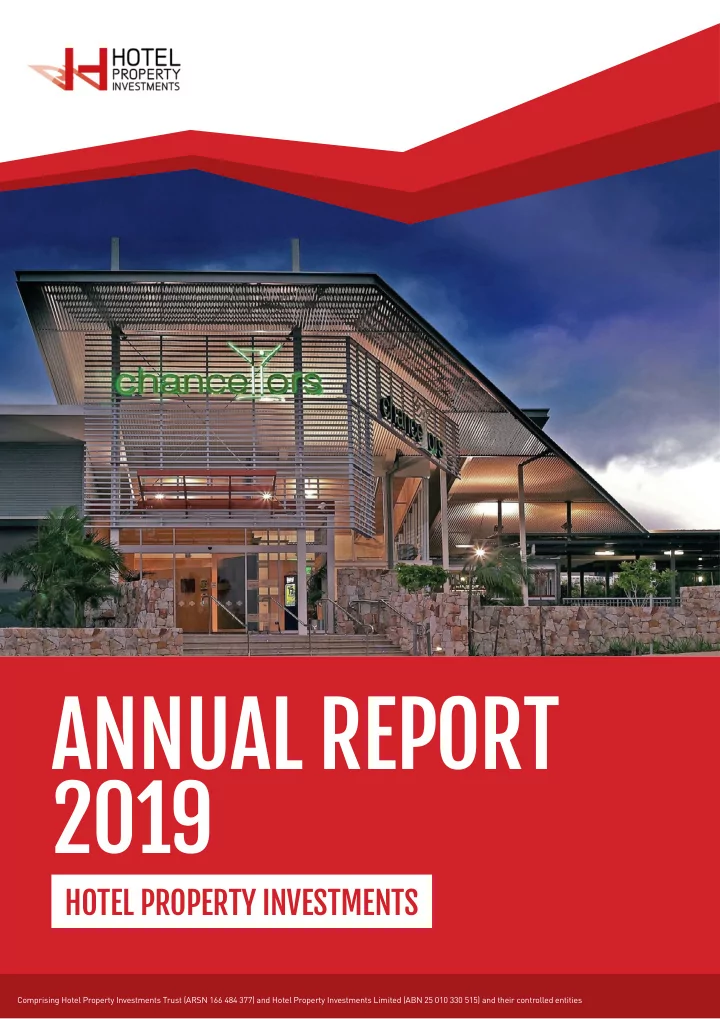
slide-26
SLIDE 26

ANNUAL REPORT 2019 | Hotel Property Investments

51 50

NOTES TO THE CONSOLIDATED FINANCIAL STATEMENTS

NOTE 14 TAXES

2019 2018 $’000 $’000 Tax expense

  • a. Tax expense recognised in profjt or loss

Current tax expense 4

  • Deferred tax expense

9 7 Tax expense attributable to profjt from continuing operations 13 7

  • b. Numerical reconciliation between tax expense and pre-tax accounting profjt

Profjt before tax 49,251 48,394 Income tax expense calculated at 30% 14,775 14,518 Trust income not subject to tax (14,768) (14,430) Effect of permanent differences 5 (80) Difference due to tax rate differential 1 (1) Tax expense on profjt before tax 13 7

  • c. Recognised deferred tax assets and liabilities

Deferred tax assets and liabilities are attributable to the following: Assets Liabilities Net 2019 2018 2019 2018 2019 2018 $’000 $’000 $’000 $’000 $’000 $’000 Plant & equipment 12 8

  • 12

8 Accrued expenses 43 22

  • 43

22 Employee liabilities 29 50

  • 29

50 Recognition of tax losses

  • 13
  • 13

84 93

  • 84

93 (d) Movements in deferred tax balances during the year 2019 2018 $’000 $’000 Balance at the beginning of the year 93 101 Recognised in profjt or loss (9) (8) 84 93 Balance represented as follows: Deferred tax asset 84 93 Deferred tax liability

  • 84

93

NOTE 15 TRADE AND OTHER PAYABLES

2019 2018 $’000 $’000 CURRENT Trade payables 26 49 Accrued interest 2,956 2,995 Other payables 2,167 2,571 5,149 5,615

NOTE 16 EMPLOYEE BENEFIT LIABILITIES

2019 2018 $’000 $’000 Employee benefjt liabilities 95 166 Represented as follows: Current liabilities 94 159 Non-current liabilities 1 7 95 166

NOTE 17 LOANS AND BORROWINGS

2019 2018 $’000 $’000 Non-current USPP Notes 228,768 228,596 Bank loans 34,466 47,048 263,234 275,644

PRIVATE PLACEMENT (“USPP”) NOTES

USPP - drawn 230,000 230,000 Borrowing costs capitalised (1,553) (1,553) Accumulated amortisation of borrowing costs 321 149 228,768 228,596 The USPP Note Purchase Agreement was executed on 8 August 2017 and funding occurred on 11 August 2017, with the proceeds used to repay bank loans. The USPP issue comprises three tranches of unsecured, Australian Dollar denominated notes:

  • A$100 million fjxed interest loan with an 8-year tenor, maturing in August 2025;
  • A$30 million fjxed interest loan with a 10-year tenor, maturing in August 2027; and
  • A$100 million fmoating interest loan with a 10-year tenor, maturing in August 2027.
slide-27
SLIDE 27

ANNUAL REPORT 2019 | Hotel Property Investments

53 52

NOTES TO THE CONSOLIDATED FINANCIAL STATEMENTS

BANK LOANS

Common Terms Deed (“CTD”) CTD - drawn 34,715 47,450 Borrowing costs capitalised (793) (1,710) Accumulated amortisation of borrowing costs 331 142 Borrowing costs written off 213 1,166 Total CTD Loans 34,466 47,048 The CTD facility maturity was extended on 28 June 2019 for 5 years maturing 28 June 2024. The facility limit remains unchanged at $78.1 million, inclusive of the $4.1 million guarantee facility.

FACILITY LIMITS

The available facilities and the amounts drawn are summarised below: 2019 USPP $’000 CTD $’000 Guarantee $’000 Total $’000 Facility limit 230,000 74,000 4,078 308,078 Drawn (230,000) (34,715) (4,078) (268,793) Available

  • 39,285
  • 39,285

2018 USPP $’000 CTD $’000 Guarantee $’000 Total $’000 Facility limit 230,000 74,000 4,078 308,078 Drawn (230,000) (47,450) (4,078) (281,528) Available

  • 26,550
  • 26,550

NOTE 18 DERIVATIVE FINANCIAL INSTRUMENTS

2019 2018 $’000 $’000 Derivative fjnancial instruments - non current liability

  • Derivative fjnancial instruments at the beginning of the year
  • (1,135)

Fair value loss for the year:

  • Cancelled derivatives
  • (45)

Close out of cancelled derivatives

  • 1,180

Fair value of derivative fjnancial instruments at end of the year

  • The HPI Group cancelled its $62.5 million interest rate swap on 19 July 2017, at a payout cost of $1.18 million.

NOTE 19 PROVISIONS

2019 2018 $’000 $’000 Provision for distribution Balance at the beginning of the year 14,302 14,458 Provisions made during the year 29,042 28,604 Provisions used during the year (28,604) (28,760) Balance at the end of the year 14,740 14,302

DISTRIBUTION

The provision for distribution relates to distributions to be paid to stapled security holders on 6 September 2019. This distribution will be funded via drawdown on the existing CTD loan facility.

NOTE 20 CONTRIBUTED EQUITY

  • No. of securities

$’000 On issue at 30 June 2019 – fully paid 145,943,076 262,640 On issue at 30 June 2018 – fully paid 145,943,076 262,640 On issue at 30 June 2018 – fully paid 145,943,076 262,640 On issue at 30 June 2017 – fully paid 145,943,076 262,640

Magnums Hotel

slide-28
SLIDE 28

ANNUAL REPORT 2019 | Hotel Property Investments

55 54

NOTES TO THE CONSOLIDATED FINANCIAL STATEMENTS

STAPLED SECURITIES

The units in the Trust are stapled to the shares in the Company and are referred to as "stapled securities". The stapled securities entitle the holder to participate in distributions and dividends and the proceeds on winding up

  • f the HPI Group in proportion to the number of stapled securities held. On a show of hands every stapled security

holder present at a meeting in person or by proxy, is entitled to one vote. A unit confers on its holder an undivided absolute, vested and indefeasible benefjcial interest in the Trust as a whole, subject to Trust liabilities, not in parts or single assets. All units confer identical interests and rights. Each member registered at the record date has a vested and indefeasible interest in a share of the distribution in proportion to the number of units held by them. All issued units are fully paid.

TREASURY SHARES

Contributed equity refmects the number of stapled securities on market at balance date, exclusive of the effect of treasury shares held. (Refer to note 23.)

NOTE 21 RETAINED EARNINGS

2019 2018 $’000 $’000 Balance at the beginning of the year 144,512 124,729 Profjt for the year 49,238 48,387 Distribution to stapled security holders (14,302) (14,302) Provision for distribution to stapled security holders (14,740) (14,302) Balance at the end of the year 164,708 144,512

NOTE 22 RESERVES

Cashfmow hedge reserve Treasury share reserve Share based payment reserve Total $’000 $’000 $’000 $’000 Opening balance at 1 July 2018

  • (490)

66 (424) Recognition of share-based payment expense

  • 38

38 Reversal of share-based payment expense

  • (55)

(55) Closing balance at 30 June 2019

  • (490)

49 (441) Opening balance at 1 July 2017

  • (186)

17 (169) Acquisition of shares

  • (304)
  • (304)

Recognition of share-based payment expense

  • 49

49 Closing balance at 30 June 2019

  • (490)

66 (424)

TREASURY SHARE RESERVE

The Treasury share reserve comprise the cost of the HPI Group's securities which were purchased on-market, and are held by the HPI Rights Plan Trust. At 30 June 2019, the HPI Group held 162,363 of the Company's securities (30 June 2018: 162,363).

SHARE BASED PAYMENT RESERVE

The share-based payments reserve comprises amounts recognised under the long-term incentive plan for executive employees and is the portion of the fair value of the total cost recognised of the unissued securities, which remain conditional on employment with the HPI Group at the relevant vesting date and certain market-based performance hurdles being obtained.

NOTE 23 NET ASSETS PER STAPLED SECURITY

2019 2018 Number of stapled securities on issue as at the end of the year 146,105,439 146,105,439 Less treasury securities (162,363) (162,363) Adjusted number of stapled securities on issue as at the end of the year 145,943,076 145,943,076 Net assets at balance date $426,907,191 $406,728,264 Net assets per stapled security $2.93 $2.79

Coomera Lodge Hotel

slide-29
SLIDE 29

ANNUAL REPORT 2019 | Hotel Property Investments

57 56

NOTES TO THE CONSOLIDATED FINANCIAL STATEMENTS

NOTE 24 EARNINGS PER STAPLED SECURITY

2019 2018 $ $ Profjt for the year 49,238,000 48,387,000 WEIGHTED AVERAGE NUMBER OF STAPLED SECURITIES On issue at the beginning of the year 146,105,439 146,105,439 Effect of treasury shares held* (162,363) (139,732) WEIGHTED AVERAGE NUMBER OF STAPLED SECURITIES 145,943,076 145,965,707 Basic and diluted earnings per stapled security – cents 33.74 33.15 * The effect of treasury shares held is the weighted average of 162,363 (2018: 162,363) shares held from date of acquisition to the end of the year.

NOTE 25 DISTRIBUTIONS

Number of stapled securities on issue as at the end of the year Total distribution $’000

  • No. of stapled

securities Distribution per stapled securities (cents) 2019 1 July 2018 to 31 December 2018 14,302 145,943,076 9.80 1 January 2019 to 30 June 2019 14,740 145,943,076 10.10 29,042 19.90 2018 1 July 2017 to 31 December 2017 14,302 145,943,076 9.80 1 January 2018 to 30 June 2018 14,302 145,943,076 9.80 28,604 19.60 Distributions are shown exclusive of expected distributions payable on treasury securities.

NOTE 26 OPERATING LEASES

The HPI Group leases out its investment properties under operating leases (refer to note 13). The future minimum lease receipts under non-cancelable leases are as follows: 2019 2018 $’000 $’000 LEASES AS LESSOR Less than one year 49,508 48,289 Between one and fjve years 117,272 143,477 More than fjve years 53,521 70,251 220,301 262,017 LEASES AS LESSEE Less than one year 96 92 Between one and fjve years 143 239 More than fjve years

  • 239

331 Payments made under operating leases are recognised in profjt or loss on a straight-line basis over the term of the lease. Lease incentives received are recognised as an integral part of the total lease expense, over the term of the lease.

NOTE 27 GROUP ENTITIES

Subsidiaries Country of incorporation Ownership interest The C.H. Trust Australia 100% HPI Hold Trust No. 1 Australia 100%1 HPI Retail Fund No. 1 Australia 100%1 HPI Vic Sub Trust No. 1 Australia 100%1 HPI NSW Sub Trust No.1 Australia 100%1 Hotel Property Investments Limited Australia 100%2 C.H. Properties Pty Ltd Australia 100%2 HPI LTIP Pty Ltd Australia 100%2 HPI Holdings No.1 Pty Ltd Australia 100%1, 2 HPI Retail Fund No. 1 Pty Ltd Australia 100%1, 2 HPI Sub Fund No. 1 Pty Ltd Australia 100%1, 2 HPI Rights Plan Trust Australia

3

1 Established in February 2018. 2 Hotel Property Investments Limited is not a subsidiary of the Trust, Hotel Property Investments Limited is stapled to the Trust. C.H. Properties Pty Ltd, HPI Holdings No. 1 Pty Ltd, HPI Retail Fund No. 1 Pty Ltd, HPI Sub Fund No. 1 Pty Ltd and HPIL LTIP Pty Ltd are 100% subsidiaries of Hotel Property Investments Ltd. 3 The HPI Rights Plan Trust is deemed to be controlled by the HPI Group and is therefore classifjed as a subsidiary for fjnancial reporting purposes.

slide-30
SLIDE 30

ANNUAL REPORT 2019 | Hotel Property Investments

59 58

NOTES TO THE CONSOLIDATED FINANCIAL STATEMENTS

NOTE 28 PARENT ENTITY

As at and throughout the fjnancial year ended 30 June 2019 the parent entity of the HPI Group was the Trust. 2019 2018 $’000 $’000 RESULTS OF THE PARENT ENTITY Profjt for the year 47,807 47,461 Other comprehensive income

  • Total comprehensive income

47,807 47,461 FINANCIAL POSITION OF THE PARENT ENTITY AT YEAR END Current assets 25,017 26,539 Total assets 681,717 676,889 Current liabilities 20,139 21,169 Total liabilities 283,373 296,813 Net assets 398,344 380,076 TOTAL EQUITY OF THE PARENT ENTITY COMPRISING OF: Contributed equity 262,642 262,642 Retained earnings 135,702 117,434 Total equity 398,344 380,076 The parent's contingent assets and commitments are the same as those of the HPI Group as disclosed in notes 32 and 34. The parent's contingent liabilities comprises of a bank guarantee, as disclosed in note 33.

NOTE 29 RELATED PARTIES

KEY MANAGEMENT PERSONNEL

The key management personnel of the HPI Group during the year were the non-executive directors of the Company, the Chief Executive Offjcer & Managing Director and the Chief Financial Offjcer & Company Secretary.

KEY MANAGEMENT PERSONNEL COMPENSATION

Key management personnel compensation during the year comprised the following: 2019 2018 $ $ Short-term employee benefjts 1,290,889 1,009,776 Post-employment benefjts 85,205 72,311 Leave entitlements 122,255

  • Share-based payment expense

38,453 49,702 1,536,802 1,131,789 Post-employment benefjts relate to defjned contribution superannuation benefjts. No other related party transactions were entered into during the year. Leave entitlements relate to long service leave and annual leave paid by HPI Group to David Charles upon retirement in October 2018.

NOTE 30 FINANCIAL INSTRUMENTS

ACCOUNTING CLASSIFICATIONS AND FAIR VALUES

The following table shows the carrying amounts and fair values of fjnancial assets and fjnancial liabilities. It does not include fair value information of fjnancial assets and fjnancial liabilities not measured at fair value if the carrying amount is a reasonable approximation of fair value. Carrying amount 2019 Financial assets at amortised cost Other fjnancial liabilities Total $’000 $’000 $’000 Financial assets not measured at fair value Trade and other receivables 369

  • 369

Cash and cash equivalents 586

  • 586

955

  • 955

Financial liabilities not measured at fair value Loans and borrowings

  • (263,234)

(263,234) Trade and other payables

  • (5,149)

(5,149)

  • (268,383)

(268,383)

slide-31
SLIDE 31

ANNUAL REPORT 2019 | Hotel Property Investments

61 60

NOTES TO THE CONSOLIDATED FINANCIAL STATEMENTS Carrying amount 2018 Financial assets at amortised cost Other fjnancial liabilities Total $’000 $’000 $’000 Financial assets not measured at fair value Trade and other receivables 353

  • 353

Cash and cash equivalents 1,240

  • 1,240

1,593

  • 1,593

Financial liabilities not measured at fair value Loans and borrowings

  • (275,644)

(275,644) Trade and other payables

  • (5,615)

(5,615)

  • (281,259)

(281,259)

CREDIT RISK

EXPOSURE TO CREDIT RISK The carrying amount of the HPI Group's fjnancial assets represents the maximum credit risk exposure. The HPI Group's maximum exposure to credit risk at the reporting date was: 2019 2018 $’000 $’000 Cash and cash equivalents 586 1,240 Trade receivables 369 353 955 1,593 There was no credit risk exposure to regions other than Australia. CONCENTRATIONS OF CREDIT RISK The HPI Group's maximum exposure to credit risk for aged trade receivables as at the reporting date by type of customer was as follows: Gross Impairment Gross Impairment 2019 $’000 2019 $’000 2018 $’000 2018 $’000 Hotel tenants Not past due 40

  • 156
  • Past due 0 – 30 days

172

  • 110
  • Past due 31 – 120 days

115

  • 7
  • 327
  • 273
  • Specialty tenants

Not past due 4

  • 41
  • Past due 0 – 30 days

33

  • 16
  • Past due 31 – 120 days

4

  • 20
  • 41
  • 77
  • 368
  • 350
  • IMPAIRMENT LOSSES

The HPI Group believes that the unimpaired amounts that are past due by more than 30 days are still collectable, based on historical payment behavior. Based on historic default rates, the HPI Group believes that no impairment allowance is necessary in respect of trade receivables past due.

LIQUIDITY RISK

The following are the contractual maturities of fjnancial liabilities, including estimated interest payments and excluding the impact of netting agreements: Carrying amount Contractual cash fmows 6 months

  • r less

6-12 months 1-2 years 2-5 years More than 5 years 2019 $’000 $’000 $’000 $’000 $’000 $’000 $’000 Loans and borrowings 264,715 344,763 5,821 5,813 11,629 66,741 254,759 Trade and other payables 5,149 5,149 5,149

  • Provision for

distribution 14,740 14,740 14,740

  • 284,604

364,652 25,710 5,813 11,629 66,741 254,759 2018 Loans and borrowings 277,450 377,924 6,555 6,661 13,325 81,367 270,016 Trade and other payables 5,615 5,615 5,615

  • Provision for

distribution 14,302 14,302 14,302

  • 297,367

397,841 26,472 6,661 13,325 81,367 270,016

MARKET RISK

INTEREST RATE RISK Interest rate profjle of the HPI Group's interest-bearing fjnancial instruments: 2019 2018 $’000 $’000 Variable rate instruments Financial assets 586 1,240 Financial liabilities (134,715) (147,450) (134,129) (146,210) CASH FLOW SENSITIVITY ANALYSIS FOR VARIABLE RATE INSTRUMENTS A change of 100 basis points in interest rates at the reporting date would have increased / (decreased) equity and profjt or loss by the amounts shown below. This analysis assumes that all other variables remain constant.

slide-32
SLIDE 32

ANNUAL REPORT 2019 | Hotel Property Investments

63 62

NOTES TO THE CONSOLIDATED FINANCIAL STATEMENTS Carrying amount $’000 + 100 bps of AUD IR Profjt/(Loss) $’000 + 100 bps of AUD IR Equity $’000

  • 100 bps of AUD

IR Profjt/(Loss) $’000

  • 100 bps of AUD

IR Equity $’000 2019 Cash at bank 586 6

  • (6)
  • Loans and borrowings

(134,715) (1,347)

  • 1,347
  • (134,129)

(1,341)

  • 1,341
  • 2018

Cash at bank 1,240 12

  • (12)
  • Loans and borrowings

(147,450) (1,475)

  • 1,475
  • (146,210)

(1,463)

  • 1,463
  • FAIR VALUES

The fair values of variable-rate fjnancial assets and liabilities approximate their carrying values.

NOTE 31 STATEMENT OF CASH FLOWS – ADDITIONAL INFORMATION

2019 2018 $’000 $’000 RECONCILIATION OF CASH FLOWS FROM OPERATING ACTIVITIES WITH PROFIT ATTRIBUTABLE TO THE STAPLED SECURITY HOLDERS Profjt for the year 49,238 48,387 ADJUSTED FOR NON-CASH ITEMS: Fair value adjustment to investment property (20,617) (21,172) Straight lining of rental income 1,410 303 Amortisation of borrowing costs 574 1,458 Depreciation expense 78 69 Share-based payments (17) 49 Tax expense/(benefjt) 13 7 INVESTING ACTIVITIES: Gain on sale of investment property (1,586)

  • FINANCING ACTIVITIES:

Fair value loss on cancelled derivatives

  • 45

Interest paid 13,030 12,444 CHANGE IN OPERATING ASSETS AND LIABILITIES (Increase)/decrease in trade and other receivables (18) (128) (Increase)/decrease in other current assets (190) 149 Increase/(decrease) in trade and other payables (796) 467 Increase/(decrease) in provisions (71) (3) Net cash from operating activities 41,048 42,075

NOTE 32 CONTINGENT ASSETS

The HPI Group is not aware of any contingent assets as at 30 June 2019 which may materially affect the operation of the business (2018: nil).

NOTE 33 CONTINGENT LIABILITIES

The HPI Group has issued a bank guarantee as security over the offjce premises for $78,304 (2018: $78,304). The parent has issued a bank guarantee of $4 million to the Company in its capacity of Responsible Entity (2018: $4 million). The HPI Group is not aware of any other contingent liabilities at 30 June 2019 which may materially affect the

  • peration of the business (2018: nil).

NOTE 34 COMMITMENTS

The HPI Group is not aware of any commitments at 30 June 2019 which may materially affect the operation of the

  • business. (2018: nil).

NOTE 35 SEGMENT INFORMATION

The HPI Group operates wholly within Australia and derives rental income, as a freehold pub owner and lessor. Revenues from QVC represented approximately $44.1 million (2018: $43.7 million) of the HPI Group's total revenues.

NOTE 36 SUBSEQUENT EVENTS

No other item, transaction or event has occurred subsequent to 30 June 2019 that is likely in the opinion of the directors to signifjcantly affect the operations of the HPI Group, the results of those operations, or the state of affairs of the HPI Group in future fjnancial periods.

Caption for Image

slide-33
SLIDE 33

ANNUAL REPORT 2019 | Hotel Property Investments

65 64

KPMG, an Australian partnership and a member firm of the KPMG network of independent member firms affiliated with KPMG International, a Swiss cooperative. Liability limited by a scheme approved under Professional Standards Legislation.

Independent Auditor’s Report

To the stapled security holders of Hotel Property Investments

Report on the audit of the Financial Report Opinion

We have audited the Financial Report of Hotel Property Investments (the Stapled Group Financial Report). In our opinion, the accompanying Stapled Group Financial Report of the Company is in accordance with the Corporations Act 2001, including:

  • giving a true and fair view of the Stapled

Group’s financial position as at 30 June 2019 and of its financial performance for the year ended on that date; and

  • complying with Australian Accounting

Standards and the Corporations Regulations 2001. The Financial Report of the Stapled Group comprises:

  • Consolidated statement of financial position as at 30 June

2019;

  • Consolidated statement of profit or loss and other

comprehensive income, consolidated statement of changes in equity, and consolidated statement of cash flows for the year then ended;

  • Notes including a summary of significant accounting

policies;

  • Directors’ Declaration.

The Stapled Group consists of the Hotel Property Investments Trust and Hotel Property Investments Limited and the entities they controlled at the year-end or from time to time during the financial year. Basis for opinion We conducted our audit in accordance with Australian Auditing Standards. We believe that the audit evidence we have obtained is sufficient and appropriate to provide a basis for our opinion. Our responsibilities under those standards are further described in the Auditor’s responsibilities for the audit of the Financial Report section of our report. We are independent of the Stapled Group, Hotel Property Investments Trust and Hotel Property Investments Limited (the Responsible Entity) in accordance with the Corporations Act 2001 and the ethical requirements of the Accounting Professional and Ethical Standards Board’s APES 110 Code of Ethics for Professional Accountants (the Code) that are relevant to our audit of the Financial Report in Australia. We have fulfilled our other ethical responsibilities in accordance with the Code. Key Audit Matters The Key Audit Matters we identified for the Stapled Group are:

  • Valuation of Investment Properties
  • Recognition of rental income

Key Audit Matters are those matters that, in our professional judgement, were of most significance in our audit of the Financial Report of the current period. These matters were addressed in the context of our audit of the Financial Report as a whole, and in forming our opinion thereon, and we do not provide a separate opinion on these matters. Valuation of Investment Properties ($708.5m) Refer to Note 13 to the Financial Report

DIRECTORS’ DECLARATION

In the opinion of the directors of Hotel Property Investments Limited, as Responsible Entity for the Hotel Property Investments Trust:

  • 1. the consolidated fjnancial statements and notes, set out on pages 27 to 63, are in accordance with the

Corporations Act 2001, including:

  • a. giving a true and fair view of the Hotel Property Investments Group fjnancial position as at 30 June 2019 and
  • f its performance for the twelve months ended on that date; and
  • b. complying with Australian Accounting Standards and the Corporations Regulations 2001.
  • 2. There are reasonable grounds to believe that the Hotel Property Investments Trust will be able to pay its debts

as and when they become due and payable. The directors draw attention to note 2 to the consolidated fjnancial statements, which includes the statement of compliance with International Financial Reporting Standards. Signed in accordance with a resolution of the directors of Hotel Property Investments Limited Michael Tilley Director Melbourne Dated this 20th day of August 2019

INDEPENDENT AUDITOR’S REVIEW REPORT

slide-34
SLIDE 34

ANNUAL REPORT 2019 | Hotel Property Investments

67 66

The key audit matter How the matter was addressed in our audit The valuation of investment properties was a key audit matter as it constituted 99.7% of the Stapled Group’s total assets as at 30 June 2019, we exercised auditor judgement and we are required to evaluate the experts engaged by the Stapled Group. The fair value of the investment properties was assessed by the Board of Directors based

  • n the combination of external valuations

conducted by CBRE, URBIS and internally prepared valuations. Half of the investment property portfolio was independently valued by external valuers as at 31 December 2018. We focused on the Stapled Group’s capitalised income projections for internally valued investment properties. Capitalised income projections are based upon a property’s estimate net market income, and application of a capitalisation rate in accordance with Stapled Group policy. The income capitalisation approach is used as a measure of fair value, unless specific conditions for the properties suggest that the component approach is a more accurate

  • measure. Component approach valuations

were based on the current market value of the land, market value of the operating authorities and the net present value of the residual income. Our audit procedures included:

  • Determined if the inputs used by the directors for the

computation of the fair value of the properties are reasonable, with reference to the market update report completed by CBRE to ensure that the inputs used by the directors are consistent with the reports furnished;

  • Obtaining the final signed external valuations conducted

during the financial year and evaluating the appropriateness

  • f the valuation methodologies and key assumptions used

by the Stapled Group’s external valuer in accordance with market practice and the accounting standards;

  • Assess the scope, competence and objectivity of the

external valuer engaged by the Stapled Group;

  • Re-performing a sample of valuations using the capitalised

income projections method by applying forecast rental income (obtained from the rental agreements that have effect into the forecast period) and capitalisation rate (sourced in accordance with Stapled Group policy criteria), and assessing the consistency of our calculations to the internally prepared valuations; and

  • Checking the valuation methodology adopted, in particular

the relevant capitalisation rate, for consistency with the Stapled Group’s valuation policy, accounting standards and industry practice.

  • For those properties valued under the component approach,

assessing the various components of the lease agreements; re-performing the calculations of forecast rental income (obtained from the rental agreements that have effect into the forecast period) and operating authorities; and evaluating the appropriateness of the external valuer’s assessment of the alternative use of the land. Recognition of Rental Income ($51.1m) Refer to Note 3(b) to the Financial Report The key audit matter How the matter was addressed in our audit The recognition of rental income was a key audit matter as it represents a significant portion of total income, which is distributed to stapled security holders and necessitates significant audit effort given the high volume

  • f rental agreements.

Additionally, the Stapled Group entered into new rental agreements with existing tenants, raising our audit effort. Rental income is recognised on a straight-line basis over the life of the rental agreement for leases where the rental income under the lease terms is fixed and measurable. For leases where the rent is determined with reference to current market information or inflationary measures e.g. the Consumer Price Index, the revenue is not straight-lined and is recognised in accordance with the rental agreement applicable for the accounting period. Our procedures included:

  • Checking a sample of monthly rental invoices and agreeing

to the original signed lease contracts and cash receipts;

  • Created an expectation to compare to actual revenue

reported by management by adjusting last year’s audited revenue balance for any disposals or acquisitions and applying the weighted average annual increase;

  • For new, cancelled or variations to leases, we checked the

lease terms to the Stapled Group’s straight line schedule used to recognise revenue on a straight line basis; and

  • Performing a recalculation of the straight line adjustment to

property revenue by using the fixed revenue over the lease term from the new or amended lease terms from the signed lease contract and comparing this to the Stapled Group’s straight line schedule. Other Information Other Information is financial and non-financial information in Hotel Property Investment’s annual reporting which is provided in addition to the Financial Report and the Auditor’s Report. The Directors of the Responsible Entity are responsible for the Other Information. Our opinion on the Financial Report does not cover the Other Information and, accordingly, we do not express an audit opinion or any form of assurance conclusion thereon, with the exception of the Remuneration Report and our related assurance opinion. In connection with our audit of the Financial Report, our responsibility is to read the Other Information. In doing so, we consider whether the Other Information is materially inconsistent with the Financial Report or our knowledge

  • btained in the audit, or otherwise appears to be materially misstated.

We are required to report if we conclude that there is a material misstatement of this Other Information, and based

  • n the work we have performed on the Other Information that we obtained prior to the date of this Auditor’s Report

we have nothing to report. Responsibilities of the Directors for the Financial Report The Directors are responsible for:

  • preparing the Financial Report that gives a true and fair view in accordance with Australian Accounting Standards

and the Corporations Act 2001;

  • implementing necessary internal control to enable the preparation of a Financial Report that gives a true and fair

view and is free from material misstatement, whether due to fraud or error;

  • assessing the Stapled Group’s ability to continue as a going concern and whether the use of the going concern

basis of accounting is appropriate. This includes disclosing, as applicable, matters related to going concern and using the going concern basis of accounting unless they either intend to liquidate the Stapled Group or to cease

  • perations, or have no realistic alternative but to do so.

Auditor’s responsibilities for the audit of the Financial Report Our objective is:

  • to obtain reasonable assurance about whether the Financial Report as a whole is free from material

misstatement, whether due to fraud or error; and

  • to issue an Auditor’s Report that includes our opinion.

Reasonable assurance is a high level of assurance, but is not a guarantee that an audit conducted in accordance with Australian Auditing Standards will always detect a material misstatement when it exists. Misstatements can arise from fraud or error. They are considered material if, individually or in the aggregate, they could reasonably be expected to influence the economic decisions of users taken on the basis of the Financial Report. A further description of our responsibilities for the audit of the Financial Report is located at the Auditing and Assurance Standards Board website at: http://www.auasb.gov.au/auditors_responsibilities/ar2.pdf This description forms part of our Auditor’s Report.

Report on the Remuneration Report

Opinion In our opinion, the Remuneration Report of Hotel Property Investments Limited for the year ended 30 June 2019, complies with Section 300A of the Corporations Act 2001. Directors’ responsibilities The Directors of Hotel Property Investments Limited are responsible for the preparation and presentation of the Remuneration Report in accordance with Section 300A of the Corporations Act 2001. Our responsibilities We have audited the Remuneration Report included in pages 14 to 23 of the Directors’ report for the year ended 30 June 2019. Our responsibility is to express an opinion on the Remuneration Report, based

  • n our audit conducted in accordance with Australian Auditing Standards.

KPMG Rachel Milum Partner Melbourne 20 August 2019

slide-35
SLIDE 35

ANNUAL REPORT 2019 | Hotel Property Investments

69 68 SECURITY HOLDER INFORMATION SUBSTANTIAL SECURITY HOLDERS

The number of stapled securities held by the HPI Group's substantial security holders as at 16 July 2019 is as follows: NAME J P MORGAN NOMINEES AUSTRALIA PTY LIMITED Stapled Securities 29,713,771 HSBC CUSTODY NOMINEES (AUSTRALIA) LIMITED 28,149,071 CITICORP NOMINEES PTY LIMITED 11,835,873 NATIONAL NOMINEES LIMITED 8,437,322

20 LARGEST SECURITY HOLDERS

AS AT 16 JULY 2019 Number of Stapled Percentage of Total Stapled Name Securities held Securities 1 J P MORGAN NOMINEES AUSTRALIA PTY LIMITED 29,713,771 20.34 2 HSBC CUSTODY NOMINEES (AUSTRALIA) LIMITED 28,149,071 19.27 3 CITICORP NOMINEES PTY LIMITED 11,835,873 8.10 4 NATIONAL NOMINEES LIMITED 8,437,322 5.77 5 CITICORP NOMINEES PTY LIMITED 2,219,539 1.52 6 BNP PARIBAS NOMINEES PTY LTD HUB24 CUSTODIAL SERV LTD DRP 1,790,477 1.23 7 NETWEALTH INVESTMENTS LIMITED 1,709,661 1.17 8 BNP PARIBAS NOMS PTY LTD 1,500,902 1.03 9 CS FOURTH NOMINEES PTY LIMITED 1,054,731 0.72 10 ECAPITAL NOMINEES PTY LIMITED 840,000 0.57 11 OXLEIGH PTY LTD 800,713 0.55 12 BRISPOT NOMINEES PTY LTD 726,854 0.50 13 UBS NOMINEES PTY LTD 519,396 0.36 14 BNP PARIBAS NOMINEES PTY LTD 492,099 0.34 15 SARGON CT PTY LTD 384,509 0.26 16 MR DAVID STEWART FIELD 377,717 0.26 17 POWERWRAP LIMITED 311,872 0.21 18 MR DAVID CALOGERO LOGGIA 311,338 0.21 19 BECJOHN PTY LIMITED 306,666 0.21 20 TENNESSEE INVESTMENTS PTY LTD 300,000 0.21 Total 91,782,511 62.83

DISTRIBUTION OF SECURITY HOLDERS

AS AT 16 JULY 2019 Range Total Holders Stapled Securities Percentage of Total Stapled Securities 1 - 1,000 2,469 1,325,493 0.59 1,001 - 5,000 3,325 9,099,271 5.28 5,001 - 10,000 1,352 10,306,045 6.39 10,001 - 100,000 1,254 28,496,693 22.78 100,001 and over 53 96,877,937 64.95 Total 8,453 146,105,439 100.00 As at 16 July 2019, there were 146,105,439 fully-paid stapled securities held by 8,453 individual security holders. The number of securityholders holding less than a marketable parcel of stapled securities is 162.

The Regatta Hotel

slide-36
SLIDE 36

ANNUAL REPORT 2019 | Hotel Property Investments

71 70 CORPORATE DIRECTORY

HOTEL PROPERTY INVESTMENTS

Hotel Property Investments Limited ABN 25 010 330 515 Hotel Property Investments Trust ARSN 166484377 Level 17, IBM Centre, 60 City Road Southbank VIC 3006 Australia Phone: (03) 9038 1774 Fax: (03) 8526 7430 www.hpitrust.com.au

SHARE REGISTRY

Link Market Services Tower 4, 727 Collins Street Docklands VIC 3008 Australia Phone (toll free within Australia): 1300 554 474 Fax: +61 2 9287 0303 www.linkmarketservices.com.au

CUSTODIAN

The Trust Company Limited Level 12, Angel Place 123 Pitt Street Sydney NSW 2001 Australia

AUDITOR

KPMG Tower Two Collins Square 727 Collins Street Melbourne VIC 3008 Australia

RESPONSIBLE ENTITY

Hotel Property Investments Limited ABN 25 010 330 515 Level 17, IBM Centre, 60 City Road Southbank VIC 3006 Australia

COMPANY SECRETARY

Hotel Property Investments Limited Blair Strik

slide-37
SLIDE 37

www.hpitrust.com.au