
SLIDE 1
How to Become a Champion
Iran Coffee.Academy
By Safa Salehi, Feb. 2018
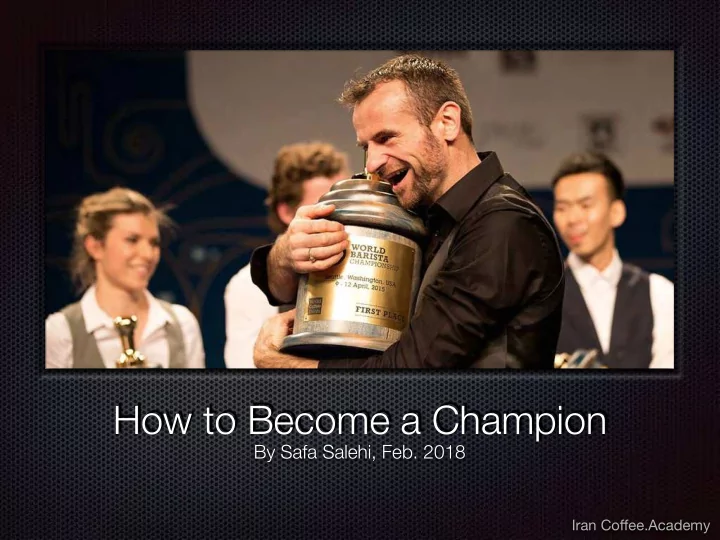
How to Become a Champion By Safa Salehi, Feb. 2018 Iran Co ff - - PowerPoint PPT Presentation
How to Become a Champion By Safa Salehi, Feb. 2018 Iran Co ff ee.Academy ABOUT SCA The Specialty Coffee Association (SCA) is a nonprofit, membership-based association built on foundations of openness, inclusivity, and the power of shared
Iran Coffee.Academy
By Safa Salehi, Feb. 2018
The Specialty Coffee Association (SCA) is a nonprofit, membership-based association built on foundations of openness, inclusivity, and the power of shared knowledge. The Specialty Coffee Association of America, established in 1982, and the Speciality Coffee Association of Europe, established in 1998, since January 2017 they have officially become one organization. The unified organization, the Specialty Coffee Association (SCA). SCA acts as a unifying force within the specialty coffee industry and works to make coffee better by raising standards worldwide through a collaborative and progressive approach. Dedicated to building an industry that is fair, sustainable, and nurturing for all, SCA draws on years of insights and inspiration from the specialty coffee community.
Iran Coffee.Academy
The World Barista Championship (WBC) is the preeminent international coffee competition produced annually by World Coffee Events (WCE). The competition focuses on promoting excellence in coffee, advancing the barista profession, and engaging a worldwide audience with an annual championship event that serves as the culmination of local and regional events around the globe.
2017 World Barista Champion: Dale Harris, UK
Has a mastery of technique, craft, and communication and service skills; Passionate about the barista profession. Coffee knowledge beyond the twelve drinks being served in the competition. Prepares and serves high quality beverages Role model and a source of inspiration for others.
Technique Communication Service Skills Passion Coffee Knowledge High Quality Beverages (Twelve Drinks) Role Model Inspiration
Iran Coffee.Academy
Iran Coffee.Academy
Introduction to coffee Extraction and Brewing Sensory Evaluation Green Coffee Coffee Roasting
Iran Coffee.Academy
Extract Coffee?
Iran Coffee.Academy
cup?
bar?
Coffee, Milk …
Iran Coffee.Academy
Coffee Variation Farming (Growing, Harvesting…) Altitude Soil Weather Process (Washed, Natural, Honey …) Storage Transport Roasting (Profile, Roast date) …
excellence in coffee, advancing the barista profession, and engaging a worldwide audience …
Iran Coffee.Academy
Excellence in Coffee, advancing the barista profession, and engaging a worldwide audience …
Your Experience World level Barista Champions Selection Suggestion by Pros Coffee Excellence winners Coffee from Famous Farm, Green Bean Seller
Iran Coffee.Academy
Cupping Brewing in different method Extract Espresso in different Ratio, Grind sizes, Roast Time … Find your Coffee Flavour Profile Find best Extraction Recipe (Grind size, Ratio, Time, Volume, Temperature) Try your Coffee with different Milk and Milk Ratio Try with different Additive for Signature
Iran Coffee.Academy
Read and Understand the Rules Follow the Rules Watch Competition in Youtube (last version) Ask the Question and check R&R Find somebody to couch you
Iran Coffee.Academy
People like Story behind their coffee cups You are presenter of Specialty coffee community behind you Necessary Info (Origin, Variation, altitude, Process, Roast, Taste Balance, Flavours, Tactile, Ratio, well explain (sig.)…) Your Presentation Concept should be Related to the 12 Cups Scientific, not just coffee pack info Shows your passion and knowledge Don't teach judges ;) Don't explain basic and Standard info
Iran Coffee.Academy
Make check lists/double check/Plan B Leave all bad Habits Capture your practice Cleaning obsession Ask your friends to help you Find how you can control your stress Be Prepare for all shits Be on-time Backup
achieve thoroughness and accuracy when accomplishing a task
Iran Coffee.Academy
Iran Coffee.Academy
Iran Coffee.Academy
–Coffee
The evaluation scale is the same for both technical and sensory judges. There are two types of scores: the Yes/No Score, and the Zero to Six Score. Yes = 1 No = 0 Unacceptable=0 Acceptable=1 Average=2 Good=3 Very Good=4 Excellent=5 Extraordinary=6
The competitor receives one point for a score of Yes on this item, and zero points for a score of No.
Some score sheet criteria is evaluated on a scale of zero to six, with zero being the lowest score and six being the highest.
Iran Coffee.Academy
World level: One technical judge will be present in the First Round of the World Barista Championship, and 0 technical judges will be present in the Semi-Final and Final Rounds. National level: 2 technical judges will be present at National level competition.
Iran Coffee.Academy
station (work table, prep table, top of machine).
practical and efficient way.
pitchers, pre-poured water in the water glasses, etc.)
performance time starts. The cloths must be clean and have a designated purpose.
competitor’s competition time. F . Competitors may have pucks in the porta filters at the start of their competition time. This will not count against “Clean working area at start-up”.
filter and prior to each extraction.
judge will mark “Yes.”
time that may be found in the espresso grinder’s dosing chamber, in the knock box, on the counter, in the trash, on the floor or elsewhere
F . The competitor should start the extraction immediately after inserting the porta filter into the machine without any delay.
times are within a 3.0-second variance.
A.The competitor should pour cold, fresh milk into a clean pitcher, which must not have been filled during the preparation time… B.The competitor should purge the steam wand before inserting it into the milk pitcher. C.The steam wand should be cleaned with a dedicated steam wand towel. D.The competitor should purge the steam wand after steaming the milk. E.The pitcher should be more or less empty after the milk beverages have been
spouts by cleaning the spouts. Rinsing, using a towel, and wiping with fingers are all acceptable methods for achieving clean spouts.
practices throughout their entire presentation.
competitor’s cloths. The competitor should use one for the steam wand, one for cleaning the filter basket and one for the workstation.
Espresso protocol: Sensory judges will stir the espresso three (3) times with a spoon to mix the flavours within the shot, then immediately taste. Sensory judges will take at least two complete sips to fully evaluate the espresso. Judges will not taste the espresso off the spoon. Competitors may override the evaluation protocol by giving the judges specific alternative instructions on how they want the espresso evaluated. As long as the instructions are reasonable, the judges should follow all instructions given by the competitor.
Competitors are advised to explain verbally to the judges 1.Why They Chose Their Particular Coffee 2.Coffee Info : Origin, Variation, Altitude, Process (All Info Relevant To Cups Flavour Profile) 3.The Basic Roast Profile 4.The Espresso Constituent Structure 5.Brewing Ratio 6.The Major Taste Elements
appearance of the crema for presence in the vessel.
based on how well the taste components (sweet, acidic, bitter) fit together and complement each
descriptions and explanations given by the competitor and compare those with the beverage served.
competitor and compare those with the weight and mouth feel and finish
and drunk from.
Visual: Judges will evaluate the appearance of the milk beverage to determine its visual score. On the surface, the milk beverage should have a 1.color combination of milk and coffee 2.with good color contrast definition 3.balance in the cup 4.symmetrical design 5.smooth 6.possibly glossy/glass-like sheen (Note: It is not acceptable for milk beverages to be topped with any additional spices and/or powders. Doing so will result in a “0” in the “taste balance” category.)
Taste Balance: 1.The milk beverage is a hot beverage that should be served at a temperature that is immediately consumable. 2.The texture (mouthfeel) and temperature 3.Taste of the coffee and milk The milk beverage should have Harmonious balance of the sweetness of the milk and its espresso base.
Accuracy of Flavour Descriptors: 1.Judges will listen to the flavour descriptions and explanations given by the competitor and compare those with the beverage served 2.The flavour profile of the beverage served should support specialty coffee. 3.This score is based on how accurately these descriptors match the flavour
4.Flavour descriptors must be given or a score of zero will be received in this category. Functional vessel used: Milk beverages must be served in a vessel from which judges must be able to drink (too hot, unable to hold and drink from vessel safely)
Well explained, Introduced, and Prepared (WHAT, HOW, WHY)
the explanation should include
The competitor must explain to the sensory judges how to drink the beverage (smell, stir, sip, etc.).
Well explained, Introduced, and Prepared (WHAT, HOW, WHY)
the explanation should include
The competitor must explain to the sensory judges how to drink the beverage (smell, stir, sip, etc.).
passion and inspiration that the barista has displayed during their routine.