HOW MICHIGAN MARINAS ARE ADOPTING BEST MANAGEMENT PRACTICES TO - - PowerPoint PPT Presentation

how michigan marinas are adopting best management
SMART_READER_LITE
LIVE PREVIEW

HOW MICHIGAN MARINAS ARE ADOPTING BEST MANAGEMENT PRACTICES TO - - PowerPoint PPT Presentation

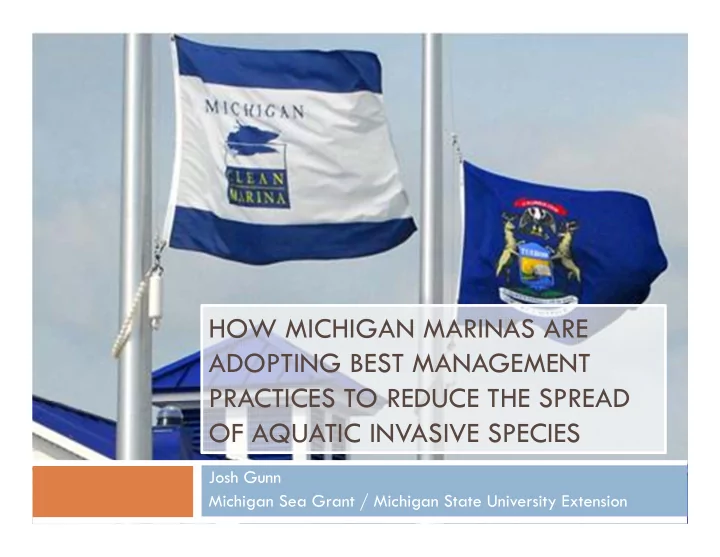
HOW MICHIGAN MARINAS ARE ADOPTING BEST MANAGEMENT PRACTICES TO REDUCE THE SPREAD OF AQUATIC INVASIVE SPECIES Josh Gunn Michigan Sea Grant / Michigan State University Extension Goal of AIS BMPs in Marinas Over 11,000 inland lakes over 5

slide-1
SLIDE 1

HOW MICHIGAN MARINAS ARE ADOPTING BEST MANAGEMENT PRACTICES TO REDUCE THE SPREAD OF AQUATIC INVASIVE SPECIES

Josh Gunn Michigan Sea Grant / Michigan State University Extension

slide-2
SLIDE 2

Goal of AIS BMPs in Marinas

  • Over 11,000 inland

lakes over 5 acres

  • Majority of AIS is in

Great Lakes, and difficulty is preventing spread into inland lakes

  • Another concern is

the spread among inland lakes

slide-3
SLIDE 3

Small Public Harbors, Municipal Marinas, Private Marinas

 Accommodation Practices  Installed public boat wash

station

 Portable boat wash station  Parking area to inspect

and clean boat

 Education Practices  Signage  Training  Clean Boats Clean Waters

Program

slide-4
SLIDE 4

 Community-based

program where volunteers go to parks, harbors, and public marinas to educate boaters and demonstrate proper ways to inspect boats and trailers

 Michigan Lakes and

Streams Association is taking an increasing role in the Clean Boats Clean Waters Program due to the increase in participation on inland lakes

slide-5
SLIDE 5

Large Privately Owned Marinas

 Maintenance services (like boat bottom pressure washing) provided

at larger marinas may be classified as an industrial activity and the facility must comply with DEQ requirement for not discharging wastewater directly into sewer system or into surface water

 There are different systems in use in Michigan to handle boatwash

wastewater prior to discharge or transfer into a storage tank:

 Filtration systems  Settling systems  Closed-loop recycling systems

 Disclaimer: Use of the mentioned systems does not

ensure compliance with Michigan DEQ requirements and Clean Water Act Regulations; please contact DEQ, local municipality, and/or consultant prior to selecting an appropriate boat wash technology

slide-6
SLIDE 6

Typical Permanent Boat Washing Station Design

 Two Key Factors:

  • 1. When boat washing is being

conducted, all wastewater goes to storage or municipal sewer

  • 2. When boat washing is not

being conducted, stormwater cannot go into municipal sewer

 NOTE: if design results in

stormwater overflow, it is considered a point source and additional permits beyond a Stormwater Discharge Permit may be required

slide-7
SLIDE 7

Boat Wash Technologies: Installed public boat wash stations

Lake Associations and Municipal Marinas showing interest in installing or retrofitting these into their facility Unless washing is done prior to boat going into lake, it only prevents removal of AIS

slide-8
SLIDE 8

Boat Wash Technologies: Portable boat wash stations

Can be packed up if space is an issue Cheaper than a permanent station Photos: Steve Kohls, Brainerd Dispatch

slide-9
SLIDE 9

Boat Wash Technologies: Filtration systems

Sewer filtration systems need maintenance (cleaning and/or replacing)

slide-10
SLIDE 10

Boat Wash Technologies: Settling Systems

 Allows larger organics

and particulates to settle prior to pumping into sewer or storage

 Can include larger

settling basins that go deeper into the ground before discharge into tank or sewer

slide-11
SLIDE 11

Boat Wash Technologies: Recycling systems

 Closed system designed

to reduce the quantity

  • f water used

 Filtration and treatment

  • f water

 Potentially higher

maintenance cost

 If chemically treated,

water will still need to be properly disposed of at end of season

slide-12
SLIDE 12

Another commonly heard suggestion…

Take this To this

slide-13
SLIDE 13

For More Information:

 Under The Great Lakes Restoration Initiative, The

Green Marina Education and Outreach Project has worked to educate marinas, boaters, and the public

  • n AIS and boat bottom washing

 Regional BMP guide to assist Great Lakes Marinas in

adopting BMPs that reduce the transfer of AIS from one body of water to another

 A previous Clean Marina Webinar was held on boat

wash practices

 webpage of past presentations:

http://www.miseagrant.umich.edu/greenmarina/boatwash/index.html

slide-14
SLIDE 14

Josh Gunn Michigan Sea Grant Extension Educator Michigan Clean Marina Coordinator Phone: (586)469-6087 Email: gunnjosh@msu.edu