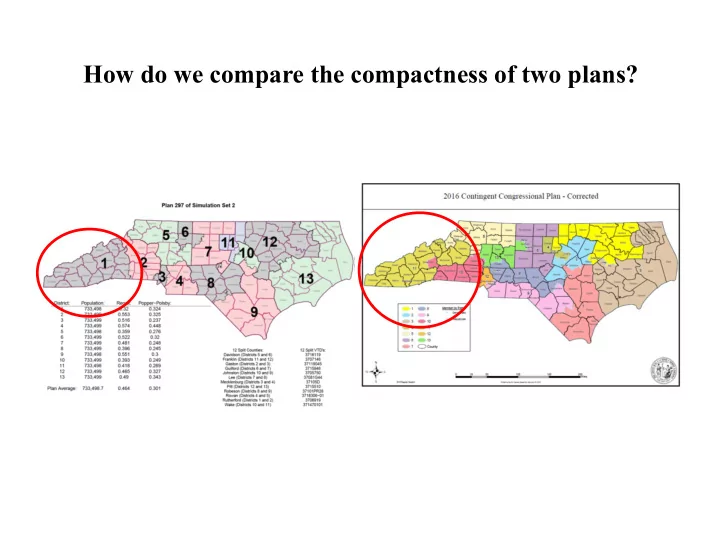
How do we compare the compactness of two plans? Measuring District - - PowerPoint PPT Presentation

how do we compare the compactness of two plans measuring
SMART_READER_LITE
LIVE PREVIEW

How do we compare the compactness of two plans? Measuring District - - PowerPoint PPT Presentation

How do we compare the compactness of two plans? Measuring District Compactness: Reock Score Measuring District Compactness: Polsby-Popper Score State Courts: 1) Obligated to follow federal law 2) Obligated to enforce state laws Federal Courts:


slide-1
SLIDE 1

How do we compare the compactness of two plans?

slide-2
SLIDE 2

Measuring District Compactness: Reock Score

slide-3
SLIDE 3

Measuring District Compactness: Polsby-Popper Score

slide-4
SLIDE 4

State Courts: 1) Obligated to follow federal law 2) Obligated to enforce state laws

slide-5
SLIDE 5

Federal Courts: 1) Obligated to follow federal law 2) Not empowered to enforce state laws

slide-6
SLIDE 6

Equal Protection Clause (Article I, Section 19): “No person shall be denied the equal protection of the laws.” “these clauses provide significant constraints against governmental conduct that disfavors certain groups of voters or creates barriers to the free ascertainment and expression of the will of the People…” (Common Cause v. Lewis 2019)

slide-7
SLIDE 7

Free Speech Clause (Article I, Section 14): “Freedom of speech and of the press are two of the great bulwarks of liberty and therefore shall never be restrained…” “[T]he North Carolina Constitution affords a direct cause of action for damages against government officers in their official capacity for speech violations, even though federal law does not” (Common Cause

  • v. Lewis 2019)
slide-8
SLIDE 8

Free Election Clause (Article I, Section 10): “All elections shall be free.” Common Cause v. Lewis (2019): “Elections are not free when partisan actors have tainted future elections by specifically and systematically designing the contours of the election districts for partisan purposes and a desire to preserve power.”

slide-9
SLIDE 9
slide-10
SLIDE 10
slide-11
SLIDE 11

Partisan Intent: Thomas Hofeller’s Draft Plans

slide-12
SLIDE 12

Partisan Intent: Thomas Hofeller’s Draft Plans

slide-13
SLIDE 13

Thousands of Non-Partisan Computer-Simulated Maps:

slide-14
SLIDE 14

Computer Simulation Algorithm:

slide-15
SLIDE 15
slide-16
SLIDE 16
slide-17
SLIDE 17
slide-18
SLIDE 18
slide-19
SLIDE 19
slide-20
SLIDE 20

Common Cause v. Lewis (2019)

July 15-26, 2019: Trial in Raleigh, North Carolina September 3, 2019: Court strikes down House and Senate District Maps; Orders Legislature to draw new non-partisan maps September 10, 2019: Legislature draws new maps by randomly selecting from Chen computer-simulated districting maps

slide-21
SLIDE 21

Legislature Uses Lottery Machine to Randomly Select Computer-Simulated Maps

slide-22
SLIDE 22

Legislature’s New Remedial House Map (Sept. 2019)

slide-23
SLIDE 23

Why did the NC General Assembly use a lottery machine?

slide-24
SLIDE 24

League of Women Voters of Michigan v. Ruth Johnson (2018)

slide-25
SLIDE 25

League of Women Voters of Michigan v. Ruth Johnson (2018)

slide-26
SLIDE 26

League of Women Voters of Michigan v. Ruth Johnson (2018)

slide-27
SLIDE 27

League of Women Voters of Michigan v. Ruth Johnson (2018)

slide-28
SLIDE 28

Redistricting Reform in Michigan:

  • Michigan referendum process: Initiated Constitutional

Amendment

  • Voters Not Politicians writes Proposal 2

Gather 315,654 signatures within 180 days, at least 120 days before Nov 2018 election (10% of electorate in Gubernatorial election) Voters approved Proposal 2 by 61% - 39% in Nov 2018

slide-29
SLIDE 29

Michigan Independent Citizens Redistricting Commission:

  • 13 Michigan voters (4 Republicans, 4 Democrats, 5

independents)

  • Commission draws Michigan’s Congressional, House, and

Senate maps

  • Commission must follow constitutional criteria in drawing

districts

slide-30
SLIDE 30

Michigan Independent Citizens Redistricting Commission:

slide-31
SLIDE 31

Example of how California’s Redistricting Commission Solicited Public Feedback on Communities of Interest (2011):

slide-32
SLIDE 32

Using Crowdsourced Maps to Describe Communities of Interest:

slide-33
SLIDE 33