Housekeeping Items Cell phones off or on vibrate Washroom location - - PDF document

housekeeping items
SMART_READER_LITE
LIVE PREVIEW

Housekeeping Items Cell phones off or on vibrate Washroom location - - PDF document

Local Government Elections Workshop March, 2020 1 Housekeeping Items Cell phones off or on vibrate Washroom location Fire exits Breaks 2 2 Common Acronyms CA The Cities Act DRO Deputy Returning Officer EO Election


slide-1
SLIDE 1

1

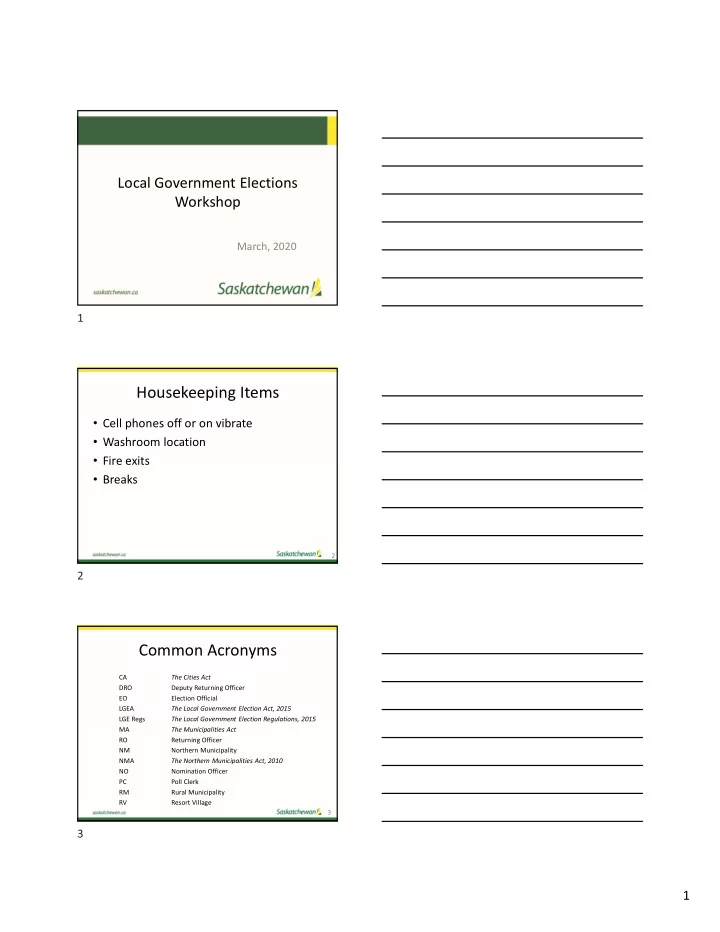
Local Government Elections Workshop

March, 2020

Housekeeping Items

  • Cell phones off or on vibrate
  • Washroom location
  • Fire exits
  • Breaks

2

Common Acronyms

CA The Cities Act DRO Deputy Returning Officer EO Election Official LGEA The Local Government Election Act, 2015 LGE Regs The Local Government Election Regulations, 2015 MA The Municipalities Act RO Returning Officer NM Northern Municipality NMA The Northern Municipalities Act, 2010 NO Nomination Officer PC Poll Clerk RM Rural Municipality RV Resort Village 3

1 2 3

slide-2
SLIDE 2

2

Things to Watch For

= Legislative changes (Sec. 10) = Legislation section reference (The Local Government Election Act, 2015)

4

Election Dates, 2020

(Sec. 10)

Resort Villages : July 25, 2020 (last Saturday of July)

* This is not a change from before.

5

Election Dates, 2020

(Sec. 10)

Cities, Towns, Villages: Monday, November 9th RM’s : November 9th

(Reeve and councillors for odd-numbered divisions)

Northern Municipalities: November 9th

(unless moved to second last Wednesday of September, or last Wednesday of September, or first Wednesday of October)

6

4 5 6

slide-3
SLIDE 3

3

General Elections & Terms of Office

  • General elections are held for each office

every four years.

– Rural municipalities hold a general election for selected divisions every two years.

  • Each council member holds office for a

four-year term. (Sec. 16)

  • Terms begin and end at the first meeting
  • f council after election day.

7

Council’s Election Duties

Council shall:

  • set the remuneration to be paid to EOs (Sec.

52);

  • pay all or municipality’s share of the costs

incurred in holding the election (Sec. 33);

  • set date of a by-election (Sec. 11); and
  • in a rural municipality, name one or more

polling places within Saskatchewan for each division (Sec. 24).

8

General Election Bylaw

(Sec. 9.1)

  • must be passed at least 90 days before

election day;

  • used for changing the method of providing

public notice.

9

7 8 9

slide-4
SLIDE 4

4

General Election Bylaw, Con’t

(Sec. 9.1)

  • inclusion of candidate’s occupation on nomination

paper and ballot, if desired;

  • form of the ballot;
  • establishment of a mail-in ballot system;
  • rules respecting the return of a deposit to a candidate,

for municipalities with population over 20,000;

  • disclosure of campaign finances;
  • use of voting machines; and/or
  • distribution and authorization of candidacy

promotional advertisements.

10

Residency

(Sec. 3 & 4)

  • Residency impacts both the ability to run

for office and the ability to vote.

  • A person’s residence is the place they

typically refer to as “home”.

  • Special rules for students and members
  • f the Canadian Forces.

11

Candidate Qualifications

(Sec. 42) In ALL municipalities, a candidate:

  • is at least 18 years of age on election day;
  • is not disqualified by this or any other Act;
  • is a Canadian citizen on the day the nomination

paper is submitted; and

  • is a Saskatchewan resident for six consecutive

months prior to the day the nomination paper is submitted;

PLUS…

12

10 11 12

slide-5
SLIDE 5

5 Candidate Qualifications, Con’t

(Sec. 42)

City, Town, Village, Northern Municipality Resort Village Rural Municipality * Has resided in the municipality for at least three consecutive months prior to the day of submitting the nomination paper. *Has resided in the resort village (RV), or on land now in the RV, for at least three consecutive months prior to the day of submitting the nomination paper; or * Is eligible to vote in the rural municipality. * Is the assessed person of property in the RV, or now in the RV, for at least three consecutive months prior to the day of submitting the nomination paper; or * Is the spouse of a person mentioned in one of the above paragraphs.

13

Eligibility & Disqualification

  • A person cannot be nominated for more than
  • ne office within a municipality.
  • Candidates cannot be a court judge or the

municipality’s auditor or solicitor.

  • Municipal employees are required to take a

leave of absence to seek office. If elected, resignation as employee is deemed to have

  • ccurred on the day before being declared

elected.

14

Voters in an Urban Municipality

(cities, towns, villages) (Sec. 36)

An eligible voter is: a) a Canadian citizen; b) at least 18 years of age; c) a Saskatchewan resident for six consecutive months before election day; and

i. has resided in the municipality, or on land now in the municipality, for at least three consecutive months immediately before election day; or ii. is the owner of assessable land in the municipality, or land now in the municipality, for at least three consecutive months immediately before election day.

15

13 14 15

slide-6
SLIDE 6

6 Voters in an Urban Municipality

(resort villages) (Sec. 36)

An eligible voter is: a) a Canadian citizen; b) at least 18 years of age; and

i. a resident of the RV, or of land now in the RV, for at least three consecutive months immediately before election day; or

  • ii. is the assessed person of property in the RV, or

land now in the RV, for at least three consecutive months immediately before election day.

16

Voters in a Rural Municipality

In addition to Canadian citizenship and age requirements, a voter of an RM must:

  • meet one of the following criteria:

(i) be a resident of the RM, or of land now in the RM, for at least three consecutive months immediately preceding the day of the election; (i.1) be the registered owner of property in the RM, or property now in the RM; (ii) be the assessed person of property in the RM, or now in the RM, pursuant to Sec. 207 of the MA; (iii) be the occupant of a permitted trailer or mobile home in the RM,

  • r land now in the RM, pursuant to Sec. 306 of the MA;

(iv) be the spouse of a person mentioned in clause (ii) or (iii); or (v) be the chief executive officer of a duly-incorporated co-operative, corporation or religious association that is assessed on the last revised assessment roll with respect to property in the rural municipality that is not exempt from taxation.

17

Voting in Wards

(Sec. 38)

  • If an urban municipality is divided into wards, a

voter is eligible to vote in the ward where he or she resides.

  • If the voter does not reside in the municipality

but owns land there, he/she votes in the ward where they own land.

  • If the voter does not reside in the municipality

AND owns land in more than one ward, he/she votes in the ward with the total highest land assessment (certificate required).

18

16 17 18
slide-7
SLIDE 7

7 Voting in Divisions

(Sec. 20 & 39)

  • Each voter in a RM is entitled to vote for the

reeve and for one division councillor.

  • The administrator must notify voters in which

division they are entitled to vote by indicating the division number on the assessment notice and on the tax notice. (MA Sec. 215 & 267)

19

Determining the Division

(Sec. 39)

The division where a person is eligible to vote is determined by the first applicable clause:

  • 1. the division where the voter resides;
  • 2. the division where all the voter’s assessed

property is situated;

  • 3. the division where the voter holds a permit

as the occupant of a trailer or mobile home (pursuant to Sec. 306 of MA);

20

Determining the Division, Con’t

Property in more than one division:

  • 4. if a non-resident voter owns assessed property

in more than one division, he or she votes in the division in which their total assessment is the highest;

  • 5. if the total assessment is equal, the person will

vote in the lower-numbered division; or

  • 6. non-residents may choose to designate a

division on or before September 1 (binding till change occurs).

21

19 20 21

slide-8
SLIDE 8

8 List of Assessed Property Owners (RM)

(Sec. 40 Repealed)

Gone!

22

Returning Officer

(Sec. 47 - 48)

The RO is the person responsible for all matters relating to the election including:

  • calling for nominations;
  • receiving nominations;
  • appointing all other EOs; and
  • receiving and declaring election results.

23

Election Officials

(Sec. 46, 48, 49)

Legislation requires the RO to appoint:

  • one or more DROs for each polling place, including for

advance polls;

  • PCs for each polling place, including advance polls; and
  • enumerators, if a voters list is being prepared.

The RO may also choose to appoint:

  • NOs to receive nominations and issue receipts on behalf
  • f the RO;
  • constables to maintain order at a polling place; and
  • any other officials deemed necessary to conduct the

election.

24

22 23 24

slide-9
SLIDE 9

9

Deputy Returning Officer

The DRO:

  • sets up the polling place and posts all required notices and signs;
  • ensures voters complete voter registration forms (unless a

voters’ list is used);

  • provides assistance to voters with disabilities;
  • keeps track of ballots;
  • provides direction to candidates and agents;
  • counts the ballots after the poll is closed;
  • makes the final decision to approve or reject a ballot;
  • completes required forms;
  • closes the poll; and
  • turns over all election materials to the RO.

25

Poll Clerk

The poll clerk:

  • assists the DRO in setting up and opening the

polling place;

  • assists the DRO with the conduct of the vote;
  • assists the DRO in allowing voters to cast their

ballots in an orderly fashion;

  • assists the DRO with the counting of ballots; and
  • assists the DRO to close the poll.

26

Oaths

(Sec. 50)

Before starting any duties required for the election, the RO must complete Form E – Oath, Affirmation or Declaration of Election Official witnessed by a notary public, a commissioner for oaths or a justice of the peace. All other EOs (DRO, PC, NO, constable, etc.) must also complete the oath witnessed by the RO or a person authorized to administer oaths.

27

25 26 27

slide-10
SLIDE 10

10 Posting Notices

(Sec. 9) All notices pursuant to the LGEA are to be posted as follows:

  • in the municipal office;
  • in the RO’s office, if different than municipal
  • ffice;
  • in one or more public locations within the

municipality/ward; and

  • in at least one issue of a newspaper that

circulates within the municipality (unless council has made other posting provisions in their general election bylaw as per Sec. 9.1-9.2).

28

Notices and Forms

Prescribed Non-Prescribed

 Form H – Notice of Call for Nominations  Form L – Notice of Call for Further Nominations  Plus many more…  Notice of Poll  Notice of Abandonment

  • f Poll

 Notice of Advance Poll

Prescribed forms available at:

Publications.Saskatchewan.ca

29

Call for Nominations

(Sec. 73 & 66)

Nomination Day = October ____, 2020 For RVs = June ____, 2020 Notice of Call for Nominations (Form H) is posted and public notice provided at least 10 business days before nomination day.

Post and provide public notice on or before :

September ____, 2020 June ____, 2020 (RVs)

30

28 29 30

slide-11
SLIDE 11

11 Completed Nomination Papers

(Sec. 67) No nomination is complete or shall be accepted unless the nominee’s acceptance statement is:

  • signed by the person nominated;
  • witnessed by two people;
  • accompanied by a completed version of the

municipality’s public disclosure statement;

  • accompanied by a deposit (if required);
  • accompanied by a criminal record check (if

required).

31

Filing the Nomination Papers

A nomination paper may be submitted to the RO

  • r NO by:
  • personal delivery by the candidate or a person

acting on the candidate’s behalf;

  • registered or ordinary mail;
  • fax;
  • email; or
  • as otherwise specified by the returning officer.

32

Receiving Nominations

(Sec. 74)

Nominations for candidates will be received at the specified location:

  • during normal office hours after posting the call for

nominations until nomination day begins; and

  • between 9:00 a.m. and 4:00 p.m. on nomination day in

a village, town, city, NM or RM (including lunch hour);

  • r
  • between 11:00 a.m. and 2:00 p.m. (including lunch

hour) on nomination day in a RV. Remember to issue a receipt for the completed nomination paper.

33

31 32 33

slide-12
SLIDE 12

12

Withdrawal Period and Nomination Outcome

  • Period for withdrawal of nominations (24

hours after close of first call for nominations).

(Sec. 76)

  • RO must assess the outcome for each office.

Possibilities include:

– equal number of nominations and vacancies; – less nominations than vacancies; or – more nominations than vacancies.

34

Candidates Acclaimed

(Sec. 77)

When the number of nominations is equal to the number of vacancies to be filled, the returning officer will:

  • declare the candidates elected; and
  • post a Notice of Abandonment of Poll (not a

prescribed form).

35

Call for Further Nominations

The RO will need to call for further nominations when:

  • there are no nominations for a single person
  • ffice (mayor, reeve; ward/division councillor):

– post Form L – Notice of Call for Further Nominations

  • the number of nominations is less than the

number to be elected (councillors elected at large):

– declare any nominated candidates to be acclaimed; and – post Form L – Notice of Call for Further Nominations

36

34 35 36

slide-13
SLIDE 13

13

Vote Required

Where there are more nominations than vacancies for an office, the RO will:

  • declare a vote will be held;
  • name when, where, and for what offices the vote

will be held;

  • name when and where the results of the vote will

be declared; and

  • post a Notice of Poll (not a prescribed form)

The RO will also post a Notice of Advance Poll (not a prescribed form) if applicable.

37

Death of a Candidate

(Sec. 80)

If a candidate dies before the close of voting on election day, the candidate is deemed to have withdrawn and:

  • if there are more remaining candidates than

vacancies, a vote is required and the election proceeds; or

  • if the number of remaining candidates is equal

to the vacancies, the RO immediately declares the remaining candidates elected.

38

Ballots

  • Ballots are prescribed forms – Form N:

– Refer to bylaw for requirement of occupation and/or arrangement of names. – Provide printer with a copy of Section 41, Regulations.

  • When ballots are received:

– verify accuracy of candidate information; – ensure same font used for all candidates; and – count the ballots.

39

37 38 39

slide-14
SLIDE 14

14 Mail-In Ballots

(Sec. 92 & Regs Sec. 18)

  • Council may enact a bylaw permitting mail-in

ballots.

  • A mail-in ballot system cannot extend the time

for voting.

  • Secrecy must be maintained.
  • The bylaw should describe the system

established by the municipality.

40

Mail-In Ballots, Con’t

  • Voters will complete Form R – Voters

Registration Form and a Declaration of Person Requesting Mail-in Ballot.

  • Candidates or agents have the right to view

these forms on election day.

  • Voter will prove identity and residency.
  • Bylaw may establish a deadline to apply.
  • RO enters notation in poll book of

applications.

41

Mail-In Ballots, Con’t

  • Bylaw may allow use of blank ballots.

– Preferred option is to use printed ballots. – All mail-in ballots should use only one format.

  • No ballots should be provided prior to Notice
  • f Poll.
  • Voter secrecy must be protected.

– Preferred option is to use a system of envelopes.

42

40 41 42

slide-15
SLIDE 15

15

Mail-In Ballots, Con’t

  • Prior to issuing ballot, initial and fold.
  • Provide detailed instructions to voter, such as:

– the purpose of each envelope; – what to include in each envelope; and – how to mark each envelope.

43

Election Supplies

  • Ballot boxes must be durable and sealable.
  • Voting compartments must provide privacy for

electors.

  • Ensure a sufficient supply of all forms.

– Checklist provided in the Election Guide.

44

Prior to Opening Polls

  • The RO provides each DRO with the supplies

required to conduct the election.

  • The DRO should review the supplies received to

make sure that everything they need has been provided.

  • It is important to count the number of ballots.
  • The polling place should be set up to ensure easy

entry and exit of voters during peak times.

  • Post required notices: Form O, Form P, Sec. 181.

45

43 44 45

slide-16
SLIDE 16

16

Rights of Candidates

Candidates have the right to:

  • obtain a copy of the voters list, if one was prepared;

and

  • be in the polling place to observe proceedings while

voters are voting. Each candidate may have two agents in attendance at each polling place to observe procedures. Candidates and agents may:

  • object to the right of any voter intending to vote;
  • examine a voter’s evidence of identity; and
  • request verification of vouching procedure.

46

Advance Poll

(Sec. 83)

  • Advance polls are required in legislation for

villages, towns, cities, and NMs.

  • RVs and RMs are required to have either an

advance poll or a mail-in ballot (as per bylaw).

  • Advance polls are held at least three days but

not more than 15 days before election day.

47

At the Close of Advance Poll

(Sec. 86)

The DRO will:

  • seal the ballot box so no other ballots can be

placed in the box until either:

  • the opening of poll on election day; or
  • the counting of ballots in the ballot box.
  • seal all election records, supplies and

materials in a locked container and provide for safe keeping until election day

48

46 47 48

slide-17
SLIDE 17

17

Election Day

  • Polls are open from 9:00 a.m. to 8:00 p.m. on

election day.

  • The DRO is responsible for the polling place on

election day.

  • Important to arrive early to prepare the

polling place.

49

Voting Procedures

  • Form R - Voter Registration form used unless a

voters list has ben prepared.

  • The voter must answer the questions and

execute the form.

  • The voter must provide appropriate

identification prior to receiving a ballot.

  • Voting process flow chart available in the

election guide.

50

Identification

(Sec. 110)

OPTION 1 OPTION 2 OPTION 3

Gov’t-issued ID with photo, name and address 2 non-photo pieces

  • f ID

A qualified voter vouches for another voter with no ID Both must show name and at least

  • ne must show

address Complete Form B (attach to Form R) Refer to Regs Table 1, Appendix D for acceptable documents Refer to Regs Table 2, Appendix D

51

49 50 51

slide-18
SLIDE 18

18 Objections to a Voter

(Sec. 112)

  • Candidates or agents may object to the

eligibility of a voter who has not yet voted.

– Objections are directed to the DRO, not to the voter. – A candidate or agent is not required to provide a reason for the objection. – An objection does not automatically disqualify the voter.

52

Special Situations

  • Spoiled ballot;
  • Forfeiture of voter or declined ballot;
  • Voters with a disability or limited mobility;
  • Interpreters;
  • Inaccessible polling place.

53

After the Close of Poll

(Sec. 128)

  • Any voters in the polling place at the time of

closing (8:00 pm) are entitled to vote.

  • The DRO will prepare a non-prescribed

certificate after the last name entered into the poll book indicating the number of persons who voted at the poll on election day.

  • Only the candidate or one of the candidate’s

agents may be in attendance to observe the ballot count.

54

52 53 54

slide-19
SLIDE 19

19

Counting the Ballots

  • Review procedures with candidates/agents.
  • Reconcile ballot numbers:

– Unused ballots should be difference between initial supply and number of voters + spoiled, declined, etc. – Ballots in the box should equal poll book entries.

  • DRO examines ballots and decides if ballot is

counted or rejected.

– Candidates/agents may object to DRO’s decision.

55

Rejected Ballots

(Sec. 129 - 131) A rejected ballot:

  • has DRO’s initials missing (unless DRO is satisfied

it should be included);

  • has more marks than the voter was entitled to

make;

  • has been written or marked in a way that could

identify the voter;

  • has been torn, defaced or otherwise treated; or
  • has not been marked.

56

Objections

(Sec. 132) When an objection is raised by a candidate or an agent, the DRO will:

  • number the objection starting with “1” on the

back of the ballot and initial the entry;

  • record the objection in the poll book along with

the number placed on the ballot;

  • on the reverse side of the ballot, record the
  • bjection either as “Rejection objected to” or

“Counting objected to”; and

  • decide whether to accept or reject the ballot

after considering the information provided.

57

55 56 57

slide-20
SLIDE 20

20 Post-Count Activities

(Sec. 135 – 137)

  • After ballots are counted, the DRO completes:

– a Form Z - Statement of Results for each office; and – a Form BB - Declaration of Poll which is attached to the poll book.

  • Ballots are enclosed in specially marked

envelopes before placement in the ballot box with other materials.

  • DRO returns ballot box and report to RO.

58

Voting Machines

(Sec. 90 & Regs Sec. 4-12)

A bylaw is required by municipalities choosing to use voting machines. Paper ballots must be used for elections:

  • either a voter is provided with a paper ballot

to mark, which is then put through the machine; or

  • a voter marks an electronic ballot, which is

then printed on paper.

59

Voting Machines Bylaw

(Sec. 90 & Regs Sec. 4-12) The bylaw must include provisions for:

  • the form of ballot;
  • procedures for voting and for counting votes;
  • mobile and special polls;
  • mail-in ballots;
  • accommodating voters with disabilities;
  • machine testing and programming;
  • procedures in event of machine failure; and
  • others…

60

58 59 60

slide-21
SLIDE 21

21 Voting Machines

(Sec. 90 & Regs Sec. 4-12)

  • All ballots are to be counted by machines.
  • All machines are to be programmed to accept

all ballots.

  • Voting machines are prohibited from being

connected to the internet.

61

Declaration of Results

(Sec. 138 – 141)

  • RO determines results of election based on

reports from all DRO’s – results are recorded on Form CC.

– If there is a tie vote, the election is determined on the basis of a draw made by a person other than the RO.

  • RO gives election materials to the administrator

for safekeeping.

  • Administrator notifies council and the Minister of

Government Relations:

– Municipal Election Results Form (MERT); and – Municipal Directory.

62

Retention of Materials

(Sec. 142)

  • The municipal administrator is responsible for

safekeeping election materials.

  • The contents of the ballot boxes must be kept

for three months after election day.

  • The nomination forms for all candidates must

be kept for the duration of the term of office (four years from the first meeting of council).

63

61 62 63

slide-22
SLIDE 22

22

Contesting the Election

The LGEA details certain actions as an offence. Question: What are some of the offences that are included in the Act?

64

Methods of Challenging an Election

Two options exist for people to contest the results

  • f an election:
  • 1. a recount, which will allege errors were made by

the DRO during the ballot count procedure; and

– This option is used when the disputed ballots have the potential to affect the outcome of the election.

  • 2. a challenge, which may allege procedural errors

by EOs, ballots cast by ineligible voters, or contraventions of legislation by candidates or

  • thers.

65

Recounts

(Sec. 158 – 167)

  • A recount may be requested if questionable

ballots might impact the outcome of the election.

  • To request a recount, a voter must apply to the

RO by completing Form MM – Notice of Request for Recount – within 10 business days of the declaration of election results.

  • The RO completes Form NN-Certificate of

Returning Officer within four days and presents to judge.

66

64 65 66

slide-23
SLIDE 23

23 Controverted Elections

(Part XI.1)

  • Bribery
  • Undue influence

Action must commence within four weeks after election.

67

Information Available Online at www.saskatchewan.ca

  • Local Government Election Guide;
  • Interactive election schedule;
  • Three-part Local Government Elections

webinar; and

  • General information about municipal elections

available.

68

Thank You

Please complete our survey Advisory Services & Municipal Relations (306) 787-2680

69

67 68 69

slide-24
SLIDE 24

24

70