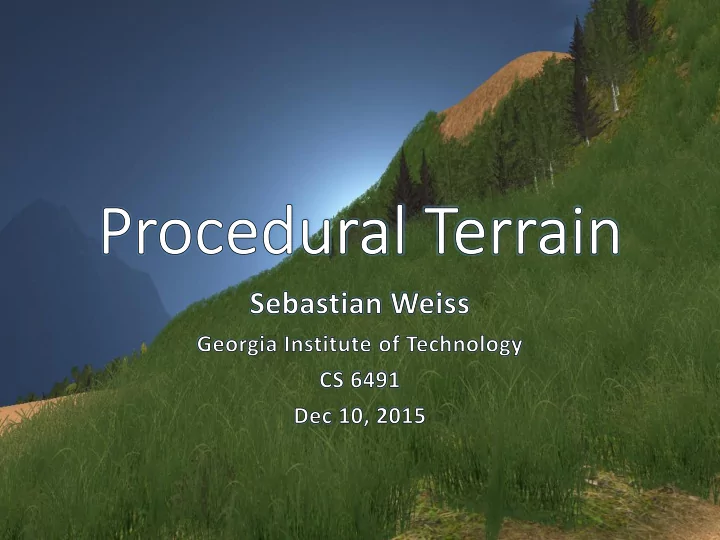
SLIDE 1
SLIDE 2 Why Procedural Terrain?
- Large area exploration
- Small details interest
- Endless worlds (e.g. Minecraft)
- Time saving for artists
Procedural generation Artistic control
SLIDE 3 Overview
- 1. Polygonal Map: initial shape
- 2. Terrain Features: tune the terrain
- 3. Water Erosion: increase realism
- 4. Vegetation: add life
SLIDE 4
Perlin Noise
The programmer’s friend
SLIDE 5
Fractal noise – sum of perlin noise
SLIDE 6
Step 1: : Polygonal Map
SLIDE 7
Voronoi diagram
SLIDE 8
Island shape
Perlin noise + distance to the center
SLIDE 9
Elevation, Temperature, Moisture
SLIDE 10
Elevation, Temperature, Moisture
SLIDE 11
Elevation, Temperature, Moisture
SLIDE 12
Elevation, Temperature, Moisture
SLIDE 13
Create height map
SLIDE 14
Step 2: : Terrain Features
SLIDE 15 Feature Curves
Interpolation between Control Points
- Elevation
- Plateau size
- Slope size
- Slope angle
- Smoothing influence
SLIDE 16 Hills
- nly elevation and smoothing, no slope
SLIDE 17 Hills
- nly elevation and smoothing, no slope
SLIDE 18
Ridge lines
45° slope
SLIDE 19
Ridge lines
45° slope
SLIDE 20
Cliffs
90° slope at one side, long smoothing at the other side
SLIDE 21
Cliffs
90° slope at one side, long smoothing at the other side
SLIDE 22
Step 3: : Hydraulic Erosion
SLIDE 23
Pipe model
Move water from one cell to another when the height is lower
SLIDE 24
Erosion
Water erodes sediment on steep slopes Sediment is deposited on flat areas
SLIDE 25
SLIDE 26
Step 4: : Vegetation
SLIDE 27 Assign biomes
- Texture
- Grass density
- Tree types
SLIDE 28
SLIDE 29
SLIDE 30
Grass
quads with texture
SLIDE 31
Grass
quads with texture
SLIDE 32
Grass
quads with texture
SLIDE 33 Trees
- Define trees recursively
- Specify properties for every layer:
- Radius, scaling
- Curvature
- Branching, splitting
- Textures
SLIDE 34
SLIDE 35
Problem: too many polygons Use impostors for distant rendering
SLIDE 36
Thanks for your attention