Hmong in China Hmong live primarily in Guizhou & There is - - PDF document

hmong in china
SMART_READER_LITE
LIVE PREVIEW

Hmong in China Hmong live primarily in Guizhou & There is - - PDF document

12/6/2011 Origins of the Hmong A Brief Look at the Hmong Scholars, anthropologists and linguistic by KaShia Moua experts have studied the Hmong but they December 6, 2011 do not agree as to their origins. The most recent ancestry can be


slide-1
SLIDE 1

12/6/2011 1

A Brief Look at the Hmong

by KaShia Moua December 6, 2011

Origins of the Hmong

 Scholars, anthropologists and linguistic

experts have studied the Hmong but they do not agree as to their origins.

 The most recent ancestry can be traced to

China.

 Within China’s diverse ethnic population,

the Hmong are known as Miao.

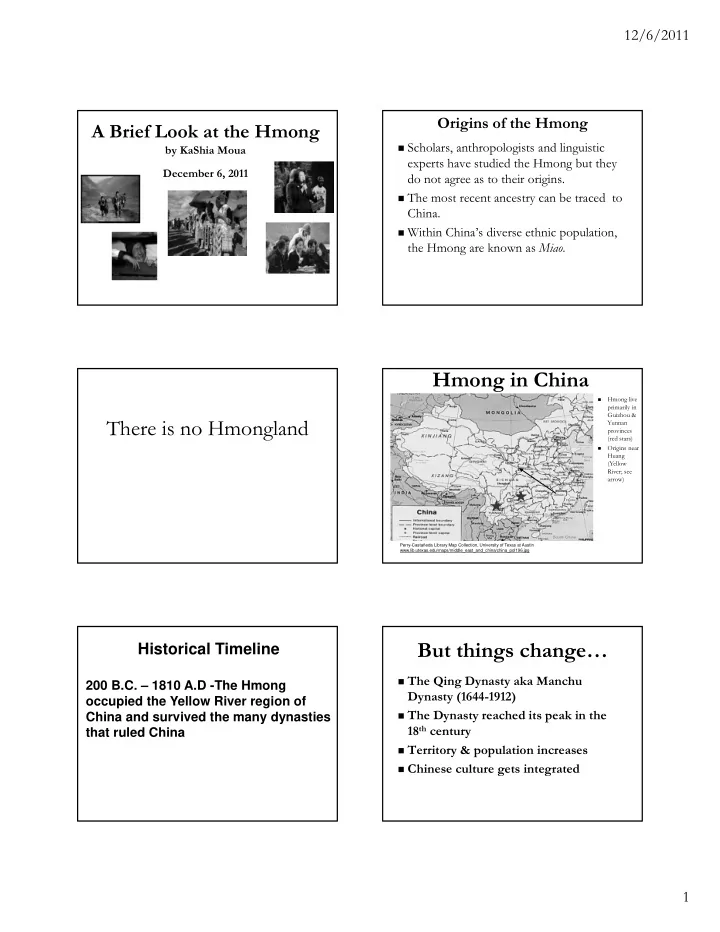
There is no Hmongland Hmong in China

Hmong live primarily in Guizhou & Yunnan provinces (red stars)

Origins near Huang (Yellow River; see arrow)

Perry-Castañeda Library Map Collection, University of Texas at Austin www.lib.utexas.edu/maps/middle_east_and_china/china_pol196.jpg

Historical Timeline

200 B.C. – 1810 A.D -The Hmong

  • ccupied the Yellow River region of

China and survived the many dynasties that ruled China

But things change…

 The Qing Dynasty aka Manchu

Dynasty (1644-1912)

 The Dynasty reached its peak in the

18th century

 Territory & population increases  Chinese culture gets integrated

slide-2
SLIDE 2

12/6/2011 2

How did Chinese and Hmong culture CLASH?

Chopsticks Spoons LANGUAGE RELIGION

Either assimilate to Chinese culture or…

…be killed

  • r

…get out

slide-3
SLIDE 3

12/6/2011 3

Thousands are killed… Millions Flee China

1790-1860

 Hmong flee persecution in China  Millions fled to Southeast Asia

(Laos, Cambodia, Vietnam, Burma, Thailand)

Hmong in Laos

1860-1960: The Hmong maintained relative peace in the highlands of Laos

Living in Laos Farming in Laos Cooking in Laos

slide-4
SLIDE 4

12/6/2011 4

Playing in Laos

Peace ends, War begins.

Leading up to the Vietnam War…

1946: The beginning of the Cold War; Viet Minh establishes presence in Eastern Laos in Hmong territory 1953: Viet Minh invades Hmong homelands in northern Laos

1963-1975 The U.S. Secret Army in Laos & the Vietnam War

Hmong in CIA’s Secret War in Laos 1963-1975

 Late 1950s: “Mr. Pop”

Edgar Buell, linked to U.S. Information Office, worked with Hmong in Laos

 1961: CIA rep. Colonel Bill

Lair met with Vang Pao, leader of the Hmong army in Laos

 Initiation of secret

cooperation between Hmong and CIA in Laos

“Mr. Pop” Edgar Buell

Hmong National Development

A “Secret War”

 Hmong soldiers were recruited under the

direction of General Vang Pao, a general under the Laotian Army, to fight in the “Secret War”

slide-5
SLIDE 5

12/6/2011 5

the promise…

What happens to Hmong men?

 Hmong boys as young as 8 years old are

recruited to fight

 Hmong soldiers are trained to fly planes  Hmong soldiers rescue American

pilots/planes that are shot down in Laos

 Hmong soldiers guard supply trails

What happens to Hmong families?

 Families are separated & displaced  Families lose their grandfathers, fathers,

husbands, brothers and sons

 Families live on foot, traveling to different

locations on a daily, weekly basis

 Babies and children die of starvation or

drug over doses

What happens in 1975?

U.S. pulls out of the war &

returns to the U.S.

Hmong are left behind & are

viewed as traitors

Hmong are hunted & killed

What happens after the Vietnam War? Hmong in Laos crossed the Mekong River and fled to Thailand to seek temporary refuge in Thai camps

May 1975, the beginning exodus of Hmong

  • refugees. Only a selected few were airlifted to

Thailand while thousands made the dangerous journey by foot.

slide-6
SLIDE 6

12/6/2011 6

Death in the Jungles

Death in the Mekong River

Hmong in Thai Refugee Camps

Hmong Survivors

 1976 – 1990s: Hmong refugees emigrated to the U.S., France, Australia, French Guyana and Canada  1990s: UN refugee camps in Thailand began closing; Hmong refugees migrate to non-UN camp, ie. Wat Tham Krabok  2004: Approx 15,000 Hmong resettle in U.S. when the last refugee camp is shut down

My family arrives in Eau Claire, WI

April 9, 1976

Looking back, Looking forward

slide-7
SLIDE 7

12/6/2011 7

Smiles all around

Immigrant vs. Refugee

Immigrant can be broadly defined as

any non-citizen in the United States, except for those legally admitted under specific non-immigrant categories or status.

Immigrant vs. Refugee

Refugee is defined as a person “unable or

unwilling to return to his or her country of

  • rigin because of persecution or a well-

founded fear of persecution on account of race, religion, nationality, membership in a particular social group, or political opinion.” INA §101(a)(42)(A)

Immigrant

An immigrant’s heart arrives in the new country years before their body does.

Refugee

An refugee’s body arrives in the new country years before their heart does.

Worldwide Hmong Population*

 China: 6,000,000  Vietnam: 787,604  Laos: 315,000  United States: 250,000  Thailand: 124,000  France: 8,000  Burma: 3,000  Australia: 1,800  French Guyana: 500-1,000

*2004 Diaspora Estimates from Professor Nicholas Tapp, Australian National University, Canberra, Australia

slide-8
SLIDE 8

12/6/2011 8

Top ten states with the highest Hmong population: California – 71,244 Minnesota – 50,200 Wisconsin – 45,268 Michigan – 8,686 North Carolina – 8,451 Colorado – 3,875 Georgia – 3,407 Washington – 3,050 Oregon – 2,729 Florida – 1,856

*U.S. Census Bureau ~2006, American Community Survey

Hmong Migration Profile in the U.S.*

Those currently living in the U.S.

► Entered before 1990 = 59% ► Entered 1990-1999 = 28.9% ► Entered 2000 or later =11.7% *U.S. Census Bureau ~2006, American Community Survey

Arrival of Hmong Refugees in the U.S.

 In 1976—the first wave of 500 Hmong to

America

 In 1980’s—second wave of 150,000+ Hmong to

America

 In 2004 – a smaller wave of 15, 000 Hmong

refugees were resettled in the United States (from Wat Tham Krabok).

Hmong in Wisconsin

 There are approximately 45,000 Hmong residing

in Wisconsin

 Some of the counties with the largest

populations: Dane, Eau Claire, Green Bay, La Crosse,

Marathon, Milwaukee, Manitowoc, Outagamie, Sheboygan and Winnebago.

*Bureau of Migrant & Refugee Labor Services, Department of Workforce Development, State of Wisconsin

Hmong Stuff…. …in general

Hmong Clan System

 Social infrastructure is based on clan names  There are 18 original clans:

 Chang/Cha

  • Lee/Ly

 Cheng

  • Lor/Lo/Lao

 Chue

  • Moua

 Hang

  • Phang/Pha

 Her/Herr

  • Thao

 Fang

  • Vang

 Khang/Kha

  • Vue

 Kong/Soung

  • Yang

 Kue

  • Xiong
slide-9
SLIDE 9

12/6/2011 9

Common Traditional Hmong Values

 Education is highly valued  Respect parents and elders  Know & respect the Hmong language,

culture and customs

 Personal belongings or assets are an

indication of hard work

Common Traditional Hmong Values Cont…

 Peace seeking (avoid confrontations or

conflicts when possible)

 Expect to know one's role and

responsibilities as a son/daughter; husband/wife; son/daughter-in-law, etc. –

*these views and expectations are changing in the U.S.

 Interdependency is an expectation;

independence is not widely encouraged

  • Traditional beliefs are that a spiritual world

coexists with the physical world

  • Spirit types include ancestral spirits, house

spirits, and natural spirits

  • Hmong spiritual teachings believe in

reincarnation

Featured in The Split Horn, 2001 www.pbs.org/splithorn/shamanism.html

Hmong Spirituality and Beliefs

The answer is “NO”

  • Shamans communicate between the

physical and spiritual worlds

  • Shamans perform rituals and sacrifice

animals to pacify spirits and cure illness

Featured in The Split Horn, 2001 www.pbs.org/splithorn/shamanism.html

Hmong Shamanism

Ancestral Worship vs Christianity

Ancestral Worship - Animism

 A family/clan in each generation

holds the belief and worships three generations of ancestors.

 About 50-60% still practice ancestral

worship and shamanism.

slide-10
SLIDE 10

12/6/2011 10

Christianity

Christianity was introduced to the Hmong by missionaries (Catholicism was the first) in the 1940's. Since then, the number of Hmong converting into different religions has increased. Some Hmong belief systems that

CLASH

with Western Ideology

 Marriage  Family size / family interdependence  Religion  Health & Healing  Gender Roles

Hmong Healing Practices that may conflict with the U.S. legal system

Herbalism (treatment for toothache, morning sickness, pain after birthing, infertility, impotence in the family, etc.)

Egg Coining (hard boiled egg, white cloth, silver bar or coin) Coining is common cure for diarrhea, fever, body ache, and headache.

Shamanism (sacrifice of certain animals)

What happens when cultures CLASH? Sometimes the clash gets you sent to the Principal’s office… Sometimes the clashes are deadly…

slide-11
SLIDE 11

12/6/2011 11

Racially Charged Hunting Tragedy

 November of 2004

 Chai Vang shoots and kills 6 Caucasian hunters

near Hayward, WI

 November of 2005

 Chai Vang sentenced to six life prison terms with

no chance of parol

Racially Charged Hunting Tragedy

 January of 2007

 James Nichols stabs, shoots and kills Hmong

hunter, Cha Vang near Peshtigo, WI

 November of 2007

 James Nichols sentenced to 69 years in prison

RACIAL CLIMATE in Wisconsin

 Tension, fear and misunderstanding

between Hmong and non-Hmong

 Stereotypes  Misconceptions  Animosity

How do we im prove the racial climate between Hmong and non-Hmong in Wisconsin?

Hmong Migration Education Act

 Legislation that encourages school

districts to include instruction that educates students about the role Hmong people played in the Vietnam War.

 The bill will also encourage education

  • n the persecution of the Hmong by

the government of Laos, and the subsequent migration of the Hmong to Wisconsin.

The Hmong Migration

Education Bill has

failed 5 times in the

Wisconsin Legislature

slide-12
SLIDE 12

12/6/2011 12

In 2007

 Wisconsin legislature

authorized construction of the

Hm ong Cultural Center

  • f W isconsin in Dane

County (has yet to be financed and built)

RESOURCES

 Hmong National Development, Inc. (HND), Washington

DC www.hndinc.org

 Hmong Resource Center Library, Hmong Cultural Center

(St. Paul, MN) www.hmongcenter.org

 Hmong Nationality Archives (St. Paul, MN)

www.hmongarchives.org

 www.hmongcenter.org  www.learnabouthmong.com  http://www.jefflindsay.com/Hmong_tragedy.html

Special thanks to Yer Vang, Esq.

Questions & Answers

THANK YOU

Contact Information: KaShia Moua ktmoua@gmail.com