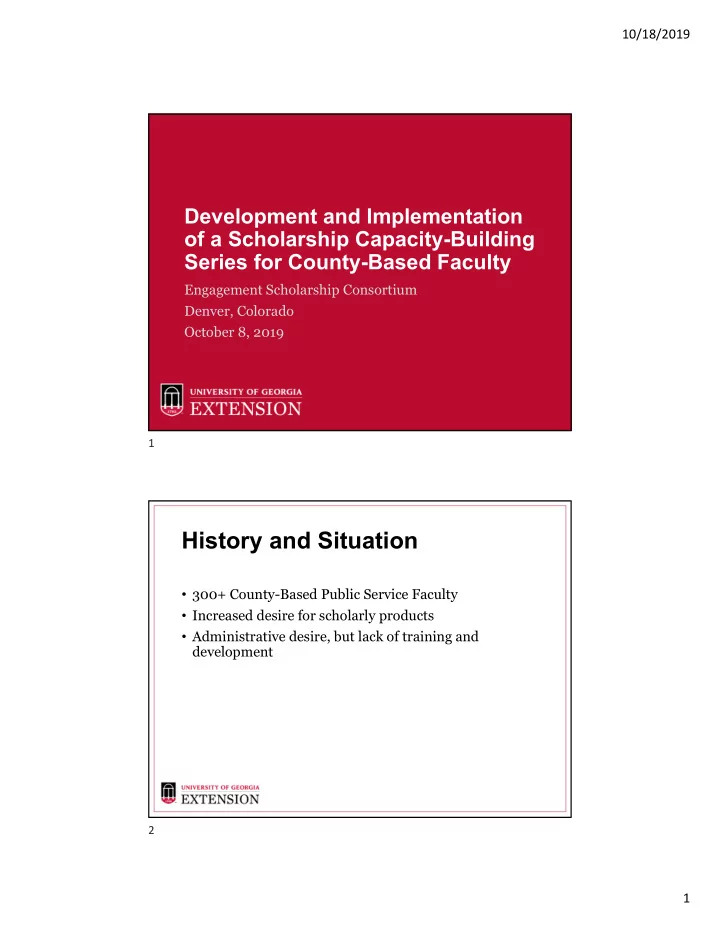
History and Situation 300+ County-Based Public Service Faculty - - PDF document

history and situation
SMART_READER_LITE
LIVE PREVIEW

History and Situation 300+ County-Based Public Service Faculty - - PDF document

10/18/2019 Development and Implementation of a Scholarship Capacity-Building Series for County-Based Faculty Engagement Scholarship Consortium Denver, Colorado October 8, 2019 1 History and Situation 300+ County-Based Public Service


slide-1
SLIDE 1

10/18/2019 1

Development and Implementation

  • f a Scholarship Capacity-Building

Series for County-Based Faculty

Engagement Scholarship Consortium Denver, Colorado October 8, 2019

History and Situation

  • 300+ County-Based Public Service Faculty
  • Increased desire for scholarly products
  • Administrative desire, but lack of training and

development

1 2

slide-2
SLIDE 2

10/18/2019 2

Needs Assessment

  • Perceptions of Scholarship Among County-Based

Extension Faculty

  • Survey Administered to Youth Development and

Family and Consumer Sciences Faculty (n=79)

  • 4 Focus Groups Followed
  • 90% of respondents eligible for promotion
  • Participants ranked perceived skill and ability as low in

many tools and concepts that may be important for meaningful involvement in community-engaged research

  • Focus Groups featured the challenge of time

Needs Assessment

Perceived skill and ability in areas of Extension‐related scholarly work (N = 79)1 Domain of skill and ability Mean SD 95% CI Grant proposal development and grants administration 2.48 0.86 (2.27, 2.66) Extension publication development2 2.57 0.84 (2.39, 2.77) Research methods and peer‐reviewed research publications 2.60 0.80 (2.41, 2.77) Conference proposals and presentations 2.75 0.95 (2.50, 2.92) Outreach Program Curriculum development 3.39 0.90 (3.17, 3.57) Program delivery 4.17 0.51 (4.06, 4.29) 1. Perceived skill/ability in each domain ranked on a scale of 1 (None at all) to 5 (A great deal) 2. N = 78

3 4

slide-3
SLIDE 3

10/18/2019 3

Needs Assessment

Self‐reported understanding of research methods and tools (N = 79)1 Research method or tool Mean SD 95% CI IBM SPSS 1.80 1.20 (1.53, 2.07) Statistical analysis 2.35 1.22 (2.08, 2.63) Program fidelity2 2.40 1.32 (2.10, 2.70) University supported survey software 2.56 1.28 (2.27, 2.84) Quantitative research methods 2.72 1.27 (2.44, 3.01) Qualitative research methods 2.78 1.36 (2.38, 3.09) Data collection tools 2.81 1.21 (2.54, 3.08) Microsoft Excel 3.22 1.24 (2.94, 3.49) Program evaluation 3.67 1.12 (3.42, 3.92) 1. Perceived understanding in each domain ranked on a scale of 1 (Poor or Not familiar with this term) to 5 (Very good) 2. N = 77

Development of the Workshop Series

  • Technical Skills
  • Dedicated Time
  • Extended Period of Dedication
  • Small Learning Community
  • September
  • March
  • June
  • September (added after initial planning)

5 6

slide-4
SLIDE 4

10/18/2019 4

Development of the Workshop Series

  • 3 Dedicated Workshop Periods
  • Athens, Georgia
  • Rock Eagle 4-H Center
  • Rock Eagle 4-H Center
  • Three Days, Two Nights
  • Meals and Lodging Provided
  • Funding Provided by the Extension Director’s

Innovation Fund ($10,000)

Workshop Series

  • Workshop One
  • Qualitative Research Primer
  • Using Atlas.ti
  • Research v Evaluation
  • Using Research to Determine Impact
  • Human Subjects Research and Institutional Review

Board

  • Journal Article Review
  • Deliverables:
  • Brainstorm a project
  • Develop an IRB application

7 8

slide-5
SLIDE 5

10/18/2019 5

Workshop Series

  • Workshop Two
  • Literature Review
  • UGA Libraries Support for Geographically

Dispersed Faculty

  • Authorship
  • Tools for Scholarly Work (audio/video recording,

transcription, Qualtrics, EndNote, SPSS, etc)

  • Deliverables:
  • Finalize project
  • Submission of an IRB application previously

completed

Workshop Series

  • Workshop Three
  • Advanced Topics and Reattacks
  • Deliverables:
  • Project Work
  • Presentation to Extension Administration

9 10

slide-6
SLIDE 6

10/18/2019 6

Workshop Series

  • Workshop Four
  • Deliverables:
  • Project Work
  • Journal Article / Other Scholarly Products

Results

  • Three journal article submissions (1 acceptance to date)
  • Three workshop sessions
  • Six poster presentations
  • One USDA ($350k) grant acceptance
  • One new statewide program and accepted logic model

11 12

slide-7
SLIDE 7

10/18/2019 7

Impact

  • Increased confidence in not only the process of

scholarly product development but also in the promotion process

  • Reinforced why they are faculty members

Impact

I’m not scared to death of it now. I also have a better understand of how it can fit into the County Extension program.

13 14

slide-8
SLIDE 8

10/18/2019 8

Impact

I have always been a big believer in research but never saw it as a viable option for county 4-H agents to conduct research….Unlike agricultural agents who have an

  • pportunity to work with quantitative research trials, I felt

most of the work done at the county level in 4-H did not easily lend itself to quantitative research. This experience has taught me a lot about qualitative research and how 4-H agents can conduct qualitative research in working with youth.

Impact

By participating in multiple sessions with the three State Specialists and seven other Extension Agents, this training provided me the opportunity to gain skills to conduct research on my own in the future. This has been the most meaningful and useful training I have participated in throughout my Extension career.

15 16

slide-9
SLIDE 9

10/18/2019 9

So What Now and Lessons Learned

  • Remaining Barrier: TIME
  • One Year Break for the 3 State Specialists
  • Time Intensive for Us
  • Supporting the Continued Work of the 8 County

Faculty

  • Publishing Our Own Work
  • Supporting New Cohort in 2020-2022 with the 8 as

mentors through the process

  • Reduction in Costs
  • Facilities Matter

Contact Information

Casey D. Mull, PhD mullcd2@uga.edu 706-542-4444 Ali Berg, PhD, RDN, LD alisoncberg@uga.edu Diane Bales, PhD dbales@uga.edu

17 18