Historical background of all-sky airglow observations at Comandante - - PowerPoint PPT Presentation

historical background of all sky airglow observations at
SMART_READER_LITE
LIVE PREVIEW

Historical background of all-sky airglow observations at Comandante - - PowerPoint PPT Presentation

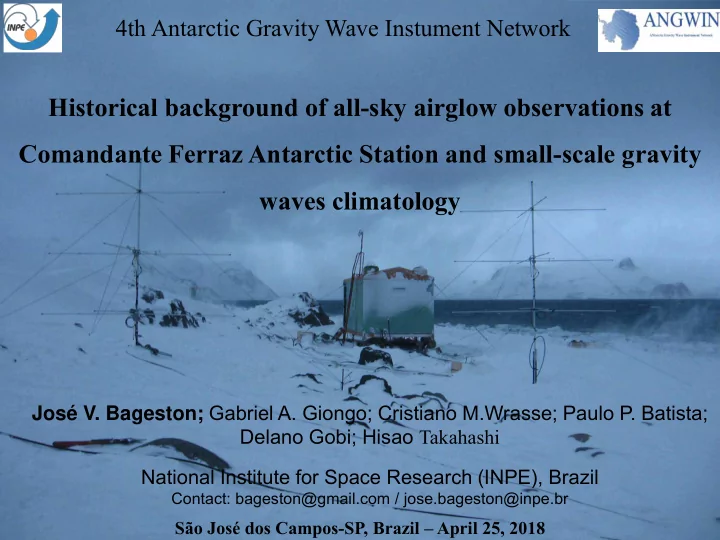
4th Antarctic Gravity Wave Instument Network Historical background of all-sky airglow observations at Comandante Ferraz Antarctic Station and small-scale gravity waves climatology Jos V. Bageston; Gabriel A. Giongo; Cristiano M.Wrasse; Paulo P.


slide-1
SLIDE 1

1

Historical background of all-sky airglow observations at Comandante Ferraz Antarctic Station and small-scale gravity waves climatology

José V. Bageston; Gabriel A. Giongo; Cristiano M.Wrasse; Paulo P. Batista; Delano Gobi; Hisao Takahashi National Institute for Space Research (INPE), Brazil

Contact: bageston@gmail.com / jose.bageston@inpe.br

São José dos Campos-SP, Brazil – April 25, 2018

4th Antarctic Gravity Wave Instument Network

slide-2
SLIDE 2

2

Outline

 Motivations for gravity wave observations at Commandant Ferraz Station;  Geogrpahycal location of Ferraz Station  Historical on the MLT instrumentation at Ferraz Station;  Gravity Waves observed at Ferraz Station (62.1°S, 58.4°W);

  • All-Sky airglow observations and its statistics;
  • Small scale gravity waves: Examples/Morphologies, wave parameters

and propagation directions;

  • Case studies of mesospheric fronts;

 Future plans for MLT researches at Ferraz Station;  Conclusions and Acknowledgments;

slide-3
SLIDE 3

3

Motivations

 High GWs activity around the Antarctica Peninsula and South America;

Data from: UARS/MLS Source: Wu and Jiang (2002)

slide-4
SLIDE 4

4

Motivations

  • Effects of Gravity Waves in the MLT winds structure;

Mesospheric wind disturbances over King George Island (Ferraz Staion) due to gravity waves. Source: Quian Li et al., 2013 (JGR: Atmospheres). doi:10.1002/jgrd.50577

slide-5
SLIDE 5

5

Motivations

  • A new airglow imager with 3 airglow filters was installed at Ferraz in

2014;

  • Possibility of reactivate of the Ferraz meteor radar in 2019;
slide-6
SLIDE 6

6

Motivations

Source: https://en.wikipedia.org/wiki/Research_stations_in_Antarctica

  • Relationship between GWs observed in the Antarctic Peninsula and in the

South America and possibility of GWs observation in the summer time (monitoring NLC occurrence) from the ground;

  • Strong engagement between the ANGWIN members;
slide-7
SLIDE 7

7

Geographical location of Ferraz Station

slide-8
SLIDE 8

8

Sarounding of Ferraz station

Source: 1º Helicopter Squadron for General Employment (Esqd HU-1), Brazilian Navy

Main station

Ionosphere instrumentation Meteorological instrumentation Mesosphere and Lower Termosphe (MLT) instrumentation

slide-9
SLIDE 9

9

MLT Instrumentation at Ferraz

2010

slide-10
SLIDE 10

10

MLT Instrumentation at Ferraz

2010 2004 2001 2011

slide-11
SLIDE 11

11

MLT Instrumentation at Ferraz

2010-2011 2014-present 2007

slide-12
SLIDE 12

12

MLT Instrumentation at Ferraz

  • The first all-sky airglow imager was installed in March 2007, but before

that an OH photometer (2000-2003) and OH CCD imager for rotational temperature (2004) has been operated at Ferraz.

  • In 2008 none GW observations were conducted at Ferraz since the previous

imager has return to Brazil for change the CCD (it was calibrated for usage in a temperature system);

slide-13
SLIDE 13

13

MLT Instrumentation at Ferraz

  • After change the CCD in the all-sky system at INPE-SJC (yearly 2009), a

technician returned to Ferraz and installed this other all-sky CCD camera, but some problem occurred in the CCD shutter (even that during tests at INPE-SJC such problem did not appeared). So, again there were none useful all-sky airglow images.

  • After brought the CCD back to SJC, a new CCD was used instead of the

previous one. After checking for similar problems this new CCD returned to Ferraz in 2010, and operated in a good shape until February 2012.

Photo taken in Feb., 2011

Year Observed Nights Usefull Nights SSGW

2007 87 44 241 2010 81 31 74 2011 123 52 149 Total 291 234 464

slide-14
SLIDE 14

14

MLT Instrumentation at Ferraz

  • However, after almost three months of operation,

a problem occurred in the power transformer near the shelter where the instruments were

  • perates. Then, the new airglow imager could
  • btain only 6 partially cloudy nights among 21
  • bserved nights, and just 4 gravity waves were

identified.

  • From 2015 to 2017 no problem occurred, but

this year (2018) the electric cables that connect the main station to Punta Plaza broken twice.

  • After the fire accident at the main Ferraz station (Feb., 2012), the Punta

Plaza region (MLT instruments) stayed without power until Jan., 2014.

  • In Feb., 2014 a post-doctorate guy went to Ferraz and a new high

performance all-sky airglow imager was installed , which operates with three filters: OHNIR; OI557.7 and OI630.0.

slide-15
SLIDE 15

15

  • Statistics of observations during the winter time for all observed years

Only a few days in August 2016 were analyzed; A quick view in the data from 2016, it seems that a similar number of GWs to 2015 can be identify; The 2017 data were sent by mail in an external hard disc, but we could not see these data yet.

Statistics of GWs at Ferraz Station

Year Observed Nights Usefull Nights SSGW MSGW 2007 87 44 234 31 2010 81 31 88 4 2011 123 52 136 36 2014 21 6 8 1 2015 228 101 104 22 2016 ** ** 15* 52 Total 291 234 585* 146

slide-16
SLIDE 16

16

Statistics of GWs at Ferraz Station

expected

  • Statistics of observations during the winter time for all observed years
slide-17
SLIDE 17

17

Simultaneous band events

Examples of Small-Scale Gravity Waves

slide-18
SLIDE 18

18

Bore event

Examples of Small-Scale Gravity Waves

slide-19
SLIDE 19

19

Wall event

Examples of Small-Scale Gravity Waves

slide-20
SLIDE 20

20

Wave-wave interaction Pulse or Solitary front

Examples of Small-Scale Gravity Waves

slide-21
SLIDE 21

21

Interesting band event

Examples of Small-Scale Gravity Waves

slide-22
SLIDE 22

22

Examples of Small-Scale Gravity Waves

slide-23
SLIDE 23

23

Examples of Small-Scale Gravity Waves

slide-24
SLIDE 24

24

Examples of Small-Scale Gravity Waves

slide-25
SLIDE 25

25

Examples of Small-Scale Gravity Waves

slide-26
SLIDE 26

26

All Seasons (Mar. Oct.) All Seasons (Mar. Oct.)

Wave parameters and prop. directions

2007; 2010-2011; 2014/2015-2016* * Only a few events were analyzed for 2016 (August), it’s missing the most part of the data

slide-27
SLIDE 27

27

Wave parameters and prop. directions

~ 62% of the total of events

slide-28
SLIDE 28

28

Wave parameters and prop. directions

128 GWs 361 GWs 96 GWs

slide-29
SLIDE 29

29

Case Studies of Meospheric Fronts (2011)

slide-30
SLIDE 30

30

Case Studies of Meospheric Fronts (2011)

5 hours before the GW 3 hours before the GW Event 1 240 km away from Ferraz 4 hours before the event Event 1 SABER and AURA soundings

slide-31
SLIDE 31

31

Case Studies of Meospheric Fronts (2011)

Event 1 Event 2

slide-32
SLIDE 32

32

Event 3

Case Studies of Meospheric Fronts (2011)

OH layer

slide-33
SLIDE 33

33

  • We have been observe gravity waves from Ferraz station since 2007,

and even considering the problems, we still obtain good data;

  • We could observed almost 600 small-scale gravity waves during 4

years;

  • Medium-scale gravity waves also were characterized for 5 years;
  • It were found 6 cases of mesospheric fronts, which were

characterized in term of their parameters and propagation condition;

  • Two cases of mesospheric fronts could be linked to tropospheric

sources, and one case was likely absorbed by the local wind;

  • The characterization of the mesospheric gravity waves in terms of

the intrinsic parameters will be conducted by using the meteor radar from KSS/KOPRI.

SUMMARY

slide-34
SLIDE 34

34

  • Rebuild/rewire the meteor radar  Probably David Fritts (GATs

Inc.) will obtain some support from the USAP-NSF for the next year;

  • We have plan to continue to observe NLC at Ferraz (we did not see

yet the data from the last summer) and Rothera;

  • Expand the NLC network: Ushuaia (Argentina) or Punta Arenas

(Chile);

  • From March, 2012 until now we don’t have mesospheric winds
  • bservations from the Ferraz meteor radar. So, we have been

contacted and obtained mesospheric winds from the King Sejong Station;

  • Continue the analysis of the previous observed gravity waves:

search for medium-scale waves; apply ray-tracing to previous

  • bserved waves and analyze the new NLC images;

Future Plans for the MLT Researches in Ferraz

slide-35
SLIDE 35

35

The new Brazilian Antarctic Station

Source: Estúdio 41 (facebook)

The new Ferraz Station will be ready in 2019!

Thank you very much for your attention! MUITO OBRIGADO PELA ATENÇÃO!