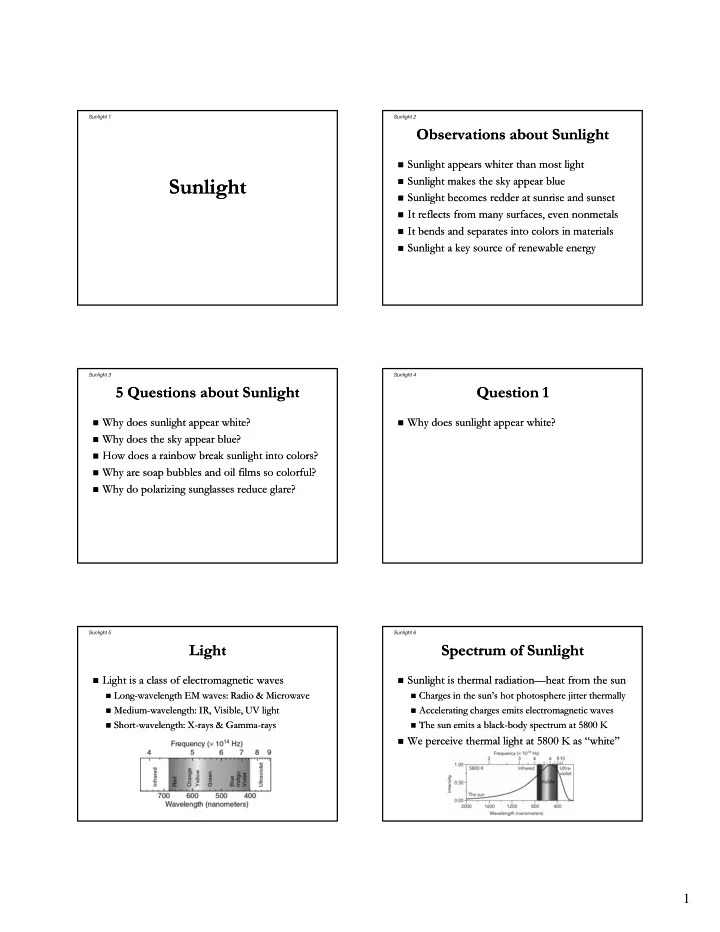
Sunlight Sunlight Sunlight makes the sky appear blue Sunlight - - PDF document

sunlight sunlight
SMART_READER_LITE
LIVE PREVIEW

Sunlight Sunlight Sunlight makes the sky appear blue Sunlight - - PDF document

Sunlight 1 Sunlight 2 Observations about Sunlight Observations about Sunlight Sunlight appears whiter than most light Sunlight appears whiter than most light Sunlight Sunlight Sunlight makes the sky appear blue Sunlight makes the sky


slide-1
SLIDE 1

1

Sunlight 1

Sunlight Sunlight

Sunlight 2

Observations about Sunlight Observations about Sunlight

Sunlight appears whiter than most light

Sunlight appears whiter than most light

Sunlight makes the sky appear blue

Sunlight makes the sky appear blue

Sunlight becomes redder at sunrise and sunset

Sunlight becomes redder at sunrise and sunset

It reflects from many surfaces, even nonmetals

It reflects from many surfaces, even nonmetals

It bends and separates into colors in materials

It bends and separates into colors in materials

Sunlight a key source of renewable energy

Sunlight a key source of renewable energy

Sunlight 3

5 Questions about Sunlight 5 Questions about Sunlight

Why does sunlight appear white?

Why does sunlight appear white?

Why does the sky appear blue?

Why does the sky appear blue?

How does a rainbow break sunlight into colors?

How does a rainbow break sunlight into colors?

Why are soap bubbles and oil films so colorful?

Why are soap bubbles and oil films so colorful?

Why do polarizing sunglasses reduce glare?

Why do polarizing sunglasses reduce glare?

Sunlight 4

Question 1 Question 1

Why does sunlight appear white?

Why does sunlight appear white?

Sunlight 5

Light Light

  • Light is

Light is a class of electromagnetic waves a class of electromagnetic waves

Long

Long-

  • wavelength EM waves: Radio & Microwave

wavelength EM waves: Radio & Microwave

Medium

Medium-

  • wavelength: IR, Visible, UV light

wavelength: IR, Visible, UV light

Sh rt

Sh rt l n th X l n th X r & G mm r & G mm r

Short

Short-wavelength: X wavelength: X-rays & Gamma rays & Gamma-

  • rays

rays

Sunlight 6

Spectrum of Sunlight Spectrum of Sunlight

Sunlight is thermal radiation

Sunlight is thermal radiation— —heat from the sun heat from the sun

Charges in the sun’s hot photosphere jitter thermally

Charges in the sun’s hot photosphere jitter thermally

Accelerating charges emits electromagnetic waves

Accelerating charges emits electromagnetic waves

Th

n mit bl k Th n mit bl k b d p tr m t 5800 K b d p tr m t 5800 K

The sun emits a black

The sun emits a black-

  • body spectrum at 5800 K

body spectrum at 5800 K

We perceive thermal light at 5800 K as “white”

We perceive thermal light at 5800 K as “white”

slide-2
SLIDE 2

2

Sunlight 7

Question 2 Question 2

Why does the sky appear blue?

Why does the sky appear blue?

Why is the sun reddish at sunrise and sunset?

Why is the sun reddish at sunrise and sunset?

Sunlight 8

Rayleigh Scattering Rayleigh Scattering

Rayleigh scattering occurs when

Rayleigh scattering occurs when

passing sunlight electrically polarizes tiny particles in the air.

passing sunlight electrically polarizes tiny particles in the air.

That alternating polarization

That alternating polarization acts as a source of light waves acts as a source of light waves, ,

so air particles scatter light

so air particles scatter light— —they absorb and then reemit it. they absorb and then reemit it.

Air particles are too small to be good antennas for light,

Air particles are too small to be good antennas for light,

so long

so long-

  • wavelengths (reds) scatter poorly

wavelengths (reds) scatter poorly

while shorter

while shorter-

  • wavelengths (violets) scatter better.

wavelengths (violets) scatter better.

Rayleigh scattered sunlight is bluish in appearance

Rayleigh scattered sunlight is bluish in appearance

The missing blue light reddens the solar disk itself

The missing blue light reddens the solar disk itself

particularly at sunrise and sunset

particularly at sunrise and sunset

Sunlight 9

Question 3 Question 3

How does a rainbow break sunlight into colors?

How does a rainbow break sunlight into colors?

Sunlight 10

Light and Refraction Light and Refraction

Sunlight slows while it passes through matter

Sunlight slows while it passes through matter

Light waves electrically polarize matter

Light waves electrically polarize matter

That polarization delays the light wave’s passage

That polarization delays the light wave’s passage

E

h m t ri l h n “ind f r fr ti n” E h m t ri l h n “ind f r fr ti n” th f t r th f t r

Each material has an “index of refraction”

Each material has an “index of refraction”— —the factor the factor by which it reduces light’s speed. by which it reduces light’s speed.

When light changes speed at an interface,

When light changes speed at an interface,

it bends toward the perpendicular if it slows down

it bends toward the perpendicular if it slows down

it bends away from the perpendicular if it speeds up

it bends away from the perpendicular if it speeds up

Sunlight 11

Light and Reflection Light and Reflection

Light polarizes different materials differently,

Light polarizes different materials differently,

which affects both how fast light travels in them and

which affects both how fast light travels in them and

relationship between its electric & magnetic fields.

relationship between its electric & magnetic fields.

Ch i h li h l fl i Ch i h li h l fl i

Changes in how light travels causes reflections

Changes in how light travels causes reflections

Sunlight partially reflects from most surfaces

Sunlight partially reflects from most surfaces

Sunlight reflects almost completely from metals

Sunlight reflects almost completely from metals

Sunlight 12

Light and Dispersion Light and Dispersion

The different colors of light in sunlight

The different colors of light in sunlight

have different frequencies

have different frequencies

and polarize a material slightly differently,

and polarize a material slightly differently,

  • th

tr l t li htl diff r nt p d th tr l t li htl diff r nt p d

so they travel at slightly different speeds.

so they travel at slightly different speeds.

Violet light usually travels slower than red

Violet light usually travels slower than red

Refraction (bending) depends speed change

Refraction (bending) depends speed change

so violet light usually bends more than red

so violet light usually bends more than red

slide-3
SLIDE 3

3

Sunlight 13

Rainbows Rainbows

  • Occur when sunlight encounters water droplets

Occur when sunlight encounters water droplets

and undergoes refraction, reflection, and dispersion.

and undergoes refraction, reflection, and dispersion.

Sunlight 14

Question 4 Question 4

Why are soap bubbles and oil films so colorful?

Why are soap bubbles and oil films so colorful?

Sunlight 15

Light and Interference Light and Interference

Overlapping waves superpose and may interfere

Overlapping waves superpose and may interfere

Light following different paths can interfere

Light following different paths can interfere

constructively if fields point in the same direction

constructively if fields point in the same direction d i l if fi ld i i i di i d i l if fi ld i i i di i

  • r destructively if fields point in opposite directions.
  • r destructively if fields point in opposite directions.

The two reflections from

The two reflections from a soap or oil film interfere a soap or oil film interfere

Different colors often

Different colors often interfere differently interfere differently

Sunlight 16

Question 5 Question 5

Why do polarizing sunglasses reduce glare?

Why do polarizing sunglasses reduce glare?

Sunlight 17

Reflection of Polarized Light Reflection of Polarized Light

  • Angled reflections depend on polarization

Angled reflections depend on polarization

  • When light’s electric field is parallel to a surface

When light’s electric field is parallel to a surface

there is a large fluctuating surface polarization

there is a large fluctuating surface polarization d h fl i d h fl i

and thus a strong reflection.

and thus a strong reflection.

When electric field is perpendicular to a surface

When electric field is perpendicular to a surface

there is a small fluctuating surface polarization

there is a small fluctuating surface polarization

and thus a weak reflection.

and thus a weak reflection.

Glare is mostly polarized parallel to the surface

Glare is mostly polarized parallel to the surface

Sunlight 18

Polarization and Sunlight Polarization and Sunlight

Polarizing sunglasses

Polarizing sunglasses

block horizontally polarized light

block horizontally polarized light

and thus block glare from horizontal surfaces.

and thus block glare from horizontal surfaces.

R l i h i h l i i ff R l i h i h l i i ff

Rayleigh scattering has polarizing effects,

Rayleigh scattering has polarizing effects,

so much of the blue sky is polarized light, too.

so much of the blue sky is polarized light, too.

slide-4
SLIDE 4

4

Sunlight 19

Summary about Sunlight Summary about Sunlight

  • Sunlight is thermal light at about

Sunlight is thermal light at about 5800 K 5800 K

It undergoes Rayleigh scattering in the air

It undergoes Rayleigh scattering in the air

It bends and reflects from raindrops

It bends and reflects from raindrops

It interferes colorfully in soap and oil films

It interferes colorfully in soap and oil films

It reflects in a polarizing fashion from surfaces

It reflects in a polarizing fashion from surfaces