
SLIDE 1
Lewisburg Neighborhoods Corporation Public Meeting:
HISTORIC PRESERVATION
www.lewisburgneighborhoods.org
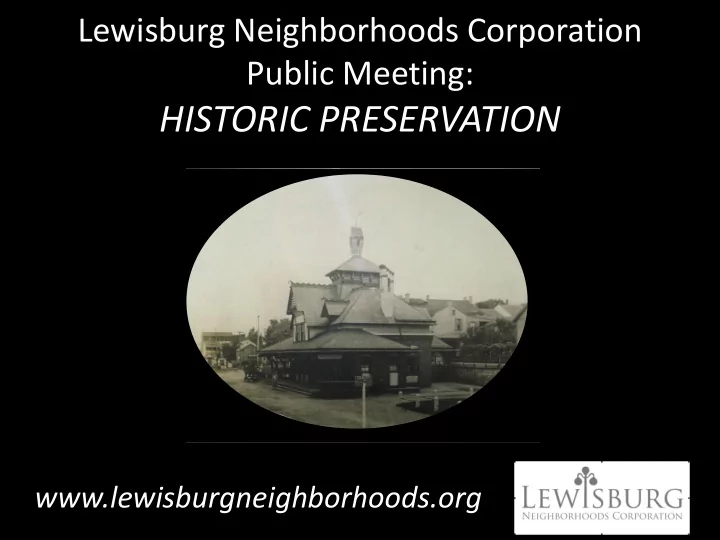
HISTORIC PRESERVATION www.lewisburgneighborhoods.org Agenda - - PowerPoint PPT Presentation
Lewisburg Neighborhoods Corporation Public Meeting: HISTORIC PRESERVATION www.lewisburgneighborhoods.org Agenda Welcome Introduction Samantha Pearson, Lewisburg Elm Street Manager Background Phoebe Faden, Ward II Borough
Lewisburg Neighborhoods Corporation Public Meeting:
HISTORIC PRESERVATION
www.lewisburgneighborhoods.org
Agenda
Manager
Member, HARB Chair, Realtor
HARB Member, Architect
Introduction
Samantha Pearson, Elm Street Manager
Main Street Programs
and lewisburgneighborhoods.org) and document request sheet
Historic Preservation
Reading Freight Station – Now Borough Building
What’s at Stake?
Pennsylvania RR Station Formerly on St John St
What’s at Stake?
Reading RR Station -- Formerly on Market St
What’s at Stake?
Reading RR Station -- Formerly on Market St
Preservation Benefits
Local Designated Historic Districts…
tourism
Background
Phoebe Faden, HARB Chair
Secretary of the Interior Standards
Rehabilitation acknowledges the need to alter or add to a historic property to meet continuing or changing uses while retaining the property's historic character. The Standards apply to historic buildings of all periods, styles, types, materials, and sizes. The Standards also encompass related landscape features and the building’s site and environment as well as attached, adjacent, or related new construction.
minimal change to the defining characteristics of the building and its site and environment.
historic materials or alteration of features and spaces that characterize a property shall be avoided.
Changes that create a false sense of historical development, such as adding conjectural features or architectural elements from other buildings, shall not be undertaken.
significance in their own right shall be retained and preserved.
that characterize a historic property shall be preserved. (continued…)
Secretary of the Interior Standards
(continued)
severity of deterioration requires replacement of a distinctive feature, the new feature shall match the old in design, color, texture, and other visual qualities and, where possible, materials. Replacement of missing features shall be substantiated by documentary, physical, or pictorial evidence.
materials shall not be used. The surface cleaning of structures, if appropriate, shall be undertaken using the gentlest means possible.
undertaken.
historic materials that characterize the property. The new work shall be differentiated from the old and shall be compatible with the massing, size, scale, and architectural features to protect the historic integrity of the property and its environment.
a manner that if removed in the future, the essential form and integrity of the historic property and its environment would be unimpaired.
Design Guidelines…
– Improve the quality of physical changes – Protect existing architectural character – Prevent incompatible new construction – Increase public awareness of architectural quality and historic preservation – Serve as a basis for objective decision-making – Protect the value of existing investments
Design Guidelines…
– Regulate growth – Guarantee good design – Control non-exterior changes to buildings – Control paint color selection – Control landscape elements (other than fences)
Local Ordinance Map -- 1985
Federal Map Overlay -- 2003
Action
Ted Strosser
and maintenance instead of replacement
Interested in Preservation?
But not planning a building project? Contact the Union County Historical Society, 570.524.8666, unioncountyhistoricalsociety.org, or the Lewisburg Neighborhoods Corporation, 570.523.0114, lewisburgneighborhoods.org. Ways to be involved:
Planning Your Project
the historic district? If not, pursue zoning and building permits as required.
a meeting for a courtesy review/questions.
applications, available on Borough website at lewisburgborough.org/permits.htm; due by the end of the month to Keystone-COG.
Building.
Planning Your Project
HARB will be glad to review and discuss the
suggestions which are more economical than the
attend Borough Council meeting to appeal decision.
HARB Application
Zoning Application
Zoning Application
Insights
Whole Panel
changes; will historic designation offer a point of leverage in seeking accommodation?
Keep It Scenic
Wrap Up
street for buildings within the historic district
replacement/repair in kind (with the same materials)
Meeting on Tuesday, July 15, 7pm, Borough Building
To find documents on hand, visit lewisburgneighborhoods.org, call 570.523.0114