Historic Early Tudor Costuming Early Tudor Timeframe 1495-1509 - - PDF document

historic early tudor costuming
SMART_READER_LITE
LIVE PREVIEW

Historic Early Tudor Costuming Early Tudor Timeframe 1495-1509 - - PDF document

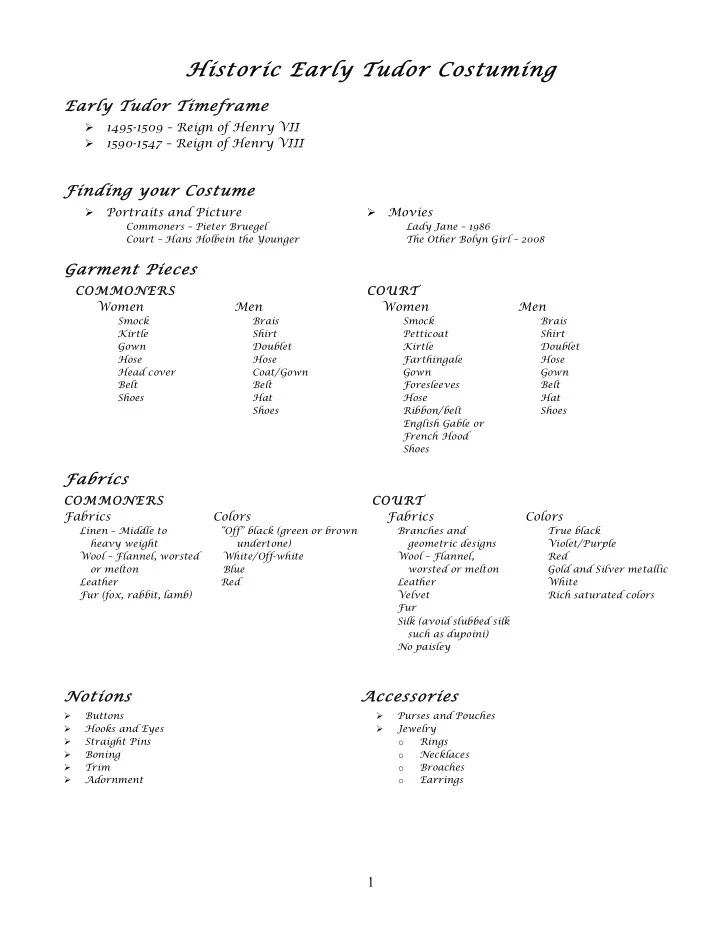
Historic Early Tudor Costuming Early Tudor Timeframe 1495-1509 Reign of Henry VII 1590-1547 Reign of Henry VIII Finding your Costume Portraits and Picture Movies Commoners Pieter Bruegel Lady Jane 1986 Court


slide-1
SLIDE 1

1

Historic Early Tudor Costuming

Early Tudor Timeframe

1495-1509 – Reign of Henry VII 1590-1547 – Reign of Henry VIII

Finding your Costume

Portraits and Picture Movies

Commoners – Pieter Bruegel Lady Jane – 1986 Court – Hans Holbein the Younger The Other Bolyn Girl – 2008

Garment Pieces

COMMONERS COURT Women Men Women Men

Smock Brais Smock Brais Kirtle Shirt Petticoat Shirt Gown Doublet Kirtle Doublet Hose Hose Farthingale Hose Head cover Coat/Gown Gown Gown Belt Belt Foresleeves Belt Shoes Hat Hose Hat Shoes Ribbon/belt Shoes English Gable or French Hood Shoes

Fabrics

COMMONERS COURT Fabrics Colors Fabrics Colors

Linen – Middle to heavy weight “Off” black (green or brown undertone) Branches and geometric designs True black Violet/Purple Wool – Flannel, worsted

  • r melton

White/Off-white Blue Wool – Flannel, worsted or melton Red Gold and Silver metallic Leather Red Leather White Fur (fox, rabbit, lamb) Velvet Rich saturated colors Fur Silk (avoid slubbed silk such as dupoini) No paisley

Notions Accessories

  • Buttons
  • Purses and Pouches
  • Hooks and Eyes
  • Jewelry
  • Straight Pins
  • Rings
  • Boning
  • Necklaces
  • Trim
  • Broaches
  • Adornment
  • Earrings
slide-2
SLIDE 2

2

Fabrics and resources: http://www.historicenterprises.com/ - medieval style clothing and accessories http://www.museumreplicas.com/- Farthingale (hoop) http://www.fabrics-store.com/ - Linen at GOOD prices www.renaissancefabrics.net - Wool fabric www.thewoolconnection.com - Wool fabric

https://www.reconstructinghistory.com/ Patterns and notions, including boning and pins Tudor Ladies Gown - RH601 - Tudor Lady's Gown & Kirtle - The perfect lady's gown for the Northern Renaissance period of Henry VIII and "Bloody" Mary Tudor. Full size paper patterns for Early Tudor Lady's Gown based on pictorial references and the work of Ninya Mikhaila and Jane Malcolm-Davies in their book The Tudor Tailor. Supportive kirtle and overgown included in

  • package. Two sleeve styles, two undersleeves, and trained or untrained skirts

with or without front split. Fits busts 30"-48" and waists 23"-41". All sizes included in one envelope. Embellishment suggestions included. Common GownRH603 - Early Tudor Commonwoman's Outfit - The perfect common woman's outfit for the Northern Renaissance period of Henry VIII and "Bloody" Mary Tudor. Full size paper patterns for Early Tudor commonwoman's outfit including front- or back-lacing kirtle, smock, cap, apron, and choice of two styles of partlet. RH606 - Early Tudor Common Man's Outfit - The perfect commoner's outfit for the Northern Renaissance period of Henry VIII and "Bloody" Mary Tudor. This

  • utfit was worn by common men across Europe and was particularly prevalent in

the works of Flemish and Netherlandish artists. Full size paper patterns for Early Tudor common man's outfit including shirt, front- or side-lacing doublet, jerkin, hosen and trousers.

slide-3
SLIDE 3

3 RH604 - Early Tudor Noble Man's Outfit - The perfect gentleman's gown for the Northern Renaissance period of Henry VIII, Anne Boleyn, and "Bloody" Mary Tudor. Full size paper patterns for Early Tudor nobleman's gown and jerkin. RH602 - Tudor Lady's Skivvies - The perfect lady's underpinnings for the Northern Renaissance period of Henry VIII and "Bloody" Mary Tudor. Full size paper patterns for Early Tudor Lady's Skivvies based on pictorial references and the work

  • f Ninya Mikhaila and Jane Malcolm-Davies in their book The Tudor Tailor.

Petticote, farthingale, and high-neck or scoop-neck smock included in pattern. Also included are a common woman's apron and three versions of the partlet &em; square pin-on, square tied, and rounded caplet. Fits busts 30"-48" and waists 23"-41". All sizes included in one envelope. Embellishment suggestions included. RH605 - Early Tudor Noble Man's Skivvies - The perfect genlteman's underclothes for the Northern Renaissance period of Henry VIII and "Bloody" Mary Tudor. Full size paper patterns for Early Tudor nobleman's shirt, doublet and hosen for wear under nobleman's jerkin and gown (RH604

slide-4
SLIDE 4

4 www.tudortailor.com - Patterns and notions, including buttons

English or gable hood This style of headdress was fashionable from the 1520s to the 1540s. Evidence from effigies suggests that it continued to be worn by gentlewomen, rather less fashionably, through the 1550s and 1560s. The pattern is based on information gathered from primary sources including: Figure on a monument to Sir Walter Devereux and his two wives (1537) in St. John’s Church, Stowe-by-Chartley, Staffordshire. Two views of a woman wearing an English Hood by Hans Holbein, c.1528-30, British Museum. Portrait of Jane Seymour, by Hans Holbein, 1537. Royal Cabinet of Paintings, Mauritshuis and a wire stiffener for a hood (inventory no.Z640*), Museum of London. Henrician bonnet kit This style of bonnet was fashionable wear for gentlemen from the late fifteenth century through to the 1540s. Our kit contains everything you need to make one bonnet including: Pattern, instructions, black velvet, buckram, domet, wire and silk 'sarcenet' for

  • lining. Jewels and feather are not included.

The pattern and materials have been based on documentary and pictorial sources including: Portrait of Henry VIII c.1536, Holbein, Museo Thyssen-Bornemisza, Madrid. Wooden model for a medal bearing a portrait of Charles de Solier, lord of Morette c1530, Christoph Weiditz, Victoria and Albert Museum, London. ‘… A bonnet of black velvet and a brooch on it, cost 5 marks.’ Inventory of Dame Agnes Hungerford, 1523. ‘… A bonnet of velvet 7s 6d.’ Amongst items of clothing stolen from Anthony Strelley, gentleman, 1543, Records of the Borough of Nottingham Early Tudor women's gowns Several styles suitable for middle class women during the first half of the sixteenth

  • century. Based on documentary descriptions, brasses, effigies and paintings, including:

Tomb effigies of two unknown ladies of c1520 at St Andrew’s Church, Prestwold, Charnwood, Leicestershire. Brass monument to T. Pownder and wife, 1525, St Mary Quay, Ipswich. Figures in The Wedding Dance in the Open Air, 1566, Pieter Bruegel. The Detriot Institute of Arts, Detriot and A Woman Seated on a Settle with Four Children, c1540, Holbein, The British Museum, London. Henrician Man's gown, doublet, jerkin and hose The patterns in this pack are based on original sources including: doublets and venetians in Arnold, J (1985) Patterns of fashion: The cut and construction of clothes for men and women c1560-1620, London: Macmillan; Hose found at Kloster Alpirsbach, Germany c1490-1529; Figures from The Embarkation at Dover and The Field of the Cloth of Gold, artist unknown, The Royal Collection; Henry VIII, after Holbein, c1536, Walker Art Gallery, Liverpool.

slide-5
SLIDE 5

5

Henrician Lady's petticoat, French kirtle and gown The patterns in this pack are based on original sources including: a pair of bodies c1598 in Arnold, J (1985) Patterns of fashion: The cut and construction of clothes for men and women c1560-1620, London: Macmillan; Mary Tudor's wardrobe accounts 1556 (E101/427/11); Elizabeth I wardrobe accounts in Arnold, J (1985) Patterns of fashion: The cut and construction of clothes for men and women c1560-1620; Two views of a woman wearing an English Hood, Hans Holbein c1528-30, British Museum; Portrait of Jane Seymour, Hans Holbein 1537, Royal Cabinet of Paintings, Mauritshuis; and a portrait of Catherine Parr att. Master John c1545, National Portrait Gallery, London. French hoods Several styles based on primary sources including: Figures on a monument to Sir George Vernon and his two wives (1567) in All Saints Church, Bakewell, Derbyshire; Figures on a monument to Thomas Manners, Earl of Rutland (1543) in St Mary's Church, Bottesford, Leicestershire; Portrait of Catherine Parr, attributed to Master John c1545. National Portrait Gallery, London; Electrotype of a medal of Mary I after Jacopo da Trezzo, c1555, National Portrait Gallery, London. Tudor girl's kirtles & petticoats The pack contains several styles which are suitable for ordinary girls for most of the 16th century. The patterns are based on original sources, including: a bodice worn under a gown by Eleanora of Toledo (died 1562) in Arnold, J (1985) Patterns of fashion: The cut and construction of clothes for men and women c1560-1620, London: Macmillan, 102; Thomasine Petre's accounts (1555); a detail from The field

  • f the cloth of gold (undated), artist unknown, Royal Collection (Hampton Court

Palace); and a detail from The St Bartholomew's day massacre (1572) by Francois Dubois, Lausanne.

slide-6
SLIDE 6

6

SHOES www.nmia.com/~bohemond/index.html - Bohemond - Shoes and pouches Mary Rose Shipwreck Tudor Shoe Based on shoes found in the Tudor era shipwreck, the Mary Rose, and on many shoes pictured in "Stepping through Time," The Mary Rose shoe is representative of men's shoes worn about 1530 to 1600 and is the perfect Tudor or renaissance

  • shoe. The Mary Rose was Henry VIII's favorite war ship which

was lost in 1545. Landsknecht Shoe Found in "Stepping Through Time" by Olaf Goubitz, Carol van Driel-Murry and Willy Groenman-van Waateringe this is the quintessential Landsknechts shoe worn by Swiss & German mercenaries that became a fashion sensation and worn all

  • ver Europe. The shoe dates commonly from 1480 to 1600

during the late medieval period and into the renaissance. Common names for this shoe are bear paw (if the shoe was cut and slashed), cow mouth or cowmouth, Kuhmaul, and bear paw shoe. This shoe is very similar to those worn by the Swiss Guard at the Vatican. The Landsknecht shoe is also worn by Henry VIII in several paintings. 15th Century Pouch "Annunciation Triptych" Gallery The 15th century medieval belt pouch is taken from the "Annunciation Triptych" illumination. This pouch shows up often in

  • ther 15th century illumination. In the "Annunciation Triptych" the

purse is adorned with two moon shaped fittings, has a buckle, and fashionably displays a bollock knife or dagger in a scabbard tucked behind the pouch. The buckle is from Museum of London's Dress

  • Accessories. This seems to be the purse or pouch of a Nobleman and is worn by a man.

http://revival.us/ These shoes, based on a simplified version of a 14th century low boot, has been crafted to what we think is a fine compromise between authenticity, function and cost. Ours are constructed for sturdy wear and are available in red, brown, black and forest green in full sizes from Ladies 5 - 10 to Men's 6-14.