
SLIDE 1
Highlights of VERITAS Results
- M. Schroedter* for the VERITAS Collaboration#
* Iowa State University, # http://veritas.sao.arizona.edu
Highlights of VERITAS Results M. Schroedter* for the VERITAS - - PowerPoint PPT Presentation
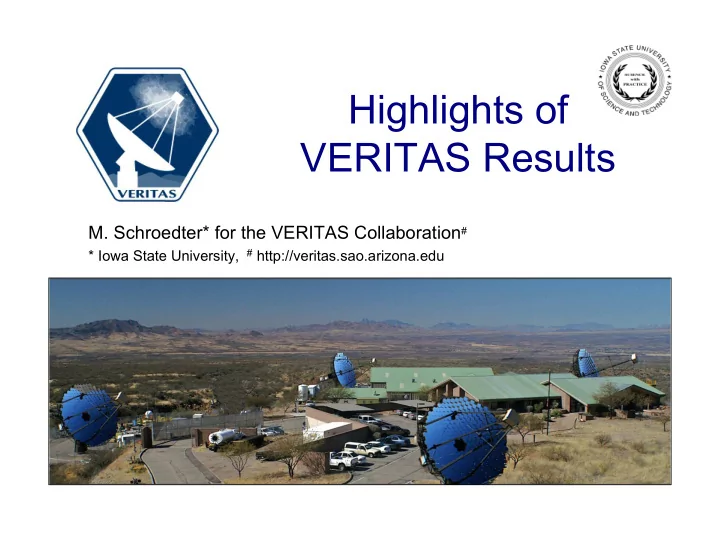
Highlights of VERITAS Results M. Schroedter* for the VERITAS Collaboration # * Iowa State University, # http://veritas.sao.arizona.edu VERITAS Collaboration VERITAS @ Adler Planetarium, June 2009 ~ 100 Scientists 22 Institutions in 4 Countries
* Iowa State University, # http://veritas.sao.arizona.edu
Stage et al. 2006
~ 100 Scientists 22 Institutions in 4 Countries Support from: Smithsonian Inst. U.S. NSF U.S. DOE STFC (U.K.) NSERC (Canada) SFI (Ireland)
U.S.
Adler Planetarium Purdue Univ. Univ. of Iowa Argonne Nat. Lab SAO
Barnard College UCLA
DePauw Univ. UCSC Washington Univ. Grinnell College
Iowa St. Univ.
Canada Ireland
McGill Univ. Cork Inst. Tech. Galway-Mayo Inst. N.U.I. Galway
U.K.
Leeds Univ.
+ 25 Associate Members
VERITAS @ Adler Planetarium, June 2009
νs and DM, Madison, 2009 Results from VERITAS Martin Schroedter
νs and DM, Madison, 2009 Results from VERITAS
Stage et al. 2006
Technique VERITAS Telescope Array
Science Highlights
VERITAS Upgrade Plans
Martin Schroedter
Sky view
Upper atmosphere Detection area: 50,000 m2 larger than football field! Energy: 0.1-50 TeV Energy resolution: ~18% Angular res.: <0.12o 8 km
1 TeV γ-ray produces relativistic particle shower
120 m
Cherenkov wavefront 1 m (3 ns) thick
~2o
well reconstructed source location
Scale
1 2 3 3 2 1
T1-new Fall 2009 T2 Spring 2006 T4 Spring 2007 T3 Fall 2006
99 m 126 m 101 m 81 m
Whipple 10m
νs and DM, Madison, 2009 Results from VERITAS Martin Schroedter
Stage et al. 2006
Telescope (x 4)
12-m diameter Davies-Cotton f 1.0, 110 m2 area
PMT Assembly
Camera (x 4)
499 PMTs, 3.5o FOV
Mirror Facets (x 350)
Reflectivity ~ 88% (Recoated every 2 years)
FADC Readout
500 Msps, dual-gain
3-Level Trigger
Pixel, Telescope, Array Deadtime ~10% @ 250 Hz
νs and DM, Madison, 2009 Results from VERITAS
Cosmic-ray event
Martin Schroedter
Stage et al. 2006
Energy Range: 100 GeV – 30 TeV (spectra >150 GeV) Energy Resolution: 15% – 20% Crab Rate ~ 40 / min (trigger) Sensitivity: 5% Crab in < 2.5 h 1% Crab in < 50 h Angular Resolution: r68 < 0.1o Pointing Accuracy: < 50’’
Effective Area (std. cuts) Energy Resolution Angular Resolution
Canonical Performance Values:
5% Crab 2.5 h 1% Crab <50 h νs and DM, Madison, 2009 Results from VERITAS
New: 30% less time!
Martin Schroedter
νs and DM, Madison, 2009 Results from VERITAS
Stage et al. 2006
Technique VERITAS Telescope Array
Science Highlights
VERITAS Upgrade Plans
Martin Schroedter
21 Sources 6 Classes
M87
Black hole - jet
Z=0.44
Starburst galaxy
M82
Active Galactic Nuclei
particle acceleration.
jet physics, BH engine.
Simultaneous MWL data crucial.
a) Blazars (10)
γVHE + γEBL e+ e-
b) Radio Galaxies: M87, Cent-A
Starburst Galaxy: M82
νs and DM, Madison, 2009 Results from VERITAS Martin Schroedter
νs and DM, Madison, 2009 Results from VERITAS
0.1-10 keV, Chandra
M82: Prototype starburst galaxy
hundreds of Myrs.
(HST shows > 200 massive star clusters.
Starburst Region
interacting with gas and B-field Clues on origin of CRʼs.
(HEGRA, Whipple). Also limits on NGC 253.
Johannes Schedler (Panther Observatory) M81 M82 M82 Martin Schroedter
Stage et al. 2006
VERITAS Data & Analysis
Only dark time (no moonlight).
Detection !
Consistent with point source at M82.
background method, and potential biases.
(E > 700 GeV)
Interpretation
not clearly associated with AGN activity.
“Discovery of Gamma-ray Emission from a Starburst Galaxy,” Acciari et al., submitted to Nature.
νs and DM, Madison, 2009 Results from VERITAS
Excess
Martin Schroedter
νs and DM, Madison, 2009 Results from VERITAS
Energy spectrum
Γ = 2.5 ± 0.6stat ± 0.2sys
Hadronic emission
pCR + pambient π0 γ γTeV π+/- e, ν e + B-field radio/IR synchro Measured 32 GHz flux is consistent with VHE γ-ray spectrum extrapolated to 20 GeV if Γ = 2.3 and B~8nT.
Leptonic signature (IC)
eCRs + γIR e + γIC Consistent with Chandra 5 keV flux for 1 GeV CR-electrons, 8 nT.
Pohl (1994), Völk et al. (1996), Persic et al. (2008), de Cea del Pozo et al. (2009)
Model of Persic et al. 2008
Martin Schroedter
Radio (Very Large Array) Optical (Hubble) X-ray (Chandra)
~6000 lyr
VHE resolution Giant elliptical radio galaxy
17 Mpc (z=0.004) International multi-λ campaign
νs and DM, Madison, 2009 Results from VERITAS 150 kly Martin Schroedter
X-ray
Nucleus
HST-1
νs and DM, Madison, 2009 Results from VERITAS
TeV γ-ray outburst
GHz
VLBA resolution at 6RS
VERITAS, VLBA, HESS, and MAGIC, Science 325, July 2009.
Martin Schroedter
νs and DM, Madison, 2009 Results from VERITAS
Stage et al. 2006
Technique VERITAS Telescope Array
Science Highlights
VERITAS Upgrade Plans
Martin Schroedter
νs and DM, Madison, 2009 Results from VERITAS
Supernova remnants (5)
(IC 443, Cassiopeia A)
(Crab, Boomerang, G54.1)
X-ray Binary
Unidentified
Galactic plane is rich in γ-ray emission:
fronts, colliding winds, superbubbles
Hope to pin down CR Origin: need ν-signature!
all VERITAS sources
Extragalactic Blazars, Radio galaxies Starburst galaxy
Martin Schroedter
νs and DM, Madison, 2009 Results from VERITAS
Energetic pulsar + wind nebula discovered by EGRET
Likely associated with large SNR G106.3+27 Fermi-LAT Bright Source list Emission at ~35 TeV reported by Milagro (Abdo et al., 2009) North
Martin Schroedter
νs and DM, Madison, 2009 Results from VERITAS
VERITAS Observations
TeV emission is extended
Color map: VERITAS Circle: Fermi error circle Dot: Pulsar position Black: 1.4 GHz DRAO Purple lines: CO
Martin Schroedter
νs and DM, Madison, 2009 Results from VERITAS Milagro
Energy spectrum
centered on emission peak
Γ = 2.3 ± 0.3stat ± 0.3sys,
Extension of spectrum is consistent within errors with Milagro point at 35 TeV If associated with pulsar
Favors hadronic origin of VHE γ ? pCR + pambient π0 γ γ
Martin Schroedter
νs and DM, Madison, 2009 Results from VERITAS
Stage et al. 2006
Technique VERITAS Telescope Array
Science Highlights
VERITAS Upgrade Plans
Martin Schroedter
νs and DM, Madison, 2009 Results from VERITAS
Complementary approaches
Dark matter annihilation
50 GeV - 10 TeV
2
Martin Schroedter
νs and DM, Madison, 2009 Results from VERITAS
Lu et al. (Chandra/ACIS)
Source Characteristics
baryonic mass)
VERITAS DM Program
~10,000m2
Dwarf Galaxies (e.g. Draco…) Local Galaxies (e.g. M32, M33) Globular Clusters (e.g. M5) Galaxy Clusters (e.g. Coma)
Limits on 7 candidate sources
Draco
Significance
0.5% Bootes I (200kpc) 1% Willman I 0.5% Ursa Minor 0.3% Draco 95% CL UL Flux at 1 TeV (Crab) Dwarf-Sph <100 kpc
Martin Schroedter
νs and DM, Madison, 2009 Results from VERITAS
2009 ICRC Talk: R. Wagner, HE 2.3 (#0625)
Assuming NFW profile
x 100 Exposure x 10 Sensitivity x 1/2 E_thresh
MSSM+DarkSUSY consistent with WMAP
Martin Schroedter
νs and DM, Madison, 2009 Results from VERITAS
Stage et al. 2006
Technique VERITAS Telescope Array
Science Highlights
VERITAS Upgrade Plans
Martin Schroedter
Stage et al. 2006
Plans to improve the sensitivity and to extend the energy range are ongoing:
VERITAS operates very well with excellent sensitivity. With the excitement in the field and the unique capabilities of Fermi, we want to improve VERITAS.
νs and DM, Madison, 2009 Results from VERITAS Martin Schroedter
νs and DM, Madison, 2009 Results from VERITAS
VERITAS is the most sensitive γ-ray detector between 0.1 - 30 TeV.
Major scientific highlights
1ES 0806+524, W Com (IBL), 3C 66A (IBL), RGB 0170+541, PKS 1424+240.
VERITAS upgrade will significantly improve sensitivity. Future discoveries driven by closer collaboration between GeV, TeV γ-ray and ν telescopes.
Martin Schroedter
3C 66A
21σ, 33h, Eth ~ 120 GeV. (ATEL #1753, ApJ 693, L104).
(due to EBL ?) .
SSC model disfavored (see L. Reyesʼ talk).
ICRC Talk: L. Reyes OG 2.3 (#0637) ICRC Talk: J. Perkins OG 2.3 (#0490) MAGIC reported 3C66B 0.12o away. 5.4σ in 54 h from 2007 data. Source confusion? VERITAS excludes 3C66B at 4.3σ.
VERITAS
VERITAS νs and DM, Madison, 2009 Results from VERITAS Martin Schroedter