VERITAS Observations of Relativistic Jets Reshmi Mukherjee 1 for the - - PowerPoint PPT Presentation

veritas observations
SMART_READER_LITE
LIVE PREVIEW

VERITAS Observations of Relativistic Jets Reshmi Mukherjee 1 for the - - PowerPoint PPT Presentation

VERITAS Observations of Relativistic Jets Reshmi Mukherjee 1 for the VERITAS Collaboration 1 Barnard College, Columbia University Sensitivity improvement: 1% Crab in ~25 hr Sensitive energy range: 100 GeV to 30 TeV Spectral


slide-1
SLIDE 1

Reshmi Mukherjee HEPRO III, Barcelona 2011

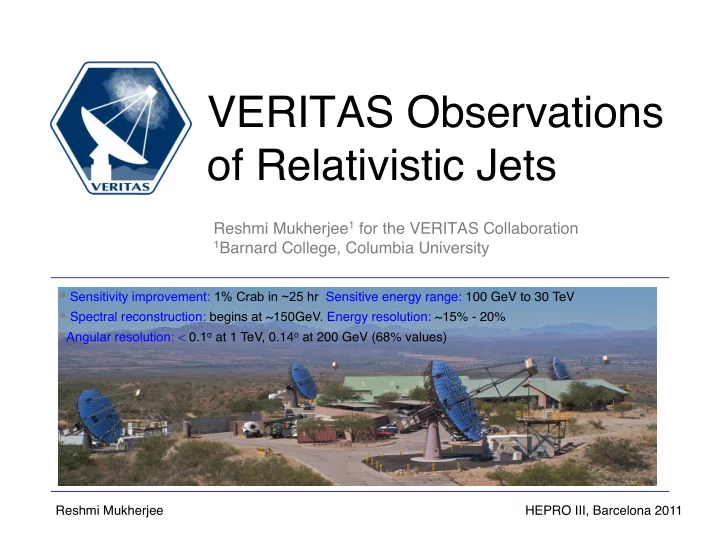
VERITAS Observations

  • f Relativistic Jets


Reshmi Mukherjee1 for the VERITAS Collaboration

1Barnard College, Columbia University

  • Sensitivity improvement: 1% Crab in ~25 hr Sensitive energy range: 100 GeV to 30 TeV
  • Spectral reconstruction: begins at ~150GeV. Energy resolution: ~15% - 20%
  • Angular resolution: < 0.1o at 1 TeV, 0.14o at 200 GeV (68% values)
slide-2
SLIDE 2

Reshmi Mukherjee

Outline

  • Highlights from the Extragalactic Program
  • TeV Blazar Sample
  • Modeling blazar SEDs
  • M87
  • Galactic sources of HE relativistic outflows
  • Gamma-ray binaries
  • Pulsar wind nebulae (PWN)

HEPRO III, Barcelona 2011

slide-3
SLIDE 3

Blazars Detected by VERITAS

AGN Type z

Mkn 421 HBL 0.030 Mkn 501 HBL 0.034 1ES 2344+514 HBL 0.044 1ES 1959+650 HBL 0.047 W Comae IBL 0.102 RGB J0710+591* HBL 0.125 H 1426+428 HBL 0.129 1ES 1215+303 IBL 0.130 1ES 0806+524 HBL 0.138 1ES 0229+200 HBL 0.139 1ES 1440+122 IBL 0.162 RX J0648.7+1516 Blazar 0.179 1ES 1218+304 HBL 0.182 RBS 0413 HBL 0.190 1ES 0414+009 HBL 0.287 PG 1553+113 HBL 0.43 < z < 0.47 1ES 0502+675 HBL 0.341 ? 3C 66A IBL 0.444 ? PKS 1424+240 IBL/HBL ? VER J0521+211 Blazar ?

Key Science Project: Discovery, MWL & ToO observations ~400 hr/yr including moonlight data

  • 19 detections
  • 10 discoveries
  • ≥4 VHE intermediate BL Lacs
  • Predominately nearby
  • EBL horizon?
  • Target selection
  • Mostly X-ray candidates
  • Now – Fermi-LAT motivated
  • All LAT detected except 1ES0229+200

Reshmi Mukherjee

slide-4
SLIDE 4

Blazar sequence – expanding on TeV source classes

Non-thermal, continuum spectra. Dramatic peak at γ-ray energies. Emission extends to GeV-TeV.

Absence of intrinsic γγ pair absorption  beaming in blazars. High isotropic γ-ray luminosity ~ 1048erg/s Optical depth >> 1  γ-ray emission originates in strongly beamed sources.

Reshmi Mukherjee

Sambruna 1996; Fossati et al. 1998.

Sambruna 1996; Fossati et al. 1998.

  • HBLs: νpk ~ 1016-18 Hz
  • IBLs: νpk ~ 1015-16 Hz
  • LBLs: νpk ~ 1013-15 Hz
  • “Extreme” HBLs > 1018 Hz

Blazars detected by Fermi

Non-HBLs – VERITAS:

  • W Comae
  • 3C 66A
  • 1ES 1215+303
  • 1ES 1440+122

HEPRO III, Barcelona 2011

slide-5
SLIDE 5
  • Intermediate-peaked (IBL).
  • First IBL to be detected > 200 GeV
  • Strong flare 2008 March (ATel 1422)
  • 2008 Jan – Apr: ~5 σ in ~40 hr observations
  • 70% of excess from 4-night flare in

2008 March

  • 275γ, 8.6σ; τ ≈1.3 ± 0.3 days, 9% CU

IBLs: VERITAS Discovery of W Com

Acciari et al. 2008 ApJ 690, L73 Reshmi Mukherjee W Comae 1ES 1218+304 B2 1215+305

FOV shows recent detection

  • f B2 1215+303

Benbow et al. ICRC 2011

HEPRO III, Barcelona 2011

slide-6
SLIDE 6

Discoveries: Finding Blazars behind the Galactic plane

Reshmi Mukherjee

  • A number of unidentified Fermi sources are expected to be blazars behind

the Galactic plane.

  • VHE telescopes are a good tool for identifying blazars at low latitudes

(better localization, higher sensitivity to flux variability).

HEPRO III, Barcelona 2011

slide-7
SLIDE 7

1 period = 1 month = 1 dark run

Blazars behind the Galactic plane

Reshmi Mukherjee

Identified as VHE candidates because of cluster of E>50 GeV (Fermi) photons at source position.

  • γ-ray excess, 15.6 σ, 5% Crab
  • Position compatible with radio & X-ray

source RGB J0521.8+2112

  • z unknown. Follow-up optical spectroscopy

revealed continuum dominated spectrum, no absorption lines, typical of BL Lacs

  • Unidentified radio & X-ray source RGB

J0648+152 located 6o off the plane

  • VERITAS: 19 h in Mar-Apr10
  • γ-ray excess, 5.3 σ, 2% Crab
  • Follow-up optical spectroscopy at Lick:

z=0.179.

  • E. Aliu et al. 2011, in prep.

HEPRO III, Barcelona 2011

VER J0521+211 VER J0648+152

slide-8
SLIDE 8

1 period = 1 month = 1 dark run

Low-latitude blazar: RX J0648.7+1516

Reshmi Mukherjee

  • Follow-up optical

spectroscopy at the Shane 3m telescope at Lick Observatory.

  • The obtained results reveal

a continuum dominated spectrum typical of BL Lac- type blazars.

  • Observed absorption lines

are compatible with z= 0.179.

HEPRO III, Barcelona 2011

  • E. Aliu et al. 2011, in prep.
slide-9
SLIDE 9

Blazar Models – What have we learnt with VERITAS?

Particle acceleration & radiation in blazar jets – Collimated ejection of plasma with bulk Lorentz factor >>1

  • Radiation – peaks in SED. Non-thermal

synchrotron & IC (Ieptonic), or hadronic processes

  • Sources of soft photons: synchrotron self-

Compton radiation, accretion disk photons, radiation scattered by BLR, …..

  • Synchrotron & SSC flux: F ~ δ3+α
  • External Compton : F ~ δ4+2α

(δ = 1/[Γ(1-βcos θ)] Doppler factor)

  • VERITAS data modeled using leptonic one-jet

model (Boettcher & Chiang 2002)

  • Observed radiation originating from ultra-rel.

e- in a spherical emission region (RB), moving at βΓc.

Relativistic jet outflow with Γ ≈ 10

Reshmi Mukherjee

HEPRO III, Barcelona 2011

  • Size of emission region

constrained by shortest timescale of

  • variab. RB<cδtvarD/(1+z)

Urry & Padovani 1995

slide-10
SLIDE 10

1 period = 1 month = 1 dark run

HBLs: RGB J0710+591

Some examples of blazar modeling:

  • “Extreme” HBL. Promising

VHE candidate

  • Redshift 0.125
  • Useful for EBL studies
  • VERITAS detection triggered
  • bservations at other

wavelengths, including Fermi

  • LAT detection
  • First Fermi-LAT source

found with VHE guidance

  • V. Acciari et al. 2010, ApJL 715, L49

ΓHE = 1.46 ± 0.17stat ± 0.05sys ΓVHE = 2.69 ± 0.26stat ± 0.20sys

Reshmi Mukherjee

HEPRO III, Barcelona 2011

Γbulk = 30 γmin = 6.104 γmax = 2.106 q=1.5 B=0.036

slide-11
SLIDE 11

Every dark run in good agreement ! 1 period = 1 month = 1 dark run

TeV Blazars: Mrk 501

1997 2009

  • V. Acciari et al., (2010) arXiv:1012.2200

Reshmi Mukherjee

  • Joint MWL campaign

VERITAS/MAGIC, Fermi-LAT, Suzaku.

  • Large shift in synchrotron peak;

little shift in IC peak. Both epochs well described by SSC model

  • X-ray data used to place limits
  • n peak frequencies:
  • 230 keV (5.5 X 10¹⁹ Hz) –

high

  • 0.6 keV (0.6 X 10¹⁷ Hz) –

low

  • Shift in VHE peak not as

dramatic

  • - Could be from onset of KN

suppression

  • - KN effects become important

above hν ~ mec2 in electron rest frame

HEPRO III, Barcelona 2011

Γbulk = 30 γmin = 1 γb = 3.105 γmax = 3.106 q=1.6 qb= 2.6

Also see Panequeʼs poster A43

slide-12
SLIDE 12

SEDs: Constraints from MW Observations

Reshmi Mukherjee Abdo et al. arXiv:1011.1053

High optical luminosity is expected to play a key role in providing the seed population for IC scattering. Correlated MW observations of IBL 3C 66A

slide-13
SLIDE 13

1 period = 1 month = 1 dark run

HBL 1ES 1218+304: Variable Emission

  • Redshift 0.182
  • Hard intrinsic spectrum Γ ≤ 1.5
  • Flare Jan 25 – Feb 5, 2009:

7% Crab to 20% Crab

  • ~1 day variability time scale

challenges kiloparsec jet model

  • f hard-spectrum emission

(Boettcher et al. 2008)

  • V. Acciari et al. 2010, ApJL 709, L163

Reshmi Mukherjee

R ≤ ct δ/(1 + z)) For typical Doppler factors δ= 20 (Marscher

2006), R<0.01pc.

slide-14
SLIDE 14
  • long-term monitoring program
  • major flares in 2008 & 2010
  • initiated large MWL efforts
  • spectral hardening with increasing flux
  • high in VHE & X-ray since 11/09
  • 35 h of data; ~400σ
  • huge flare on Feb 17th 2010
  • variability on 5-10 min time scales
  • >10σ per 2 minute bin

ApJ submitted (2010)

TeV Blazar: Mrk 421

Reshmi Mukherjee

HEPRO III, Barcelona 2011

slide-15
SLIDE 15

M87 – Radio Galaxy – 2008 Flare

  • Location of TeV γ-ray emission??
  • TeV: night-by-night averaged VHE light

curve in 2008. Strong variability resulted in the detection of at least 2 flares

  • X-ray: Chandra core and HST-1 knot
  • VLBA: 43 GHz observations of nucleus,

peak and flux integrated along the jet -- radio flux of the unresolved core risng.

  • Temporal coincidence of TeV & radio flares

indicates they are related.

Wagner et al. 2009

HEPRO III, Barcelona 2011

Also see M. Raueʼs talk & D.E. Harris A.23

slide-16
SLIDE 16

Reshmi Mukherjee

Outline

  • Highlights from the Extragalactic Program
  • TeV Blazar Sample
  • Modeling blazar SEDs
  • M87
  • Galactic sources of HE relativistic outflows
  • Gamma-ray binaries
  • Pulsar wind nebulae (PWN)

HEPRO III, Barcelona 2011

slide-17
SLIDE 17

Galactic Science Program

  • Pulsar Wind Nebulae

(pointed observations)

  • TeV emission from nebulae of

energetic young pulsars. Large fraction of Galactic TeV sources. .

  • TeV PWNe associated with high

Edot/d2 pulsars.

  • TeV observations of binaries:
  • Binaries are the only variable Galactic TeV sources.
  • TeV emission probes the highest energy particles accelerated. May provide

the keys to an understanding of astrophysical jets.

  • Two Scenarios: Microquasar: gamma-rays are produced in a radio-emitting jet
  • Pulsar Binary: particles accelerated in the shock produced by the interaction
  • f the pulsar wind and the wind of the companion

Reshmi Mukherjee

Galactic sources of HE relativistic outflows

HEPRO III, Barcelona 2011

Mirabel 2006 Science

slide-18
SLIDE 18

Stage et al. 2006

HMXB LS I+61o 303

  • Compact object orbiting a Be companion star
  • 26.5 day, inclined orbit, e=0.54, circumstellar disk
  • Extended radio structure; microquasar? (but radio images shows orbital

morphology change)

  • Strong VHE emission only near apastron: 15-20% of Crab Nebula Flux

(MAGIC/VERITAS)

  • GeV emission peaks near periastron; 6 GeV cut-off; orbital modulation;
  • rbit-to-orbit variations;
  • Different component than in TeV?

Reshmi Mukherjee

HEPRO III, Barcelona 2011

J.Casares et al (MNRAS 360, 1105 (2005))

slide-19
SLIDE 19

Stage et al. 2006

HMXB LS I+61o 303: VERITAS Follow up

Reshmi Mukherjee

HEPRO III, Barcelona 2011

2008-2009: 37 h data, 3.3 σ, no detection Almost entire orbit covered 2009-2010: 18 h data, 0.8 σ, no detection Deep exposure near apastron

Acciari et al. 2011, ApJ arXiv: 1105.0449

slide-20
SLIDE 20

Stage et al. 2006

HMXB LS I+61o 303: VERITAS Follow up

Reshmi Mukherjee

HEPRO III, Barcelona 2011

October 2010: periastron detection 5% of the Crab Nebula flux at E>300 GeV Is this long term variability related to the environment of the Be star?

Acciari et al. 2011, ApJ arXiv: 1105.0449

slide-21
SLIDE 21

HESS J0632+057: a new binary?

Reshmi Mukherjee

HESS J0632+057: Only unidentified TeV source in Galactic plane that is point-like.

  • Discovered by H.E.S.S. in 2004/2006 (Γ=2.53, F(>1

TeV) ~3% Crab.

  • MWL follow-up shows a hard spectrum X-ray source

& faint radio source coincident with a massive B0pe star (MWC148) (Hinton et al 2009).

  • Faint point-like, variable radio source (<2ʼʼ extension,

0.2-0.4 mJy, Skilton et al 2009)

  • Not detected by Fermi LAT
  • No binary system identified (e.g. Aragona et al 2010)
  • VERITAS non-detection 2006-2009, VERITAS

detection in 2010. Implies variability.

  • Variable X-ray emission measured by Swift. (Falcone

et al 2010))

Hinton ApJL 690 (2009)

A new TeV binary system? Coincident with Be star MWC 148? (Hinton et al 2009). An unusual isolated massive star? (confined stellar wind, Townsend et al 2007)

HEPRO III, Barcelona 2011

XMM

slide-22
SLIDE 22

TeV Variability

Reshmi Mukherjee

VERITAS Feb-Mar 2010 HESS/VERITAS. (in prep.)

  • 30 h in Dec 2006 - Jan 2009: not detected

by VERITAS (ApJ 687 L94 (2009))

  • Excluded with ~4σ confidence that HESS

J0632+057 is a steady gamma-ray emitter

  • H.E.S.S./VERITAS campaign in

2009/2010 (publication in prep)

  • 8h in Oct 2009: no detection (UL~1.3%

Crab)

  • 20 h in Feb/March 2010: clear detection

(7.5 σ, 1.5% Crab)

  • clearly variable in VHE gamma rays
  • is it a VHE binary? Need detection of
  • rbital modulation (at any wavelength)

HEPRO III, Barcelona 2011

slide-23
SLIDE 23

And finally…

Reshmi Mukherjee

  • Swift X-ray monitoring establishes periodic behavior (T=320±5 days)

(Bongiorno, 2011) Atel #3153

  • VERITAS observations Feb 7/8, 2011 triggered by X-ray activity (Atel #3152)
  • > 8σ, F (E> 300 GeV) ~ 4% Crab
  • Confirmed by MAGIC (Atel #3161)

HEPRO III, Barcelona 2011

slide-24
SLIDE 24

Reshmi Mukherjee

Pulsar Wind Nebulae

  • Most of the rotational energy in pulsars is

lost in the form of a particle wind made of electrons (leptonic accelerators?)

  • This wind form the PWN that shines at all

wavelengths. Does CTA 1 emit from the shell? from the PWN? from both? CTA 1 radio shell Age~13 kyr Dist=1.4±0.3 kpc Pulsar Ė=4.5x1035erg/s First pulsar discovered at GeV γ- rays by Fermi-LAT

(Gaensler & Slane, 2006, ARA&A, 44, 17)

HEPRO III, Barcelona 2011

slide-25
SLIDE 25

Reshmi Mukherjee

The most recent: CTA 1

  • Observations: 26.5 hrs between Oct

2010 and Jan 2011

  • Extended emission centered around

the pulsar (7.3σ/6.2σ pre/post-trials significance)

  • Preliminary flux ~4% Crab - working
  • n spectrum
  • Morphology clearly suggests young

PWN

  • Properties of CTA 1 nicely fit in the

middle of those of known TeV/X-ray PWN

Black Contours:1420 MHz show SNR shell Red Circle: Fermi pulsar Green : 3 to 7σ TeV contours

HEPRO III, Barcelona 2011

  • B. McArthur for the VERITAS Collab. 3rd Fermi Symp. 2011 May
slide-26
SLIDE 26

Reshmi Mukherjee

Recent Studies of the Cygnus Region

  • MGRO J2019+37:
  • ~80% Crab at 20 TeV (Abdo et al. 2007)
  • Located towards the Cyg OB1 association
  • Coincident with two EGRET UIDs (3EG

J2021+3716 & 3EG J2021+3616)

  • 3EG J2016+3651=blazar B2013+370?

(Mukherjee et al., 2000)

  • 3EG J2021+3716 = radio pulsar PSR

J2021+3651 (Roberts et al., 2002)

  • Both associations have been now confirmed

with the LAT: 1FGL J2021.0+3651(pulsed) and 1FGL J2015.7+3708 (very variable, V=139)

(Abdo et al., 2009)

HEPRO III, Barcelona 2011

Abdo et al. 2007)

slide-27
SLIDE 27

Reshmi Mukherjee

VERITAS Observations Cygnus Region

HEPRO III, Barcelona 2011

  • E. Aliu for the VERITAS Collab. 3rd Fermi Symp. 2011 May

VERITAS Observations:

  • 75 hrs between May &

December 2010

  • Point--‐like source detected

coincident with the CTB 87 PWN. – VER J2016+372: 6.1σ F (E>1TeV) ~ 0.8% Crab Nebula. Can exclude at 99% level the blazar B 2013+370. – 1FGLJ2015.7+3708 is variable, likely assoc. with blazar.

  • GeV and TeV emission in this

region seems to be of quiet different

  • rigin!
  • VER J2016+372 could contribute

to the MGRO J2019+37

slide-28
SLIDE 28

Reshmi Mukherjee

HEPRO III, Barcelona 2011

VERITAS Observations Cygnus Region

  • E. Aliu for the VERITAS Collab. 3rd Fermi Symp. 2011 May
  • Broad emission region detected in extended source analysis
  • 0.23° integration radius, 650 GeV threshold
  • Broad TeV Excess: 7.4 σ post
  • Coincides with MGRO J2019+37 (dashed ellipse).
  • Substructure and/or multiple sources? Under evaluation.
slide-29
SLIDE 29

Reshmi Mukherjee NERQUAM, Yale 2011

  • Remnant of historic supernova in 1054 A.D.
  • Dist ~ 2 kpc Period ~ 33 ms
  • Most energetic pulsar 4.6 x 1038 erg/s
  • One of the brightest GeV γ-ray pulsars
  • Powers the brightest TeV γ-ray source

The Crab pulsar

Break between few MeV and few GeV (exponential cutoff) Acceleration regions (polar vs outer gap) and radiation mechanisms (curvature radiation) studied through the cutoff MAGIC detection above 25 GeV suggested that emission comes from a region > 6 stellar radii ➔ outer gap scenarios favored

slide-30
SLIDE 30

Reshmi Mukherjee

Crab: Latest Results VERITAS

HEPRO III, Barcelona 2011

  • N. Otte for the VERITAS Collab. 3rd Fermi Symp. 2011 May
slide-31
SLIDE 31

Reshmi Mukherjee

Crab: Latest Results VERITAS

HEPRO III, Barcelona 2011

  • N. Otte for the VERITAS Collab. 3rd Fermi Symp. 2011 May
slide-32
SLIDE 32

Summary of Results

Reshmi Mukherjee

HEPRO III, Barcelona 2011

(see: http//veritas.sao.arizona.edu)

made with TeVCat

slide-33
SLIDE 33

Reshmi Mukherjee

Thanks

  • to all my VERITAS colleagues

(veritas.sao.arizona.edu)

HEPRO III, Barcelona 2011