Highlights from VERITAS studies of TeV astroparticle physics Nahee - - PowerPoint PPT Presentation

highlights from veritas studies of tev astroparticle
SMART_READER_LITE
LIVE PREVIEW

Highlights from VERITAS studies of TeV astroparticle physics Nahee - - PowerPoint PPT Presentation

Highlights from VERITAS studies of TeV astroparticle physics Nahee Park For The VERITAS Collaboration The VERITAS Collaboration ~100 members, 20 institutions University of Minnesota Bartol Research Institute / University of


slide-1
SLIDE 1

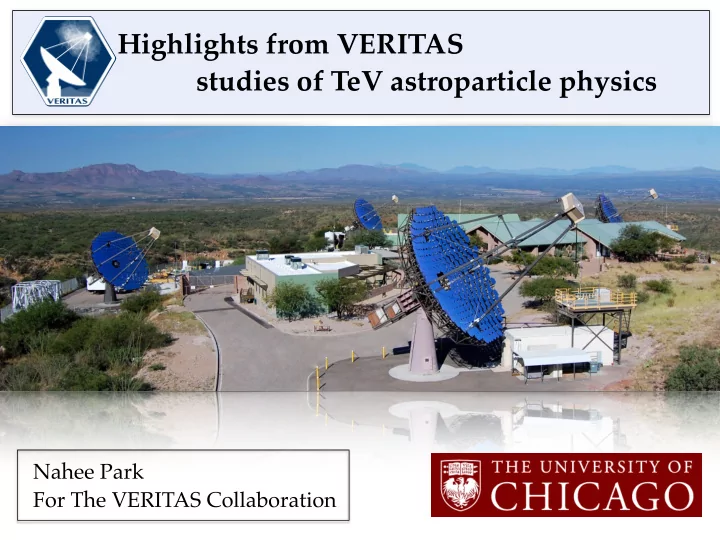
Highlights from VERITAS 
 studies of TeV astroparticle physics

Nahee Park For The VERITAS Collaboration

slide-2
SLIDE 2

The VERITAS Collaboration

2

  • N. Park, TeV Particle Astrophysics 2015

๏ ~100 members, 20 institutions

  • 24 non-affiliated members
  • +35 associate members
  • Managing Organization: Smithsonian

Astrophysical Observatory

  • Adler Planetarium
  • Argonne National Lab
  • Barnard College / Columbia University
  • Bartol Research Institute / University of

Delaware

  • Georgia Institute of Technology
  • Iowa State University
  • Purdue University
  • University of California, Los Angeles
  • University of California, Santa Cruz
  • University of Chicago
  • University of Iowa
  • University of Minnesota
  • University of Utah
  • Washington University in St. Louis
  • McGill University, Montreal
  • University College Dublin
  • Cork Institute of Technology
  • Galway-Mayo Institute of Technology
  • National University of Ireland, Galway
slide-3
SLIDE 3

Study VHE γ-rays(~80 GeV to ~ 30 TeV) from astrophysical sources


 Fully operational since 2007

  • Continuous improvement in performance 


with two major upgrades (2009 & 2012)

  • Sensitive to detect 1% Crab Nebula signal in ~25 hr


with angular resolution of <0.1 degree at 1 TeV

  • ~ 1000 hours/yr in “dark time” observation,


~300 hours of bright moonlight data 
 (moon illumination > 30%)

VERITAS : Observatory Overview

3

  • N. Park, TeV Particle Astrophysics 2015

2007/09 ~ 2009/06

V4 : 2007-2009 V5 : 2009-2012 V6 : 2012-present

slide-4
SLIDE 4

Study VHE γ-rays(~80 GeV to ~ 30 TeV) from astrophysical sources


 Fully operational since 2007

  • Continuous improvement in performance 


with two major upgrades (2009 & 2012)

  • Sensitive to detect 1% Crab Nebula signal in ~25 hr


with angular resolution of <0.1 degree at 1 TeV

  • ~ 1000 hours/yr in “dark time” observation,


~300 hours of bright moonlight data 
 (moon illumination > 30%)

VERITAS : Observatory Overview

3

  • N. Park, TeV Particle Astrophysics 2015

2007/09 ~ 2009/06 2009/09 ~ present

V4 : 2007-2009 V5 : 2009-2012 V6 : 2012-present

slide-5
SLIDE 5

Study VHE γ-rays(~80 GeV to ~ 30 TeV) from astrophysical sources


 Fully operational since 2007

  • Continuous improvement in performance 


with two major upgrades (2009 & 2012)

  • Sensitive to detect 1% Crab Nebula signal in ~25 hr


with angular resolution of <0.1 degree at 1 TeV

  • ~ 1000 hours/yr in “dark time” observation,


~300 hours of bright moonlight data 
 (moon illumination > 30%)

VERITAS : Observatory Overview

3

  • N. Park, TeV Particle Astrophysics 2015

2007/09 ~ 2009/06 2009/09 ~ present

V4 : 2007-2009 V5 : 2009-2012 V6 : 2012-present

slide-6
SLIDE 6

Study VHE γ-rays(~80 GeV to ~ 30 TeV) from astrophysical sources


 Fully operational since 2007

  • Continuous improvement in performance 


with two major upgrades (2009 & 2012)

  • Sensitive to detect 1% Crab Nebula signal in ~25 hr


with angular resolution of <0.1 degree at 1 TeV

  • ~ 1000 hours/yr in “dark time” observation,


~300 hours of bright moonlight data 
 (moon illumination > 30%)

VERITAS : Observatory Overview

3

  • N. Park, TeV Particle Astrophysics 2015

2007/09 ~ 2009/06 2009/09 ~ present

2012 : Camera Upgrade

V4 : 2007-2009 V5 : 2009-2012 V6 : 2012-present

slide-7
SLIDE 7

VERITAS Catalog

54 detections, with at least 8 source classes

4

  • N. Park, TeV Particle Astrophysics 2015

http://tevcat.uchicago.edu

slide-8
SLIDE 8

VERITAS Catalog

54 detections, with at least 8 source classes

5

  • N. Park, TeV Particle Astrophysics 2015

Pulsar Pulsar Wind Nebula Supernova Remnant Binary Unidentified Starburst Galaxy Blazar / Radio Galaxy

http://tevcat.uchicago.edu

slide-9
SLIDE 9

VERITAS Catalog

54 detections, with at least 8 source classes

5

  • N. Park, TeV Particle Astrophysics 2015

Pulsar Pulsar Wind Nebula Supernova Remnant Binary Unidentified Starburst Galaxy Blazar / Radio Galaxy

Galactic Sources (19)

http://tevcat.uchicago.edu

slide-10
SLIDE 10

VERITAS Catalog

54 detections, with at least 8 source classes

5

  • N. Park, TeV Particle Astrophysics 2015

Pulsar Pulsar Wind Nebula Supernova Remnant Binary Unidentified Starburst Galaxy Blazar / Radio Galaxy

Galactic Sources (19) Extragalactic Sources (35)

http://tevcat.uchicago.edu

slide-11
SLIDE 11

VERITAS Catalog

54 detections, with at least 8 source classes

5

  • N. Park, TeV Particle Astrophysics 2015

Pulsar Pulsar Wind Nebula Supernova Remnant Binary Unidentified Starburst Galaxy Blazar / Radio Galaxy

Galactic Sources (19) Extragalactic Sources (35)

Dark Matter Search,
 Intergalactic Magnetic Field Studies,
 Cosmic-ray electron measurement, IceCube followups, 
 Lorentz Invariance Violation,
 ….

Other Astroparticle Studies

http://tevcat.uchicago.edu

slide-12
SLIDE 12

VERITAS Catalog

54 detections, with at least 8 source classes

5

  • N. Park, TeV Particle Astrophysics 2015

Pulsar Pulsar Wind Nebula Supernova Remnant Binary Unidentified Starburst Galaxy Blazar / Radio Galaxy

Galactic Sources (19) Extragalactic Sources (35)

Dark Matter Search,
 Intergalactic Magnetic Field Studies,
 Cosmic-ray electron measurement, IceCube followups, 
 Lorentz Invariance Violation,
 ….

Other Astroparticle Studies ➥ Focused talk by Ben Zitzer today
 18: 12 in Dark matter search 
 session 


http://tevcat.uchicago.edu

slide-13
SLIDE 13

Galactic Highlights

6

  • N. Park, TeV Particle Astrophysics 2015

HESS J0632+57 LS I +61° 303 Continuous monitoring on binaries

HESS J0632+57: detected at phase ~ 0.35 & 0.75 LS I +61° 303: bright flare around apastron, 2014

Deep exposure on Crab pulsar 
 & search for other VHE pulsars

Upper limit on Geminga pulsar for E> 200 GeV

Crab pulsar Geminga pulsar

E>2TeV observations on Galactic Center

Detection of diffusive emissions 
 and point sources in the rich star forming regions

Deep observations on known SNRs

Cassiopeia A, IC 443 & Tycho

  • Studying acceleration in 


different environments & evolutionary stages

slide-14
SLIDE 14

Galactic Highlights

6

  • N. Park, TeV Particle Astrophysics 2015

HESS J0632+57 LS I +61° 303 Continuous monitoring on binaries

HESS J0632+57: detected at phase ~ 0.35 & 0.75 LS I +61° 303: bright flare around apastron, 2014

Deep exposure on Crab pulsar 
 & search for other VHE pulsars

Upper limit on Geminga pulsar for E> 200 GeV

Crab pulsar Geminga pulsar

E>2TeV observations on Galactic Center

Detection of diffusive emissions 
 and point sources in the rich star forming regions

Deep observations on known SNRs

Cassiopeia A, IC 443 & Tycho

  • Studying acceleration in 


different environments & evolutionary stages

slide-15
SLIDE 15

Galactic Highlights

6

  • N. Park, TeV Particle Astrophysics 2015

HESS J0632+57 LS I +61° 303 Continuous monitoring on binaries

HESS J0632+57: detected at phase ~ 0.35 & 0.75 LS I +61° 303: bright flare around apastron, 2014

Deep exposure on Crab pulsar 
 & search for other VHE pulsars

Upper limit on Geminga pulsar for E> 200 GeV

Crab pulsar Geminga pulsar

E>2TeV observations on Galactic Center

Detection of diffusive emissions 
 and point sources in the rich star forming regions

Deep observations on known SNRs

Cassiopeia A, IC 443 & Tycho

  • Studying acceleration in 


different environments & evolutionary stages

slide-16
SLIDE 16

Resolving shell morphology of IC 443

Deep observation of IC 443 with VERITAS has resolved significant VHE emissions from the entire NE lobe

Emission correlated most strongly with shocked gas

  • Emission dominated by CRs interacting with

gas in contact with shock front

7

  • N. Park, TeV Particle Astrophysics 2015

VERITAS - ICRC 2015 3, 6, 9 σ contours

WISE – 22, 12, 4.6 µm Optical-DSS Y ellow-12CO/Red - HC0+ from Lee et al (2012)

slide-17
SLIDE 17

Flux & spectra measurement in IC 443

8

  • N. Park, TeV Particle Astrophysics 2015

Energy (TeV) E2 dN/dE (TeV-1 cm-2 s-1)

Reg 1 Reg 3 Reg 2 Entire Remnant Entire Remnant

VERITAS - ICRC 2015

slide-18
SLIDE 18

Flux & spectra measurement in IC 443

8

  • N. Park, TeV Particle Astrophysics 2015

Energy (TeV) E2 dN/dE (TeV-1 cm-2 s-1)

Reg 1 Reg 3 Reg 2 Entire Remnant Entire Remnant

Reg 1 : Maser emission Reg 3 : Swept-up material; no cloud Reg 2 :Extended maser emission VERITAS - ICRC 2015

Region Norm (/550 GeV) * 10-13 TeV-1 cm-2 s-1 Index χ2 / ndf Entire Remnant 9.92 ± 0.90

  • 2.80 ± 0.09

2.76 / 3 Region 1 3.69 ± 0.42

  • 3.15 ± 0.11

9.98 / 3 Region 2 2.33 ± 0.42

  • 3.19 ± 0.17

1.85 / 3 Region 3 1.86 ± 0.49

  • 2.49 ± 0.42

2.64 / 3

Power-law fit results:

slide-19
SLIDE 19

Deep exposure on Tycho

Extended TeV energy measurements to cover 400 GeV - 10 TeV

A power-law index of TeV shows softer tendency

  • PL index = 2.92 ± 0.42stat

No clear illumination of molecular clouds in GeV-TeV energy ranges

9

  • N. Park, TeV Particle Astrophysics 2015

CO cloud / X-ray (Chandra, E>4.1 keV) / X-ray (NuSTAR, 20 keV<E<40 keV)/
 Red (Fermi, 95% C.L. centroid, this study)

slide-20
SLIDE 20

Extragalactic Highlights

Flaring activities provide a unique chance to study the dynamics of relativistic particles in blazars

Also, a highly elevated flux increases the chance to get a glimpse of the extragalactic γ-ray horizon, enabling cosmological studies and the propagation studies of γ-rays

10

  • N. Park, TeV Particle Astrophysics 2015

Recent VERITAS ATELs

slide-21
SLIDE 21

Extragalactic Highlights

Flaring activities provide a unique chance to study the dynamics of relativistic particles in blazars

Also, a highly elevated flux increases the chance to get a glimpse of the extragalactic γ-ray horizon, enabling cosmological studies and the propagation studies of γ-rays

10

  • N. Park, TeV Particle Astrophysics 2015

D i s c

  • v

e r y ! D i s c

  • v

e r y !

Recent VERITAS ATELs

slide-22
SLIDE 22

Extragalactic Highlight (2)

Detection of PKS 1222+216 (z=0.432)

FSRQ March 2014 detection 
 w/ 6 hours over 10 nights, 
 clearly delayed from LAT flare Steady, persistent flux of 3% Crab flux

Discovery of RGB J2243+203 (z>0.39)

Fermi-detected IBL

  • Γ2FGL ~ 1.75; Γ1FHL ~ 2.4

December 2014 detection

  • 20th : triggered by elevated flux 


from Fermi-LAT

  • 21-24th : Detection with ~ 6% Crab above 160 GeV

11

  • N. Park, TeV Particle Astrophysics 2015

Γ = 4.64 ± 0.55

slide-23
SLIDE 23

Detection of PKS 1441+25 (z=0.939)

A very distant FSRQ detected at VHE during exceptional outburst

12

  • N. Park, TeV Particle Astrophysics 2015
slide-24
SLIDE 24

Detection of PKS 1441+25 (z=0.939) (2)

A very distant FSRQ detected at VHE during exceptional outburst

Detection of γ-ray up to 200 GeV, elevated radio state correlated with optical & GeV brightening 
 → Emission region is beyond broad line region,
 Distance between black hole & emission region is estimated 
 to be > 5000 Schwarzschild radii


13

  • N. Park, TeV Particle Astrophysics 2015
slide-25
SLIDE 25

Detection of PKS 1441+25 (z=0.939) (3)

A very distant FSRQ detected at VHE during exceptional outburst

Setting stringent upper limit on the near-ultraviolet to near-infrared EBL
 just from a single source!

  • Competitive below 1 um with combined analysis
  • No significant tension with local constraints

14

  • N. Park, TeV Particle Astrophysics 2015
slide-26
SLIDE 26

Summary

VERITAS has been operated successfully for over seven years.

The sensitivity of VERITAS has been improved with two major upgrades

The scientific goals of VERITAS include understanding the acceleration, interactions, and propagation of TeV particles by

  • bserving very high energy gamma-rays from extreme environments

in both Galactic and extragalactic sources.

  • IC 443 : middle-aged SNRs, VERITAS resolved shell morphology & spectra from

different regions of the SNR

  • Tycho : historic SNR, softer index was resolved with deep exposure
  • Detection of two new VEH blazars - RGB J2243+203 & S3 1227+25
  • Detection of flaring activities on PKS 1222+216 & 1ES 1959+650
  • Detailed MWL studies on the most distance FSRQ - PKS 1441+25 (z=0.94),

providing constraining EBL limit

  • And many more interesting results

15

  • N. Park, TeV Particle Astrophysics 2015