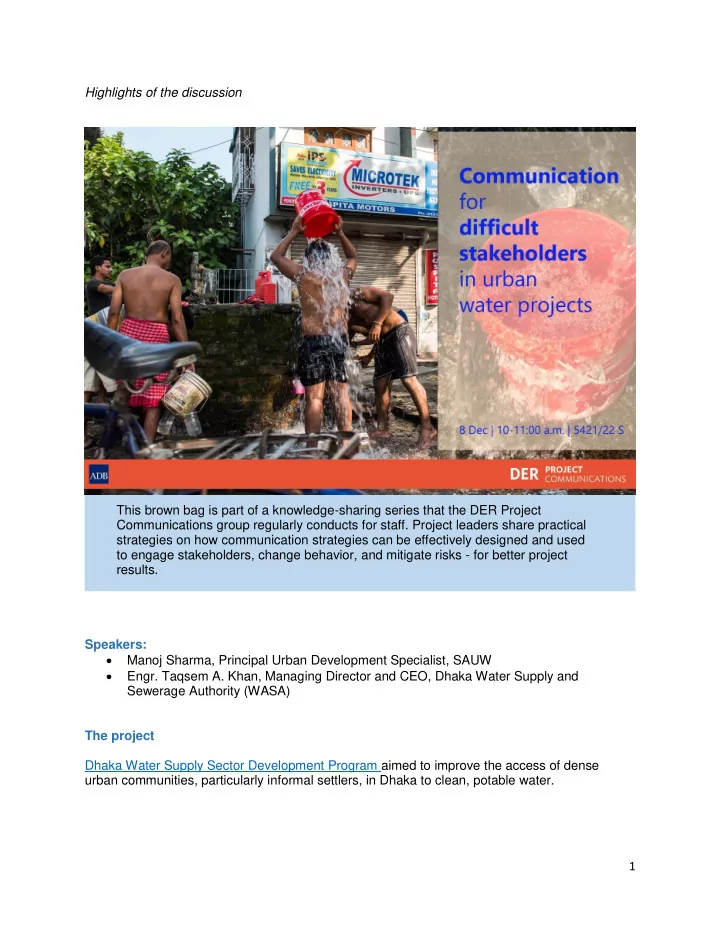
Highlights of the discussion This brown bag is part of a - - PDF document

highlights of the discussion this brown bag is part of a
SMART_READER_LITE
LIVE PREVIEW

Highlights of the discussion This brown bag is part of a - - PDF document

Highlights of the discussion This brown bag is part of a knowledge-sharing series that the DER Project Communications group regularly conducts for staff. Project leaders share practical strategies on how communication strategies can be


slide-1
SLIDE 1

1 Highlights of the discussion This brown bag is part of a knowledge-sharing series that the DER Project Communications group regularly conducts for staff. Project leaders share practical strategies on how communication strategies can be effectively designed and used to engage stakeholders, change behavior, and mitigate risks - for better project results. Speakers:

  • Manoj Sharma, Principal Urban Development Specialist, SAUW
  • Engr. Taqsem A. Khan, Managing Director and CEO, Dhaka Water Supply and

Sewerage Authority (WASA) The project Dhaka Water Supply Sector Development Program aimed to improve the access of dense urban communities, particularly informal settlers, in Dhaka to clean, potable water.

slide-2
SLIDE 2

2 Project Communications lessons

  • 1. Communications played a critical role in changing traditional mindsets of an often
  • verlooked key stakeholder -- government

Projects often focus solely on beneficiaries. Executing and implementing agencies are not often considered among the stakeholders needing help to change behavior and attitudes.

  • Many in the Dhaka government feared that providing legal water connections would

be a lost investment, anticipating slum dwellers would be delinquent bill payers and fearing water bills would legitimize their claims to public lands

  • ADB’s assistance in stakeholder mapping and analysis showed the government that:
  • Slum dwellers would have the ability to pay since they were already paying

five times more for water from intermediary “muscle men” called Mustangs who operated illegal connections. Mustangs hide the cheap, illegal pipes near drains contaminating the water supply and causing public health problems particularly for children.

  • Billing statements are usually charged to landowners and informal settlers

cannot be billed even if they were willing to pay for legal connections.

  • 2. Social mobilization and behavior change communication by local NGOs improved

payment, collection, and water conservation The project engaged NGOs to address the behavioral barriers and difficult political context that prevented slum dwellers from accessing clean water from legal connections. The NGOs formed community-based organizations (CBOs) to communicate and help implement changes through the following approaches:

  • community consultations to determine willingness for legal connections and

design payment collection schemes

  • door-to-door communication and community discussions with sectoral groups (i.e.,

mothers, teenagers, vendors, students, etc.) to convince households about the benefits of legal connections on health and personal savings

  • focus group discussions with household heads about the processes of billing and

payment, and why billing statements cannot be used to claim land ownership

  • community meetings to inform new customers where to report complaints and

grievances, leaky and faulty pipes, and what to do on their own to conserve water

  • 3. Neutralizing difficult opposing stakeholders through strong partnerships

Mustangs dominated the business to supply water through illegal connections to informal settlers in Dhaka who form 30% of the population. Having lost their livelihood when households agreed to having legal water connections and comply with the monthly payment schemes, Mustangs destroyed WASA’s newly installed water pipes disrupting water services in many areas. To neutralize these opposing forces:

  • CBOs facilitated inter-stakeholder communication through meetings in tea stalls,

video showing in public places, school awareness activities to diffuse tension and discuss why the Mustangs’ actions were harmful
slide-3
SLIDE 3

3

  • WASA partnered with the police and magistrates to ensure that Mustangs who

destroyed water pipes and other service equipment were apprehended to discourage more disruptions Results of the project communication interventions

  • Stakeholders agreed to designate CBOs to be the water account holders and

collect bill payments from assigned households.

  • Women reduced the time spent to fetching water allowing them to focus on other
  • tasks. Women were grateful that they did not have to be exposed to and transact

with the Mustangs.

  • WASA reported a bill recovery of 98%, and a non-revenue water loss of less than

10%. Child mortality also decreased significantly. DER’s Project Communications and Disclosure group provides project support and capacity building to ADB’s operational departments and staff to help project teams:

  • communicate better with project stakeholders to enrich project design and strengthen

implementation

  • promote systems, new technologies and behaviors that are crucial to project success

Templates, samples and tools for determining the extent of projects’ communication needs, identifying stakeholders and developing communication strategies are available in DER’s intranet. DER also provides direct technical support for project teams. Please contact:

  • Karen Lane | klane@adb.org | 6138
  • (Pinky) Rosalynn Madeleine Serafica | rserafica@adb.org | 1432
slide-4
SLIDE 4

Commun Communica ication tion Str Strate tegies gies to to Reac each out h out to the P to the Poor P

  • or People in

eople in Urban Urban Water ter

  • Engr. Taqsem A. Khan

Managing Director & CEO Manila, 2017

slide-5
SLIDE 5

Visi

n

slide-6
SLIDE 6
slide-7
SLIDE 7
slide-8
SLIDE 8

Traditional Mind Set

Bureaucratic complicacy

Lack of Transparency

Trade Union

Vested Interest

Challenges Challenges

slide-9
SLIDE 9

We are the masters AND the Customers are our servants

But Just Opposite

Customers are our masters AND We service providers are the servants

slide-10
SLIDE 10

Challenges…… Bureaucratic complicacy

Interference

Conflict of interest Procrastination Indecisiveness

slide-11
SLIDE 11

Challenges…… Lack of Transparency

No Corporate Structure Absence of Visionary leadership Inappropriate Organogram & hierarchy No availability of Competitive pay scale

slide-12
SLIDE 12

Challenges…… Trade Union

Long Management Approach CBA Issues

slide-13
SLIDE 13

Challenges…… Vested Interest

Insider & outsider Bureaucracy Political Contractors/Vendors Interest

slide-14
SLIDE 14
slide-15
SLIDE 15

We Target for 100% Connection

  • f

by 2018

slide-16
SLIDE 16

7 r 7 reas asons

  • ns to su
  • supp

pply ly le legal al wat ater r to

  • LI

LIC

01 01

Water is Human Right-

UN Declaration 2010

02 02

Human Survival

03 03

Revenue Potential

04 04

Muscleman

slide-17
SLIDE 17

7 re 7 reas asons

  • ns to su
  • suppl

pply y le legal al wat ater r to

  • LI

LIC

05 05 06 06 07 07

Improvement of Public Health

Child Mortality Rate Empowerment of Women

slide-18
SLIDE 18

UN Declaration - 2010

Opening Water Point for Informal Settlement Opening DTW for Informal Settlements

slide-19
SLIDE 19
slide-20
SLIDE 20
slide-21
SLIDE 21
slide-22
SLIDE 22
slide-23
SLIDE 23

Reduce Child Mortality

slide-24
SLIDE 24

Empowerment of Women

slide-25
SLIDE 25

Method to use IDA fund in LIC

Financed Development Partners or from International NGO to DWASA Financed by International NGO to LIC

Engage local NGO To implement Water Points, Caretaker training, O&M training etc. Seek Permission from DWASA To implement Water Points, Caretaker training, O&M training etc.

1 2

slide-26
SLIDE 26