HIGH BURDEN OF METABOLIC COMORBIDITIES IN A CITYWIDE COHORT OF HIV - PowerPoint PPT Presentation
HIGH BURDEN OF METABOLIC COMORBIDITIES IN A CITYWIDE COHORT OF HIV OUTPATIENTS Evolving Health Care Needs of People Aging with HIV in Washington, DC Matthew E. Levy 1 , Alan E. Greenberg 1 , Rachel Hart 2 , Lindsey Powers Happ 1 , Colleen
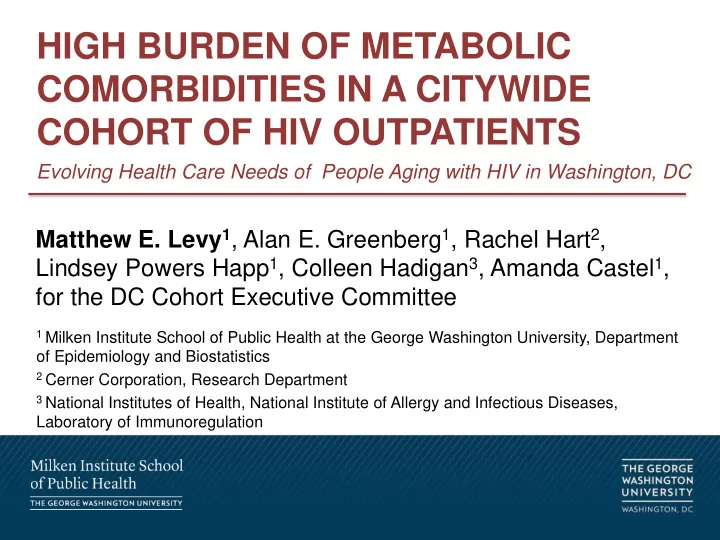
HIGH BURDEN OF METABOLIC COMORBIDITIES IN A CITYWIDE COHORT OF HIV OUTPATIENTS Evolving Health Care Needs of People Aging with HIV in Washington, DC Matthew E. Levy 1 , Alan E. Greenberg 1 , Rachel Hart 2 , Lindsey Powers Happ 1 , Colleen Hadigan 3 , Amanda Castel 1 , for the DC Cohort Executive Committee 1 Milken Institute School of Public Health at the George Washington University, Department of Epidemiology and Biostatistics 2 Cerner Corporation, Research Department 3 National Institutes of Health, National Institute of Allergy and Infectious Diseases, Laboratory of Immunoregulation
Background • 1.5-2-fold increased risk of cardiovascular disease in HIV-infected populations • Availability of population-level prevalence estimates for predisposing metabolic comorbidities will be increasingly important • Burden of metabolic risk factors is not well- characterized in older HIV-infected populations
Objectives 1. Determine prevalence of hypertension, type 2 diabetes, dyslipidemia, and obesity in a large representative sample of HIV outpatients in Washington, DC 2. Examine differences in prevalence by age, sex, and race/ethnicity 3. Assess clinical correlates of these metabolic abnormalities
Methods • Included participants from the DC Cohort study: an ongoing, prospective, multi-center, observational cohort study of HIV outpatients at 13 clinical sites in DC • Routinely monitored and abstracted data in outpatient medical record systems into central database • Conducted secondary cross-sectional analysis of participants ≥18 years old enrolled between 2011 -2015
Variable Definitions • Hypertension : (a) ICD-9, (b) antihypertensive, or (c) BP ≥ 140/90 mm Hg on ≥2 occasions • Type 2 Diabetes : (a) ICD-9, (b) anti-diabetes medication, or (c) either serum glucose ≥200 mg/ dL or HbA1c ≥6.5% on ≥2 occasions (fasting or non-fasting) • Dyslipidemia : (a) ICD-9, (b) lipid-lowering therapy, or (c) either total cholesterol ≥200 mg/ dL or HDL-C <40 mg/dL on ≥1 occasion (fasting or non-fasting) • Obesity : (a) ICD- 9 or (b) BMI ≥30 on ≥1 occasion
Patient Characteristics (n=7,018) % Age (median, IQR) 50 (39-57) Age ≥60 18% Male sex at birth 73% Non-Hispanic black 77% ARV Exposed 97% PI-based regimen 50% Smoking history (current/previous) 63% Receipt of primary care at site 74%
Overall Prevalence 60 49.8% 48.0% 45.6% 50 Prevalence (%) 35.2% 40 30 20 12.9% 10 0 Hypertension Type 2 Obesity Dyslipidemia Multimorbidity Diabetes
Prevalence by Age Group 60-69: 74.1% 100 ≥70: 86.1% 60-69: 66.0% 90 60-69: 68.1% ≥70: 77.5% ≥70: 74.2% 80 Prevalence (%) 70 60 50-59 60-69: 31.1% 50 ≥70: 23.9% 60-69: 24.4% 60-69 ≥70: 28.7% 40 70+ 30 20 10 0 Hypertension Type 2 Obesity Dyslipidemia Multimorbidity Diabetes All p<0.001
Prevalence by Sex 60 50 Prevalence (%) 40 30 Male Female 20 10 0 Hypertension Type 2 Obesity Dyslipidemia Multimorbidity Diabetes p<0.001 for all except hypertension
Prevalence by Race/Ethnicity 70 60 Non- Prevalence (%) 50 Hispanic Black 40 Non- 30 Hispanic White 20 Hispanic 10 0 Hypertension Type 2 Diabetes Obesity Dyslipidemia Multimorbidity All p<0.001
Proportions of Patients with Comorbidities Who Lacked Evidence of Treatment • Hypertension: 38% • Diabetes: 40% • Dyslipidemia (excluding HDL- dyslipidemia) : 56%
Correlates of Metabolic Comorbidities Hypertension Type 2 Diabetes Dyslipidemia Obesity OR (95% CI) OR (95% CI) OR (95% CI) OR (95% CI) Time since HIV 1.01 (1.00, 1.02) * 1.01 (1.00, 1.02) * 1.00 (1.00, 1.01) 1.00 (0.99, 1.01) diagnosis Time on PI- 1.11 (1.09, 1.14) *** 0.98 (0.96, 1.00) 1.01 (0.99, 1.04) 1.01 (0.98, 1.04) based regimen Time on NNRTI- 1.09 (1.06, 1.12) *** 0.95 (0.93, 0.98) *** 1.03 (1.01, 1.06) ** 1.01 (0.97, 1.04) based regimen Time on any 1.07 (1.04, 1.11) *** 0.95 (0.92, 0.98) ** 1.05 (1.01, 1.08) ** 1.04 (1.00, 1.08) other regimen ORs are per 1-year increase * p<0.05; ** p<0.01; *** p<0.001 * All models adjusted for age, sex at birth, race/ethnicity, HIV transmission risk category, housing status, employment status, smoking history, alcohol abuse history, recreational drug use history, whether primary care is received at the clinical site, anxiety/stress disorder, depression, hepatitis C, chronic kidney disease, hypertension, diabetes, dyslipidemia, overweight/obesity, length of time since HIV diagnosis, length of time on PI-based regimens, length of time on NNRTI-based regimens, length of time on other (non-PI-, non-NNRTI-based) regimens, most recent CD4 cell count, nadir CD4 cell count, AIDS diagnosis, and most recent viral load.
Conclusions • High prevalence of metabolic comorbidities in a contemporary cohort despite access to health care • Very high burden of certain comorbidities among older patients • Large proportions may have unmet treatment needs • Models of HIV care that more centrally incorporate primary and secondary prevention of metabolic disease may be warranted
Recommend
More recommend
Explore More Topics
Stay informed with curated content and fresh updates.