SLIDE 1
Mike Morris LIFE Moorland Project Manager
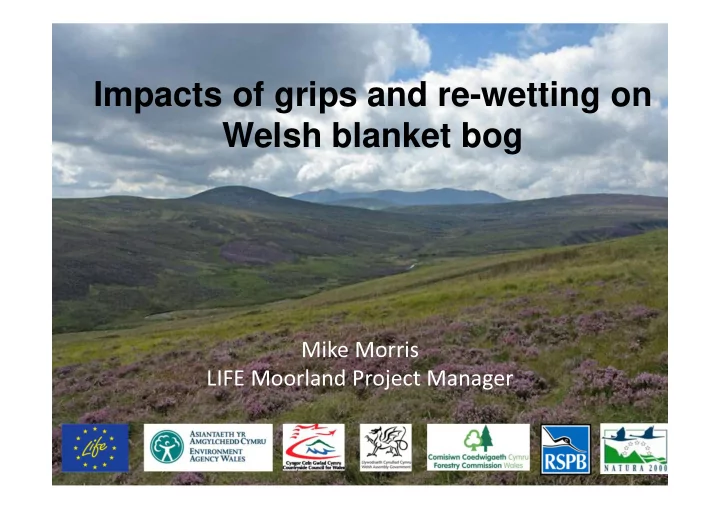
Impacts of grips and re-wetting on Welsh blanket bog
SLIDE 2 Lake Vyrnwy catchment:
- 10,000 ha
- approx. 4,800 ha blanket bog
- upland areas were drained in 1950-70s
- Special Area of Conservation (Habitats Directive)
- blanket bog in ‘unfavourable’ condition due to
drainage & historic overgrazing & burning
- Lake is water supply to Liverpool
- Upland areas are hill farmed by the Royal Society
for the Protection of Birds (low levels, April-Oct only)
The study site
Lake Vyrnwy
SLIDE 3 The project aims
- Restore damaged blanket bog to ‘favourable’ condition
–Blocking drainage ditches across a large upland catchment –Removal of self-seeding non-native species
- Structure restoration to provide experimental conditions
–4 sub-catchments, blocked sequentially 1 per winter –Longitudinal (before/after) data per sub-catchment –Experiment/Control data between sub-catchments
- Research targeted to address stakeholder concerns & project priorities.
–Recovery of vegetation? –Recovery of conditions for vegetation (higher, stable water tables)? –Effects on organic carbon release & discharge water colour? –Implications for flood risk management?
SLIDE 4
Local farming concerns – Traditional farming methods – Ground will become too wet – Stock loss in wetter areas – Increase in parasites
The study site
SLIDE 5
SLIDE 6
SLIDE 7
SLIDE 8
SLIDE 9
SLIDE 10
SLIDE 11
SLIDE 12
SLIDE 13
SLIDE 14 Open Blocked 5 10 15 20 25 Tipulid abundance
Value Std.Error DF t-value p-value (Intercept)
0.2345055 84
0.5116 blocked1 1.3077334 0.3209386 26 4.074715 0.0004
i.e. in simple blocked vs open comparison, blocked has significantly more tipulids
Invertebrate surveys
SLIDE 15
Vegetation field methods
SLIDE 16 LIFE Vegetation Monitoring
- 30 fixed transects with 10 1m2 quadrats each
- Quadrats were 50:50 on grip/non-grip areas
Within each quadrat the following was recorded:
- Species composition, abundance, height and structure measures
- Evidence of grazing/sheep presence
- Depth of peat
- Location, altitude, aspect
- Area of heather mowing
- Area of ditch blocking waste material
SLIDE 17 Summary
– Grips have not, overall, been successful in drying areas to match surrounding habitats – At individual grip scales, there is evidence of a ‘drying zone’ (key blanket bog species lower abundance within 15m of grip)
– Sheep presence was strongly linked to drier areas – Sheep largely avoid areas of drained bog – Greater grazing pressure directly adjacent to grips.
SLIDE 18 Local farming concerns
- Traditional farming methods
– Upland draining – High stocking rates – Liming – Removal of cattle/ponies
SLIDE 19 Graminoid species height lower close to drain Weak decline in Sphagnum species nearer drains
Drain impacts
SLIDE 20 Sheep presence associated with shorter vegetation and Graminoid abundance Lower C. vulgaris and other dwarf shrubs cover with sheep presence
Sheep presence
SLIDE 21 Local farming concerns
- Ground will become too wet
– Stock loss – Reduction in grazing levels – Loss of income
SLIDE 22
SLIDE 23 Drained areas have 5-33cm deeper peat Sheep presence lower in drained areas
Sheep presence
SLIDE 24 Local farming concerns
- Stock loss in wetter areas
– Stock becoming stuck – Stock loss in grips vs newly created wetter areas
SLIDE 25 30 sheep carcasses during restoration Survey: 6 months 7500m 898 individual pools 0 sheep in 2 years Dams installed
Pools profiled.
SLIDE 26
April 2007 May 2010
SLIDE 27 Local farming concerns
– Tick (Ixodes ricinus) i. April & August surveying ii. Two catchments – Liver fluke (Fasciola hepatica) i. Random surveying of bog pools
SLIDE 28 Farming response
10 20 30 40 50 60 70 80 90 Berw yn SAC Migneint SAC Number of responses Total Positive Negative Unknow n Visits
SLIDE 29 Impacts on farming
- True impacts of drains
- Stock loss
- Parasites
Nine private landowner agreements Extra 1000 ha blanket bog restoration
SLIDE 30
SLIDE 31
SLIDE 32
SLIDE 33
Acknowledgements
Thanks to Lorraine Wilson, Matthew Carroll, Joe Holden, Alona Armstrong, Jared Wilson, Ian Johnstone, Fiona Walker, Jude Lane, ECUS Ltd EU LIFE-Nature Fund and project partners (RSPB, CCW, EAW, FCW)
www.blanketbogswales.org
SLIDE 34 “If your ankles get wet, that’s a bog”, said Eeyore. “I see”, said Pooh. “Whereas”, continued Eeyore, “if you sink in up to your neck, that’s a swamp”.
AA Milne