
SLIDE 1
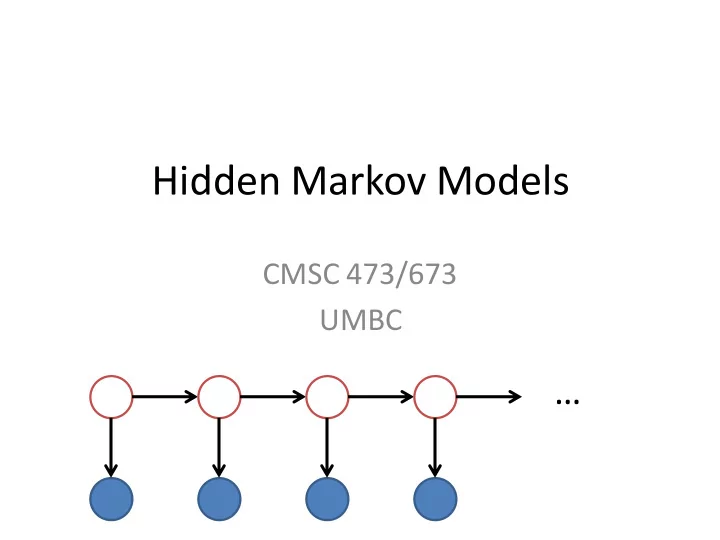
Hidden Markov Models CMSC 473/673 UMBC Recap from last time - - PowerPoint PPT Presentation
Hidden Markov Models CMSC 473/673 UMBC Recap from last time Expectation Maximization (EM) 0. Assume some value for your parameters Two step, iterative algorithm 1. E-step: count under uncertainty, assuming these parameters 2. M-step:
estimated counts
E-step: count under uncertainty, assuming these parameters
w z1 & w z2 & w z3 & w z4 & w
E-step: count under uncertainty, assuming these parameters
break into 4 disjoint pieces
a, b, e, etc. We run the code, vs. The run failed unobserved: vowel or constonant? part of speech?
Adjective Noun Verb Noun Verb Noun Prep Noun Noun Prep Noun Noun (i): (ii):
Class-based model Bigram model
Model all class sequences
Adjective Noun Verb Noun Verb Noun Prep Noun Noun Prep Noun Noun (i): (ii):
Class-based model Bigram model
Model all class sequences
Adjective Noun Verb Noun Verb Noun Prep Noun Noun Prep Noun Noun (i): (ii):
Class-based model Bigram model
Model all class sequences
Adjective Noun Verb Noun Verb Noun Prep Noun Noun Prep Noun Noun (i): (ii):
Class-based model Bigram model
Model all class sequences
1. Explain this sentence as a sequence of (likely?) latent (unseen) tags (labels) 2. Produce a tag sequence for this sentence Adjective Noun Verb Noun Verb Noun Prep Noun Noun Prep Noun Noun (i): (ii):
Class-based model Bigram model
Model all class sequences
Adapted from Luke Zettlemoyer
Nouns milk cat cats UMBC Baltimore bread speak give Verbs run Adjectives would-be wettest large happy red fake
Adapted from Luke Zettlemoyer
Nouns milk cat cats UMBC Baltimore bread speak give Verbs run Adjectives would-be wettest large happy red fake Determiners Conjunctions a the every what and
if because Prepositions in under top
Adapted from Luke Zettlemoyer
Nouns milk cat cats UMBC Baltimore bread speak give Verbs run Adjectives would-be wettest large happy red fake can do may Determiners Conjunctions a the every what and
if because Prepositions in under top
“I can eat.”
Adapted from Luke Zettlemoyer
Nouns milk cat cats UMBC Baltimore bread speak give Verbs run Adjectives would-be wettest large happy red fake can do may Determiners Conjunctions a the every what and
if because Prepositions in under top
Adapted from Luke Zettlemoyer
Nouns milk cat cats UMBC Baltimore bread speak give Verbs run Adjectives would-be wettest large happy red fake can do may Determiners Conjunctions a the every what and
if because Prepositions in under top Adverbs recently happily
Adapted from Luke Zettlemoyer
Nouns milk cat cats UMBC Baltimore bread speak give Verbs run Adjectives would-be wettest large happy red fake can do may Determiners Conjunctions a the every what and
if because Prepositions in under top Adverbs recently happily
“Today, we eat there.”
then there (location)
Adapted from Luke Zettlemoyer
Nouns milk cat cats UMBC Baltimore bread speak give Verbs run Adjectives would-be wettest large happy red fake can do may Determiners Conjunctions a the every what and
if because Prepositions in under top Adverbs recently happily
“I ate.” “There is a cat.”
then there (location) I you there
Adapted from Luke Zettlemoyer
Nouns milk cat cats UMBC Baltimore bread speak give Verbs run Adjectives would-be wettest large happy red fake can do may Determiners Conjunctions a the every what and
if because Prepositions in under top Adverbs recently happily then there (location) I you there Numbers
1,324
Closed class words Open class words
Adapted from Luke Zettlemoyer
Nouns milk cat cats UMBC Baltimore bread speak give Verbs run Adjectives would-be wettest large happy red fake can do may Determiners Conjunctions a the every what and
if because Prepositions in under top Adverbs recently happily then there (location) I you there Numbers
1,324
Adapted from Luke Zettlemoyer
Closed class words Open class words Nouns milk cat cats UMBC Baltimore bread speak give can do may Verbs Adjectives would-be wettest large happy red fake
Kamp & Partee (1995)
Adverbs recently happily then there (location)
intransitive
run
ditransitive transitive subsective non- subsective modals, auxiliaries
I you Determiners Prepositions Conjunctions
Pronouns
a the every what in under top and
if because there Numbers
1,324
Adapted from Luke Zettlemoyer
Closed class words Open class words Nouns milk cat cats UMBC Baltimore bread speak give can do may Verbs Adjectives would-be wettest large happy red fake
Kamp & Partee (1995)
Adverbs recently happily then there (location)
intransitive
run
ditransitive transitive subsective non- subsective modals, auxiliaries
I you Determiners Prepositions Conjunctions
Pronouns
a the every what in under top Particles
(set) up
so (far) not (call)
and
if because there Numbers
1,324
Adapted from Luke Zettlemoyer
Closed class words Open class words Nouns milk cat cats UMBC Baltimore bread speak give can do may Verbs Adjectives would-be wettest large happy red fake
Kamp & Partee (1995)
Adverbs recently happily then there (location)
intransitive
run
ditransitive transitive subsective non- subsective modals, auxiliaries
Numbers I you
1,324 Determiners Prepositions Conjunctions
Pronouns
and
if a the every what in under top Particles
(set) up
so (far) not (call)
Language evolves! “I’m reading this because I want to procrastinate.” → “I’m reading this because procrastination.”
https://www.theatlantic.com/technology/archive/2013/11/english-has-a-new-preposition-because-internet/281601/
because because
3SLP: Chapter 10
Adjective Noun Verb Noun Verb Noun Prep Noun Noun Prep Noun Noun (i): (ii):
Class-based model Bigram model
Model all class sequences
𝑞 𝑥𝑗|𝑨𝑗
Adjective Noun Verb Noun Verb Noun Prep Noun Noun Prep Noun Noun (i): (ii):
Class-based model Bigram model
Model all class sequences
𝑞 𝑥𝑗|𝑨𝑗 𝑞 𝑨𝑗|𝑨𝑗−1
Adjective Noun Verb Noun Verb Noun Prep Noun Noun Prep Noun Noun (i): (ii):
Class-based model Bigram model
Model all class sequences
𝑞 𝑥𝑗|𝑨𝑗 𝑞 𝑨𝑗|𝑨𝑗−1
𝑨1,..,𝑨𝑂
𝑞 𝑨1, 𝑥1, 𝑨2, 𝑥2, … , 𝑨𝑂, 𝑥𝑂
𝑞 𝑨1, 𝑥1, 𝑨2, 𝑥2, … , 𝑨𝑂, 𝑥𝑂 = 𝑞 𝑨1| 𝑨0 𝑞 𝑥1|𝑨1 ⋯ 𝑞 𝑨𝑂| 𝑨𝑂−1 𝑞 𝑥𝑂|𝑨𝑂 = ෑ
𝑗
𝑞 𝑥𝑗|𝑨𝑗 𝑞 𝑨𝑗| 𝑨𝑗−1
𝑞 𝑨1, 𝑥1, 𝑨2, 𝑥2, … , 𝑨𝑂, 𝑥𝑂 = 𝑞 𝑨1| 𝑨0 𝑞 𝑥1|𝑨1 ⋯ 𝑞 𝑨𝑂| 𝑨𝑂−1 𝑞 𝑥𝑂|𝑨𝑂 = ෑ
𝑗
𝑞 𝑥𝑗|𝑨𝑗 𝑞 𝑨𝑗| 𝑨𝑗−1
if we knew the probability parameters then we could estimate z and evaluate likelihood… but we don’t! :( if we did observe z, estimating the probability parameterswould be easy… but we don’t! :(
𝑞 𝑨1, 𝑥1, 𝑨2, 𝑥2, … , 𝑨𝑂, 𝑥𝑂 = 𝑞 𝑨1| 𝑨0 𝑞 𝑥1|𝑨1 ⋯ 𝑞 𝑨𝑂| 𝑨𝑂−1 𝑞 𝑥𝑂|𝑨𝑂 = ෑ
𝑗
𝑞 𝑥𝑗|𝑨𝑗 𝑞 𝑨𝑗| 𝑨𝑗−1
𝑞 𝑨1, 𝑥1, 𝑨2, 𝑥2, … , 𝑨𝑂, 𝑥𝑂 = 𝑞 𝑨1| 𝑨0 𝑞 𝑥1|𝑨1 ⋯ 𝑞 𝑨𝑂| 𝑨𝑂−1 𝑞 𝑥𝑂|𝑨𝑂 = ෑ
𝑗
𝑞 𝑥𝑗|𝑨𝑗 𝑞 𝑨𝑗| 𝑨𝑗−1
transition probabilities/parameters
𝑞 𝑨1, 𝑥1, 𝑨2, 𝑥2, … , 𝑨𝑂, 𝑥𝑂 = 𝑞 𝑨1| 𝑨0 𝑞 𝑥1|𝑨1 ⋯ 𝑞 𝑨𝑂| 𝑨𝑂−1 𝑞 𝑥𝑂|𝑨𝑂 = ෑ
𝑗
𝑞 𝑥𝑗|𝑨𝑗 𝑞 𝑨𝑗| 𝑨𝑗−1
emission probabilities/parameters transition probabilities/parameters
Each zi can take the value of one of K latent states Transition and emission distributions do not change
𝑞 𝑨1, 𝑥1, 𝑨2, 𝑥2, … , 𝑨𝑂, 𝑥𝑂 = 𝑞 𝑨1| 𝑨0 𝑞 𝑥1|𝑨1 ⋯ 𝑞 𝑨𝑂| 𝑨𝑂−1 𝑞 𝑥𝑂|𝑨𝑂 = ෑ
𝑗
𝑞 𝑥𝑗|𝑨𝑗 𝑞 𝑨𝑗| 𝑨𝑗−1
emission probabilities/parameters transition probabilities/parameters
Each zi can take the value of one of K latent states Transition and emission distributions do not change Q: How many different probability values are there with K states and V vocab items?
𝑞 𝑨1, 𝑥1, 𝑨2, 𝑥2, … , 𝑨𝑂, 𝑥𝑂 = 𝑞 𝑨1| 𝑨0 𝑞 𝑥1|𝑨1 ⋯ 𝑞 𝑨𝑂| 𝑨𝑂−1 𝑞 𝑥𝑂|𝑨𝑂 = ෑ
𝑗
𝑞 𝑥𝑗|𝑨𝑗 𝑞 𝑨𝑗| 𝑨𝑗−1
emission probabilities/parameters transition probabilities/parameters
Each zi can take the value of one of K latent states Transition and emission distributions do not change Q: How many different probability values are there with K states and V vocab items? A: VK emission values and K2 transition values
𝑞 𝑨1, 𝑥1, 𝑨2, 𝑥2, … , 𝑨𝑂, 𝑥𝑂 = 𝑞 𝑨1| 𝑨0 𝑞 𝑥1|𝑨1 ⋯ 𝑞 𝑨𝑂| 𝑨𝑂−1 𝑞 𝑥𝑂|𝑨𝑂 = ෑ
𝑗
𝑞 𝑥𝑗|𝑨𝑗 𝑞 𝑨𝑗| 𝑨𝑗−1
emission probabilities/parameters transition probabilities/parameters
𝑞 𝑨1, 𝑥1, 𝑨2, 𝑥2, … , 𝑨𝑂, 𝑥𝑂 = 𝑞 𝑨1| 𝑨0 𝑞 𝑥1|𝑨1 ⋯ 𝑞 𝑨𝑂| 𝑨𝑂−1 𝑞 𝑥𝑂|𝑨𝑂 = ෑ
𝑗
𝑞 𝑥𝑗|𝑨𝑗 𝑞 𝑨𝑗| 𝑨𝑗−1
emission probabilities/parameters transition probabilities/parameters
z1
w1
w2 w3 w4
z2 z3 z4
represent the probabilities and independence assumptions in a graph
𝑞 𝑨1, 𝑥1, 𝑨2, 𝑥2, … , 𝑨𝑂, 𝑥𝑂 = 𝑞 𝑨1| 𝑨0 𝑞 𝑥1|𝑨1 ⋯ 𝑞 𝑨𝑂| 𝑨𝑂−1 𝑞 𝑥𝑂|𝑨𝑂 = ෑ
𝑗
𝑞 𝑥𝑗|𝑨𝑗 𝑞 𝑨𝑗| 𝑨𝑗−1
emission probabilities/parameters transition probabilities/parameters
z1
w1
w2 w3 w4
z2 z3 z4
Graphical Models (see 478/678)
𝑞 𝑨1, 𝑥1, 𝑨2, 𝑥2, … , 𝑨𝑂, 𝑥𝑂 = 𝑞 𝑨1| 𝑨0 𝑞 𝑥1|𝑨1 ⋯ 𝑞 𝑨𝑂| 𝑨𝑂−1 𝑞 𝑥𝑂|𝑨𝑂 = ෑ
𝑗
𝑞 𝑥𝑗|𝑨𝑗 𝑞 𝑨𝑗| 𝑨𝑗−1
emission probabilities/parameters transition probabilities/parameters
z1
w1
w2 w3 w4
z2 z3 z4
𝑞 𝑥1|𝑨1 𝑞 𝑥2|𝑨2 𝑞 𝑥3|𝑨3 𝑞 𝑥4|𝑨4
𝑞 𝑨1, 𝑥1, 𝑨2, 𝑥2, … , 𝑨𝑂, 𝑥𝑂 = 𝑞 𝑨1| 𝑨0 𝑞 𝑥1|𝑨1 ⋯ 𝑞 𝑨𝑂| 𝑨𝑂−1 𝑞 𝑥𝑂|𝑨𝑂 = ෑ
𝑗
𝑞 𝑥𝑗|𝑨𝑗 𝑞 𝑨𝑗| 𝑨𝑗−1
emission probabilities/parameters transition probabilities/parameters
z1
w1
w2 w3 w4
z2 z3 z4
𝑞 𝑥1|𝑨1 𝑞 𝑥2|𝑨2 𝑞 𝑥3|𝑨3 𝑞 𝑥4|𝑨4
𝑞 𝑨2| 𝑨1 𝑞 𝑨3| 𝑨2 𝑞 𝑨4| 𝑨3
𝑞 𝑨1, 𝑥1, 𝑨2, 𝑥2, … , 𝑨𝑂, 𝑥𝑂 = 𝑞 𝑨1| 𝑨0 𝑞 𝑥1|𝑨1 ⋯ 𝑞 𝑨𝑂| 𝑨𝑂−1 𝑞 𝑥𝑂|𝑨𝑂 = ෑ
𝑗
𝑞 𝑥𝑗|𝑨𝑗 𝑞 𝑨𝑗| 𝑨𝑗−1
emission probabilities/parameters transition probabilities/parameters
z1
w1
w2 w3 w4
z2 z3 z4
𝑞 𝑥1|𝑨1 𝑞 𝑥2|𝑨2 𝑞 𝑥3|𝑨3 𝑞 𝑥4|𝑨4
𝑞 𝑨2| 𝑨1 𝑞 𝑨3| 𝑨2 𝑞 𝑨4| 𝑨3 𝑞 𝑨1| 𝑨0 initial starting distribution (“BOS”)
𝑞 𝑨1, 𝑥1, 𝑨2, 𝑥2, … , 𝑨𝑂, 𝑥𝑂 = 𝑞 𝑨1| 𝑨0 𝑞 𝑥1|𝑨1 ⋯ 𝑞 𝑨𝑂| 𝑨𝑂−1 𝑞 𝑥𝑂|𝑨𝑂 = ෑ
𝑗
𝑞 𝑥𝑗|𝑨𝑗 𝑞 𝑨𝑗| 𝑨𝑗−1
emission probabilities/parameters transition probabilities/parameters
z1
w1
w2 w3 w4
z2 z3 z4
𝑞 𝑥1|𝑨1 𝑞 𝑥2|𝑨2 𝑞 𝑥3|𝑨3 𝑞 𝑥4|𝑨4
𝑞 𝑨2| 𝑨1 𝑞 𝑨3| 𝑨2 𝑞 𝑨4| 𝑨3 𝑞 𝑨1| 𝑨0 initial starting distribution (“BOS”)
Each zi can take the value of one of K latent states Transition and emission distributions do not change
z1 = N
w1
w2 w3 w4
z2 = N z3 = N z4 = N z1 = V z2 = V z3 = V z4 = V
z1 = N
w1
w2 w3 w4
𝑞 𝑥1|𝑂 𝑞 𝑥2|𝑂 𝑞 𝑥3|𝑂 𝑞 𝑥4|𝑂
z2 = N z3 = N z4 = N z1 = V z2 = V z4 = V
𝑞 𝑥4|𝑊 𝑞 𝑥3|𝑊 𝑞 𝑥2|𝑊 𝑞 𝑥1|𝑊
z3 = V
z1 = N
w1
w2 w3 w4
𝑞 𝑥1|𝑂 𝑞 𝑥2|𝑂 𝑞 𝑥3|𝑂 𝑞 𝑥4|𝑂
𝑞 𝑂| start z2 = N z3 = N z4 = N z1 = V z2 = V z3 = V z4 = V 𝑞 𝑊| 𝑊 𝑞 𝑊| 𝑊 𝑞 𝑊| 𝑊 𝑞 𝑊| start
𝑞 𝑥4|𝑊 𝑞 𝑥3|𝑊 𝑞 𝑥2|𝑊 𝑞 𝑥1|𝑊
𝑞 𝑂| 𝑂 𝑞 𝑂| 𝑂 𝑞 𝑂| 𝑂
z1 = N
w1
w2 w3 w4
𝑞 𝑥1|𝑂 𝑞 𝑥2|𝑂 𝑞 𝑥3|𝑂 𝑞 𝑥4|𝑂
𝑞 𝑂| start z2 = N z3 = N z4 = N z1 = V z2 = V z3 = V z4 = V 𝑞 𝑊| 𝑊 𝑞 𝑊| 𝑊 𝑞 𝑊| 𝑊 𝑞 𝑊| start
𝑞 𝑊| 𝑂 𝑞 𝑊| 𝑂 𝑞 𝑊| 𝑂 𝑞 𝑂| 𝑊 𝑞 𝑂| 𝑊 𝑞 𝑂| 𝑊
𝑞 𝑥4|𝑊 𝑞 𝑥3|𝑊 𝑞 𝑥2|𝑊 𝑞 𝑥1|𝑊
𝑞 𝑂| 𝑂 𝑞 𝑂| 𝑂 𝑞 𝑂| 𝑂
Unigram Language Model
𝑞 𝑥1, 𝑥2, … , 𝑥𝑂 = 𝑞 𝑥1 𝑞 𝑥2 ⋯ 𝑞 𝑥𝑂 = ෑ
𝑗
𝑞 𝑥𝑗
Unigram Class-based Language Model (“K” coins) Unigram Language Model
𝑞 𝑥1, 𝑥2, … , 𝑥𝑂 = 𝑞 𝑥1 𝑞 𝑥2 ⋯ 𝑞 𝑥𝑂 = ෑ
𝑗
𝑞 𝑥𝑗 𝑞 𝑨1, 𝑥1, 𝑨2, 𝑥2, … ,𝑨𝑂, 𝑥𝑂 = 𝑞 𝑨1 𝑞 𝑥1|𝑨1 ⋯ 𝑞 𝑨𝑂 𝑞 𝑥𝑂|𝑨𝑂 = ෑ
𝑗
𝑞 𝑥𝑗|𝑨𝑗 𝑞 𝑨𝑗
Hidden Markov Model Unigram Class-based Language Model (“K” coins) Unigram Language Model
𝑞 𝑥1, 𝑥2, … , 𝑥𝑂 = 𝑞 𝑥1 𝑞 𝑥2 ⋯ 𝑞 𝑥𝑂 = ෑ
𝑗
𝑞 𝑥𝑗 𝑞 𝑨1, 𝑥1, 𝑨2, 𝑥2, … ,𝑨𝑂, 𝑥𝑂 = 𝑞 𝑨1 𝑞 𝑥1|𝑨1 ⋯ 𝑞 𝑨𝑂 𝑞 𝑥𝑂|𝑨𝑂 = ෑ
𝑗
𝑞 𝑥𝑗|𝑨𝑗 𝑞 𝑨𝑗 𝑞 𝑨1, 𝑥1, 𝑨2, 𝑥2, … , 𝑨𝑂, 𝑥𝑂 = 𝑞 𝑨1| 𝑨0 𝑞 𝑥1|𝑨1 ⋯ 𝑞 𝑨𝑂| 𝑨𝑂−1 𝑞 𝑥𝑂|𝑨𝑂 = ෑ
𝑗
𝑞 𝑥𝑗|𝑨𝑗 𝑞 𝑨𝑗| 𝑨𝑗−1
z1 = N
w1 w2 w3 w4
𝑞 𝑥1|𝑂 𝑞 𝑥3|𝑂 𝑞 𝑥4|𝑂
𝑞 𝑂| start z2 = N z3 = N z4 = N z1 = V z2 = V z3 = V z4 = V 𝑞 𝑊| 𝑂 𝑞 𝑂| 𝑊
𝑞 𝑥2|𝑊
𝑞 𝑂| 𝑂 z1 = N
w1 w2 w3 w4
𝑞 𝑥1|𝑂 𝑞 𝑥4|𝑂
𝑞 𝑂| start z2 = N z3 = N z4 = N z1 = V z2 = V z3 = V z4 = V 𝑞 𝑊| 𝑊 𝑞 𝑊| 𝑂 𝑞 𝑂| 𝑊
𝑞 𝑥3|𝑊 𝑞 𝑥2|𝑊 N V end start N V w1 w2 W3 w4 N V Transition Counts Emission Counts
end emission not shown
z1 = N
w1 w2 w3 w4
𝑞 𝑥1|𝑂 𝑞 𝑥3|𝑂 𝑞 𝑥4|𝑂
𝑞 𝑂| start z2 = N z3 = N z4 = N z1 = V z2 = V z3 = V z4 = V 𝑞 𝑊| 𝑂 𝑞 𝑂| 𝑊
𝑞 𝑥2|𝑊
𝑞 𝑂| 𝑂 z1 = N
w1 w2 w3 w4
𝑞 𝑥1|𝑂 𝑞 𝑥4|𝑂
𝑞 𝑂| start z2 = N z3 = N z4 = N z1 = V z2 = V z3 = V z4 = V 𝑞 𝑊| 𝑊 𝑞 𝑊| 𝑂 𝑞 𝑂| 𝑊
𝑞 𝑥3|𝑊 𝑞 𝑥2|𝑊 N V end start 2 N 1 2 2 V 2 1 w1 w2 W3 w4 N 2 1 2 V 2 1 Transition Counts Emission Counts
end emission not shown
z1 = N
w1 w2 w3 w4
𝑞 𝑥1|𝑂 𝑞 𝑥3|𝑂 𝑞 𝑥4|𝑂
𝑞 𝑂| start z2 = N z3 = N z4 = N z1 = V z2 = V z3 = V z4 = V 𝑞 𝑊| 𝑂 𝑞 𝑂| 𝑊
𝑞 𝑥2|𝑊
𝑞 𝑂| 𝑂 z1 = N
w1 w2 w3 w4
𝑞 𝑥1|𝑂 𝑞 𝑥4|𝑂
𝑞 𝑂| start z2 = N z3 = N z4 = N z1 = V z2 = V z3 = V z4 = V 𝑞 𝑊| 𝑊 𝑞 𝑊| 𝑂 𝑞 𝑂| 𝑊
𝑞 𝑥3|𝑊 𝑞 𝑥2|𝑊 N V end start 1 N .2 .4 .4 V 2/3 1/3 w1 w2 W3 w4 N .4 .2 .4 V 2/3 1/3 Transition MLE Emission MLE
end emission not shown
z1 = N
w1 w2 w3 w4
𝑞 𝑥1|𝑂 𝑞 𝑥3|𝑂 𝑞 𝑥4|𝑂
𝑞 𝑂| start z2 = N z3 = N z4 = N z1 = V z2 = V z3 = V z4 = V 𝑞 𝑊| 𝑂 𝑞 𝑂| 𝑊
𝑞 𝑥2|𝑊
𝑞 𝑂| 𝑂 z1 = N
w1 w2 w3 w4
𝑞 𝑥1|𝑂 𝑞 𝑥4|𝑂
𝑞 𝑂| start z2 = N z3 = N z4 = N z1 = V z2 = V z3 = V z4 = V 𝑞 𝑊| 𝑊 𝑞 𝑊| 𝑂 𝑞 𝑂| 𝑊
𝑞 𝑥3|𝑊 𝑞 𝑥2|𝑊 N V end start 1 N .2 .4 .4 V 2/3 1/3 w1 w2 W3 w4 N .4 .2 .4 V 2/3 1/3 Transition MLE Emission MLE
end emission not shown
smooth these values if needed
Calculate the (log) likelihood of an observed sequence w1, …, wN Calculate the most likely sequence of states (for an
𝑞 𝑨1, 𝑥1, 𝑨2, 𝑥2, … , 𝑨𝑂, 𝑥𝑂 = 𝑞 𝑨1| 𝑨0 𝑞 𝑥1|𝑨1 ⋯ 𝑞 𝑨𝑂| 𝑨𝑂−1 𝑞 𝑥𝑂|𝑨𝑂 = ෑ
𝑗
𝑞 𝑥𝑗|𝑨𝑗 𝑞 𝑨𝑗| 𝑨𝑗−1
emission probabilities/parameters transition probabilities/parameters
Calculate the (log) likelihood of an observed sequence w1, …, wN Calculate the most likely sequence of states (for an
𝑞 𝑨1, 𝑥1, 𝑨2, 𝑥2, … , 𝑨𝑂, 𝑥𝑂 = 𝑞 𝑨1| 𝑨0 𝑞 𝑥1|𝑨1 ⋯ 𝑞 𝑨𝑂| 𝑨𝑂−1 𝑞 𝑥𝑂|𝑨𝑂 = ෑ
𝑗
𝑞 𝑥𝑗|𝑨𝑗 𝑞 𝑨𝑗| 𝑨𝑗−1
emission probabilities/parameters transition probabilities/parameters
𝑞 𝑥1, 𝑥2, … , 𝑥𝑂 =
𝑨1,⋯,𝑨𝑂
𝑞 𝑨1, 𝑥1, 𝑨2, 𝑥2, … , 𝑨𝑂, 𝑥𝑂
Q: In a K-state HMM for a length N observation sequence, how many summands (different latent sequences) are there?
𝑞 𝑥1, 𝑥2, … , 𝑥𝑂 =
𝑨1,⋯,𝑨𝑂
𝑞 𝑨1, 𝑥1, 𝑨2, 𝑥2, … , 𝑨𝑂, 𝑥𝑂
Q: In a K-state HMM for a length N observation sequence, how many summands (different latent sequences) are there? A: KN
𝑞 𝑥1, 𝑥2, … , 𝑥𝑂 =
𝑨1,⋯,𝑨𝑂
𝑞 𝑨1, 𝑥1, 𝑨2, 𝑥2, … , 𝑨𝑂, 𝑥𝑂
Q: In a K-state HMM for a length N observation sequence, how many summands (different latent sequences) are there? A: KN Goal: Find a way to compute this exponential sum efficiently (in polynomial time)
𝑞 𝑥1, 𝑥2, … , 𝑥𝑂 =
𝑨1,⋯,𝑨𝑂
𝑞 𝑨1, 𝑥1, 𝑨2, 𝑥2, … , 𝑨𝑂, 𝑥𝑂
Q: In a K-state HMM for a length N observation sequence, how many summands (different latent sequences) are there? A: KN Goal: Find a way to compute this exponential sum efficiently (in polynomial time) Like in language modeling, you need to model when to stop generating. This ending state is generally not included in “K.”
z1 = N
w1
w2 w3 w4
𝑞 𝑥1|𝑂 𝑞 𝑥2|𝑂 𝑞 𝑥3|𝑂 𝑞 𝑥4|𝑂
𝑞 𝑂| start z2 = N z3 = N z4 = N z1 = V z2 = V z3 = V z4 = V 𝑞 𝑊| 𝑊 𝑞 𝑊| 𝑊 𝑞 𝑊| 𝑊 𝑞 𝑊| start
𝑞 𝑊| 𝑂 𝑞 𝑊| 𝑂 𝑞 𝑊| 𝑂 𝑞 𝑂| 𝑊 𝑞 𝑂| 𝑊 𝑞 𝑂| 𝑊
𝑞 𝑥4|𝑊 𝑞 𝑥3|𝑊 𝑞 𝑥2|𝑊 𝑞 𝑥1|𝑊
𝑞 𝑂| 𝑂 𝑞 𝑂| 𝑂 𝑞 𝑂| 𝑂
Q: What are the latent sequences here (EOS excluded)?
z1 = N
w1
w2 w3 w4
𝑞 𝑥1|𝑂 𝑞 𝑥2|𝑂 𝑞 𝑥3|𝑂 𝑞 𝑥4|𝑂
𝑞 𝑂| start z2 = N z3 = N z4 = N z1 = V z2 = V z3 = V z4 = V 𝑞 𝑊| 𝑊 𝑞 𝑊| 𝑊 𝑞 𝑊| 𝑊 𝑞 𝑊| start
𝑞 𝑊| 𝑂 𝑞 𝑊| 𝑂 𝑞 𝑊| 𝑂 𝑞 𝑂| 𝑊 𝑞 𝑂| 𝑊 𝑞 𝑂| 𝑊
𝑞 𝑥4|𝑊 𝑞 𝑥3|𝑊 𝑞 𝑥2|𝑊 𝑞 𝑥1|𝑊
𝑞 𝑂| 𝑂 𝑞 𝑂| 𝑂 𝑞 𝑂| 𝑂
(N, w1), (N, w2), (N, w3), (N, w4) (N, w1), (N, w2), (N, w3), (V, w4) (N, w1), (N, w2), (V, w3), (N, w4) (N, w1), (N, w2), (V, w3), (V, w4) A: (N, w1), (V, w2), (N, w3), (N, w4) (N, w1), (V, w2), (N, w3), (V, w4) (N, w1), (V, w2), (V, w3), (N, w4) (N, w1), (V, w2), (V, w3), (V, w4) (V, w1), (N, w2), (N, w3), (N, w4) (V, w1), (N, w2), (N, w3), (V, w4) … (six more) Q: What are the latent sequences here (EOS excluded)?
z1 = N
w1
w2 w3 w4
𝑞 𝑥1|𝑂 𝑞 𝑥2|𝑂 𝑞 𝑥3|𝑂 𝑞 𝑥4|𝑂
𝑞 𝑂| start z2 = N z3 = N z4 = N z1 = V z2 = V z3 = V z4 = V 𝑞 𝑊| 𝑊 𝑞 𝑊| 𝑊 𝑞 𝑊| 𝑊 𝑞 𝑊| start
𝑞 𝑊| 𝑂 𝑞 𝑊| 𝑂 𝑞 𝑊| 𝑂 𝑞 𝑂| 𝑊 𝑞 𝑂| 𝑊 𝑞 𝑂| 𝑊
𝑞 𝑥4|𝑊 𝑞 𝑥3|𝑊 𝑞 𝑥2|𝑊 𝑞 𝑥1|𝑊
𝑞 𝑂| 𝑂 𝑞 𝑂| 𝑂 𝑞 𝑂| 𝑂
(N, w1), (N, w2), (N, w3), (N, w4) (N, w1), (N, w2), (N, w3), (V, w4) (N, w1), (N, w2), (V, w3), (N, w4) (N, w1), (N, w2), (V, w3), (V, w4) A: (N, w1), (V, w2), (N, w3), (N, w4) (N, w1), (V, w2), (N, w3), (V, w4) (N, w1), (V, w2), (V, w3), (N, w4) (N, w1), (V, w2), (V, w3), (V, w4) (V, w1), (N, w2), (N, w3), (N, w4) (V, w1), (N, w2), (N, w3), (V, w4) … (six more) Q: What are the latent sequences here (EOS excluded)?
z1 = N
w1
w2 w3 w4
𝑞 𝑥1|𝑂 𝑞 𝑥2|𝑂 𝑞 𝑥3|𝑂 𝑞 𝑥4|𝑂
𝑞 𝑂| start z2 = N z3 = N z4 = N z1 = V z2 = V z3 = V z4 = V 𝑞 𝑊| 𝑊 𝑞 𝑊| 𝑊 𝑞 𝑊| 𝑊 𝑞 𝑊| start
𝑞 𝑊| 𝑂 𝑞 𝑊| 𝑂 𝑞 𝑊| 𝑂 𝑞 𝑂| 𝑊 𝑞 𝑂| 𝑊 𝑞 𝑂| 𝑊
𝑞 𝑥4|𝑊 𝑞 𝑥3|𝑊 𝑞 𝑥2|𝑊 𝑞 𝑥1|𝑊
𝑞 𝑂| 𝑂 𝑞 𝑂| 𝑂 𝑞 𝑂| 𝑂
N V end start .7 .2 .1 N .15 .8 .05 V .6 .35 .05 w1 w2 w3 w4 N .7 .2 .05 .05 V .2 .6 .1 .1
z1 = N
w1
w2 w3 w4
𝑞 𝑥1|𝑂 𝑞 𝑥2|𝑂 𝑞 𝑥3|𝑂 𝑞 𝑥4|𝑂
𝑞 𝑂| start z2 = N z3 = N z4 = N z1 = V z2 = V z3 = V z4 = V 𝑞 𝑊| 𝑊 𝑞 𝑊| 𝑊 𝑞 𝑊| 𝑊 𝑞 𝑊| start
𝑞 𝑊| 𝑂 𝑞 𝑊| 𝑂 𝑞 𝑊| 𝑂 𝑞 𝑂| 𝑊 𝑞 𝑂| 𝑊 𝑞 𝑂| 𝑊
𝑞 𝑥4|𝑊 𝑞 𝑥3|𝑊 𝑞 𝑥2|𝑊 𝑞 𝑥1|𝑊
𝑞 𝑂| 𝑂 𝑞 𝑂| 𝑂 𝑞 𝑂| 𝑂
Q: What’s the probability of (N, w1), (V, w2), (V, w3), (N, w4)? N V end start .7 .2 .1 N .15 .8 .05 V .6 .35 .05 w1 w2 w3 w4 N .7 .2 .05 .05 V .2 .6 .1 .1
z1 = N
w1 w2 w3 w4
𝑞 𝑥1|𝑂 𝑞 𝑥4|𝑂
𝑞 𝑂| start z2 = N z3 = N z4 = N z1 = V z2 = V z3 = V z4 = V 𝑞 𝑊| 𝑊 𝑞 𝑊| 𝑂 𝑞 𝑂| 𝑊
𝑞 𝑥3|𝑊 𝑞 𝑥2|𝑊 Q: What’s the probability of (N, w1), (V, w2), (V, w3), (N, w4)? A: (.7*.7) * (.8*.6) * (.35*.1) * (.6*.05) = 0.0002822 N V end start .7 .2 .1 N .15 .8 .05 V .6 .35 .05 w1 w2 w3 w4 N .7 .2 .05 .05 V .2 .6 .1 .1
z1 = N
w1 w2 w3 w4
𝑞 𝑥1|𝑂 𝑞 𝑥4|𝑂
𝑞 𝑂| start z2 = N z3 = N z4 = N z1 = V z2 = V z3 = V z4 = V 𝑞 𝑊| 𝑊 𝑞 𝑊| 𝑂 𝑞 𝑂| 𝑊
𝑞 𝑥3|𝑊 𝑞 𝑥2|𝑊 Q: What’s the probability of (N, w1), (V, w2), (V, w3), (N, w4) with ending included (unique ending symbol “#”)? A: (.7*.7) * (.8*.6) * (.35*.1) * (.6*.05) * (.05 * 1) = 0.00001235 N V end start .7 .2 .1 N .15 .8 .05 V .6 .35 .05 w1 w2 w3 w4
#
N .7 .2 .05 .05 V .2 .6 .1 .1
end
1
z1 = N
w1
w2 w3 w4
𝑞 𝑥1|𝑂 𝑞 𝑥2|𝑂 𝑞 𝑥3|𝑂 𝑞 𝑥4|𝑂
𝑞 𝑂| start z2 = N z3 = N z4 = N z1 = V z2 = V z3 = V z4 = V 𝑞 𝑊| 𝑊 𝑞 𝑊| 𝑊 𝑞 𝑊| 𝑊 𝑞 𝑊| start
𝑞 𝑊| 𝑂 𝑞 𝑊| 𝑂 𝑞 𝑊| 𝑂 𝑞 𝑂| 𝑊 𝑞 𝑂| 𝑊 𝑞 𝑂| 𝑊
𝑞 𝑥4|𝑊 𝑞 𝑥3|𝑊 𝑞 𝑥2|𝑊 𝑞 𝑥1|𝑊
𝑞 𝑂| 𝑂 𝑞 𝑂| 𝑂 𝑞 𝑂| 𝑂
Q: What’s the probability of (N, w1), (V, w2), (N, w3), (N, w4)? N V end start .7 .2 .1 N .15 .8 .05 V .6 .35 .05 w1 w2 w3 w4 N .7 .2 .05 .05 V .2 .6 .1 .1
z1 = N
w1 w2 w3 w4
𝑞 𝑥1|𝑂 𝑞 𝑥3|𝑂 𝑞 𝑥4|𝑂
𝑞 𝑂| start z2 = N z3 = N z4 = N z1 = V z2 = V z3 = V z4 = V 𝑞 𝑊| 𝑂 𝑞 𝑂| 𝑊
𝑞 𝑥2|𝑊
𝑞 𝑂| 𝑂
Q: What’s the probability of (N, w1), (V, w2), (N, w3), (N, w4)? A: (.7*.7) * (.8*.6) * (.6*.05) * (.15*.05) = 0.00007056 N V end start .7 .2 .1 N .15 .8 .05 V .6 .35 .05 w1 w2 w3 w4 N .7 .2 .05 .05 V .2 .6 .1 .1
z1 = N
w1 w2 w3 w4
𝑞 𝑥1|𝑂 𝑞 𝑥3|𝑂 𝑞 𝑥4|𝑂
𝑞 𝑂| start z2 = N z3 = N z4 = N z1 = V z2 = V z3 = V z4 = V 𝑞 𝑊| 𝑂 𝑞 𝑂| 𝑊
𝑞 𝑥2|𝑊
𝑞 𝑂| 𝑂
Q: What’s the probability of (N, w1), (V, w2), (N, w3), (N, w4) with ending (unique symbol “#”)? A: (.7*.7) * (.8*.6) * (.6*.05) * (.15*.05) * (.05 * 1) = 0.000002646 N V end start .7 .2 .1 N .15 .8 .05 V .6 .35 .05 w1 w2 w3 w4
#
N .7 .2 .05 .05 V .2 .6 .1 .1
end
1
z1 = N
w1 w2 w3 w4
𝑞 𝑥1|𝑂 𝑞 𝑥3|𝑂 𝑞 𝑥4|𝑂
𝑞 𝑂| start z2 = N z3 = N z4 = N z1 = V z2 = V z3 = V z4 = V 𝑞 𝑊| 𝑂 𝑞 𝑂| 𝑊
𝑞 𝑥2|𝑊
𝑞 𝑂| 𝑂 z1 = N
w1 w2 w3 w4
𝑞 𝑥1|𝑂 𝑞 𝑥4|𝑂
𝑞 𝑂| start z2 = N z3 = N z4 = N z1 = V z2 = V z3 = V z4 = V 𝑞 𝑊| 𝑊 𝑞 𝑊| 𝑂 𝑞 𝑂| 𝑊
𝑞 𝑥3|𝑊 𝑞 𝑥2|𝑊
z1 = N
w1 w2 w3 w4
𝑞 𝑥1|𝑂 𝑞 𝑥3|𝑂 𝑞 𝑥4|𝑂
𝑞 𝑂| start z2 = N z3 = N z4 = N z1 = V z2 = V z3 = V z4 = V 𝑞 𝑊| 𝑂 𝑞 𝑂| 𝑊
𝑞 𝑥2|𝑊
𝑞 𝑂| 𝑂 z1 = N
w1 w2 w3 w4
𝑞 𝑥1|𝑂 𝑞 𝑥4|𝑂
𝑞 𝑂| start z2 = N z3 = N z4 = N z1 = V z2 = V z3 = V z4 = V 𝑞 𝑊| 𝑊 𝑞 𝑊| 𝑂 𝑞 𝑂| 𝑊
𝑞 𝑥3|𝑊 𝑞 𝑥2|𝑊 Up until here, all the computation was the same Let’s reuse what computations we can
z1 = N
w1 w2 w3 w4
𝑞 𝑥1|𝑂 𝑞 𝑥3|𝑂 𝑞 𝑥4|𝑂
𝑞 𝑂| start z2 = N z3 = N z4 = N z1 = V z2 = V z3 = V z4 = V 𝑞 𝑊| 𝑂 𝑞 𝑂| 𝑊
𝑞 𝑥2|𝑊
𝑞 𝑂| 𝑂 z1 = N
w1 w2 w3 w4
𝑞 𝑥1|𝑂 𝑞 𝑥4|𝑂
𝑞 𝑂| start z2 = N z3 = N z4 = N z1 = V z2 = V z3 = V z4 = V 𝑞 𝑊| 𝑊 𝑞 𝑊| 𝑂 𝑞 𝑂| 𝑊
𝑞 𝑥3|𝑊 𝑞 𝑥2|𝑊 Solution: pass information "forward" in the graph, e.g., from timestep 2 to 3...
z1 = N
w1 w2 w3 w4
𝑞 𝑥1|𝑂 𝑞 𝑥3|𝑂 𝑞 𝑥4|𝑂
𝑞 𝑂| start z2 = N z3 = N z4 = N z1 = V z2 = V z3 = V z4 = V 𝑞 𝑊| 𝑂 𝑞 𝑂| 𝑊
𝑞 𝑥2|𝑊
𝑞 𝑂| 𝑂 z1 = N
w1 w2 w3 w4
𝑞 𝑥1|𝑂 𝑞 𝑥4|𝑂
𝑞 𝑂| start z2 = N z3 = N z4 = N z1 = V z2 = V z3 = V z4 = V 𝑞 𝑊| 𝑊 𝑞 𝑊| 𝑂 𝑞 𝑂| 𝑊
𝑞 𝑥3|𝑊 𝑞 𝑥2|𝑊 Issue: these are only two of the 16 paths through the trellis Solution: pass information "forward" in the graph, e.g., from timestep 2 to 3...
z1 = N
w1 w2 w3 w4
𝑞 𝑥1|𝑂 𝑞 𝑥3|𝑂 𝑞 𝑥4|𝑂
𝑞 𝑂| start z2 = N z3 = N z4 = N z1 = V z2 = V z3 = V z4 = V 𝑞 𝑊| 𝑂 𝑞 𝑂| 𝑊
𝑞 𝑥2|𝑊
𝑞 𝑂| 𝑂 z1 = N
w1 w2 w3 w4
𝑞 𝑥1|𝑂 𝑞 𝑥4|𝑂
𝑞 𝑂| start z2 = N z3 = N z4 = N z1 = V z2 = V z3 = V z4 = V 𝑞 𝑊| 𝑊 𝑞 𝑊| 𝑂 𝑞 𝑂| 𝑊
𝑞 𝑥3|𝑊 𝑞 𝑥2|𝑊 Issue: these are only two of the 16 paths through the trellis Solution: pass information "forward" in the graph, e.g., from timestep 2 to 3... Solution: … marginalize (sum)
previous timesteps (0 & 1)
zi-1 = C zi-1 = B zi-1 = A zi = C zi = B zi = A
let’s first consider “any shared path ending with B (AB, BB, or CB)→ B” assume any necessary information has been properly computed and stored along these paths: α(i-1, A), α(i-1, B), α(i-1, C)
zi-2 = C zi-2 = B zi-2 = A
α(i-1, C) α(i-1, B) α(i-1, A)
let’s first consider “any shared path ending with B (AB, BB, or CB)→ B” marginalize across the previous hidden state values, α(i-1, A), α(i-1, B), α(i-1, C)
zi-1 = C zi-1 = B zi-1 = A zi = C zi = B zi = A zi-2 = C zi-2 = B zi-2 = A
α(i-1, C) α(i-1, B) α(i-1, A)
let’s first consider “any shared path ending with B (AB, BB, or CB)→ B” marginalize across the previous hidden state values, α(i-1, A), α(i-1, B), α(i-1, C) 𝛽 𝑗, 𝐶 =
𝑡
𝛽 𝑗 − 1, 𝑡 ∗ 𝑞 𝐶 𝑡) ∗ 𝑞(obs at 𝑗 | 𝐶)
zi-1 = C zi-1 = B zi-1 = A zi = C zi = B zi = A zi-2 = C zi-2 = B zi-2 = A
α(i-1, C) α(i-1, B) α(i-1, A) α(i, B)
let’s first consider “any shared path ending with B (AB, BB, or CB)→ B” marginalize across the previous hidden state values 𝛽 𝑗, 𝐶 =
𝑡
𝛽 𝑗 − 1, 𝑡 ∗ 𝑞 𝐶 𝑡) ∗ 𝑞(obs at 𝑗 | 𝐶) computing α at time i-1 will correctly incorporate paths through time i-2: we correctly obey the Markov property
zi-1 = C zi-1 = B zi-1 = A zi = C zi = B zi = A zi-2 = C zi-2 = B zi-2 = A
α(i-1, C) α(i-1, B) α(i-1, A) α(i, B)
let’s first consider “any shared path ending with B (AB, BB, or CB)→ B” marginalize across the previous hidden state values 𝛽 𝑗, 𝐶 =
𝑡′
𝛽 𝑗 − 1, 𝑡′ ∗ 𝑞 𝐶 𝑡′) ∗ 𝑞(obs at 𝑗 | 𝐶) computing α at time i-1 will correctly incorporate paths through time i-2: we correctly obey the Markov property α(i, B) is the total probability of all paths to that state B from the beginning
zi-1 = C zi-1 = B zi-1 = A zi = C zi = B zi = A zi-2 = C zi-2 = B zi-2 = A
how likely is it to get into state s this way? what are the immediate ways to get into state s? what’s the total probability up until now?
2 (3) -State HMM Likelihood with Forward Probabilities
w3 w4
𝑞 𝑥3|𝑂 𝑞 𝑥4|𝑂
z3 = N z4 = N z3 = V z4 = V 𝑞 𝑂| 𝑂 z1 = N
w1 w2 w3 w4
𝑞 𝑥1|𝑂 𝑞 𝑥4|𝑂
𝑞 𝑂| start z2 = N z3 = N z4 = N z1 = V z2 = V z3 = V z4 = V 𝑞 𝑊| 𝑊 𝑞 𝑊| 𝑂 𝑞 𝑂| 𝑊
𝑞 𝑥3|𝑊 𝑞 𝑥2|𝑊
𝑞 𝑂| 𝑊
α[1, N] = (.7*.7) α[2, V] = α[1, N] * (.8*.6) + α[1, V] * (.35*.6)
N V end start .7 .2 .1 N .15 .8 .05 V .6 .35 .05 w1 w2 w3 w4 N .7 .2 .05 .05 V .2 .6 .1 .1
𝑞 𝑊| start
α[3, V] = α[2, V] * (.35*.1)+ α[2, N] * (.8*.1) α[3, N] = α[2, V] * (.6*.05) + α[2, N] * (.15*.05)
2 (3) -State HMM Likelihood with Forward Probabilities
w3 w4
𝑞 𝑥3|𝑂 𝑞 𝑥4|𝑂
z3 = N z4 = N z3 = V z4 = V 𝑞 𝑂| 𝑂 z1 = N
w1 w2 w3 w4
𝑞 𝑥1|𝑂 𝑞 𝑥4|𝑂
𝑞 𝑂| start z2 = N z3 = N z4 = N z1 = V z2 = V z3 = V z4 = V 𝑞 𝑊| 𝑊 𝑞 𝑊| 𝑂 𝑞 𝑂| 𝑊
𝑞 𝑥3|𝑊 𝑞 𝑥2|𝑊
𝑞 𝑂| 𝑊
α[1, N] = (.7*.7) α[2, V] = α[1, N] * (.8*.6) + α[1, V] * (.35*.6) α[3, V] = α[2, V] * (.35*.1)+ α[2, N] * (.8*.1) α[3, N] = α[2, V] * (.6*.05) + α[2, N] * (.15*.05)
N V end start .7 .2 .1 N .15 .8 .05 V .6 .35 .05 w1 w2 w3 w4 N .7 .2 .05 .05 V .2 .6 .1 .1
𝑞 𝑊| start
α[1, V] = (.2*.2)
2 (3) -State HMM Likelihood with Forward Probabilities
w3 w4
𝑞 𝑥3|𝑂 𝑞 𝑥4|𝑂
z3 = N z4 = N z3 = V z4 = V 𝑞 𝑂| 𝑂 z1 = N
w1 w2 w3 w4
𝑞 𝑥1|𝑂 𝑞 𝑥4|𝑂
𝑞 𝑂| start z2 = N z3 = N z4 = N z1 = V z2 = V z3 = V z4 = V 𝑞 𝑊| 𝑊 𝑞 𝑊| 𝑂 𝑞 𝑂| 𝑊
𝑞 𝑥3|𝑊 𝑞 𝑥2|𝑊
𝑞 𝑂| 𝑊
α[1, N] = (.7*.7) = .49 α[2, V] = α[1, N] * (.8*.6) + α[1, V] * (.35*.6) = 0.2436 α[3, V] = α[2, V] * (.35*.1)+ α[2, N] * (.8*.1) α[3, N] = α[2, V] * (.6*.05) + α[2, N] * (.2*.05)
N V end start .7 .2 .1 N .15 .8 .05 V .6 .35 .05 w1 w2 w3 w4 N .7 .2 .05 .05 V .2 .6 .1 .1
𝑞 𝑊| start
α[1, V] = (.2*.2) = .04 α[2, N] = α[1, N] * (.15*.2) + α[1, V] * (.6*.2) = .0195
2 (3) -State HMM Likelihood with Forward Probabilities
w3 w4
𝑞 𝑥3|𝑂 𝑞 𝑥4|𝑂
z3 = N z4 = N z3 = V z4 = V 𝑞 𝑂| 𝑂 z1 = N
w1 w2 w3 w4
𝑞 𝑥1|𝑂 𝑞 𝑥4|𝑂
𝑞 𝑂| start z2 = N z3 = N z4 = N z1 = V z2 = V z3 = V z4 = V 𝑞 𝑊| 𝑊 𝑞 𝑊| 𝑂 𝑞 𝑂| 𝑊
𝑞 𝑥3|𝑊 𝑞 𝑥2|𝑊
𝑞 𝑂| 𝑊
α[1, N] = (.7*.7) = .49 α[2, V] = α[1, N] * (.8*.6) + α[1, V] * (.35*.6) = 0.2436 α[3, V] = α[2, V] * (.35*.1)+ α[2, N] * (.8*.1) α[3, N] = α[2, V] * (.6*.05) + α[2, N] * (.2*.05)
N V end start .7 .2 .1 N .15 .8 .05 V .6 .35 .05 w1 w2 w3 w4 N .7 .2 .05 .05 V .2 .6 .1 .1
𝑞 𝑊| start
α[1, V] = (.2*.2) = .04 α[2, N] = α[1, N] * (.15*.2) + α[1, V] * (.6*.2) = .0195
α = double[N+2][K*] α[0][*] = 0.0 α[0][START] = 1.0 for(i = 1; i ≤ N+1; ++i) { }
α = double[N+2][K*] α[0][*] = 0.0 α[0][START] = 1.0 for(i = 1; i ≤ N+1; ++i) { for(state = 0; state < K*; ++state) { } }
α = double[N+2][K*] α[0][*] = 0.0 α[0][START] = 1.0 for(i = 1; i ≤ N+1; ++i) { for(state = 0; state < K*; ++state) { pobs = pemission(obsi | state) } }
α = double[N+2][K*] α[0][*] = 0.0 α[0][START] = 1.0 for(i = 1; i ≤ N+1; ++i) { for(state = 0; state < K*; ++state) { pobs = pemission(obsi | state) for(old = 0; old < K*; ++old) { pmove = ptransition(state | old) α[i][state] += α[i-1][old] * pobs * pmove } } }
α = double[N+2][K*] α[0][*] = 0.0 α[0][START] = 1.0 for(i = 1; i ≤ N+1; ++i) { for(state = 0; state < K*; ++state) { pobs = pemission(obsi | state) for(old = 0; old < K*; ++old) { pmove = ptransition(state | old) α[i][state] += α[i-1][old] * pobs * pmove } } }
we still need to learn these (EM if not observed)
α = double[N+2][K*] α[0][*] = 0.0 α[0][START] = 1.0 for(i = 1; i ≤ N+1; ++i) { for(state = 0; state < K*; ++state) { pobs = pemission(obsi | state) for(old = 0; old < K*; ++old) { pmove = ptransition(state | old) α[i][state] += α[i-1][old] * pobs * pmove } } }
Q: What do we return? (How do we return the likelihood of the sequence?)
α = double[N+2][K*] α[0][*] = 0.0 α[0][START] = 1.0 for(i = 1; i ≤ N+1; ++i) { for(state = 0; state < K*; ++state) { pobs = pemission(obsi | state) for(old = 0; old < K*; ++old) { pmove = ptransition(state | old) α[i][state] += α[i-1][old] * pobs * pmove } } }
Q: What do we return? (How do we return the likelihood of the sequence?)
Original: http://www.cs.jhu.edu/~jason/465/PowerPoint/lect24-hmm.xls
α = double[N+2][K*] α[0][*] = -∞ α[0][*] = 0.0 for(i = 1; i ≤ N+1; ++i) { for(state = 0; state < K*; ++state) { pobs = log pemission(obsi | state) for(old = 0; old < K*; ++old) { pmove = log ptransition(state | old) α[i][state] = logadd(α[i][state], α[i-1][old] + pobs + pmove) } } }
α = double[N+2][K*] α[0][*] = -∞ α[0][*] = 0.0 for(i = 1; i ≤ N+1; ++i) { for(state = 0; state < K*; ++state) { pobs = log pemission(obsi | state) for(old = 0; old < K*; ++old) { pmove = log ptransition(state | old) α[i][state] = logadd(α[i][state], α[i-1][old] + pobs + pmove) } } } logadd 𝑚𝑞, 𝑚𝑟 = log exp 𝑚𝑞 + exp(𝑚𝑟)
α = double[N+2][K*] α[0][*] = -∞ α[0][*] = 0.0 for(i = 1; i ≤ N+1; ++i) { for(state = 0; state < K*; ++state) { pobs = log pemission(obsi | state) for(old = 0; old < K*; ++old) { pmove = log ptransition(state | old) α[i][state] = logadd(α[i][state], α[i-1][old] + pobs + pmove) } } } logadd 𝑚𝑞, 𝑚𝑟 = log exp 𝑚𝑞 + exp(𝑚𝑟)
this can still overflow! (why?)
α = double[N+2][K*] α[0][*] = -∞ α[0][*] = 0.0 for(i = 1; i ≤ N+1; ++i) { for(state = 0; state < K*; ++state) { pobs = log pemission(obsi | state) for(old = 0; old < K*; ++old) { pmove = log ptransition(state | old) α[i][state] = logadd(α[i][state], α[i-1][old] + pobs + pmove) } } }
scipy.misc.logsumexp
Calculate the (log) likelihood of an observed sequence w1, …, wN Calculate the most likely sequence of states (for an
𝑞 𝑨1, 𝑥1, 𝑨2, 𝑥2, … , 𝑨𝑂, 𝑥𝑂 = 𝑞 𝑨1| 𝑨0 𝑞 𝑥1|𝑨1 ⋯ 𝑞 𝑨𝑂| 𝑨𝑂−1 𝑞 𝑥𝑂|𝑨𝑂 = ෑ
𝑗
𝑞 𝑥𝑗|𝑨𝑗 𝑞 𝑨𝑗| 𝑨𝑗−1
emission probabilities/parameters transition probabilities/parameters
max
𝑨1,⋯,𝑨𝑂 𝑞 𝑨1, 𝑥1,𝑨2, 𝑥2,… ,𝑨𝑂, 𝑥𝑂
Q: In a K-state HMM for a length N observation sequence, how many comparisons (different latent sequences) do we make?
max
𝑨1,⋯,𝑨𝑂 𝑞 𝑨1, 𝑥1,𝑨2, 𝑥2,… ,𝑨𝑂, 𝑥𝑂
Q: In a K-state HMM for a length N observation sequence, how many comparisons (different latent sequences) do we make? A: KN
max
𝑨1,⋯,𝑨𝑂 𝑞 𝑨1, 𝑥1,𝑨2, 𝑥2,… ,𝑨𝑂, 𝑥𝑂
Q: In a K-state HMM for a length N observation sequence, how many comparisons (different latent sequences) do we make? A: KN Goal: Find a way to compute this exponential comparison efficiently (in polynomial time)
max
𝑨1,⋯,𝑨𝑂 𝑞 𝑨1, 𝑥1,𝑨2, 𝑥2,… ,𝑨𝑂, 𝑥𝑂
Q: In a K-state HMM for a length N observation sequence, how many comparisons (different latent sequences) do we make? A: KN Goal: Find a way to compute this exponential comparison efficiently (in polynomial time)
9 6 7 3 32 1 4
9 6 7 3 32 1 4 max_val = -∞ max_index = -1 for(i = 0; i < N; ++i) { if(obs[i] > max_val) { max_val = obs[i] max_index = i } } return (max_val, max_index)
9 6 7 3 32 1 4 max_val = -∞ max_index = -1 for(i = 0; i < N; ++i) { if(obs[i] > max_val) { max_val = obs[i] max_index = i } } return (max_val, max_index) index: 4
9 6 7 3 32 1 4
9 6 7 3 32 1 4
9 6 7 3 32 1 4
9 6 7 3 32 1 4
9 6 7 3 32 1 4
Q: What “index” do we return?
9 6 7 3 32 1 4
Q: What “index” do we return?
9 6 7 3 32 1 4
Q: What “index” do we return?
9 6 7 3 32 1 4
9 6 7 3 32 1 4
9 6 7 3 32 1 4 +3→ 10 +3→ 7
9 6 7 3 32 1 4 +3→ 10 +3→ 7
9 6 7 3 32 1 4 +3→ 10 +3→ 7 +10→ 19 +10→ 16 +10→ 42 +10→ 11
9 6 7 3 32 1 4 +3→ 10 +3→ 7 +10→ 19 +10→ 16 +10→ 42 +10→ 11
9 6 7 3 32 1 4 +3→ 10 +3→ 7 +10→ 19 +10→ 16 +10→ 42 +10→ 11
Q: What “index” do we return?
9 6 7 3 32 1 4 +3→ 10 +3→ 7 +10→ 19 +10→ 16 +10→ 42 +10→ 11
Q: What “index” do we return?
9 6 7 3 32 1 4 +3→ 10 +3→ 7 +10→ 19 +10→ 16 +10→ 42 +10→ 11
Q: What “index” do we return?
consider “any shared path ending with B (AB, BB, or CB)→ B” maximize across the previous hidden state values
zi-1 = C zi-1 = B zi-1 = A zi = C zi = B zi = A zi-2 = C zi-2 = B zi-2 = A
𝑤 𝑗, 𝐶 = max
𝑡′
𝑤 𝑗 − 1, 𝑡′ ∗ 𝑞 𝐶 𝑡′) ∗ 𝑞(obs at 𝑗 | 𝐶)
v(i, B) is the maximum probability of any paths to that state B from the beginning (and emitting the
consider “any shared path ending with B (AB, BB, or CB)→ B” maximize across the previous hidden state values
zi-1 = C zi-1 = B zi-1 = A zi = C zi = B zi = A zi-2 = C zi-2 = B zi-2 = A
computing v at time i-1 will correctly incorporate (maximize over) paths through time i-2: we correctly obey the Markov property
𝑤 𝑗, 𝐶 = max
𝑡′
𝑤 𝑗 − 1, 𝑡′ ∗ 𝑞 𝐶 𝑡′) ∗ 𝑞(obs at 𝑗 | 𝐶)
v(i, B) is the maximum probability of any paths to that state B from the beginning (and emitting the
2 (3) -State Viterbi
w3 w4
𝑞 𝑥3|𝑂 𝑞 𝑥4|𝑂
z3 = N z4 = N z3 = V z4 = V 𝑞 𝑂| 𝑂 z1 = N
w1 w2 w3 w4
𝑞 𝑥1|𝑂 𝑞 𝑥4|𝑂
𝑞 𝑂| start z2 = N z3 = N z4 = N z1 = V z2 = V z3 = V z4 = V 𝑞 𝑊| 𝑊 𝑞 𝑊| 𝑂 𝑞 𝑂| 𝑊
𝑞 𝑥3|𝑊 𝑞 𝑥2|𝑊
𝑞 𝑂| 𝑊
v[1, N] = (.7*.7) = .49
N V end start .7 .2 .1 N .15 .8 .05 V .6 .35 .05 w1 w2 w3 w4 N .7 .2 .05 .05 V .2 .6 .1 .1
𝑞 𝑊| start
v[1, V] = (.2*.2) = .04
Up until here, all the computation was the same Let’s reuse what computations we can
2 (3) -State Viterbi
w3 w4
𝑞 𝑥3|𝑂 𝑞 𝑥4|𝑂
z3 = N z4 = N z3 = V z4 = V 𝑞 𝑂| 𝑂 z1 = N
w1 w2 w3 w4
𝑞 𝑥1|𝑂 𝑞 𝑥4|𝑂
𝑞 𝑂| start z2 = N z3 = N z4 = N z1 = V z2 = V z3 = V z4 = V 𝑞 𝑊| 𝑊 𝑞 𝑊| 𝑂 𝑞 𝑂| 𝑊
𝑞 𝑥3|𝑊 𝑞 𝑥2|𝑊
𝑞 𝑂| 𝑊
v[1, N] = (.7*.7) = .49 v[2, V] = max{v[1, N] * (.8*.6), v[1, V] * (.35*.6)} = 0.2352
N V end start .7 .2 .1 N .15 .8 .05 V .6 .35 .05 w1 w2 w3 w4 N .7 .2 .05 .05 V .2 .6 .1 .1
𝑞 𝑊| start
v[1, V] = (.2*.2) = .04 v[2, N] = max{v[1, N] * (.15*.2), v[1, V] * (.6*.2)} = .0588
Up until here, all the computation was the same Let’s reuse what computations we can
2 (3) -State Viterbi
w3 w4
𝑞 𝑥3|𝑂 𝑞 𝑥4|𝑂
z3 = N z4 = N z3 = V z4 = V 𝑞 𝑂| 𝑂 z1 = N
w1 w2 w3 w4
𝑞 𝑥1|𝑂 𝑞 𝑥4|𝑂
𝑞 𝑂| start z2 = N z3 = N z4 = N z1 = V z2 = V z3 = V z4 = V 𝑞 𝑊| 𝑊 𝑞 𝑊| 𝑂 𝑞 𝑂| 𝑊
𝑞 𝑥3|𝑊 𝑞 𝑥2|𝑊
𝑞 𝑂| 𝑊
v[1, N] = (.7*.7) = .49 v[2, V] = max{v[1, N] * (.8*.6), v[1, V] * (.35*.6)} = 0.2352 v[3, V] = max{v[2, V] * (.35*.1), v[2, N] * (.8*.1)} v[3, N] = max{v[2, V] * (.6*.05), v[2, N] * (.2*.05)}
N V end start .7 .2 .1 N .15 .8 .05 V .6 .35 .05 w1 w2 w3 w4 N .7 .2 .05 .05 V .2 .6 .1 .1
𝑞 𝑊| start
v[1, V] = (.2*.2) = .04 v[2, N] = max{v[1, N] * (.15*.2), v[1, V] * (.6*.2)} = .0588
2 (3) -State Viterbi
w3 w4
𝑞 𝑥3|𝑂 𝑞 𝑥4|𝑂
z3 = N z4 = N z3 = V z4 = V 𝑞 𝑂| 𝑂 z1 = N
w1 w2 w3 w4
𝑞 𝑥1|𝑂 𝑞 𝑥4|𝑂
𝑞 𝑂| start z2 = N z3 = N z4 = N z1 = V z2 = V z3 = V z4 = V 𝑞 𝑊| 𝑊 𝑞 𝑊| 𝑂 𝑞 𝑂| 𝑊
𝑞 𝑥3|𝑊 𝑞 𝑥2|𝑊
𝑞 𝑂| 𝑊
v[1, N] = (.7*.7) = .49 v[2, V] = max{v[1, N] * (.8*.6), v[1, V] * (.35*.6)} = 0.2352 v[3, V] = max{v[2, V] * (.35*.1), v[2, N] * (.8*.1)} v[3, N] = max{v[2, V] * (.6*.05), v[2, N] * (.2*.05)}
N V end start .7 .2 .1 N .15 .8 .05 V .6 .35 .05 w1 w2 w3 w4 N .7 .2 .05 .05 V .2 .6 .1 .1
𝑞 𝑊| start
v[1, V] = (.2*.2) = .04 v[2, N] = max{v[1, N] * (.15*.2), v[1, V] * (.6*.2)} = .0588
2 (3) -State Viterbi
w3 w4
𝑞 𝑥3|𝑂 𝑞 𝑥4|𝑂
z3 = N z4 = N z3 = V z4 = V 𝑞 𝑂| 𝑂 z1 = N
w1 w2 w3 w4
𝑞 𝑥1|𝑂 𝑞 𝑥4|𝑂
𝑞 𝑂| start z2 = N z3 = N z4 = N z1 = V z2 = V z3 = V z4 = V 𝑞 𝑊| 𝑊 𝑞 𝑊| 𝑂 𝑞 𝑂| 𝑊
𝑞 𝑥3|𝑊 𝑞 𝑥2|𝑊
𝑞 𝑂| 𝑊
v[1, N] = (.7*.7) = .49 v[2, V] = max{v[1, N] * (.8*.6), v[1, V] * (.35*.6)} = 0.2352 v[3, V] = max{v[2, V] * (.35*.1), v[2, N] * (.8*.1)} v[3, N] = max{v[2, V] * (.6*.05), v[2, N] * (.2*.05)}
N V end start .7 .2 .1 N .15 .8 .05 V .6 .35 .05 w1 w2 w3 w4 N .7 .2 .05 .05 V .2 .6 .1 .1
𝑞 𝑊| start
v[1, V] = (.2*.2) = .04 v[2, N] = max{v[1, N] * (.15*.2), v[1, V] * (.6*.2)} = .0588
keep backpointers: record the state that produced the maximum
v = double[N+2][K*] b = int[N+2][K*] v[0][*] = 0 v[0][START] = 1.0
v = double[N+2][K*] b = int[N+2][K*] v[0][*] = 0 v[0][START] = 1.0 for(i = 1; i ≤ N+1; ++i) { for(state = 0; state< K*; ++state) { } }
v = double[N+2][K*] b = int[N+2][K*] v[0][*] = 0 v[0][START] = 1.0 for(i = 1; i ≤ N+1; ++i) { for(state = 0; state< K*; ++state) { pobs = pemission(obsi | state) for(old = 0; old < K*; ++old) { pmove = ptransition(state| old) } } }
v = double[N+2][K*] b = int[N+2][K*] v[0][*] = 0 v[0][START] = 1.0 for(i = 1; i ≤ N+1; ++i) { for(state = 0; state< K*; ++state) { pobs = pemission(obsi | state) for(old = 0; old < K*; ++old) { pmove = ptransition(state| old) if(v[i-1][old] * pobs * pmove > v[i][state]) { v[i][state] = v[i-1][old] * pobs * pmove b[i][state] = old } } } }
v = double[N+2][K*] b = int[N+2][K*] v[0][*] = 0 v[0][START] = 1.0 for(i = 1; i ≤ N+1; ++i) { for(state = 0; state< K*; ++state) { pobs = pemission(obsi | state) for(old = 0; old < K*; ++old) { pmove = ptransition(state| old) if(v[i-1][old] * pobs * pmove > v[i][state]) { v[i][state] = v[i-1][old] * pobs * pmove b[i][state] = old } } } } Q: How do we return the most likely tag sequence?
v = double[N+2][K*] b = int[N+2][K*] v[0][*] = 0 v[0][START] = 1.0 for(i = 1; i ≤ N+1; ++i) { for(state = 0; state< K*; ++state) { pobs = pemission(obsi | state) for(old = 0; old < K*; ++old) { pmove = ptransition(state| old) if(v[i-1][old] * pobs * pmove > v[i][state]) { v[i][state] = v[i-1][old] * pobs * pmove b[i][state] = old } } } } Q: How do we return the most likely tag sequence?
v = double[N+2][K*] b = int[N+2][K*] v[0][*] = -∞ v[0][START] = 0.0 for(i = 1; i ≤ N+1; ++i) { for(state = 0; state< K*; ++state) { pobs = log pemission(obsi | state) for(old = 0; old < K*; ++old) { pmove = log ptransition(state| old) if(v[i-1][old] + pobs + pmove > v[i][state]) { v[i][state] = v[i-1][old] + pobs + pmove b[i][state] = old } } } }
α = double[N+2][K*] α[0][*] = 0.0 α[0][START] = 1.0 for(i = 1; i ≤ N+1; ++i) { for(state= 0; state< K*; ++state) { pobs = pemission(obsi | state) for(old = 0; old < K*; ++old) { pmove = ptransition(state| old) α[i][state] += α[i-1][old] * pobs * pmove } } } v = double[N+2][K*] b = int[N+2][K*] v[0][*] = 0.0 v[0][START] = 1.0 for(i = 1; i ≤ N+1; ++i) { for(state= 0; state< K*; ++state) { pobs = pemission(obsi | state) for(old = 0; old < K*; ++old) { pmove = ptransition(state| old) if(v[i-1][old] * pobs * pmove > v[i][state]) { v[i][state] = v[i-1][old] * pobs * pmove b[i][state] = old } } } }
α = double[N+2][K*] α[0][*] = 0.0 α[0][START] = 1.0 for(i = 1; i ≤ N+1; ++i) { for(state= 0; state< K*; ++state) { pobs = pemission(obsi | state) for(old = 0; old < K*; ++old) { pmove = ptransition(state| old) α[i][state] += α[i-1][old] * pobs * pmove } } } v = double[N+2][K*] b = int[N+2][K*] v[0][*] = 0.0 v[0][START] = 1.0 for(i = 1; i ≤ N+1; ++i) { for(state= 0; state< K*; ++state) { pobs = pemission(obsi | state) for(old = 0; old < K*; ++old) { pmove = ptransition(state| old) if(v[i-1][old] * pobs * pmove > v[i][state]) { v[i][state] = v[i-1][old] * pobs * pmove b[i][state] = old } } } }
Calculate the (log) likelihood of an observed sequence w1, …, wN Calculate the most likely sequence of states (for an
𝑞 𝑨1, 𝑥1, 𝑨2, 𝑥2, … , 𝑨𝑂, 𝑥𝑂 = 𝑞 𝑨1| 𝑨0 𝑞 𝑥1|𝑨1 ⋯ 𝑞 𝑨𝑂| 𝑨𝑂−1 𝑞 𝑥𝑂|𝑨𝑂 = ෑ
𝑗
𝑞 𝑥𝑗|𝑨𝑗 𝑞 𝑨𝑗| 𝑨𝑗−1
emission probabilities/parameters transition probabilities/parameters
commonly attributed to Winston Churchill
Forward Values α(i, s) is the total probability of all paths: 1. that start from the beginning 2. that end (currently) in s at step i 3. that emit the observation
𝛽 𝑗, 𝑡 =
𝑡′
𝛽 𝑗 − 1, 𝑡′ ∗ 𝑞 𝑡 𝑡′) ∗ 𝑞(obs at 𝑗 | 𝑡)
Forward Values α(i, s) is the total probability of all paths: 1. that start from the beginning 2. that end (currently) in s at step i 3. that emit the observation
Backward Values β(i, s) is the total probability of all paths: 1. that start at step i at state s 2. that terminate at the end
3. (that emit the observation obs at i+1) 𝛽 𝑗, 𝑡 =
𝑡′
𝛽 𝑗 − 1, 𝑡′ ∗ 𝑞 𝑡 𝑡′) ∗ 𝑞(obs at 𝑗 | 𝑡) 𝛾 𝑗, 𝑡 =
𝑡′
𝛾 𝑗 + 1, 𝑡′ ∗ 𝑞(𝑡′|𝑡) ∗ 𝑞 obs at 𝑗 + 1 𝑡′)
β = double[N+2][K*] β[n+1][END] = 1.0 for(i = N; i ≥ 0; --i) { for(next = 0; next < K*; ++next) { pobs = pemission(obsi+1 | next) for(state = 0; state < K*; ++state) { pmove = ptransition(next | state) β[i][state] += β[i+1][next] * pobs * pmove } } }
β = double[N+2][K*] β[n+1][END] = 1.0 for(i = N; i ≥ 0; --i) { for(next = 0; next < K*; ++next) { pobs = pemission(obsi+1 | next) for(state = 0; state < K*; ++state) { pmove = ptransition(next | state) β[i][state] += β[i+1][next] * pobs * pmove } } } Q: What does β[0][START] represent?
β = double[N+2][K*] β[n+1][END] = 1.0 for(i = N; i ≥ 0; --i) { for(next = 0; next < K*; ++next) { pobs = pemission(obsi+1 | next) for(state = 0; state < K*; ++state) { pmove = ptransition(next | state) β[i][state] += β[i+1][next] * pobs * pmove } } } Q: What does β[0][START] represent? A: Total probability of all paths from stop to start, for the
β = double[N+2][K*] β[n+1][END] = 1.0 for(i = N; i ≥ 0; --i) { for(next = 0; next < K*; ++next) { pobs = pemission(obsi+1 | next) for(state = 0; state < K*; ++state) { pmove = ptransition(next | state) β[i][state] += β[i+1][next] * pobs * pmove } } } Q: What does β[0][START] represent? A: The marginal likelihood of the observed sequence
β = double[N+2][K*] β[n+1][END] = 1.0 for(i = N; i ≥ 0; --i) { for(next = 0; next < K*; ++next) { pobs = pemission(obsi+1 | next) for(state = 0; state < K*; ++state) { pmove = ptransition(next | state) β[i][state] += β[i+1][next] * pobs * pmove } } } Q: What does β[0][START] represent? A: α[N+1][END]
2 (3) -State HMM Likelihood with Backward Probabilities
w3 w4
𝑞 𝑥3|𝑂 𝑞 𝑥4|𝑂
z3 = N z4 = N z3 = V z4 = V 𝑞 𝑂| 𝑂 z1 = N
w1 w2 w3 w4
𝑞 𝑥1|𝑂 𝑞 𝑥4|𝑂
𝑞 𝑂| start z2 = N z3 = N z4 = N z1 = V z2 = V z3 = V z4 = V 𝑞 𝑊| 𝑊 𝑞 𝑊| 𝑂 𝑞 𝑂| 𝑊
𝑞 𝑥3|𝑊 𝑞 𝑥2|𝑊
𝑞 𝑂| 𝑊
β[3, V] = β[4, V] * (.35*.1)+ β[4, N] * (.6*.05) β[3, N] = β[4, V] * (.8*.1) + β[4, N] * (.15*.05)
N V end start .7 .2 .1 N .15 .8 .05 V .6 .35 .05 w1 w2 w3 w4 N .7 .2 .05 .05 V .2 .6 .1 .1
𝑞 𝑊| start Up until here, all the computation was the same Let’s reuse what computations we can
2 (3) -State HMM Likelihood with Backward Probabilities
w3 w4
𝑞 𝑥3|𝑂 𝑞 𝑥4|𝑂
z3 = N z4 = N z3 = V z4 = V 𝑞 𝑂| 𝑂 z1 = N
w1 w2 w3 w4
𝑞 𝑥1|𝑂 𝑞 𝑥4|𝑂
𝑞 𝑂| start z2 = N z3 = N z4 = N z1 = V z2 = V z3 = V z4 = V 𝑞 𝑊| 𝑊 𝑞 𝑊| 𝑂 𝑞 𝑂| 𝑊
𝑞 𝑥3|𝑊 𝑞 𝑥2|𝑊
𝑞 𝑂| 𝑊
β[2, V] = β[3, N] * (.6*.05) + β[3, V] * (.35*.1) β[3, V] = β[4, V] * (.35*.1)+ β[4, N] * (.6*.05) β[3, N] = β[4, V] * (.8*.1) + β[4, N] * (.15*.05)
N V end start .7 .2 .1 N .15 .8 .05 V .6 .35 .05 w1 w2 w3 w4 N .7 .2 .05 .05 V .2 .6 .1 .1
𝑞 𝑊| start
β[2, N] = β[3, N] * (.15*.05) + β[3, V] * (.8*.1)
Up until here, all the computation was the same Let’s reuse what computations we can
2 (3) -State HMM Likelihood with Backward Probabilities
w3 w4
𝑞 𝑥3|𝑂 𝑞 𝑥4|𝑂
z3 = N z4 = N z3 = V z4 = V 𝑞 𝑂| 𝑂 z1 = N
w1 w2 w3 w4
𝑞 𝑥1|𝑂 𝑞 𝑥4|𝑂
𝑞 𝑂| start z2 = N z3 = N z4 = N z1 = V z2 = V z3 = V z4 = V 𝑞 𝑊| 𝑊 𝑞 𝑊| 𝑂 𝑞 𝑂| 𝑊
𝑞 𝑥3|𝑊 𝑞 𝑥2|𝑊
𝑞 𝑂| 𝑊
β[1, N] = β[2, N] * (.15*.2) + β[2, V] * (.8*.6) β[2, V] = β[3, N] * (.6*.05) + β[3, V] * (.35*.1) β[3, V] = β[4, V] * (.35*.1)+ β[4, N] * (.6*.05) β[3, N] = β[4, V] * (.8*.1) + β[4, N] * (.15*.05)
N V end start .7 .2 .1 N .15 .8 .05 V .6 .35 .05 w1 w2 w3 w4 N .7 .2 .05 .05 V .2 .6 .1 .1
𝑞 𝑊| start
β[1, V] = β[2, N] * (.6*.2) + β[2, V] * (.35*.6) β[2, N] = β[3, N] * (.15*.05) + β[3, V] * (.8*.1)
zi-1 = C zi-1 = B zi-1 = A zi = C zi = B zi = A zi+1 = C zi+1 = B zi+1 = A
α(i, s) is the total probability of all paths: 1. that start from the beginning 2. that end (currently) in s at step i 3. that emit the observation obs at i β(i, s) is the total probability of all paths: 1. that start at step i at state s 2. that terminate at the end
3. (that emit the observation obs at i+1)
zi-1 = C zi-1 = B zi-1 = A zi = C zi = B zi = A zi+1 = C zi+1 = B zi+1 = A
α(i, s) is the total probability of all paths: 1. that start from the beginning 2. that end (currently) in s at step i 3. that emit the observation obs at i β(i, s) is the total probability of all paths: 1. that start at step i at state s 2. that terminate at the end
3. (that emit the observation obs at i+1)
α(i, B) β(i, B)
zi-1 = C zi-1 = B zi-1 = A zi = C zi = B zi = A zi+1 = C zi+1 = B zi+1 = A
α(i, s) is the total probability of all paths: 1. that start from the beginning 2. that end (currently) in s at step i 3. that emit the observation obs at i β(i, s) is the total probability of all paths: 1. that start at step i at state s 2. that terminate at the end
3. (that emit the observation obs at i+1)
α(i, B) β(i, B) α(i, B) * β(i, B) = total probability of paths through state B at step i
zi-1 = C zi-1 = B zi-1 = A zi = C zi = B zi = A zi+1 = C zi+1 = B zi+1 = A
α(i, s) is the total probability of all paths: 1. that start from the beginning 2. that end (currently) in s at step i 3. that emit the observation obs at i β(i, s) is the total probability of all paths: 1. that start at step i at state s 2. that terminate at the end
3. (that emit the observation obs at i+1)
α(i, B) β(i, B) α(i, s) * β(i, s) = total probability of paths through state s at step i
we can compute posterior state probabilities
(normalize by marginal likelihood)
zi-1 = C zi-1 = B zi-1 = A zi = C zi = B zi = A
α(i, s) is the total probability of all paths: 1. that start from the beginning 2. that end (currently) in s at step i 3. that emit the observation obs at i β(i, s) is the total probability of all paths: 1. that start at step i at state s 2. that terminate at the end
3. (that emit the observation obs at i+1)
α(i, B) β(i+1, s)
zi+1 = C zi+1 = B zi+1 = A
zi-1 = C zi-1 = B zi-1 = A zi = C zi = B zi = A
α(i, B) β(i+1, s’)
zi+1 = C zi+1 = B zi+1 = A
α(i, s) is the total probability of all paths: 1. that start from the beginning 2. that end (currently) in s at step i 3. that emit the observation obs at i β(i, s) is the total probability of all paths: 1. that start at step i at state s 2. that terminate at the end
3. (that emit the observation obs at i+1)
α(i, B) * p(s’ | B) * p(obs at i+1 | s’) * β(i+1, s’) = total probability of paths through the B→s’ arc (at time i)
zi-1 = C zi-1 = B zi-1 = A zi = C zi = B zi = A
α(i, B) β(i+1, s’)
zi+1 = C zi+1 = B zi+1 = A
α(i, s) is the total probability of all paths: 1. that start from the beginning 2. that end (currently) in s at step i 3. that emit the observation obs at i β(i, s) is the total probability of all paths: 1. that start at step i at state s 2. that terminate at the end
3. (that emit the observation obs at i+1)
we can compute posterior transition probabilities
(normalize by marginal likelihood)
α(i, B) * p(s’ | B) * p(obs at i+1 | s’) * β(i+1, s’) = total probability of paths through the B→s’ arc (at time i)
α(i, s) * β(i, s) = total probability of paths through state s at step i α(i, s) * p(s’ | B) * p(obs at i+1 | s’) * β(i+1, s’) = total probability of paths through the s→s’ arc (at time i)
α(i, s) * β(i, s) = total probability of paths through state s at step i α(i, s) * p(s’ | B) * p(obs at i+1 | s’) * β(i+1, s’) = total probability of paths through the s→s’ arc (at time i)
α(i, s) * p(s’ | B) * p(obs at i+1 | s’) * β(i+1, s’) = total probability of paths through the s→s’ arc (at time i) α(i, s) * β(i, s) = total probability of paths through state s at step i
𝑞 𝑨𝑗 = 𝑡, 𝑨𝑗+1 = 𝑡′ 𝑥1,⋯ , 𝑥𝑂) =
estimated counts
estimated counts
pobs(w | s) ptrans(s’ | s)
estimated counts
pobs(w | s) ptrans(s’ | s)
𝑞∗ 𝑨𝑗 = 𝑡 𝑥1,⋯ , 𝑥𝑂) = 𝛽 𝑗, 𝑡 ∗ 𝛾(𝑗, 𝑡) 𝛽(𝑂 + 1, END) 𝑞∗ 𝑨𝑗 = 𝑡, 𝑨𝑗+1 = 𝑡′ 𝑥
1, ⋯ , 𝑥𝑂) =
𝛽 𝑗, 𝑡 ∗ 𝑞 𝑡′ 𝑡 ∗ 𝑞 obs𝑗+1 𝑡′ ∗ 𝛾(𝑗 + 1, 𝑡′) 𝛽(𝑂 + 1, END)
“maximize log-likelihood, assuming these uncertain counts”
if we observed the hidden transitions…
“maximize log-likelihood, assuming these uncertain counts”
we don’t observe the hidden transitions, but we can approximately count
“maximize log-likelihood, assuming these uncertain counts”
we don’t observe the hidden transitions, but we can approximately count
we compute these in the E-step, with
N V end start N V w1 w2 W3 w4 N V Expected Transition Counts Expected Emission Counts
end emission not shown
z1 = N
w1 w2 w3 w4
𝑞
∗ 𝑥1|𝑂
𝑞
∗ 𝑥2|𝑂
𝑞
∗ 𝑥3|𝑂
𝑞
∗ 𝑥4|𝑂
𝑞
∗ 𝑂| start
z2 = N z3 = N z4 = N z1 = V z2 = V z3 = V z4 = V 𝑞
∗ 𝑊| 𝑊
𝑞
∗ 𝑊| start
𝑞
∗ 𝑊| 𝑂
𝑞
∗ 𝑊| 𝑂
𝑞
∗ 𝑊| 𝑂
𝑞
∗ 𝑂| 𝑊
𝑞
∗ 𝑂| 𝑊
𝑞
∗ 𝑂| 𝑊
𝑞
∗ 𝑥4|𝑊
𝑞
∗ 𝑥3|𝑊
𝑞
∗ 𝑥2|𝑊
𝑞
∗ 𝑥1|𝑊
𝑞
∗ 𝑂| 𝑂
𝑞
∗ 𝑂| 𝑂
𝑞
∗ 𝑂| 𝑂
𝑞
∗ 𝑊| 𝑊
𝑞
∗ 𝑊| 𝑊
N V end start N V w1 w2 W3 w4 N V Expected Transition Counts Expected Emission Counts
end emission not shown
z1 = N
w1 w2 w3 w4
𝑞
∗ 𝑥1|𝑂
𝑞
∗ 𝑥2|𝑂
𝑞
∗ 𝑥3|𝑂
𝑞
∗ 𝑥4|𝑂
𝑞
∗ 𝑂| start
z2 = N z3 = N z4 = N z1 = V z2 = V z3 = V z4 = V 𝑞
∗ 𝑊| 𝑊
𝑞
∗ 𝑊| start
𝑞
∗ 𝑊| 𝑂
𝑞
∗ 𝑊| 𝑂
𝑞
∗ 𝑊| 𝑂
𝑞
∗ 𝑂| 𝑊
𝑞
∗ 𝑂| 𝑊
𝑞
∗ 𝑂| 𝑊
𝑞
∗ 𝑥4|𝑊
𝑞
∗ 𝑥3|𝑊
𝑞
∗ 𝑥2|𝑊
𝑞
∗ 𝑥1|𝑊
𝑞
∗ 𝑂| 𝑂
𝑞
∗ 𝑂| 𝑂
𝑞
∗ 𝑂| 𝑂
𝑞
∗ 𝑊| 𝑊
𝑞
∗ 𝑊| 𝑊
all of these p* arcs are specific to a time-step
all of these p* arcs are specific to a time-step
N V end start N V w1 w2 W3 w4 N V Expected Transition Counts Expected Emission Counts
end emission not shown
z1 = N
w1 w2 w3 w4
𝑞
∗ 𝑥1|𝑂
𝑞
∗ 𝑥2|𝑂
𝑞
∗ 𝑥3|𝑂
𝑞
∗ 𝑥4|𝑂
𝑞
∗ 𝑂| start
z2 = N z3 = N z4 = N z1 = V z2 = V z3 = V z4 = V 𝑞
∗ 𝑊| 𝑊
=.5 𝑞
∗ 𝑊| start
𝑞
∗ 𝑊| 𝑂
𝑞
∗ 𝑊| 𝑂
𝑞
∗ 𝑊| 𝑂
𝑞
∗ 𝑂| 𝑊
𝑞
∗ 𝑂| 𝑊
𝑞
∗ 𝑂| 𝑊
𝑞
∗ 𝑥4|𝑊
𝑞
∗ 𝑥3|𝑊
𝑞
∗ 𝑥2|𝑊
𝑞
∗ 𝑥1|𝑊
𝑞
∗ 𝑂| 𝑂
=.4 𝑞
∗ 𝑂| 𝑂
=.6 𝑞
∗ 𝑂| 𝑂
=.5 𝑞
∗ 𝑊| 𝑊
=.3 𝑞
∗ 𝑊| 𝑊
=.3
all of these p* arcs are specific to a time-step
N V end start N 1.5 V 1.1 w1 w2 W3 w4 N V Expected Transition Counts Expected Emission Counts
end emission not shown
z1 = N
w1 w2 w3 w4
𝑞
∗ 𝑥1|𝑂
𝑞
∗ 𝑥2|𝑂
𝑞
∗ 𝑥3|𝑂
𝑞
∗ 𝑥4|𝑂
𝑞
∗ 𝑂| start
z2 = N z3 = N z4 = N z1 = V z2 = V z3 = V z4 = V 𝑞
∗ 𝑊| start
𝑞
∗ 𝑊| 𝑂
𝑞
∗ 𝑊| 𝑂
𝑞
∗ 𝑊| 𝑂
𝑞
∗ 𝑂| 𝑊
𝑞
∗ 𝑂| 𝑊
𝑞
∗ 𝑂| 𝑊
𝑞
∗ 𝑥4|𝑊
𝑞
∗ 𝑥3|𝑊
𝑞
∗ 𝑥2|𝑊
𝑞
∗ 𝑥1|𝑊
𝑞
∗ 𝑊| 𝑊
𝑞
∗ 𝑂| 𝑂
𝑞
∗ 𝑂| 𝑂
𝑞
∗ 𝑂| 𝑂
𝑞
∗ 𝑊| 𝑊
𝑞
∗ 𝑊| 𝑊
𝑞
∗ 𝑊| 𝑊
=.5 𝑞
∗ 𝑂| 𝑂
=.4 𝑞
∗ 𝑂| 𝑂
=.6 𝑞
∗ 𝑂| 𝑂
=.5 𝑞
∗ 𝑊| 𝑊
=.3 𝑞
∗ 𝑊| 𝑊
=.3
N V end start 1.8 .1 .1 N 1.5 .8 .1 V 1.4 1.1 .4 w1 w2 W3 w4 N .4 .3 .2 .2 V .1 .6 .3 .3 Expected Transition Counts Expected Emission Counts
end emission not shown
z1 = N
w1 w2 w3 w4
𝑞
∗ 𝑥1|𝑂
𝑞
∗ 𝑥2|𝑂
𝑞
∗ 𝑥3|𝑂
𝑞
∗ 𝑥4|𝑂
𝑞
∗ 𝑂| start
z2 = N z3 = N z4 = N z1 = V z2 = V z3 = V z4 = V 𝑞
∗ 𝑊| start
𝑞
∗ 𝑊| 𝑂
𝑞
∗ 𝑊| 𝑂
𝑞
∗ 𝑊| 𝑂
𝑞
∗ 𝑂| 𝑊
𝑞
∗ 𝑂| 𝑊
𝑞
∗ 𝑂| 𝑊
𝑞
∗ 𝑥4|𝑊
𝑞
∗ 𝑥3|𝑊
𝑞
∗ 𝑥2|𝑊
𝑞
∗ 𝑥1|𝑊
𝑞
∗ 𝑊| 𝑊
𝑞
∗ 𝑂| 𝑂
𝑞
∗ 𝑂| 𝑂
𝑞
∗ 𝑂| 𝑂
𝑞
∗ 𝑊| 𝑊
𝑞
∗ 𝑊| 𝑊
(these numbers are made up)
N V end start 1.8/2 .1/2 .1/2 N 1.5/ 2.4 .8/ 2.4 .1/ 2.4 V 1.4/2.9 1.1/ 2.9 .4/ 2.9 w1 w2 W3 w4 N .4/ 1.1 .3/ 1.1 .2/ 1.1 .2/ 1.1 V .1/ 1.3 .6/ 1.3 .3/ 1.3 .3/ 1.3
Expected Transition MLE Expected Emission MLE
end emission not shown
z1 = N
w1 w2 w3 w4
𝑞
∗ 𝑥1|𝑂
𝑞
∗ 𝑥2|𝑂
𝑞
∗ 𝑥3|𝑂
𝑞
∗ 𝑥4|𝑂
𝑞
∗ 𝑂| start
z2 = N z3 = N z4 = N z1 = V z2 = V z3 = V z4 = V 𝑞
∗ 𝑊| start
𝑞
∗ 𝑊| 𝑂
𝑞
∗ 𝑊| 𝑂
𝑞
∗ 𝑊| 𝑂
𝑞
∗ 𝑂| 𝑊
𝑞
∗ 𝑂| 𝑊
𝑞
∗ 𝑂| 𝑊
𝑞
∗ 𝑥4|𝑊
𝑞
∗ 𝑥3|𝑊
𝑞
∗ 𝑥2|𝑊
𝑞
∗ 𝑥1|𝑊
𝑞
∗ 𝑊| 𝑊
𝑞
∗ 𝑂| 𝑂
𝑞
∗ 𝑂| 𝑂
𝑞
∗ 𝑂| 𝑂
𝑞
∗ 𝑊| 𝑊
𝑞
∗ 𝑊| 𝑊
(these numbers are made up)
α = computeForwards() β = computeBackwards()
α = computeForwards() β = computeBackwards() L = α[N+1][END]
𝑞∗ 𝑨𝑗 = 𝑡 𝑥1,⋯ , 𝑥𝑂) = 𝛽 𝑗, 𝑡 ∗ 𝛾(𝑗, 𝑡) 𝛽(𝑂 + 1, END) 𝑞∗ 𝑨𝑗 = 𝑡, 𝑨𝑗+1 = 𝑡′ 𝑥
1, ⋯ , 𝑥𝑂) =
𝛽 𝑗, 𝑡 ∗ 𝑞 𝑡′ 𝑡 ∗ 𝑞 obs𝑗+1 𝑡′ ∗ 𝛾(𝑗 + 1, 𝑡′) 𝛽(𝑂 + 1, END)
α = computeForwards() β = computeBackwards() L = α[N+1][END] for(i = N; i ≥ 0; --i) { }
α = computeForwards() β = computeBackwards() L = α[N+1][END] for(i = N; i ≥ 0; --i) { for(next = 0; next < K*; ++next) { cobs(obsi+1 | next) += α[i+1][next]* β[i+1][next]/L } }
𝑞∗ 𝑨𝑗 = 𝑡 𝑥1,⋯ , 𝑥𝑂) = 𝛽 𝑗, 𝑡 ∗ 𝛾(𝑗, 𝑡) 𝛽(𝑂 + 1, END)
α = computeForwards() β = computeBackwards() L = α[N+1][END] for(i = N; i ≥ 0; --i) { for(next = 0; next < K*; ++next) { cobs(obsi+1 | next) += α[i+1][next]* β[i+1][next]/L for(state = 0; state < K*; ++state) { u = pobs(obsi+1 | next) * ptrans(next | state) ctrans(next| state) += α[i][state] * u * β[i+1][next]/L } } }
𝑞∗ 𝑨𝑗 = 𝑡, 𝑨𝑗+1 = 𝑡′ 𝑥
1, ⋯ , 𝑥𝑂) =
𝛽 𝑗, 𝑡 ∗ 𝑞 𝑡′ 𝑡 ∗ 𝑞 obs𝑗+1 𝑡′ ∗ 𝛾(𝑗 + 1, 𝑡′) 𝛽(𝑂 + 1, END)
estimated counts
pobs(w | s) ptrans(s’ | s)
𝑞∗ 𝑨𝑗 = 𝑡 𝑥1,⋯ , 𝑥𝑂) = 𝛽 𝑗, 𝑡 ∗ 𝛾(𝑗, 𝑡) 𝛽(𝑂 + 1, END) 𝑞∗ 𝑨𝑗 = 𝑡, 𝑨𝑗+1 = 𝑡′ 𝑥
1, ⋯ , 𝑥𝑂) =
𝛽 𝑗, 𝑡 ∗ 𝑞 𝑡′ 𝑡 ∗ 𝑞 obs𝑗+1 𝑡′ ∗ 𝛾(𝑗 + 1, 𝑡′) 𝛽(𝑂 + 1, END)
Baum-Welch
labeled data:
examples unlabeled data:
labeled data:
examples unlabeled data:
labeled data:
examples unlabeled data:
labeled data:
examples unlabeled data:
N V end start 2 N 1 2 2 V 2 1 w1 w2 W3 w4 N 2 1 2 V 2 1 Transition Counts Emission Counts
N V end start 1.8 .1 .1 N 1.5 .8 .1 V 1.4 1.1 .4 w1 w2 W3 w4 N .4 .3 .2 .2 V .1 .6 .3 .3 Expected Transition Counts Expected Emission Counts N V end start 2 N 1 2 2 V 2 1 w1 w2 W3 w4 N 2 1 2 V 2 1 Transition Counts Emission Counts
N V end start 1.8 .1 .1 N 1.5 .8 .1 V 1.4 1.1 .4 w1 w2 W3 w4 N .4 .3 .2 .2 V .1 .6 .3 .3 Expected Transition Counts Expected Emission Counts N V end start 2 N 1 2 2 V 2 1 w1 w2 W3 w4 N 2 1 2 V 2 1 Transition Counts Emission Counts
N V end start 1.8 .1 .1 N 1.5 .8 .1 V 1.4 1.1 .4 w1 w2 W3 w4 N .4 .3 .2 .2 V .1 .6 .3 .3 Expected Transition Counts Expected Emission Counts N V end start 2 N 1 2 2 V 2 1 w1 w2 W3 w4 N 2 1 2 V 2 1 Transition Counts Emission Counts
N V end start 3.8 .1 .1 N 2.5 2.8 2.1 V 3.4 2.1 .4 w1 w2 W3 w4 N 2.4 .3 1.2 2.2 V .1 2.6 1.3 .3 Mixed Transition Counts Mixed Emission Counts
Viterbi Maximize over all latent sequences Number of comparisons: KN Pro: returns single best sequence Con: individual words may be incorrectly tagged max
𝑨1,⋯,𝑨𝑂 𝑞 𝑨1, 𝑥1, 𝑨2, 𝑥2, … , 𝑨𝑂, 𝑥𝑂
Viterbi Maximize over all latent sequences Number of comparisons: KN Pro: returns single best sequence Con: individual words may be incorrectly tagged Posterior Maximize over each word’s tag Number of comparisons: ? max
𝑨1,⋯,𝑨𝑂 𝑞 𝑨1, 𝑥1, 𝑨2, 𝑥2, … , 𝑨𝑂, 𝑥𝑂
max
𝑨𝑗
𝑞 𝑨𝑗 𝑥
Viterbi Maximize over all latent sequences Number of comparisons: KN Pro: returns single best sequence Con: individual words may be incorrectly tagged Posterior Maximize over each word’s tag Number of comparisons: NK Pro: maximizes expected number
max
𝑨1,⋯,𝑨𝑂 𝑞 𝑨1, 𝑥1, 𝑨2, 𝑥2, … , 𝑨𝑂, 𝑥𝑂
max
𝑨𝑗
𝑞 𝑨𝑗 𝑥
Viterbi Maximize over all latent sequences Number of comparisons: KN Pro: returns single best sequence Con: individual words may be incorrectly tagged Posterior
Maximize over each word’s tag Number of comparisons: NK Pro: maximizes expected number of correct tags Con: resulting sequence may be nonsense
max
𝑨1,⋯,𝑨𝑂 𝑞 𝑨1, 𝑥1, 𝑨2, 𝑥2, … , 𝑨𝑂, 𝑥𝑂
max
𝑨𝑗
𝑞 𝑨𝑗 𝑥