Heterogeneous (Mixed) Housing/Zoning (Pepper Potting) vs Homogeneous - - PowerPoint PPT Presentation

heterogeneous mixed housing zoning pepper potting vs
SMART_READER_LITE
LIVE PREVIEW

Heterogeneous (Mixed) Housing/Zoning (Pepper Potting) vs Homogeneous - - PowerPoint PPT Presentation

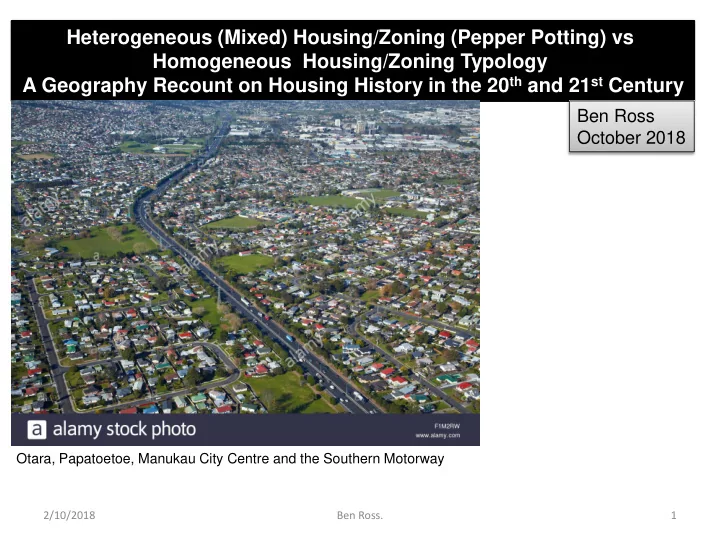
Heterogeneous (Mixed) Housing/Zoning (Pepper Potting) vs Homogeneous Housing/Zoning Typology A Geography Recount on Housing History in the 20 th and 21 st Century Ben Ross October 2018 Otara, Papatoetoe, Manukau City Centre and the Southern


slide-1
SLIDE 1

Heterogeneous (Mixed) Housing/Zoning (Pepper Potting) vs Homogeneous Housing/Zoning Typology A Geography Recount on Housing History in the 20th and 21st Century

Ben Ross October 2018

Otara, Papatoetoe, Manukau City Centre and the Southern Motorway

2/10/2018 Ben Ross. 1

slide-2
SLIDE 2
  • 1. Chicago School
  • 2. Public Housing and the Rise of the Homogeneous Zones post WWII
  • 3. Deindustrialisation and Gentrification
  • 4. Fall of the Homogenous Zone and Rise of the Heterogeneous Zones
  • 5. Housing Affordability and Equity
  • 6. Transport in Determining Housing Affordability
  • 7. Access to Centres and Housing Affordability - Why the Heterogeneous Zone is

Promoted

2/10/2018 Ben Ross. 2

slide-3
SLIDE 3

Chicago School (and later Social Integration)

The school is perhaps best known for the subcultural theories of Thrasher, Frazier, and Sutherland, and for applying the principles of ecology to develop the social disorganization theory (now called Social Integration) which refers to consequences

  • f the failure of:
  • social institutions or social organizations including the family, schools, church,

political institutions, policing, business, etc. in identified communities and/or neighbourhoods, or in society at large; and

  • social relationships that traditionally encourage co-operation between people.

Thomas defined social disorganization as "the inability of a neighbourhood to solve its problems together" which suggested a level of social pathology and personal disorganization, so the term, "differential social organization" was preferred by many, and may have been the source of Sutherland's (1947) differential association theory. The researchers have provided a clear analysis that the city is a place where life is superficial, where people are anonymous, where relationships are transitory and friendship and family bonds are weak. They have observed the weakening of primary social relationships and relate this to a process of social disorganization (comparison with the concept of anomie and the strain theories is instructive). Source: https://en.wikipedia.org/wiki/Chicago_school_(sociology) also The Dictionary of Human Geography – 4th Edition. (Johnston, Gregory, Pratt and Watts). (2000)

2/10/2018 Ben Ross. 3

slide-4
SLIDE 4

Public Housing and the Rise of the Homogeneous Zones post WWII Multi Nuclei Model (https://en.wikipedia.org/wiki/Multiple_nuclei_model )

New state houses in the 'Harp of Erin' estate

  • f Oranga, Auckland City, New Zealand.

Aerial photograph taken in 1947. National Library of New Zealand (Alexander Turnbull Library)

2/10/2018 Ben Ross. 4

slide-5
SLIDE 5

Deindustrialisation and Gentrification

https://thetyee.ca/Culture/2018/06/26/Crime-Fiction-Gentrification-Upheaval/ https://marketbusinessnews.com/financial-glossary/gentrification/ 2/10/2018 Ben Ross. 5

slide-6
SLIDE 6

Fall of the Homogeneous Zone and Rise of the Heterogeneous Zones Remember the Multi Nuclei Model?

https://austin.towers.net/refresh-your-memory-on-plaza-saltillos-upcoming-mixed-use-development/ https://fmlink.com/articles/nyc-mixed-use-project-industrial-commercial/

Other public officials pointed out the diverse assets the mixed-use project will bring, including critically needed affordable housing for a community that will undergo a major transformation, and a state-of-the-art school that will not only address overcrowding in District 30 but will help the growing community prepare for the future.

Industrial jobs were also to be provided! (Lesson for #OurManukau ?)

2/10/2018 Ben Ross. 6

slide-7
SLIDE 7

2/10/2018 Ben Ross. 7

Housing Affordability and Equity

  • Remember the Homogeneous Zone?
  • Remember the Heterogeneous Zone?
  • Housing Affordability is more than the

price of a house being no more than 3x the household income (or rent being no more than 3x household income

  • Housing affordability needs to

incorporate transport costs and accessibility to local or sub regional amenities (retail and leisure)

  • Land? Does it matter who owns the land?

As I have said before even with the 30:30:30 model Panuku should hold onto the land in a Centre, develop it, charge ground rents to give access to affordability and create leverage for future housing

Airport to Botany Rapid Transit (A2B)

slide-8
SLIDE 8

2/10/2018 Ben Ross. 8

  • How so?
  • Commuter costs are not always added

to housing costs. (No point of building “affordable homes” if the resident is then faced with a long commute by car) to work no matter WHO owns the land)

  • How accessible is transit, how expensive is

the transit (one zone fares are too expensive), where does it goes and what are its operating hours compared to say a shift worker

  • How accessible is transit to places of retail
  • r recreation (if you still need to travel

by car it is still an added expense)?

Transport in determining Housing Affordability

slide-9
SLIDE 9

2/10/2018 Ben Ross. 9

Access to Centres and Housing Affordability Why the Heterogeneous Zone is Promoted

  • Housing affordability is more than the price or the rent of the house
  • The price of the commute (work or leisure) is often left out in determining

housing affordability

  • Homogeneous use zones (no matter who owns the land) does not promote

housing affordability owing to access to employment and recreation

  • The Heterogeneous Zone (aka the Centre or Mixed Use Zone) promotes better

housing affordability due to close proximity to either employment or leisure

  • Land: Public Land should be held onto with development BUT the Pepper Pot

Model (i.e. Mixed Use and mixed types) should still be followed Heterogeneous zoning not fully utilised. Manukau City Centre (Node and Metropolitan Centre). Source: Panuku