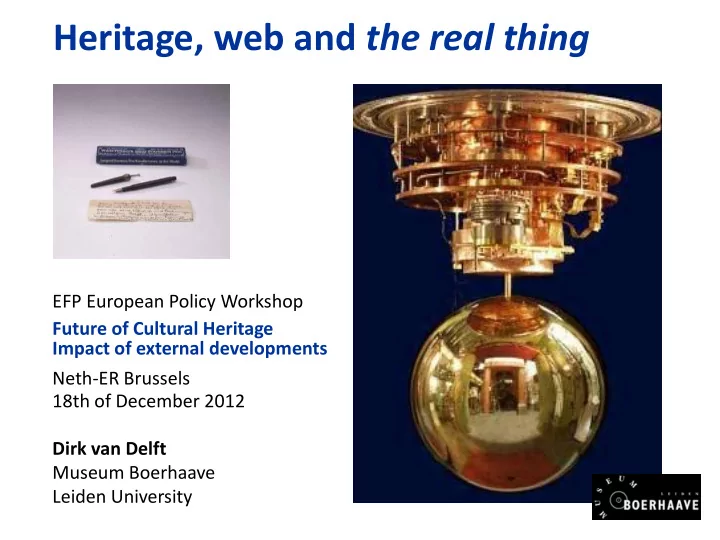
SLIDE 1
Heritage, web and the real thing
EFP European Policy Workshop Future of Cultural Heritage Impact of external developments Neth-ER Brussels 18th of December 2012 Dirk van Delft Museum Boerhaave Leiden University
SLIDE 2
Paul Ehrenfest (1880-1933)
SLIDE 3
Solvay conference , Brussels, 1927
SLIDE 4
Boerhaave Biography Prize 2012
SLIDE 5
Cryogenic Laboratory Heike Kamerlingh Onnes
SLIDE 6
SLIDE 7
Villa ‘De witte olifant’ , Witte Rozenstraat, Leiden
SLIDE 8
SLIDE 9
SLIDE 10
SLIDE 11
Copenhagen conference, 15 September 1933
SLIDE 12
Ehrenfest’s farewell letter to Jan Burgers, 24 September 1933
SLIDE 13
Martin J. Klein († 2009; part 1 biography 1970)
SLIDE 14 Museum Boerhaave:
National Museum for the History of Science and Medicine Founded in 1928 Present location: 1991 Collection: 100,000 artefacts, books, paintings, etc. (permanent exhibition: 2000) Staff: 35 FTE
Mission:
Based on its unique, magnificent collection, Museum Boerhaave aspires to appeal to a rich and varied audience, to excite and educate them, in a way that is fun for them. In this regard, the museum's constant aim is to dovetail with current events, never losing sight of the goal of creating support for science in society.
SLIDE 15
1922: jubilee professorship Kamerlingh Onnes = starting point Museum Boerhaave
SLIDE 16 Museum Boerhaave shows five centuries of Dutch innovation
Huygens pendulum Narcose mask Auzoux model Big electromagnet
SLIDE 17 November 2010: Zijlstra’s Museum Tests 1. Numbers of visitors
- 2. Cultural entrepeneurship
- 3. Education and youngster participation
- 4. International renowed collection
- 5. Decentralisation
- 6. Innovation
Recent acquisition: Land surveyor; Golden Age
SLIDE 18 Museum Boerhaave new style:
- It’s all about the real thing
- Nothing can compete with the historical sensation
- Don’t worship artefacts in isolation, but incorporate them into fascinating
stories
- Don’t concentrate on technical explanations but offer relevant contexts
Other ingredients of these stories:
- Pictures
- Film clips
- Archive material
- Interactive displays
- Augmented reality
- Models
- Games
Auzoux collection
SLIDE 19
String galvanometer Willem Einthoven
SLIDE 20
tele-elektrocardiogram (ECG)
SLIDE 21
Anatomical theater
SLIDE 22 Workshop ( 2008): ‘Artificial Cold and International Cooperation in Science’
Common Room
SLIDE 23
Exhibition My Skin
SLIDE 24
Exhibition Newton in the Netherlands
SLIDE 25
Salon Boerhaave: ’s Gravesande Vis viva drop test
SLIDE 26 E.J. Dijksterhuis The Mechanisation of the World Picture (1950)
Past: History of science = history of ideas
P.C. Hooft Prize 1952
SLIDE 27 Present: The gap between the worlds of the academic historian of science and the museum curator has gone
Peter Galison (Harvard): Image and Logic: A Material Culture of Microphysics (1997)
Atlas detector, Large Hadron Collider, Geneva
SLIDE 28 Leiden University Chair: Material Heritage of the Sciences Inaugural Lecture (January 2009)
Bling bling, key value and the underestimated instrument
SLIDE 29
Museum Boerhaave publications
SLIDE 30 Museum curators deal with material culture
- History of science research related to items from the collection
- Technical research
- Restoration
Restoration papier mâché anatomical models Auzoux collection
SLIDE 31
Replica pendulum Christiaan Huygens / Salomon Coster
SLIDE 32
SLIDE 33
Golden Age: Christiaan Huygens
SLIDE 34
Rings of Saturn
SLIDE 35
Christiaan Huygens Systema Saturnium (1659)
SLIDE 36
Observations Huygens ↔ performance of the lenses
SLIDE 37
Be careful about your curators! Accommodate scientific function in Parent Museums
SLIDE 38
Science and digital heritage
SLIDE 39
Second Golden Age
Kamerlingh Onnes Lorentz Zeeman and Ehrenfest De Sitter
SLIDE 40 Kirov Military Medical Academy St Petersburg
Herman Boerhaave (1668-1738)
SLIDE 41
SLIDE 42
SLIDE 43
SLIDE 44
SLIDE 45
DISHES
Digital Initiative in Scientific Heritage for Europeana and Society
Collections Trust Deutsches Museum (München) Museo Galileo (Florence) Medicinsk Museion (Kopenhagen) National Museums of Scotland (Edinburg) Science Museum (Londen) Coimbra Science Museum Norsk Teknisk Museum (Oslo) Museum Boerhaave Stiftelsen Tekniska Museet Technische Museum Wien
SLIDE 46
Teylers Museum Oval Room
SLIDE 47
SLIDE 48
Stichting Academisch Erfgoed
SLIDE 49 web presentation: Tuberculosis in the European Domain
Electron microscope
SLIDE 50 Collection of photographic plates, Zeehospitium Katwijk (ca. 1925)
Tuberculosis: a story,
SLIDE 51
Augmented Bodies / Piet Zwart Institute
SLIDE 52
Enhanced Publications (Huygens ING, DANS, Brill) Visual explanation of pictures, schemes and descriptions
SLIDE 53 Digitale Science Collection: integration of databases 2.0
Multimedia web-exhibitions (Physique Amusante) Public participation in collection management (helping the curator; mystery objects) Repository / new acquisitions / platform for collectors and connaisseurs / News Collect personal stories to specific objects Games Twitter, facebook, flickr Sciences Medicine Technology NEMO
SLIDE 54
Website as a meeting place; create an associated community
SLIDE 55
Ehrenfest 2.0
SLIDE 56 Ehrenfest e-biography: digital sources
- Inventory Ehrenfest archive MB
- Fortcoming: digitized letters
- Dissertation Marijn Hollestelle
- DBNL: Casimir, Haphazard Reality
- RCE image bank: 2 hits
- Europeana: 7 hits
- Science & Society picture library: 0 hits
- Emilio Sègre visual archives; AIP: ca. 50 hits
- DCN: 3 hits
- SAE: 2 hits
- Niels Bohr Library & Archives
SLIDE 57
Where is Paul Ehrenfest?
SLIDE 58 Arnold Sommerfeld Crowd transcription of Ehrenfest letters (Russian)
SLIDE 59
Museum Boerhaave artefacts as props in international movies
SLIDE 61
SLIDE 62 Nickolas Barris
Lorentz – Einstein documentary movie Crowd sourcing Historians of science Lorentz, Einstein, Ehrenfest map
SLIDE 63 Auction during Museum Boerhaave fundraising dinner, 15 December 2011
SLIDE 64
Ehrenfest e-biography
Enhanced publication: in-depth treatment and explanations for the layman Collecting stories via website; crowd sourcing Collecting and describing new material Flexibel digital 2.0 exhibition Online picture album Volunteers for making transcriptions Sociogram e-biography links to movie e-biography links to heritage e-biography links to contexts e-biography links to education e-biography links to research
SLIDE 65 Summary:
- 1. Don’t get rid of your curators: they have the knowledge
- 2. Keep on digitizing and opening up vulnerable heritage material
- 3. Heritage projects can’t do without innovative outreach
- 4. Build up a digital Science Collection Database with extra’s for the visitors
- 5. Use heritage for relevant stories
SLIDE 66 Summary:
- 1. Don’t get rid of your curators: they have the knowledge
- 2. Keep on digitizing and opening up vulnerable heritage material
- 3. Heritage projects can’t do without innovative outreach
- 4. Build up a digital Science Collection Database with extra’s for the visitors
- 5. Use heritage for relevant stories
THANK YOU!